
Quick Summary
| Key Insight | What You Need to Know |
|---|---|
| Damaged Brand Reputation | Offensive, negative, or spammy content makes your brand look unprofessional and untrustworthy. |
| Loss of Customer Trust | A toxic environment will scare away genuine followers and customers who no longer feel safe engaging with you. |
| Legal & Compliance Headaches | Failing to remove illegal content can result in hefty fines, especially with regulations like the EU's Digital Services Act (DSA). |
| Wasted Marketing Spend | Comment sections full of spam and negativity completely derail your marketing message and torpedo your campaign's ROI. |
Think of social media content moderation as the essential practice of overseeing and managing what people post on your brand's channels. It’s all about making sure that user-generated content—comments, reviews, posts—sticks to your community guidelines and the law. This is how you keep your online spaces safe, positive, and free from spam, hate speech, and other junk.
Why Content Moderation Is Your Brand's First Defense
Picture your social media page as your digital storefront. When it’s clean, welcoming, and well-organized, people want to come in, look around, and connect. But if it’s neglected, it can quickly become a chaotic mess that drives away the very customers you want to attract and seriously damages your reputation. That’s why social media content moderation has shifted from a simple admin task to a core business strategy.
In this light, moderation isn’t just about deleting bad comments; it's your first line of defense. It's the strategic work you do to build a thriving community where your brand and customers can have real, safe conversations.
The Real Risks of an Unmoderated Page
Leaving your social channels unmonitored is like leaving your shop door wide open overnight. You're inviting trouble. The risks are huge and can have a lasting impact on your brand's health and your bottom line. All it takes is one viral comment packed with lies or hate to trigger a PR nightmare, wiping out years of hard-earned brand trust in a few hours.
The sheer amount of content being created today makes watching everything by hand impossible. With over 5.31 billion social media users posting around the clock in 2025, the scale is staggering. Worse yet, harmful content is known to spread up to six times faster than the truth. You can dig deeper into the challenges shaping social media moderation based on recent findings.
The main risks you face are:
- Damaged Brand Reputation: Offensive, negative, or spammy content makes your brand look unprofessional and untrustworthy.
- Loss of Customer Trust: A toxic environment will scare away genuine followers and customers who no longer feel safe engaging with you.
- Legal & Compliance Headaches: Failing to remove illegal content can result in hefty fines, especially with regulations like the EU's Digital Services Act (DSA).
- Wasted Marketing Spend: Comment sections full of spam and negativity completely derail your marketing message and torpedo your campaign's ROI.
Moderation Is About Cultivating a Community, Not Censorship
It's a common myth that moderation is just about censoring people or shutting down negative feedback. That couldn't be further from the truth. Good moderation is more like being a gardener for your community. It’s the difference between a carefully curated art gallery and a wall covered in random graffiti. Both involve public expression, but only one provides a welcoming and valuable experience for everyone.
By setting and enforcing clear guidelines, you’re not shutting down conversations. You’re simply setting the ground rules for having a productive one. This is what keeps your online space a genuine asset for your brand and your audience.
Ultimately, taking moderation seriously sends a clear signal to your community: you value their experience. It shows that you're invested in creating a respectful and positive place for them to be, which is the bedrock of lasting customer loyalty. In an unpredictable online world, that proactive approach is your best defense.
Exploring Different Moderation Approaches
Choosing the right way to moderate your social media content is a lot like setting up security for a big public event. Do you need a bouncer checking IDs at the door? Or maybe security guards roaming the floor? Perhaps you just need a system where attendees can flag trouble themselves. Each strategy has its own pros and cons, and the best fit depends entirely on your community's size, type, and risk profile.
There’s no one-size-fits-all solution here. Brands typically lean on one of four main models: pre-moderation, post-moderation, reactive moderation, and distributed moderation. Getting a feel for how each one works is the first step toward building a system that actually protects your brand while letting your community thrive.
Pre-Moderation: The Gatekeeper Model
Imagine a private, members-only club where every single person is vetted at the door before they can step inside. That's pre-moderation in a nutshell. Every comment, photo, or review from a user sits in a queue, waiting for a human to give it the green light before it ever sees the light of day.
This approach gives you the ultimate level of control, making it a go-to for brands in heavily regulated spaces or those with a younger audience. You can be virtually certain that nothing inappropriate will ever pop up on your page. But that safety net has a price. It can really slow down the conversation, making your community feel stiff and potentially frustrating users who want to see their contributions appear instantly.
Post-Moderation: The Patrol Model
In contrast, post-moderation is all about letting content go live immediately, with moderators reviewing it afterward. Think of it as a security guard actively patrolling the event floor. They're on the lookout for trouble and can step in quickly, but they aren't stopping every person at the entrance.
This model is a great middle ground, balancing community freedom with brand safety. It keeps conversations flowing in real time, which is absolutely essential for engagement. The big risk, of course, is that a nasty comment could be visible for a short time before a moderator catches it. For many businesses, this is a perfectly acceptable trade-off for a more lively and interactive community. Many of the best AI comment moderation tools for 2025 are built to supercharge this very process, automatically flagging risky content for a human to look at.
Reactive Moderation: The Community Watch
Reactive moderation is basically a community-powered security force. It hands the reins over to your audience, relying on them to flag or report content that breaks the rules. This is just like concertgoers alerting staff to a problem in the crowd. Your team isn't proactively scanning everything; they're jumping into action when your community raises a red flag.
This method is incredibly scalable and budget-friendly, which is why it's a favorite for platforms buried under a mountain of user-generated content. It also empowers your most loyal followers to take an active role in keeping the space safe. The catch? You're completely at the mercy of your community's willingness to report things, meaning harmful content could linger until someone finally flags it.
This decision tree shows the basic thought process for deciding if a new piece of content needs a closer look.
The graphic really zeros in on that critical moment—deciding if content is harmful—which is the heart of any moderation strategy.
Distributed Moderation: The Jury Model
Last but not least, distributed moderation (also called community moderation) takes the reactive model one step further. It doesn't just let the community report problems; it gives them the power to decide what’s acceptable. This usually involves some kind of voting or rating system where users can upvote or downvote posts, directly impacting their visibility.
This democratic approach has become hugely popular, especially on massive platforms. Following the 2024 U.S. presidential election, social media giants like X, Meta, and Reddit have increasingly relied on these kinds of user-driven systems. For example, X's Community Notes program trusts users to flag and add context to misleading posts, shifting the burden from a central team to the community itself.
The smartest social media content moderation strategies rarely stick to just one approach. They blend different methods to create a custom-fit system, pairing the speed of automation with the careful judgment of human oversight.
How to Build Your Moderation Playbook
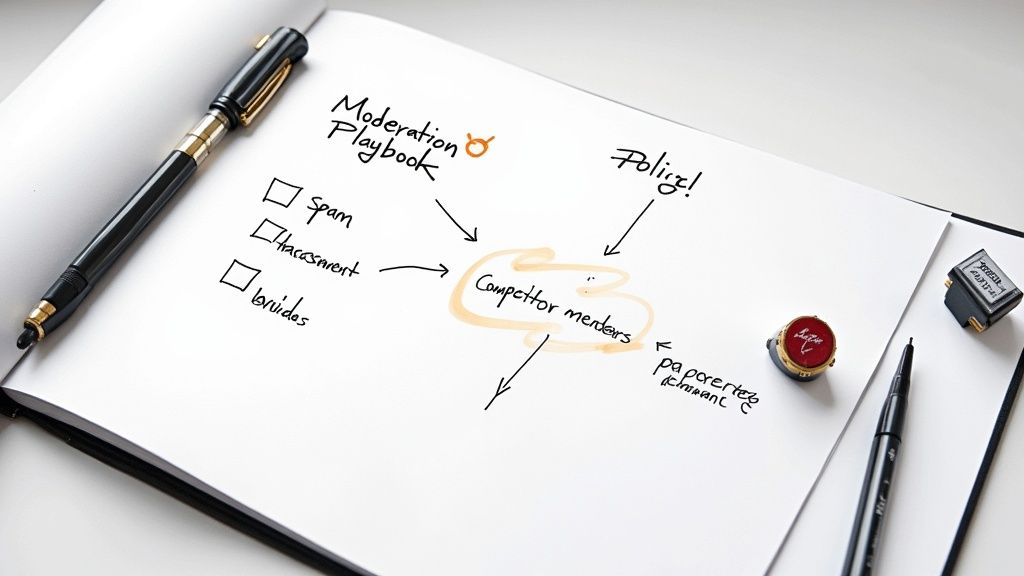
Consistent and effective social media content moderation doesn't just happen. It’s built on a clear, well-documented playbook that becomes your team's single source of truth. Think of it as the constitution for your online community—it defines the laws, outlines the consequences, and makes sure every moderator enforces the rules fairly.
Without this guide, moderation quickly becomes subjective and chaotic. That leads to inconsistent actions that can confuse and alienate your audience. A solid playbook, on the other hand, empowers your team to act decisively, transparently, and in perfect sync with your brand values.
Defining Your Community Guidelines
First things first: you need to establish your community guidelines. These are the public-facing rules that tell your audience what’s okay and what’s not. Keep them simple and easy to understand, and make sure they reflect your brand’s personality. Ditch the legal jargon and focus on setting a clear, welcoming tone.
Your guidelines are the bedrock of your playbook. They should cover the most common problem areas while still leaving a little wiggle room for human judgment.
Start by covering these core categories:
- Respect and Civility: Make it clear that personal attacks, hate speech, bullying, and harassment have no place here.
- Spam and Self-Promotion: Define exactly what you consider spam, like repetitive posts, irrelevant links, or unauthorized sales pitches.
- Safety and Legality: Ban any content that is illegal, threatening, or promotes dangerous activities. No exceptions.
- Relevance: Ask that all contributions stay on topic. This keeps conversations productive and valuable for everyone.
From there, you can add rules that are specific to your brand. For an e-commerce store, this might mean creating guidelines around posting competitor links or explaining how to handle customer service issues in public comments versus private messages. The goal is to be thorough but not overwhelming.
Establishing a Violation and Escalation Framework
Once your rules are public, you need a clear internal process for what to do when they're broken. Not all violations are created equal. A slightly spammy comment doesn't warrant the same response as a direct threat, and a tiered system ensures your team's reactions are always proportionate to the offense.
This is where you translate your public guidelines into concrete, internal actions. A structured framework removes the guesswork and ensures every user is treated the same way for the same violation.
A well-defined escalation path is crucial. It protects your front-line moderators from having to make difficult, high-stakes decisions alone and ensures sensitive issues are handled by the right people.
A tiered approach is the best way to standardize your social media content moderation process, making it fair and predictable. Here’s a simple framework you can adapt to get started.
Content Violation Severity and Action Plan
This table provides a sample framework for categorizing violations and defining the appropriate response, ensuring your moderation team acts consistently.
| Violation Level | Examples | Moderation Action | Escalation Protocol |
|---|---|---|---|
| Level 1 | Off-topic comments, mild self-promotion | Hide or delete the comment, send a warning | Document the incident; no escalation needed |
| Level 2 | Repetitive spam, insults, profanity | Delete comment, issue a temporary mute (24 hrs) | Inform community manager of repeat offenders |
| Level 3 | Harassment, hate speech, threats | Immediately delete, ban user, and report | Escalate to legal or leadership immediately |
By mapping out these levels in advance, you remove ambiguity and empower moderators to act confidently.
Equipping and Training Your Moderation Team
Your playbook is only as good as the people who use it. Proper training is non-negotiable, ensuring your moderators—whether they're in-house or from an agency—know the guidelines and your brand voice inside and out. Give them clear instructions, plenty of real-world examples, and pre-approved responses for common situations.
Training isn't a one-and-done event, either. It should be an ongoing process. Regular check-ins and playbook updates will keep it relevant as your community grows and social media platforms change. By investing in your team, you turn your playbook from a static document into a living guide that actively protects and nurtures your community, making sure your brand's social presence remains a safe and valuable asset.
Combining Human Insight with AI Efficiency
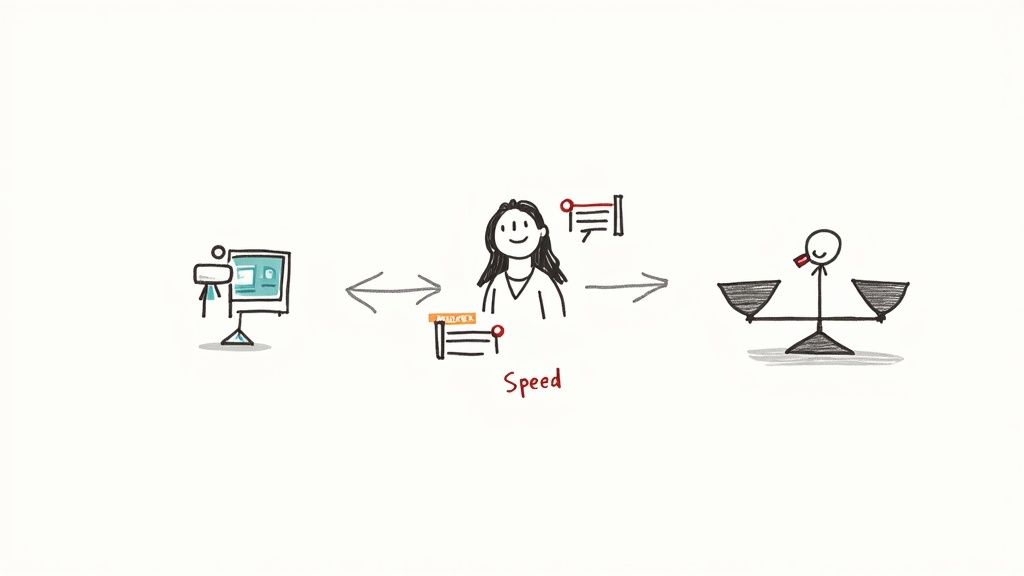
Let's be realistic: manually policing every single comment just isn't possible anymore. The future of effective social media content moderation isn't a battle of people versus technology—it's about creating a smart partnership that plays to the strengths of both. This hybrid model combines the raw speed and power of AI with the irreplaceable nuance of human judgment.
Think of AI as your tireless front-line defense, working 24/7. It's the system that never sleeps, instantly scanning a flood of incoming content for the most obvious violations. This isn't just about making moderation faster; it makes the entire process smarter, more accurate, and ultimately more sustainable for your team.
The Role of AI as the First Filter
AI moderation tools are built to handle the high-volume, low-complexity grunt work that would completely overwhelm a human team. They’re brilliant at pattern recognition and can be trained to automatically spot and act on a huge range of issues.
This initial pass by the AI is crucial for maintaining a basic level of safety and cleanliness on your profiles. The primary jobs for AI in this system include:
- Keyword and Phrase Flagging: Instantly catching profanity, brand-specific slurs, or competitor mentions based on the lists you create.
- Spam and Bot Detection: Identifying and hiding repetitive, nonsensical comments from fake accounts. This is your best defense against the wave of automated spam you see from bots commenting on Instagram.
- Harmful Image Recognition: Automatically flagging content containing nudity, violence, or other graphic imagery before it has a chance to spread.
By automating these fundamental tasks, the AI frees up your most valuable resource: the time and mental energy of your human moderators.
Where Human Moderators Are Irreplaceable
While AI is great at catching the obvious stuff, it lacks the deep contextual awareness that is uniquely human. This is where your team shines. Human moderators step in to handle the complex, ambiguous cases that an AI flags for review, making the final call on what stays and what goes.
Moderating at scale is incredibly difficult, and automated systems are notorious for making mistakes. Those errors often involve accidentally censoring legitimate conversations, which is exactly why you need human oversight. Humans succeed precisely where algorithms falter.
The real power of a hybrid model is how it shields human moderators from the most draining parts of the job. By filtering out the vast majority of clear-cut violations, AI lets your team focus their expertise where it truly matters—on the gray areas that demand critical thinking.
This frees them up to apply their skills to things like:
- Understanding Sarcasm and Nuance: An AI often can't tell the difference between a sarcastic joke and a genuine insult. A person can easily read the intent behind the words.
- Interpreting Cultural Context: Slang, memes, and cultural references change in the blink of an eye. Human moderators stay on top of these trends and understand context that would completely confuse an algorithm.
- Making Difficult Judgment Calls: Deciding when a heated debate crosses the line into harassment requires a level of subjective judgment that AI simply can't replicate.
The Financial and Operational Benefits of a Hybrid Approach
This collaborative workflow isn't just about getting moderation right; it has a real impact on your bottom line and operational efficiency. The market itself shows how valuable this combined approach is. The global content moderation market, valued at around USD 12.48 billion in 2025, is expected to explode to USD 42.36 billion by 2035.
This massive growth is happening because brands are seeing tangible results from a hybrid strategy. By pairing AI with human teams, you protect your moderators’ well-being, slash response times, and ensure your community guidelines are enforced with both consistency and empathy. It's this balanced approach that builds a safe, engaging, and thriving online community.
Here's the rewritten section, designed to sound like it was written by an experienced human expert.
How Do You Actually Measure Success in Moderation?
It’s easy to think of social media content moderation as a clean-up crew, a cost of doing business. But that’s a huge mistake. Great moderation is a growth engine, not just a defensive play. The real trick is proving it.
To show the value of your work, you have to look past the obvious stuff, like how many comments you deleted this week. The real measure of success isn't what you remove; it's the healthy, vibrant community you build as a result. That means tracking the right numbers—the Key Performance Indicators (KPIs) that tell the true story of your impact.
First, Get Your Moderation House in Order
Before you can connect moderation to big-picture business goals, you need to know if your day-to-day operations are even working. Think of these as the vital signs of your community. They tell you how efficient and accurate your team is, and they’re the first place you’ll spot problems.
Here’s what to keep a close eye on:
- Average Response Time: How fast are you getting to flagged content? The quicker you act, the less time toxic comments have to poison the well and damage your brand's reputation.
- Moderator Accuracy Rate: Are your moderators making the right calls? You're aiming for consistency. A high accuracy rate—ideally over 95%—means your team understands your guidelines inside and out and is applying them fairly.
- Resolution Rate: When a user reports something, how often is it actually resolved? This metric is all about follow-through and shows how effective your team is at closing the loop.
These metrics give you a hard data baseline. They help you understand if your playbook is working, where your team needs more training, and how you can tighten up your process.
Connecting the Dots to What the Business Cares About
Once you have a handle on your team's performance, it's time for the most important step: linking your work to the bottom line. This is how you stop being seen as a cost center and start being recognized as a strategic partner. You need to show leadership how a safe online space directly fuels company growth.
A positive, well-managed community doesn't just feel better—it performs better. When you clean up the trolls and spam, you create an environment where real customers want to hang out, and that directly impacts the metrics your marketing and sales teams live by.
A healthy comment section isn’t just a nice-to-have; it's a critical asset that enhances customer experience and protects brand equity. The data you collect is proof that investing in moderation pays real dividends.
For example, start tracking how your moderation efforts influence these outcomes:
- Improved Brand Sentiment: What’s the overall vibe of conversations about your brand? As you weed out negativity, you should see a tangible lift in positive sentiment. This is your brand's reputation, measured in real-time.
- Higher User Engagement: People are more likely to jump into a conversation when they feel safe. Keep an eye on metrics like comments per post, likes, and shares. A well-moderated space is an active space.
- Increased Customer Loyalty and Lifetime Value: Happy customers stick around. When your community feels like a place where they're heard and respected, they become more than just buyers—they become advocates. A great community reduces churn and builds a loyal base that spends more over the long haul.
- Reduction in Policy Violations Over Time: This is the ultimate proof that you're not just playing whack-a-mole. A steady decline in flagged content shows your community is learning the rules of the road. Your consistent moderation is creating a positive culture that starts to police itself.
By tracking these KPIs, you can build a powerful story backed by data. You can prove that social media content moderation isn't an expense—it’s a core driver of customer trust, loyalty, and sustainable business growth.
Navigating Legal and Ethical Challenges
https://www.youtube.com/embed/lk8OTEi5ME4
Effective social media content moderation isn’t just about following your own playbook. It's about navigating a tricky maze of global laws and ethical gray areas. When you operate online, your brand is suddenly subject to rules that change from one country to the next, creating a tangled web of compliance duties.
New regulations, like the European Union’s Digital Services Act (DSA), are completely changing the game for how platforms handle content. The DSA demands that large platforms be far more transparent about their moderation, offer clear ways for users to appeal decisions, and crack down harder on illegal content. For brands, this means you have to be ready to justify every call you make and give users a fair shot to contest it. Accountability is no longer optional.
This legal pressure forces a constant balancing act. On one side, you have the ideal of free expression. On the other, there's the critical need to shield users from harm. It’s an ethical tightrope that moderators walk every single day.
The Ethical Tightrope Walk
Every single moderation decision has weight. Takedown a post, and one user might cry censorship. Leave it up, and another might see it as negligence. This is where the ethical side of things becomes so incredibly important. A fair process isn't just about sticking to the rules; it's about being transparent and consistent in how you apply them.
A huge part of this is building a clear appeals process. If a user’s content gets removed, they need a straightforward way to understand why and ask for a second look. This simple step goes a long way in building trust and showing your community that you’re committed to fairness, not just control.
Content moderation at scale is nearly impossible to do perfectly. The goal isn’t flawless execution but a fair, transparent, and humane process that respects both the law and the user.
Supporting the people doing this work is just as critical. The mental health of human moderators is a massive ethical concern. It's irresponsible and totally unsustainable to expose them to a constant stream of toxic content without the right support systems in place.
Supporting Your Human Moderators
Your moderation team is your brand’s first line of defense, so protecting their well-being is non-negotiable. These are the people who see the worst parts of the internet—from vile hate speech to graphic images—which can take a serious psychological toll.
To properly support them, you absolutely need to implement these steps:
- Provide Mental Health Resources: Offer easy access to counseling and therapy services, ideally with professionals who understand the specific trauma moderators face.
- Implement Rotation Schedules: Make sure no one is stuck reviewing the most toxic queues all day, every day. Rotate duties to give them regular breaks from the most distressing content.
- Foster a Supportive Culture: Create a work environment where moderators feel safe talking about the challenges of their job without any stigma.
At the end of the day, a strong moderation strategy is both compliant and conscientious. It means understanding complex laws, including those that govern things like trolling on social media, while also upholding ethical standards that protect your users and your team. This dual focus is what keeps your brand’s online space safe, responsible, and thriving.
Answering Your Top Content Moderation Questions
Even with a great plan in place, a few practical questions always pop up when it comes to the day-to-day grind of social media content moderation. Let's clear the air on some of the most common ones.
Should We Just Delete All Negative Comments?
This is a big one, and the short answer is: absolutely not. It's a classic mistake to treat all negative feedback as toxic content that needs to be wiped from existence. Honest customer complaints and even blunt criticism are gold—they're free insights into how you can improve.
Scrubbing your comments clean of anything remotely negative doesn't make you look perfect; it makes you look fragile and untrustworthy. People can spot an overly sanitized comments section from a mile away.
The real goal is to get rid of the stuff that actually violates your community rules—think spam, hate speech, or personal attacks. For the legitimate negative feedback, you address it head-on. Responding with transparency and a helpful attitude can turn a public complaint into a powerful testament to your customer service.
Good moderation isn't about building an echo chamber where only praise is allowed. It’s about creating a safe place for real conversations, even the tough ones. That's what builds a strong, respected brand.
How Can a Small Team Possibly Handle All This?
If you're a small team, the thought of moderating a flood of comments can be daunting. But you don't need a huge department to do this well—you just need to be smart about it. Efficiency is the name of the game.
The best approach is a hybrid one. Let AI tools do the heavy lifting by automatically catching the obvious junk like spam links and clear-cut profanity. This frees up your team's time and brainpower to deal with the nuanced comments that actually need a human touch.
Here’s how a small team can make it work:
- Automate the Easy Stuff: Use a moderation tool to instantly hide or remove spam, bots, and comments with specific banned words.
- Pick Your Battles: Focus your energy on the social media channels that matter most to your business. You don't have to be perfect everywhere all at once.
- Create Canned Responses: For common questions or issues, have a set of pre-written (but customizable) replies ready to go. It’s a huge time-saver.
By blending smart automation with focused human oversight, even a single person can manage a professional and healthy online community. It's all about working smarter, not just harder.
Ready to stop wasting time on spam and start focusing on growth? See how FeedGuardians can automate your comment moderation, protect your brand, and turn your social media into a conversion machine. Explore the solution at FeedGuardians.
Tired of manually moderating comments?
FeedGuardians automates spam filtering, responds to customers, and protects your brand — setup in 3 minutes.