
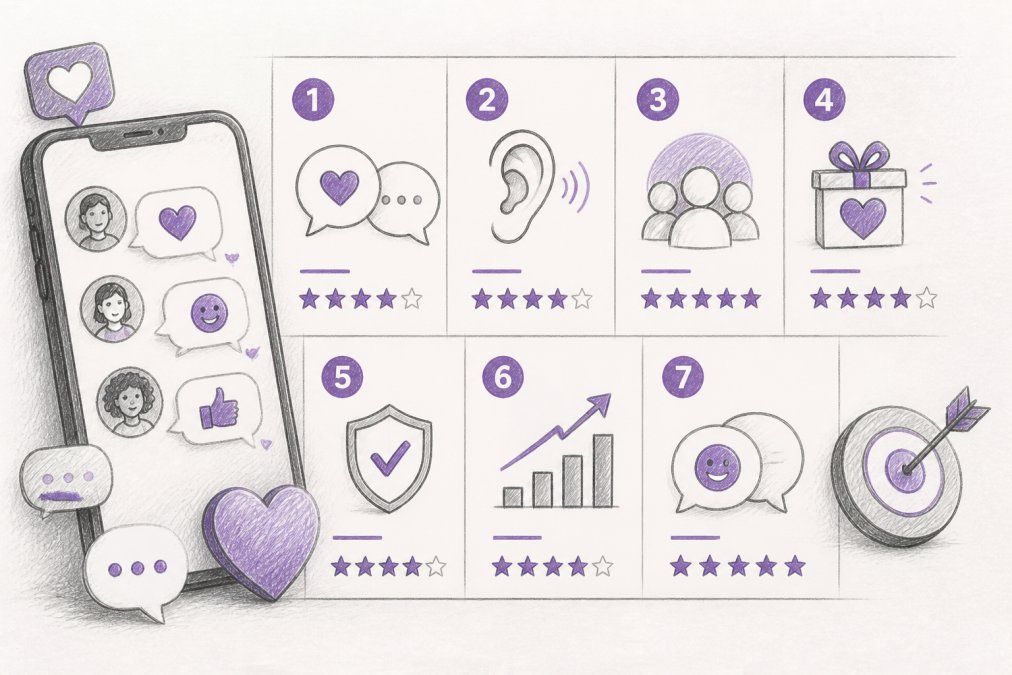
Quick Summary
| Key Insight | What You Need to Know |
|---|---|
| 1. Practice Active Listening | 1. Practice Active Listening and Respond in Real Time |
| 2. Humanize Your Brand | 2. Humanize Your Brand with Relatable Content and Transparency |
| 3. Encourage User-Generated Content | 3. Encourage User-Generated Content and Digital Reciprocity |
| 4. Use Social Media | 4. Use Social Media Comment Automation Software to Scale Meaningful Interactions |
| 5. Use Social Media | 5. Use Social Media Response Templates for Consistent, Empathetic Replies |
| 6. Set Digital Boundaries | 6. Set Digital Boundaries and Prioritize Mental Health |
Table of Contents
- 1. Practice Active Listening and Respond in Real Time
- 2. Humanize Your Brand with Relatable Content and Transparency
- 3. Encourage User-Generated Content and Digital Reciprocity
- 4. Use Social Media Comment Automation Software to Scale Meaningful Interactions
- 5. Use Social Media Response Templates for Consistent, Empathetic Replies
- 6. Set Digital Boundaries and Prioritize Mental Health
- 7. Follow Best Practices for Social Media Community Management: Conflict Resolution and Accessibility
- Frequently Asked Questions
Last Updated: September 16, 2026
1. Practice Active Listening and Respond in Real Time
Active listening on social media means reading every comment for intent, not just keywords, then replying while the conversation is still live. This is the foundation of meaningful interactions: people engage more when they feel heard, not processed. A comment answered in minutes reads as a conversation; the same reply two days later reads as a form letter.
Speed matters, but so does substance. A common mistake is replying with "Thanks for your feedback!" and moving on. That closes a loop without opening a relationship. Real-time response works best when it does three things:
- Acknowledge the specific point the person made, not just the fact they commented
- Answer the actual question, even if the answer is "we don't know yet"
- Ask one follow-up question that invites a second reply
That third step is where most brands stop, and it's where digital reciprocity starts. Psychologists describe reciprocity as the pull to return a gesture once we receive one. A thoughtful reply is a gesture. A follow-up question makes it easy to return.
2. Humanize Your Brand with Relatable Content and Transparency
Humanizing a brand means showing the people, decisions, and imperfections behind the logo. Audiences respond to transparency because it signals that a real person is accountable for what the account posts. That accountability is what separates a social presence from a broadcast channel.
In practice, humanizing looks like naming the person who runs the account, sharing a behind-the-scenes decision, or admitting when a post missed the mark. Relatable content performs because it gives people something to respond to beyond the product. Instead of "New drop Friday," try "We argued about this color for a week. Did we get it right?" One invites a scroll; the other invites a conversation.
What most guides miss is that transparency has to survive bad days. When a launch goes wrong, the brands that keep their audience are the ones that say so plainly. Trust building is cumulative, and it compounds fastest when things are imperfect.
3. Encourage User-Generated Content and Digital Reciprocity
User-generated content is any post, photo, review, or clip a customer creates about your brand, and it consistently outperforms brand-made content on engagement metrics. When you reshare it with credit, you complete a loop of digital reciprocity: the customer gave you content, you gave them visibility. That exchange is why UGC builds community faster than any campaign.
The psychology behind that loop is worth understanding, because it explains why some UGC programs compound and others stall. Reciprocity is the social pull to return a gesture once we receive one, researchers have documented it across cultures for decades.
- Invite with a specific, answerable prompt. "Show us your desk setup with our lamp" beats "share your experience." Specific prompts get specific content, which is easier to reshare and easier for others to imitate.
- Ask permission in writing before you amplify. A short DM, "Can we feature this on our page with credit to your handle?", takes ten seconds and prevents the resentment that comes from surprise reposts. Keep a simple log of who approved what, so you can honor a takedown request later.
- Close the loop publicly. Reply, reshare, tag, and add a genuine comment. A bare repost with no caption reads as content harvesting; a repost with "This setup from @handle solved the cable problem we've been complaining about for months" reads as a relationship.
A few operational guardrails keep the program healthy:
- Credit by handle, every time. Even when the platform makes it easy to strip the tag, leave it on.
- Disclose paid partnerships. If a creator was compensated, say so in the caption. Undisclosed paid endorsements are a legal exposure, not just an etiquette miss (the FTC).
- Reply to reviews, not just the glowing ones. A thoughtful response to a three-star review is more persuasive to onlookers than ten five-star thank-yous.
- Feature one customer story per week in your regular content rhythm. Consistency in posting matters here more than volume, a predictable cadence trains your audience to expect the feature, and expectation is what turns an audience into a community.
One more mechanism worth naming: reciprocity works best when the return gesture is proportional and fast. A customer who tags you on a Tuesday and gets a reshare on Friday has already moved on. The brands that build the strongest UGC pipelines respond within a day, which is why the same team that handles comments should own the UGC queue.
4. Use Social Media Comment Automation Software to Scale Meaningful Interactions
Here's how the workflow typically runs:
5. Use Social Media Response Templates for Consistent, Empathetic Replies
| Situation | Template opener | What to add |
|---|---|---|
| Product question | "Great question, here's how it works:" | The specific answer, in plain language |
| Complaint | "That's not the experience we want for you." | A concrete next step and a timeline |
| Praise | "Thank you, this made our day." | Reference the detail they mentioned |
| Spam or troll | No reply; hide or remove. | Log the pattern for moderation rules |
6. Set Digital Boundaries and Prioritize Mental Health
1. What are the response windows? Pick hours when the team is actively monitoring, and publish them. Outside those hours, an auto-reply that sets expectations ("We're offline until 9 a.m. and will reply then") is not a cop-out, it is a boundary that protects both the team and the audience. Rotate who covers each window so no single person owns the inbox seven days a week.
-
Good-faith criticism → respond publicly, own the specific issue, state a next step.
-
Bad-faith bait → do not engage in the thread. Hide or remove per your published guidelines, log the account, and move on.
-
Threats or doxxing → escalate immediately to legal or security, preserve screenshots, and do not reply.
-
Debrief after a pile-on. A 15-minute team call after a hostile event catches the people who absorbed the worst of it before it festers.
-
Separate the personal and the brand account. Moderators should not be replying from their own handles to hostile strangers.
-
Track the pattern, not just the incident. If the same account or topic keeps triggering hostility, that is a signal to adjust the content or the moderation rules, not to toughen up the team.
7. Follow Best Practices for Social Media Community Management: Conflict Resolution and Accessibility
- Write alt text for every image, describing the content, not the filename
- Capitalize hashtags so screen readers can parse them (#CommunityBuilding, not #communitybuilding)
- Avoid relying on color alone to convey meaning in graphics
- Caption every video, including short clips
Frequently Asked Questions
What are meaningful interactions on social media?
Meaningful interactions are exchanges that go beyond likes and shares, involving genuine conversation, active listening, and reciprocity. They build relationships, foster community, and drive customer retention. Metrics include comment sentiment, reply rates, and conversation depth, not just reach or impressions. For brands, meaningful interactions turn casual followers into loyal advocates by showing that you value their input and respond authentically.
How can social media comment automation software improve interaction quality?
Social media comment automation software like FeedGuardians uses AI to moderate comments in real time, hiding spam and hate speech with 98.7% accuracy, while also sending personalized replies in your brand voice. This keeps conversations civil and timely, so your team can focus on high-value interactions. Automation handles volume, but human escalation ensures sensitive issues get a personal touch, boosting customer satisfaction and trust.
What are some best practices for social media community management?
Best practices for social media community management include setting clear guidelines, responding promptly, using response templates for consistency, and fostering inclusivity. Encourage user-generated content, acknowledge feedback publicly, and resolve conflicts privately when possible. Also, prioritize accessibility by using alt text and captions. These practices build a safe, engaging space that encourages meaningful interactions and strengthens brand loyalty.
How do you measure meaningful interactions on social media?
Measure meaningful interactions by tracking engagement metrics like comment-to-like ratio, reply rate, sentiment analysis, and conversation length. Also monitor customer retention and satisfaction scores linked to social channels. Unlike reach, these metrics show whether your audience is actually connecting with your content and each other.
Why is community management important for brand growth?
Community management drives brand growth by building trust, increasing customer retention, and turning followers into advocates. When you actively listen and respond, you create a sense of belonging that encourages user-generated content and positive word-of-mouth. A well-managed community also provides valuable feedback for product improvements and content strategy, directly impacting customer satisfaction and long-term loyalty.
Community management at scale is a real challenge: the more comments you attract, the harder it becomes to answer each one like it matters. FeedGuardians was built to close that gap, with real-time moderation that hides spam and hate, 24/7 AI replies trained on your tone and terminology, and a human escalation option for the comments that need a person. Start for free and see how many of your comments turn into conversations.
Tired of manually moderating comments?
FeedGuardians automates spam filtering, responds to customers, and protects your brand — setup in 3 minutes.
Frequently Asked Questions
What are meaningful interactions on social media?
Meaningful interactions are exchanges that go beyond likes and shares, involving genuine conversation, active listening, and reciprocity. They build relationships, foster community, and drive customer retention. Metrics include comment sentiment, reply rates, and conversation depth, not just reach or impressions. For brands, meaningful interactions turn casual followers into loyal advocates by showing that you value their input and respond authentically.
How can social media comment automation software improve interaction quality?
Social media comment automation software like FeedGuardians uses AI to moderate comments in real time, hiding spam and hate speech with 98.7% accuracy, while also sending personalized replies in your brand voice. This keeps conversations civil and timely, so your team can focus on high-value interactions. Automation handles volume, but human escalation ensures sensitive issues get a personal touch, boosting customer satisfaction and trust.
What are some best practices for social media community management?
Best practices for social media community management include setting clear guidelines, responding promptly, using response templates for consistency, and fostering inclusivity. Encourage user-generated content, acknowledge feedback publicly, and resolve conflicts privately when possible. Also, prioritize accessibility by using alt text and captions. These practices build a safe, engaging space that encourages meaningful interactions and strengthens brand loyalty.
How do you measure meaningful interactions on social media?
Measure meaningful interactions by tracking engagement metrics like comment-to-like ratio, reply rate, sentiment analysis, and conversation length. Also monitor customer retention and satisfaction scores linked to social channels. Unlike reach, these metrics show whether your audience is actually connecting with your content and each other.
Why is community management important for brand growth?
Community management drives brand growth by building trust, increasing customer retention, and turning followers into advocates. When you actively listen and respond, you create a sense of belonging that encourages user-generated content and positive word-of-mouth. A well-managed community also provides valuable feedback for product improvements and content strategy, directly impacting customer satisfaction and long-term loyalty.