
Quick Summary
| Key Insight | What You Need to Know |
|---|---|
| What Brand Reputation Management | What Brand Reputation Management Means for PR Agencies Why brand equity matters to your bottom line |
| Why brand equity matters | Why brand equity matters to your bottom line |
| The Importance of Proactive | The Importance of Proactive Reputation Monitoring Real-time sentiment analysis and media monitoring Building your digital footprint strategy |
| Real-time sentiment analysis and | Real-time sentiment analysis and media monitoring |
| Building your digital footprint | Building your digital footprint strategy |
| Crisis Communication Plan Template | Crisis Communication Plan Template for Immediate Response The 4-step crisis mitigation framework Stakeholder engagement during crisis events |
Table of Contents
- What Brand Reputation Management Means for PR Agencies
- The Importance of Proactive Reputation Monitoring
- Crisis Communication Plan Template for Immediate Response
- Brand Sentiment Analysis Tools and Implementation
- How to Handle Negative Online Reviews and Defamation
- SEO and PR Integration for Long-Term Reputation
- Building Trust Through Brand Transparency and Values
- Measuring Reputation Success: KPIs and Audit Frameworks
Last Updated: August 3, 2026
What Brand Reputation Management Means for PR Agencies
Brand reputation management encompasses media relations, crisis communication, sentiment monitoring, and stakeholder engagement. Protecting brand reputation requires real-time monitoring systems, documented crisis protocols, and integrated response workflows that catch problems at the mention stage, not the headline stage. For PR agencies managing multiple client accounts, one misstep can ripple across your entire roster and damage your agency's credibility.
Why brand equity matters to your bottom line
Brand equity is the financial value that accrues from customer perception and loyalty. Strong brand equity enables premium pricing, customer forgiveness, and active brand defense. When equity erodes, customer acquisition costs rise, retention plummets, and negative reviews trigger cascading backlash.
For PR agencies, protecting client brand equity directly impacts renewal rates and referrals. Agencies that help clients maintain or grow brand equity become strategic partners commanding higher fees and longer contracts. Companies with strong reputations see measurable improvements in customer lifetime value, reduced churn, and higher conversion rates on new product launches.
The Importance of Proactive Reputation Monitoring
Most agencies wait for crises before assessing reputation risk. Proactive monitoring flips this dynamic: your team identifies emerging issues before they escalate, giving you days or weeks to craft responses instead of hours to manage chaos.
Proactive reputation monitoring means tracking mentions of your client's brand, key executives, and relevant keywords across news outlets, social media, review sites, and forums. When you know what's being said before the client discovers it through angry customer emails or journalist inquiries, you control the narrative.
Real-time sentiment analysis and media monitoring
Sentiment analysis identifies and categorizes opinions in text to determine attitude toward a topic. A negative mention addressed within two hours typically generates less engagement than one sitting unresponded for 24 hours.
Set up alerts for: brand name, key product names, competitor comparisons, executive names, industry-specific hashtags, and crisis keywords relevant to your client's sector. Customize thresholds so your team catches genuine issues without drowning in noise.
Building your digital footprint strategy
Your client's digital footprint is the sum of owned and earned online presence: website, social profiles, press coverage, review sites, and user-generated content. A strong digital footprint means search results reflect the brand's intended narrative.
Building a strong digital footprint requires three parallel efforts: optimize owned channels (website, social profiles, LinkedIn company page), earn coverage in relevant publications, and monitor third-party mentions so search results reflect brand values. A single thought leadership article can be repurposed as a press release, social content, email, and website resource, building digital footprint efficiently.
Crisis Communication Plan Template for Immediate Response
Every client needs a documented crisis communication plan before a crisis hits. A crisis communication plan specifies roles, communication channels, message frameworks, and approval workflows so your team executes rather than debates when emergencies occur.
The 4-step crisis mitigation framework
Step 1: Assessment and containment (0-2 hours). Verify scope and severity. How many people are affected? Which platforms amplify the issue? Notify leadership and relevant departments so everyone operates from the same facts.
Step 2: Immediate notification (2-4 hours). Notify stakeholders who need to know: employees, key customers, partners, and relevant media. Acknowledge the issue, confirm awareness, and outline next steps.
Step 3: Substantive response (4-24 hours). Develop a thoughtful response addressing root causes, outlining corrective action, and demonstrating accountability. Pre-approved message frameworks accelerate approval and publication.
Step 4: Recovery and narrative control (24+ hours). Monitor response, adjust messaging based on feedback, and amplify positive coverage supporting your desired narrative.
Stakeholder engagement during crisis events
Different stakeholders require different messaging. Employees need reassurance that leadership is in control. Customers need evidence the issue won't affect them. Investors need assurance the crisis won't materially impact business. Media needs clear, quotable statements.
Monitor social media, customer service channels, and news coverage to understand how groups are reacting. Brands that communicate transparently, take accountability, and follow through often see customer loyalty increase post-crisis.
Brand Sentiment Analysis Tools and Implementation
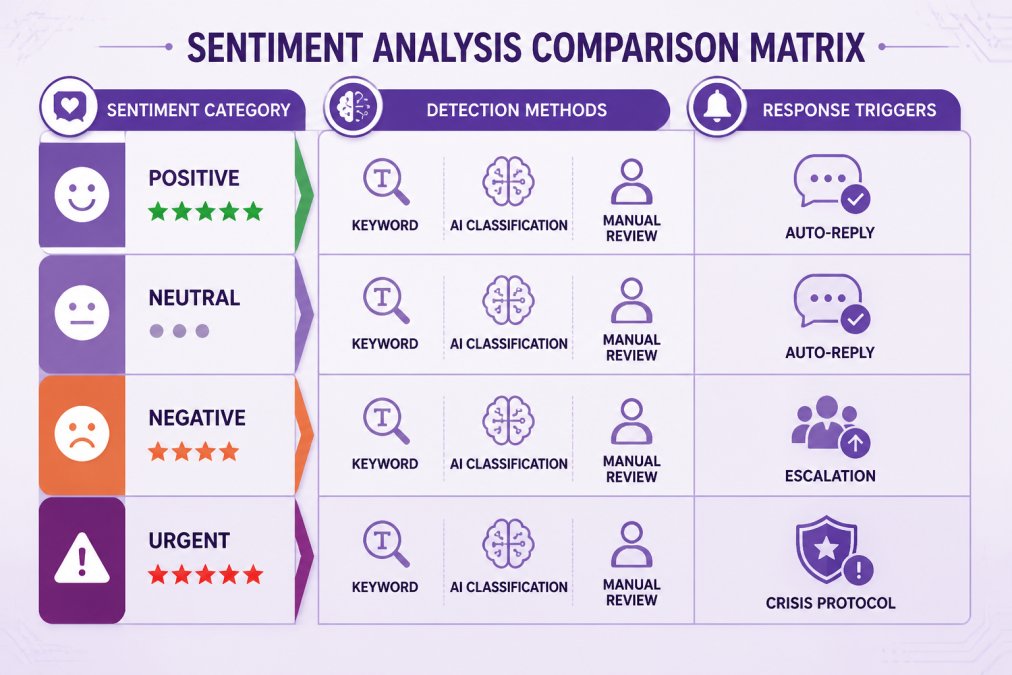
Brand sentiment analysis tools automate scanning mentions and categorizing them as positive, neutral, negative, or urgent. This categorization lets your team focus response efforts where they matter most.
AI-driven sentiment detection and response
AI-driven sentiment analysis uses machine learning to classify mentions with greater accuracy than keyword matching. AI models understand context: "I'm disappointed this product sold out" differs from "I'm disappointed with this product's quality."
AI sentiment tools achieve 85-90% accuracy on straightforward cases and 70-80% on nuanced cases. Implementation means feeding the tool examples of your client's mentions and refining classification thresholds. Lower thresholds catch more potential issues but generate false positives; higher thresholds reduce noise but might miss emerging problems.
AI-driven response goes beyond detection to suggest or partially automate responses. Tools can flag complaints and suggest response templates, or automatically route urgent mentions to senior team members. Your team still approves before anything goes public.
Social listening for competitive intelligence
Social listening extends beyond monitoring your client's brand to tracking competitor mentions, industry trends, and relevant sector conversations. This broader listening reveals opportunities and threats that brand-specific monitoring misses.
Competitive intelligence from social listening informs strategy. If competitors gain positive sentiment around particular features, position your client's alternative approach. Social listening data becomes valuable to share with clients during quarterly reviews, elevating PR from reactive service to strategic partner.
How to Handle Negative Online Reviews and Defamation
Negative reviews are inevitable for brands with significant customer volume. A brand responding thoughtfully to legitimate complaints and professionally disputing false claims demonstrates it cares about customer experience.
Defamation, false statements damaging reputation, requires different approach than legitimate negative reviews. A customer expressing a bad experience is expressing opinion. Someone fabricating false claims about product safety or unethical practices may have crossed into defamation.
Damage control strategies that work
Effective damage control starts with triage: is this a legitimate complaint, misunderstanding, or false claim? Legitimate complaints deserve genuine engagement. Thank the reviewer, acknowledge the specific issue, explain what went wrong, and outline corrective action. This often converts angry customers into loyal ones.
Misunderstandings require clarification without defensiveness. False claims require documenting falsity carefully, gathering evidence, and responding with facts. Respond within 24-48 hours. A quick response signals engagement; a week-long delay signals indifference.
Legal vs. PR considerations in response
Some negative content crosses from reputation management into legal territory. A competitor making false claims about product safety, an employee posting trade secrets, or bad-faith actors spreading demonstrably false information may warrant legal action.
The tension is real: legal action can stop harmful content but may amplify it if handled poorly. The right approach depends on scope and impact. A single negative review, no matter how false, typically doesn't warrant legal action. A coordinated campaign of false claims demonstrably damaging business may justify legal intervention.
SEO and PR Integration for Long-Term Reputation
Search engine optimization and PR serve the same goal: ensuring that when someone researches your client, they find information reflecting the brand's intended narrative. The most effective reputation management integrates both.
When journalists write about your client, coverage generates backlinks boosting search rankings. When your client publishes thought leadership content, SEO optimization ensures it ranks for relevant keywords. When negative stories rank high, SEO-optimized positive content can push them down.
Search engine optimization as reputation defense
SEO improves website visibility in organic search results through technical improvements, content optimization, and link building. For reputation management, SEO ensures positive, owned content ranks higher than third-party content in search results for your client's brand name and key terms.
When someone searches "[Client Name]," results should be dominated by your client's owned channels, positive third-party coverage, and thought leadership content. Improving search rankings for positive content requires three efforts: optimize your client's owned website for their brand name, build backlinks to positive content through PR coverage and guest articles, and create content around keywords currently showing negative results.
Content strategy and thought leadership
Thought leadership positions your client's executives as knowledgeable experts through published articles, speaking engagements, media interviews, and original research. A content strategy supporting thought leadership requires identifying topics where your client has genuine expertise, developing content around those topics, and distributing through channels generating both search visibility and media coverage.
Align content strategy with your client's business goals and reputation priorities. A financial services firm concerned about regulatory perception should develop thought leadership on compliance and risk management. A consumer brand concerned about sustainability should develop thought leadership on environmental practices and supply chain transparency.
Building Trust Through Brand Transparency and Values
Trust is the foundation of reputation. A brand with high trust weathers crises that would devastate low-trust brands. Building trust requires consistency between what a brand says and does, transparency about operations and values, and accountability when things go wrong.
Employee advocacy as your reputation shield
Employees are your client's most credible advocates. When employees speak positively about their company on social media and in professional networks, they create a distributed reputation buffer. If a crisis hits, customers and stakeholders are more likely to give the company the benefit of the doubt.
Employee advocacy programs encourage employees to share company news, thought leadership content, and brand stories on personal social media accounts. Content shared by employees gets more engagement and reach than content shared by companies directly. Implementing employee advocacy requires three elements: provide guidelines and pre-approved content, make sharing easy with ready-made assets, and recognize participation so employees see advocacy as valued.
Corporate social responsibility and brand consistency
Corporate social responsibility initiatives build reputation when authentic and consistent with brand values. A company claiming to prioritize environmental causes while having poor environmental practices is seen as hypocritical.
Your role includes advising clients on whether claimed values align with actual practices. If there's misalignment, advise either changing operations to match claims or adjusting claims to match reality. Continuing to market misaligned values is a reputation disaster waiting to happen.
Measuring Reputation Success: KPIs and Audit Frameworks
Reputation management without measurement is just activity. To demonstrate value to clients and identify what's working, you need key performance indicators tracking reputation changes over time.
A reputation audit framework establishes a baseline of your client's current reputation across relevant channels and audiences, then tracks changes quarterly or semi-annually. This framework should measure sentiment, search visibility, media coverage, and stakeholder perception.
| Metric | Measurement Method | Frequency | Target |
|---|---|---|---|
| Sentiment ratio | AI analysis of mentions | Weekly | 70%+ positive |
| Search visibility | First-page results audit | Monthly | 80%+ owned/positive content |
| Media coverage tone | Manual review of articles | Monthly | 60%+ positive |
| Stakeholder perception | Quarterly survey | Quarterly | 75%+ favorable |
| Crisis response time | Internal tracking | Per incident | <4 hours |
| Review response rate | Platform audit | Weekly | 95%+ of reviews addressed |
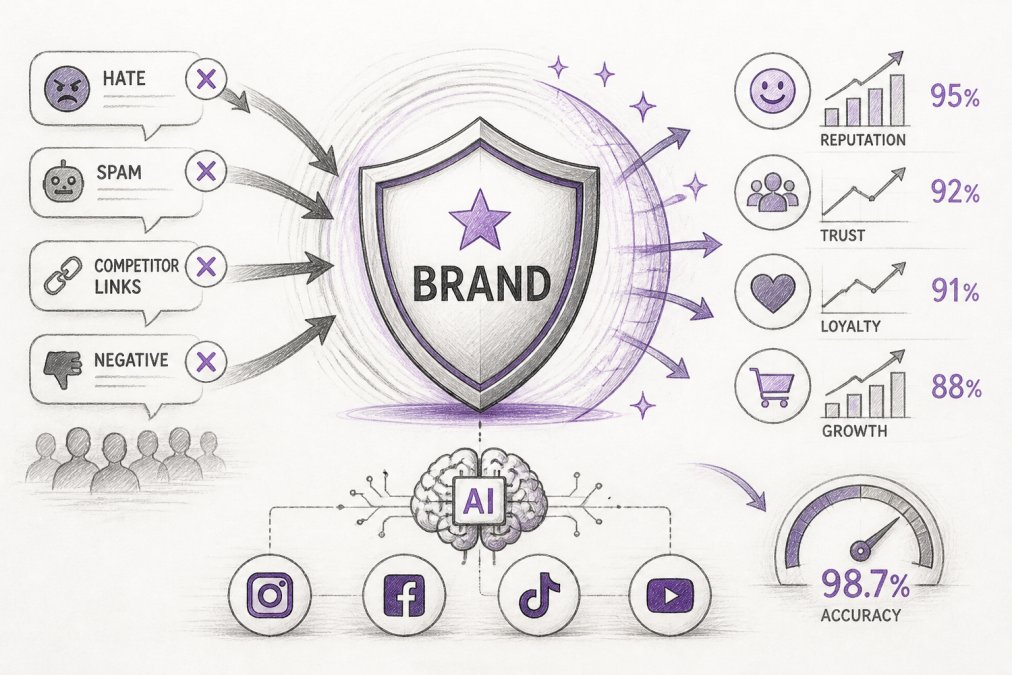
FeedGuardians helps PR agencies protect brand reputation by automating comment moderation and response across Instagram, Facebook, TikTok, and YouTube. With AI-powered detection identifying and hiding spam, hate speech, and competitor links with 98.7% accuracy, your clients' social channels stay clean and on-brand. The platform delivers 24/7 AI-powered replies in your client's unique voice, ensuring no customer inquiry goes unanswered while your team focuses on strategy. For PR agencies managing multiple client accounts, real-time moderation and intelligent automation prevent reputation damage before it spreads. Start for free today and turn social comments into conversations that strengthen brand reputation.
Frequently Asked Questions
What's the difference between PR and reputation management?
PR focuses on building positive media coverage and stakeholder relationships, while reputation management actively monitors, protects, and repairs your brand's public perception. Reputation management is reactive to threats and proactive in sentiment monitoring. PR is one tool within a broader reputation protection strategy. Both work together: PR creates positive brand narrative while reputation management ensures that narrative stays intact across all digital channels and media outlets.
How do AI-driven sentiment analysis tools improve crisis communication?
AI sentiment analysis detects emerging issues in real-time across social media, reviews, and news mentions before they escalate into full crises. These tools flag negative sentiment spikes, identify key influencers spreading criticism, and suggest response templates aligned with your brand voice. This speed means your crisis communication plan activates faster, reducing damage control time from hours to minutes. The tools also track sentiment recovery post-response, showing whether your crisis mitigation strategy is working.
Can employee advocacy actually protect brand reputation?
Yes. When employees share company content and defend brand values authentically on their personal networks, it amplifies positive messaging and provides social proof that competitors cannot replicate. Employees are trusted sources, so their advocacy reaches audiences skeptical of official brand communications. During crises, employees who understand and support company values become reputation shields by providing context and countering misinformation. Training employees to be brand ambassadors creates a distributed defense network that protects reputation across multiple platforms simultaneously.
How should PR agencies handle the legal vs. PR intersection when facing defamation?
PR and legal teams must coordinate immediately. PR handles public messaging and narrative control while legal evaluates whether defamation claims have merit and determines response options. PR should not make legal admissions in public statements. The strategy differs based on legal advice: if the claim is false, PR can aggressively correct the record with facts; if there's legal risk, PR focuses on transparency and brand values without addressing specifics. Both teams must align on timing, tone, and key messages to avoid contradicting each other publicly.
This article was written using GrandRanker
Tired of manually moderating comments?
FeedGuardians automates spam filtering, responds to customers, and protects your brand — setup in 3 minutes.
Frequently Asked Questions
What's the difference between PR and reputation management?
PR focuses on building positive media coverage and stakeholder relationships, while reputation management actively monitors, protects, and repairs your brand's public perception. Reputation management is reactive to threats and proactive in sentiment monitoring. PR is one tool within a broader reputation protection strategy. Both work together: PR creates positive brand narrative while reputation management ensures that narrative stays intact across all digital channels and media outlets.
How do AI-driven sentiment analysis tools improve crisis communication?
AI sentiment analysis detects emerging issues in real-time across social media, reviews, and news mentions before they escalate into full crises. These tools flag negative sentiment spikes, identify key influencers spreading criticism, and suggest response templates aligned with your brand voice. This speed means your crisis communication plan activates faster, reducing damage control time from hours to minutes. The tools also track sentiment recovery post-response, showing whether your crisis mitigation strategy is working.
Can employee advocacy actually protect brand reputation?
Yes. When employees share company content and defend brand values authentically on their personal networks, it amplifies positive messaging and provides social proof that competitors cannot replicate. Employees are trusted sources, so their advocacy reaches audiences skeptical of official brand communications. During crises, employees who understand and support company values become reputation shields by providing context and countering misinformation. Training employees to be brand ambassadors creates a distributed defense network that protects reputation across multiple platforms simultaneously.
How should PR agencies handle the legal vs. PR intersection when facing defamation?
PR and legal teams must coordinate immediately. PR handles public messaging and narrative control while legal evaluates whether defamation claims have merit and determines response options. PR should not make legal admissions in public statements. The strategy differs based on legal advice: if the claim is false, PR can aggressively correct the record with facts; if there's legal risk, PR focuses on transparency and brand values without addressing specifics. Both teams must align on timing, tone, and key messages to avoid contradicting each other publicly.