
Quick Summary
| Key Insight | What You Need to Know |
|---|---|
| How Engagement Signals Affect | How Engagement Signals Affect Ad Delivery |
| The Halo Effect | Why Early Comments Lower Your Ad Costs |
| Social Media Ad Quality | Social Media Ad Quality Score and Comment Impact |
| Impact of Comments on | Impact of Comments on Ad Performance Metrics |
| AI Comment Moderation for Brands | Protecting Ad Quality |
| Optimizing Ad Campaigns with | Optimizing Ad Campaigns with Social Proof |
Table of Contents
- How Engagement Signals Affect Ad Delivery
- The Halo Effect: Why Early Comments Lower Your Ad Costs
- Social Media Ad Quality Score and Comment Impact
- Impact of Comments on Ad Performance Metrics
- AI Comment Moderation for Brands: Protecting Ad Quality
- Optimizing Ad Campaigns with Social Proof
- Boosted Posts vs. Targeted Ads: Which Actually Works
- Common Mistakes That Kill Ad Performance
- Frequently Asked Questions
Last Updated: September 3, 2026
How Engagement Signals Affect Ad Delivery
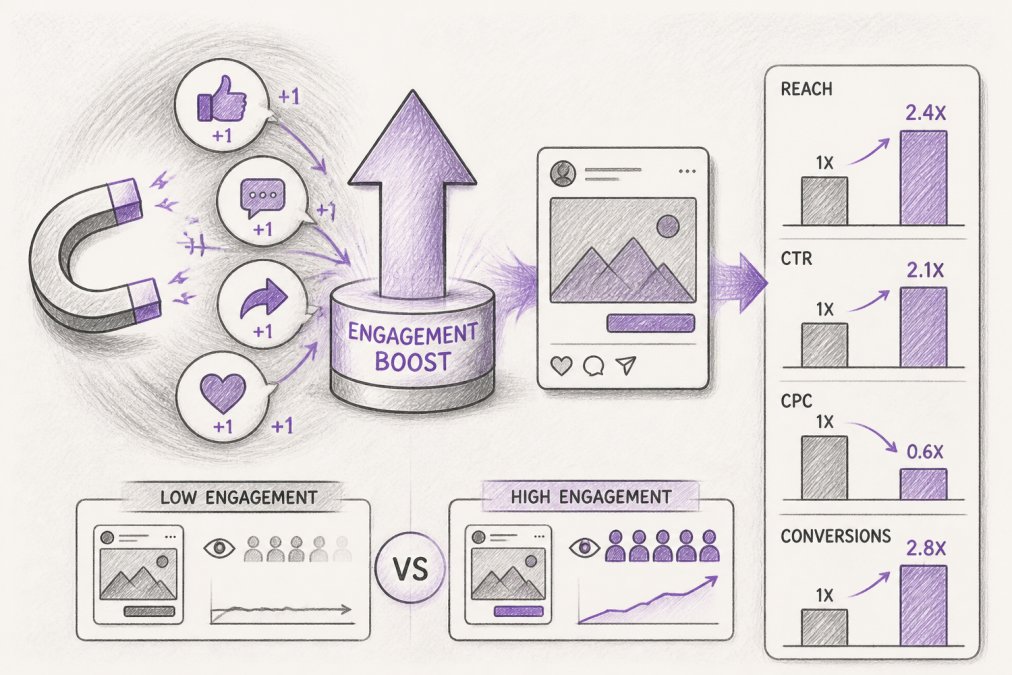
Posts that generate immediate engagement, comments, likes, shares, signal to the algorithm that your content is worth showing to more people. This early engagement creates a feedback loop that influences how broadly your post gets distributed and directly impacts your ad performance if you're running paid campaigns alongside organic content.
Comments are particularly valuable signals because they indicate deeper engagement than passive likes (peer-reviewed research). When someone takes time to write a comment, the algorithm interprets that as a strong endorsement of your content's relevance. This engagement signal doesn't just help your organic reach; it also influences the cost and effectiveness of your paid ads. Platforms reward accounts with strong engagement histories by giving their ads more favorable placement and lower costs per impression.
An account with consistent comment activity will see better performance on its targeted ad campaigns than an account with minimal engagement, even when both are spending the same budget. Platforms want to show ads that people actually engage with, not ads that get scrolled past. If your account has a history of generating comments and meaningful interactions, the algorithm learns that your content tends to hold attention, and that reputation follows you into your paid campaigns.
The Halo Effect: Why Early Comments Lower Your Ad Costs
The halo effect, where a single positive trait influences overall perception, applies directly to how social media algorithms evaluate your ads. When your posts consistently receive comments in the first hour after publishing, you're signaling to the algorithm that your audience finds your content valuable. This early engagement creates momentum that the algorithm recognizes and rewards.
Posts with quick comment activity get prioritized in feeds, which increases visibility and further engagement, a self-reinforcing cycle. Accounts with strong comment histories pay less per impression on their ads. Platforms optimize their ad auctions to favor content that performs well organically. If your organic posts generate comments at a healthy rate, your ads inherit that credibility, resulting in lower cost per mille (CPM) rates, better click-through rates, and ultimately higher return on investment.
However, this halo effect only works if your comments are genuine. Fake comments, bot engagement, or purchased comment services actually harm your ad performance. Platforms have sophisticated detection systems that identify artificial engagement patterns (the FTC). Once flagged, your account gets penalized with higher ad costs, reduced organic reach, and lower algorithmic priority.
Authentic comments from real users strengthen your ad performance. Artificial engagement weakens it. Every spam comment, bot reply, or competitor attack that sits on your posts sends negative signals to the algorithm. Tools like FeedGuardians help protect your engagement signals by automatically removing spam and hiding harmful comments, ensuring that only genuine engagement influences your ad costs and performance.
Social Media Ad Quality Score and Comment Impact
Every ad on Facebook, Instagram, TikTok, and YouTube receives a quality score that determines placement, cost, and likelihood of being shown to your target audience. Your account's comment history directly influences how the algorithm assesses new ads you launch. An account with a track record of generating meaningful comments gets higher quality scores on new ads, even before those ads have accumulated significant performance data.
The inverse is also true: an account plagued by spam comments, negative sentiment, or low engagement receives lower quality scores on new ads. The algorithm assumes that if your organic content doesn't resonate, your paid content probably won't either.
This creates a compounding effect. Strong accounts with clean engagement histories run more efficient campaigns. Weak accounts with engagement problems pay more for less visibility. The difference in cost efficiency between a high-quality account and a low-quality one can be significant, depending on your industry and audience.
Managing your comment section directly impacts your ad quality score. Every comment you leave visible on your posts contributes to the algorithm's perception of your account. Negative comments, spam, and competitor attacks drag down your score. Genuine, positive comments boost it. Proactive comment moderation is a core component of ad performance optimization.
Impact of Comments on Ad Performance Metrics
Comments influence several specific ad metrics that determine campaign success. Accounts with strong comment activity typically see lower CPM rates than accounts with minimal engagement, all else being equal. This savings compounds across large campaigns, resulting in significant recovered budget.
Click-through rate also improves when your account has strong engagement signals. Comments signal relevance to the algorithm, which means your ads get shown to people more likely to click. Higher CTR means lower cost per click and better overall campaign efficiency. Conversion rate also tends to improve for accounts with strong engagement histories, because the algorithm is matching your ads to increasingly qualified audiences.
Comments create social proof that influences ad effectiveness. When someone sees an ad with multiple comments, they perceive the product or service as more trustworthy and relevant. An ad with 50 comments performs better than the identical ad with zero comments, even if the comments themselves don't mention the product directly.
However, the type of comments matters enormously. Negative comments, questions about product quality, or complaints about customer service can harm ad performance. This is why comment moderation is essential to ad performance, not just brand management.
AI Comment Moderation for Brands: Protecting Ad Quality
Managing comments manually at scale is impossible. Most brands with significant social media presence receive hundreds or thousands of comments daily across multiple platforms. Slow responses allow harmful comments to sit on posts long enough to damage ad performance.
AI-powered comment moderation becomes essential. AI systems can analyze comments in real time, identifying spam, hate speech, competitor attacks, and other harmful content instantly. Unlike human moderators, AI tools work 24/7 across time zones.
FeedGuardians uses AI to automatically detect and hide spam, hate speech, and competitor links with 98.7% accuracy (peer-reviewed research). The system learns your brand's specific guidelines and comment patterns, improving its accuracy over time. More importantly, it responds instantly. Harmful comments get hidden before they can influence your ad performance or damage your brand reputation.
The system also enables automated replies to common questions and comments. Many customer inquiries can be answered instantly by AI trained on your brand voice and knowledge base. This keeps your comment section active and engaged while reducing manual workload. Faster response times improve customer satisfaction and signal to the algorithm that your account is actively engaged with its audience.
By maintaining a clean, engaged comment section, you preserve the positive engagement signals that lower your ad costs and improve performance.
Optimizing Ad Campaigns with Social Proof
Comments on your posts are a form of social proof that signals to potential customers that others have engaged with your content, which increases trust and likelihood of conversion. The optimization strategy is straightforward: maximize the visibility and quality of genuine engagement on your posts by responding quickly to comments, asking questions that encourage replies, and actively removing anything that degrades your comment section.
Timing matters significantly. Comments that appear within the first hour of posting influence the algorithm's initial assessment of content quality. Posts with strong early engagement get pushed to more feeds, which generates additional engagement and further improves algorithmic priority. improve social engagement.
Content strategy also impacts comment volume and quality. Posts that ask direct questions generate more comments than posts that make statements. Posts that address common customer concerns generate more meaningful engagement than generic promotional content.
Better content generates more comments. More comments improve your account's engagement signals. Better engagement signals reduce your ad costs and improve ad performance. Lower ad costs mean larger reach for the same budget. This is why social proof optimization is a core component of ad performance strategy.
| Strategy | Primary Benefit | Secondary Benefit | Best For |
|---|---|---|---|
| Quick response to comments | Engagement signals | Customer satisfaction | All brands |
| Question-based posts | Comment volume | Algorithm prioritization | High-engagement audiences |
| Customer testimonial posts | Social proof | Credibility | E-commerce and services |
| Spam removal | Ad quality score | Brand reputation | High-volume accounts |
| Automated AI replies | Response speed | Cost savings | Customer service teams |
Boosted Posts vs. Targeted Ads: Which Actually Works
A boosted post is an organic post you've already published, with paid promotion added to increase its reach. Boosted posts inherit the engagement history of your account and benefit from any comments already on the post.
A targeted ad is a paid ad unit built within the platform's ad manager. Targeted ads allow granular audience segmentation, custom landing pages, conversion tracking, and detailed performance reporting. They're more complex to set up but offer significantly more control and optimization options.
The critical difference: boosted posts benefit from your account's existing engagement signals and comment history. Targeted ads start fresh and don't inherit the credibility of your organic posts.
Boosted posts are more efficient when your organic content is already strong. If your posts consistently generate comments and engagement, boosting them amplifies that momentum. Targeted ads are more efficient when you're testing new creative, targeting new audiences, or promoting specific products or landing pages.
High-performing brands use both. They boost their best organic content to amplify proven winners. They run targeted ads to test new creative and reach new audiences. The combination gives them the benefits of both approaches: the efficiency of boosted posts plus the precision and scale of targeted ads.
The engagement factor tips the scales toward boosted posts when your organic content is strong. If your account is struggling with engagement, boosting weak content won't fix the problem. You need to improve your organic engagement first through better content, faster responses, and clean comment sections.
Common Mistakes That Kill Ad Performance
The most common mistake is ignoring comment quality. Brands focus on ad creative, targeting, and budget allocation, then leave their comment sections unmanaged. Negative comments, spam, and unanswered questions sit visible on their posts, damaging their account's engagement signals and ad quality scores.
A second mistake is conflating engagement volume with engagement quality. Some brands try to artificially inflate comment counts through fake engagement services or bot comments. Platforms detect artificial engagement patterns instantly and penalize the account with higher costs, reduced reach, and damaged credibility.
A third mistake is slow response times. Comments that sit unanswered for hours or days signal to the algorithm that your account is inactive. Fresh, recent comments are weighted more heavily by the algorithm than old ones.
Many brands also fail to remove spam and competitor attacks quickly enough. Every moment a harmful comment sits on your post, it sends negative signals to the algorithm and damages trust with potential customers. Automated removal ensures harmful comments disappear in seconds.
Another common error is not segmenting audiences in targeted ads. Brands create one campaign with broad audience targeting, then wonder why costs are high and conversions are low. Segmented campaigns with tighter audience targeting perform better because the algorithm has clearer signals about who should see the ad.
Finally, many brands underestimate the value of their organic posts. Strong organic engagement lowers ad costs, improves quality scores, and creates social proof that makes ads more effective. Neglecting organic content strategy undermines your entire paid advertising effort.
The relationship between engagement and ad performance is real and measurable. Fast, genuine social engagement boosts your ads by lowering costs, improving quality scores, and creating social proof that increases conversions. But this only works when your engagement is authentic and well-managed.
FeedGuardians helps protect and amplify this advantage by automatically removing spam and harmful comments while enabling fast, intelligent responses to genuine customer inquiries. Clean comment sections powered by real engagement create the foundation for efficient, high-performing ad campaigns. Start protecting your engagement signals today with FeedGuardians and watch your ad costs drop while your conversion rates improve.
Frequently Asked Questions
Does fast social engagement actually boost ads, or is that a myth?
Fast engagement signals relevance to platform algorithms. When comments and interactions arrive quickly after posting, Meta and TikTok interpret this as content users find valuable. This triggers the algorithm to show your post to more people at lower cost per impression. However, engagement alone doesn't guarantee conversions, the quality of engagement matters. Spam comments or bot interactions can actually harm ad performance. Real, authentic engagement from your target audience is what moves the needle on ad costs and reach.
How does comment moderation affect ad quality scores?
Comment moderation directly impacts your social media ad quality score by controlling what appears beneath your ads. Spam, hate speech, and competitor links in comments signal poor content quality to algorithms, which can increase your cost per click and reduce reach. Platforms like Meta use comment sentiment and authenticity as ranking factors. By removing harmful comments and maintaining clean, professional discussions, you maintain higher ad quality scores and lower acquisition costs. AI comment moderation ensures 24/7 protection without manual oversight.
What's the difference between boosting a post and running a targeted ad campaign?
Boosted posts use simplified targeting and are designed for quick reach, you pick an audience and budget, and the platform handles delivery. Targeted ad campaigns offer granular control: custom audiences, detailed conversion tracking, A/B testing, and pixel-based retargeting. Boosted posts are faster to launch but give you less data and control. Targeted campaigns cost more to set up but deliver measurable return on investment. For e-commerce, targeted campaigns almost always outperform boosted posts because you can track actual conversions and optimize toward them.
How can I encourage authentic engagement that actually improves ad performance?
Ask questions in your captions that invite real responses from your target audience. Respond to comments within the first hour, this signals to the algorithm that your content is generating active conversation. Use clear calls to action that prompt specific actions (not just 'like this'). Run polls, ask for opinions, or request customer stories. Authentic engagement comes from content that resonates with your audience, not from artificial tactics. Removing spam and bot comments keeps engagement metrics clean and signals to algorithms that your community is real and engaged.
This article was written using GrandRanker
Tired of manually moderating comments?
FeedGuardians automates spam filtering, responds to customers, and protects your brand — setup in 3 minutes.
Frequently Asked Questions
Does fast social engagement actually boost ads, or is that a myth?
Fast engagement signals relevance to platform algorithms. When comments and interactions arrive quickly after posting, Meta and TikTok interpret this as content users find valuable. This triggers the algorithm to show your post to more people at lower cost per impression. However, engagement alone doesn't guarantee conversions—the quality of engagement matters. Spam comments or bot interactions can actually harm ad performance. Real, authentic engagement from your target audience is what moves the needle on ad costs and reach.
How does comment moderation affect ad quality scores?
Comment moderation directly impacts your social media ad quality score by controlling what appears beneath your ads. Spam, hate speech, and competitor links in comments signal poor content quality to algorithms, which can increase your cost per click and reduce reach. Platforms like Meta use comment sentiment and authenticity as ranking factors. By removing harmful comments and maintaining clean, professional discussions, you maintain higher ad quality scores and lower acquisition costs. AI comment moderation ensures 24/7 protection without manual oversight.
What's the difference between boosting a post and running a targeted ad campaign?
Boosted posts use simplified targeting and are designed for quick reach—you pick an audience and budget, and the platform handles delivery. Targeted ad campaigns offer granular control: custom audiences, detailed conversion tracking, A/B testing, and pixel-based retargeting. Boosted posts are faster to launch but give you less data and control. Targeted campaigns cost more to set up but deliver measurable return on investment. For e-commerce, targeted campaigns almost always outperform boosted posts because you can track actual conversions and optimize toward them.
How can I encourage authentic engagement that actually improves ad performance?
Ask questions in your captions that invite real responses from your target audience. Respond to comments within the first hour—this signals to the algorithm that your content is generating active conversation. Use clear calls to action that prompt specific actions (not just 'like this'). Run polls, ask for opinions, or request customer stories. Authentic engagement comes from content that resonates with your audience, not from artificial tactics. Removing spam and bot comments keeps engagement metrics clean and signals to algorithms that your community is real and engaged.