
Quick Summary
| Key Insight | What You Need to Know |
|---|---|
| Acknowledge the specific problem | Acknowledge the specific problem in one or two sentences instead of opening with blame. |
| Set a first-response target | Set a first-response target of a public reply within 24 to 48 hours on Google and Yelp. |
| Route reviews alleging safety | Route reviews alleging safety issues, billing fraud, legal threats, or discrimination to a manager. |
| Ask satisfied customers to | Ask satisfied customers to update their review, but never condition the fix on it. |
| Pull 90 days of | Pull 90 days of history as a baseline before changing your review response process. |
| Why Negative Reviews Can | Why Negative Reviews Can Be a Marketing Opportunity |
Last Updated: November 9, 2026
Quick Summary
Turn negative reviews into marketing opportunities by responding fast and in public with empathy, accountability, and a clear next step, then moving the fix to a private channel. Log each response and its root cause so repeated complaints become one process fix, and measure response time, response rate, and resolution rate to prove the impact.
- Acknowledge the specific problem in one or two sentences instead of opening with blame.
- Set a first-response target of a public reply within 24 to 48 hours on Google and Yelp.
- Route reviews alleging safety issues, billing fraud, legal threats, or discrimination to a manager.
- Ask satisfied customers to update their review, but never condition the fix on it.
- Pull 90 days of history as a baseline before changing your review response process.
Table of Contents
- Why Negative Reviews Can Be a Marketing Opportunity
- How to Respond to Negative Reviews: A Step-by-Step Framework
- Negative Review Response Examples That Build Trust
- Negative Review Response Templates for Common Scenarios
- Social Media Comment Moderation Tools That Scale Your Response
- Handling Fake, Abusive, or Unverified Reviews
- Measuring the Business Impact of Your Review Responses
- Put FeedGuardians to Work on Your Negative Reviews
- Frequently Asked Questions
Why Negative Reviews Can Be a Marketing Opportunity
A negative review is not a verdict. It's a public test of how you treat people when things go wrong, and prospects are watching.
Most businesses treat online reviews as a scoreboard. The smart ones treat them as a stage: every public response is read by quiet observers deciding whether to buy.
So what makes a bad review an asset?
- It shows you're real. A perfect rating with no complaints looks fake to modern buyers.
- It lets you control the narrative. Ignore a complaint and the reviewer writes the ending. Respond well and you write it.
- It reveals fixable problems. Customer feedback points straight at what to improve.
The stakes are high. A BrightLocal survey on local consumer review habits has repeatedly found that most shoppers read business responses and factor them into trust.
How to Respond to Negative Reviews: A Step-by-Step Framework
Responding to a negative review is the process of answering a public complaint with empathy, accountability, and a clear next step, then moving the fix to a private channel.
What most guides leave out is the operating system behind the reply: who owns it, how fast it ships, and what happens when the complaint is disputed. Here is the four-step framework we recommend, plus the workflow that keeps it consistent.
Step 1: Acknowledge the Customer's Concern
Start by naming the problem in your own words. This proves you actually read the review, not just skimmed the stars.
- Say what went wrong: "You ordered on Friday and it arrived late."
- Skip the excuses. Nobody wants a logistics lecture.
- Keep it to one or two sentences.
A common mistake is opening with "We're sorry you feel that way." That reads as blame. Acknowledge the specific issue instead.
Watch out: a public reply can be screenshotted, so write the acknowledgment as if it will be shared.
Step 2: Apologize and Show Empathy
An apology without empathy is just words. Empathy means acknowledging how the experience affected the customer.
Try this: "That's frustrating, and we'd be annoyed too." It costs nothing and defuses most of the anger. Avoid passive phrasing like "mistakes were made." Own it directly.
Step 3: Offer a Resolution and Take the Conversation Offline
Give a concrete fix, then move the details to a private channel. Public threads are for showing you care; private messages are for solving the problem.
- State the resolution: refund, replacement, or a call.
- Invite them to continue privately.
- Follow up after the fix to confirm it landed.
Watch out: never promise a resolution you can't deliver. A broken promise in public is worse than the original review.
Step 4: Log the Response and Route the Fix
The reply is the visible part. The durable part is the record. Log the review, the response, the resolution offered, and the root cause in one place so patterns surface. When the same shipping delay generates five one-star reviews in a week, the log turns five complaints into one process fix. Systematic documentation of these interactions builds the trust necessary for effectively asking patients for reviews when you are ready to expand your digital presence.
The Response Workflow: Ownership, Escalation, and Timing
A framework only works if someone owns each step. Most teams that respond inconsistently are missing an assignment layer, not empathy.
- Assign an owner by channel. Google Business Profile, Yelp, Facebook, and industry-specific review sites each get a named owner. When no one owns a channel, responses stall.
- Set a first-response target. A common practitioner target is a public reply within 24 to 48 hours on Google and Yelp, and faster on social platforms. Pick a number, publish it internally, and track it.
- Define escalation triggers. Route to a manager when the review alleges safety issues, billing fraud, legal threats, or discrimination.
Platform Mechanics That Change the Reply
The same complaint needs a different reply depending on where it lands.
- Google Business Profile: replies are public. Keep them short, professional, and free of order numbers or personal data.
- Yelp: public comments are visible; private messaging is the place for order details.
- Facebook and Instagram: comments are threaded and fast-moving. A public reply plus a private message is the standard pattern; hiding a comment should be reserved for policy violations, not criticism.
Watch out: responding with the customer's order number, address, or health information can create a privacy problem that outlasts the original complaint. Ask for details privately instead.
Negative Review Response Examples That Build Trust
The best negative review response examples share one trait: they sound like a person, not a policy.
Example 1 (late delivery): "Hi Marcus, you're right, your order showed up four days late and that's not the experience we want you to have. We're sorry. We've refunded your shipping and sent a replacement for the damaged item. We'd love to make this right, so please check your inbox for a note from our team."
Example 2 (product quality): "Thanks for flagging this, Dana. That's not how our product should perform, and we've passed your feedback to our quality team.
Notice what these do: they name the issue, apologize plainly, and offer a fix. No corporate hedging. No defensiveness.
Negative Review Response Templates for Common Scenarios
Templates save time, but they should never read like templates. Use these as starting points, then personalize the first line so the reviewer knows you saw them.
- Late delivery: "Hi [Name], your order arrived later than promised and that's on us. We're sorry. We've refunded your shipping and [specific fix]. Please message us so we can make it right."
- Damaged item: "Hi [Name], a damaged item is not acceptable. We're sending a replacement today at no cost. Sorry for the hassle."
- Wrong item sent: "Hi [Name], we shipped the wrong item and that's our mistake. The correct one is on its way, and keep the original with our apologies."
The pattern is simple: acknowledge, apologize, offer a fix, invite a private follow-up.
Social Media Comment Moderation Tools That Scale Your Response
Manual review responses don't scale.
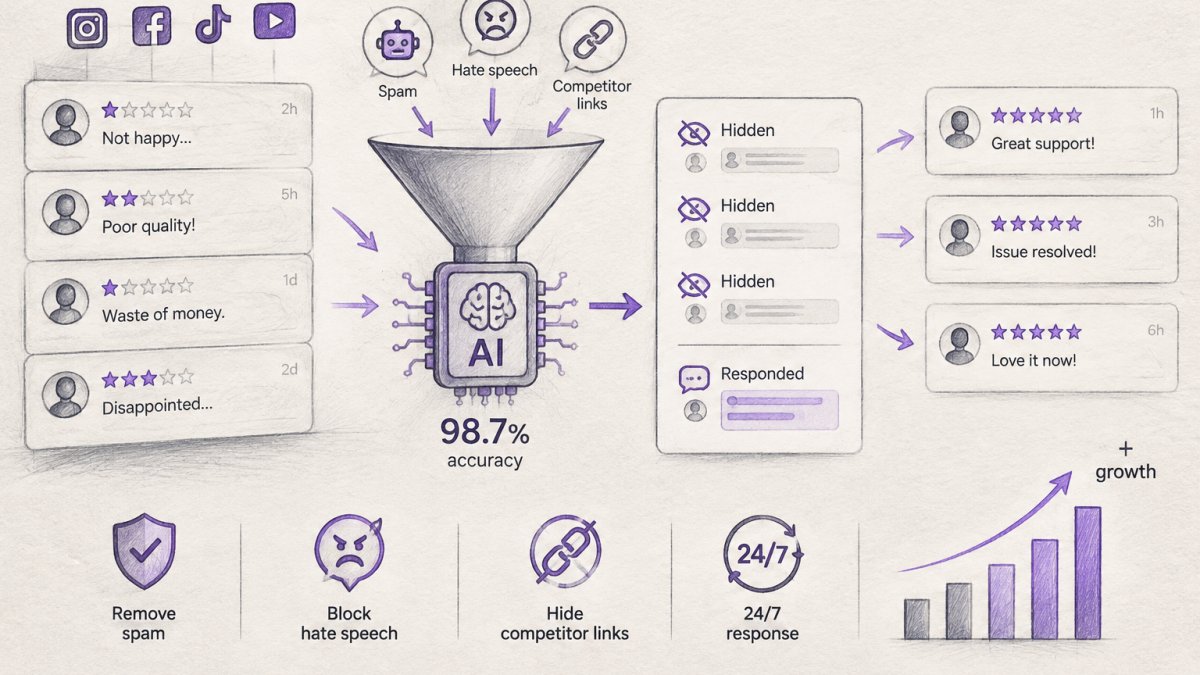
This is where FeedGuardians earns its place. FeedGuardians automatically detects and hides spam, hate speech, and competitor links with 98.7% accuracy, and delivers 24/7 AI-powered replies in your brand voice.
| Need | Manual moderation | FeedGuardians |
|---|---|---|
| Response time | Hours, business hours only | 24/7 automated |
| Spam and hate filtering | Human review | Auto-hide, keyword and AI rules |
| Brand voice | Varies by team member | Learned from your tone |
| Scale across clients | Breaks past a few accounts | Built for multi-account volume |
If you want to see how it handles spam and abusive comments at scale, you can explore the AI comment moderation tool and see how it works for your accounts.
Handling Fake, Abusive, or Unverified Reviews
Not every negative review is real. Some are spam, some are competitors, some are abusive. Tell them apart before you respond.
- Check for a matching order. No record? Ask for details publicly, then verify privately.
- Look for patterns. A burst of one-star reviews with no detail often signals a coordinated attack.
- Know the rules. Platforms have policies on fake and abusive content, and hiding legitimate criticism can carry legal risk. Before you remove anything, read up on the legal risks of hiding comments on business pages.
For a deeper playbook on abusive comments specifically, our guide on how to handle toxic comments on Instagram walks through the escalation steps.
Measuring the Business Impact of Your Review Responses
A good response feels nice. But does it move the business? The gap in most review-response advice is measurement: teams track star ratings and call it a day, then cannot say whether responding faster or better changed anything.
Here is a measurement model you can run without new software, using data most businesses already have.
Define the KPIs Before You Start
Pick a small set and write down the formula for each. A KPI without a formula is a vibe.
- Response time: median hours between review publication and public reply, per platform. Track the median, not the average, so one slow outlier does not hide the pattern.
- Response rate: public replies divided by total new reviews in the period. A rate below 100% tells you which channels are unowned.
- Resolution rate: reviews where the customer confirmed a fix divided by reviews that received a reply.
Build a Simple Baseline
Before changing anything, pull 90 days of history: review volume by platform, star distribution, response rate, and median response time. That baseline is what every later comparison runs against. Without it, improvement claims are guesses.
Connect Responses to Revenue
The honest way to link review work to money is a before-and-after comparison on matched pages or locations, not a single correlation.
- Compare conversion rate on pages where low-star reviews received a public reply against similar pages where they did not, over the same period.
- Compare repeat purchase rate for customers who left a negative review and received a resolution against those who received no reply.
- Track whether resolved reviewers update their rating, and whether that coincides with a lift in page conversion.
Most practitioners find the clearest signal is not the star rating itself but the presence of a thoughtful public reply on the page a buyer is reading. That is the mechanism to test.
Review the Numbers on a Fixed Cadence
A monthly review of response time, response rate, resolution rate, and sentiment shift is enough to catch drift. Quarterly, revisit the revenue comparisons and retire KPIs that are not moving decisions.
Watch out: optimizing for average star rating alone can push teams to suppress criticism or chase reviews, which violates platform policies and erodes trust. Measure response quality and resolution, not just the score.
To track sentiment and response impact in one place, you can view the comment analytics dashboard and watch volume, sentiment, and spam rates at a glance. And if you want the case for why this matters to revenue, our breakdown of whether comment moderation increases ad conversions connects the dots.
Put FeedGuardians to Work on Your Negative Reviews
Turning negative reviews into marketing opportunities comes down to speed, empathy, and consistency. Miss any one, and a single bad review can sit at the top of your page for months.
That's the challenge we built FeedGuardians to solve. Our AI replies in your brand voice around the clock, hides spam and hate with 98.7% accuracy, and escalates to a human when a situation needs a real person.
Get started with FeedGuardians and turn your toughest reviews into your best trust signals.
Frequently Asked Questions
What is the 3-3-3 rule for marketing?
The 3-3-3 rule is a content scheduling guideline: post 3 times per week, at 3 consistent times, and engage for 3 minutes after each post. For review management, a similar rhythm works: check new reviews 3 times daily, respond within 3 hours during business hours, and follow up 3 days after resolution. This cadence keeps your brand responsive without overwhelming your team, and it turns negative reviews into timely conversations that show customers you are paying attention.
Is review gating illegal?
Review gating, the practice of asking only happy customers for reviews while filtering out unhappy ones, can raise concerns under U.S. consumer protection rules on deceptive practices. Instead, ask all customers for feedback, then use negative reviews as a public opportunity to demonstrate your service recovery. This approach is legal, builds trust, and gives you authentic marketing material that resonates with buyers.
How should a business respond to a negative review?
Respond promptly and professionally: acknowledge the specific concern, apologize for the experience without admitting fault, and offer a resolution or invite the conversation offline. Keep your public response under 100 words and avoid defensive language. For example, 'Thank you for sharing this. We're sorry your order arrived damaged. Please message us so we can send a replacement right away.' This approach shows other readers you handle problems well, turning a negative review into a marketing opportunity.
Can you use negative reviews in marketing?
Yes. Negative reviews, when handled well, become social proof of your customer service. Share anonymized examples of resolved complaints in case studies, highlight your response time and resolution rate, and use constructive criticism to improve products. Brands that publicly demonstrate accountability see higher customer trust. Tools like FeedGuardians help you respond consistently across platforms, turning critical feedback into content that shows prospects you stand behind your service.

Tired of manually moderating comments?
FeedGuardians automates spam filtering, responds to customers, and protects your brand — setup in 3 minutes.
Frequently Asked Questions
What is the 3-3-3 rule for marketing?
The 3-3-3 rule is a content scheduling guideline: post 3 times per week, at 3 consistent times, and engage for 3 minutes after each post. For review management, a similar rhythm works: check new reviews 3 times daily, respond within 3 hours during business hours, and follow up 3 days after resolution. This cadence keeps your brand responsive without overwhelming your team, and it turns negative reviews into timely conversations that show customers you are paying attention.
Is review gating illegal?
Review gating, the practice of asking only happy customers for reviews while filtering out unhappy ones, can raise concerns under U.S. consumer protection rules on deceptive practices. Instead, ask all customers for feedback, then use negative reviews as a public opportunity to demonstrate your service recovery. This approach is legal, builds trust, and gives you authentic marketing material that resonates with buyers.
How should a business respond to a negative review?
Respond promptly and professionally: acknowledge the specific concern, apologize for the experience without admitting fault, and offer a resolution or invite the conversation offline. Keep your public response under 100 words and avoid defensive language. For example, 'Thank you for sharing this. We're sorry your order arrived damaged. Please message us so we can send a replacement right away.' This approach shows other readers you handle problems well, turning a negative review into a marketing opportunity.
Can you use negative reviews in marketing?
Yes. Negative reviews, when handled well, become social proof of your customer service. Share anonymized examples of resolved complaints in case studies, highlight your response time and resolution rate, and use constructive criticism to improve products. Brands that publicly demonstrate accountability see higher customer trust. Tools like FeedGuardians help you respond consistently across platforms, turning critical feedback into content that shows prospects you stand behind your service.