
Quick Summary
| Key Insight | What You Need to Know |
|---|---|
| The False Choice | Efficiency vs. Brand Reputation |
| How Standardizing Brand Voice | How Standardizing Brand Voice Saves Hours Every Day Eliminating Manual Response Time Scaling Content Production Across Teams |
| Eliminating Manual Response Time | Eliminating Manual Response Time |
| Scaling Content Production Across | Scaling Content Production Across Teams |
| AI-Powered Comment Moderation Tools | AI-Powered Comment Moderation Tools and Spam Prevention Real-Time Detection and Filtering The 98.7% Accuracy Standard |
| Real-Time Detection and Filtering | Real-Time Detection and Filtering |
Table of Contents
- The False Choice: Efficiency vs. Brand Reputation
- How Standardizing Brand Voice Saves Hours Every Day
- AI-Powered Comment Moderation Tools and Spam Prevention
- Social Media Brand Voice Guidelines: Building Your Framework
- Protect Brand Reputation on Social Media: The Revenue Impact
- Operational Efficiency Meets Brand Identity
- Common Pitfalls in Brand Voice Development
- Conclusion
Last Updated: August 26, 2026
The False Choice: Efficiency vs. Brand Reputation
Most social media managers face a brutal tradeoff: automate responses and sound generic, or maintain authentic brand voice and drown in manual work. This choice is false. The real problem isn't choosing between efficiency and authenticity, it's that most teams haven't figured out how to standardize brand voice without losing what makes them distinctive.
When you standardize brand voice properly, you don't lose personality. You amplify it. You create a framework that teaches an AI system, or a team member, exactly how to sound like your brand every single time. That's when the magic happens: you save hours daily while protecting the trust customers have built with you.
In this guide, we'll show you exactly how standardizing brand voice solves both problems simultaneously: it cuts hours of manual work while preventing the spam-like, generic responses that tank engagement and conversions.
How Standardizing Brand Voice Saves Hours Every Day
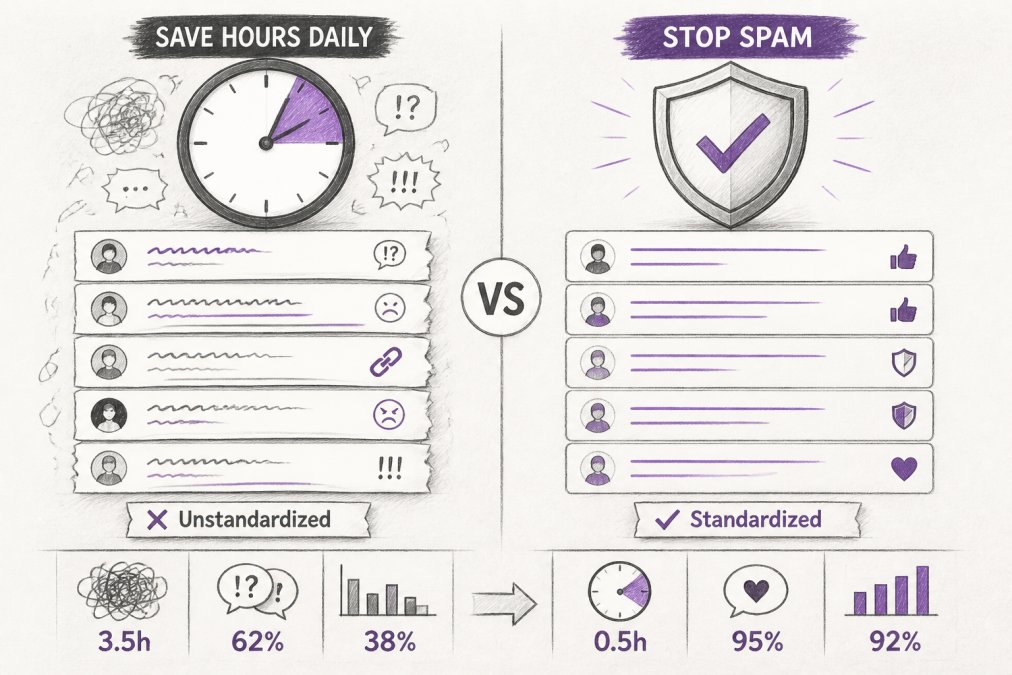
A social media manager without automation typically spends 3-5 hours daily on comment moderation and responses alone (bls.gov). That's 15-25 hours per week on a single task.
Standardizing brand voice cuts this dramatically. When you define your tone, terminology, and guidelines in a structured framework, you can automate the response layer entirely. The AI learns your voice and replies 24/7 without your intervention. Spam detection happens in real time. The math is straightforward: fewer hours spent = more time on strategy, growth, and creative work.
Eliminating Manual Response Time
The biggest time drain is repetition. A brand receives the same questions over and over: "What's your shipping policy?" "Do you have this in size M?" "When does this drop?" A human answers each one individually, spending 2-3 minutes per response (peer-reviewed research). Multiply that by 50-100 comments daily, and you're looking at 2-4 hours of pure repetition.
Standardized brand voice frameworks eliminate this layer. You define how your brand answers common questions. The AI learns that tone and terminology, then replies automatically in your voice. The response sounds authentic because it's built on your actual guidelines, not a generic template.
Scaling Content Production Across Teams
Scaling a content team without losing brand consistency is where most organizations fail. You hire a second writer, then a third. Each one interprets brand voice slightly differently. Customers notice the inconsistency.
Standardizing brand voice solves this at the source. Instead of hoping new team members absorb your tone through osmosis, you give them a documented framework: specific words you use, words you avoid, the rhythm and length of your sentences, how you handle customer complaints. A new writer follows the framework and sounds like the brand immediately.
For agencies managing multiple clients, this framework becomes a scalability tool. Instead of hiring specialized writers for each account, you hire one strong writer, train them on the standardization framework, and they can maintain voice across all clients. You're using structure to enable consistency at scale.
AI-Powered Comment Moderation Tools and Spam Prevention
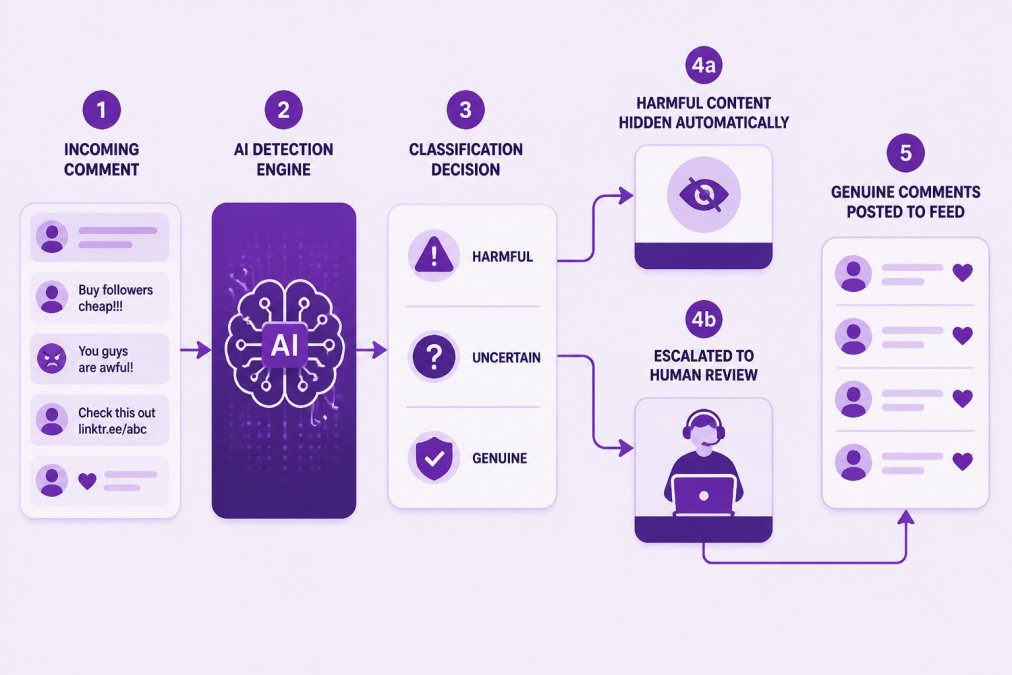
Spam, hate speech, competitor links, and scams flood social media every day. A human moderator catches most of it, but it's exhausting and error-prone. AI-powered comment moderation tools handle this at machine speed, detecting spam, scams, hate speech, and competitor links in real time, before most humans would even read the comment.
Real-Time Detection and Filtering
Real-time detection means harmful content never appears on your feed in the first place. A customer scrolls your Instagram post and sees only genuine comments and conversations. They don't see spam, hate, or competitor promotions. The experience feels clean, professional, trustworthy.
This matters more than most brands realize. Customers judge your brand partially on the quality of your comment section. A section full of spam signals poor management. A clean section signals a brand that cares about its community.
Real-time moderation also protects your ad performance. Platforms like Facebook and Instagram penalize accounts with high rates of spam or hate speech in comments (facebook.com). Clean moderation improves ad performance directly.
The 98.7% Accuracy Standard
FeedGuardians detects and hides harmful content with 98.7% accuracy, meaning that out of 1,000 comments, the AI correctly classifies 987 of them, catching real spam while letting genuine customer feedback through. This accuracy level represents the current standard in the industry, high enough to trust the system while remaining human-reviewable for edge cases.
Social Media Brand Voice Guidelines: Building Your Framework
Standardizing brand voice isn't about creating a rulebook that sounds robotic. It's about documenting how your brand actually talks so others, human team members or AI systems, can replicate it consistently. customer support efficiency.
Defining Your Unique Brand Voice
Your brand voice is the personality behind every word you write. It's not just what you say, it's how you say it. A luxury brand uses different vocabulary and sentence structure than a casual streetwear brand.
Defining this means answering specific questions: What words do you use repeatedly? What words would you never use? What's your sentence length? How do you handle humor? Do you use emojis? How formal or casual are you? How do you respond to complaints?
Write down concrete examples. Instead of saying "we're friendly," show it: "When a customer complains, we say 'That's frustrating, here's exactly what we'll do' not 'We regret any inconvenience.'" These specifics are what an AI system learns.
Delegating Without Losing Authenticity
The fear with delegation is that a new team member or an AI system will dilute your brand voice. That fear is legitimate without a framework. But with one, delegation becomes possible without sacrificing authenticity.
A new hire reads your brand voice guidelines, sees examples of how you respond to different situations, and understands the framework. They write a comment. It sounds like your brand because they followed the guidelines. The same principle applies to AI. When you feed an AI system your guidelines and past comments, it learns the pattern and can generate new responses in that voice, in real time.
Protect Brand Reputation on Social Media: The Revenue Impact
Brand reputation on social media directly affects revenue. When your comment section is full of spam, hate, and competitor promotions, customers lose trust. They're less likely to buy. When your responses are inconsistent or generic, they question whether your brand is real or professional. Conversions drop.
Revenue Leaks from Inconsistent Messaging
Inconsistent messaging creates friction in the customer journey. A prospect visits your Instagram and sees thoughtful, personalized responses to customer questions. They feel confident. Then they email you and get a generic, formal response that sounds nothing like your Instagram voice. The disconnect is jarring. They question whether they're dealing with the same brand. Some abandon the purchase.
This happens at scale across every touchpoint. Inconsistency reduces trust and increases purchase hesitation. The leak also happens through spam and hate in your comments. A prospect considering a purchase reads your Instagram comments and sees spam, scams, and hate speech. They assume your brand doesn't care enough to moderate. They buy from a competitor instead.
Standardizing brand voice eliminates the first leak by ensuring every response sounds like your brand. Automating moderation eliminates the second by keeping your comment section clean.
Customer Trust and Brand Authority
Trust is the foundation of every customer relationship. On social media, trust is built through consistency. When a customer sees your brand respond the same way, sound the same way, and maintain the same values across every interaction, they trust you. They're more likely to buy, more likely to recommend you, more likely to stay loyal.
Brand authority works the same way. An authority brand sounds confident and consistent. It doesn't contradict itself. It maintains its standards even when it's busy. That consistency signals expertise and reliability.
Operational Efficiency Meets Brand Identity
The central tension of modern marketing is this: scale requires automation, but automation often kills authenticity. Standardizing brand voice is the bridge that lets you do both.
Workflow Automation Without the Generic Sound
Workflow automation typically means templates and rules. A customer asks about shipping, the template fires: "Thank you for your interest. Shipping typically takes 5-7 business days." It's accurate but generic. It could be any brand.
Standardized brand voice changes this. Instead of a generic template, you have a framework that says: "We acknowledge the question, we're friendly and conversational, we include a specific detail, we end with an invitation to ask more." The template becomes a guide, not a script. The AI learns your voice and fills in the details. The response sounds like your brand.
Scaling Across Multiple Platforms and Clients
Scaling across platforms (Instagram, Facebook, TikTok, YouTube) or across multiple client accounts requires consistency. Without standardization, each platform or client becomes a separate job. With standardization, you document each brand's voice once. The framework travels with the brand across all platforms. A customer sees the same voice everywhere. An agency manages more clients because each one has a documented framework.
Common Pitfalls in Brand Voice Development
Most brands fail at standardizing brand voice because they skip the hard part: actually defining what their voice is. Here are the mistakes that derail the process.
Confusing brand voice with brand personality. Brand personality is who you are. Brand voice is how you sound. A brand can have a friendly personality but a professional voice.
Writing guidelines that are too generic. "Be authentic" and "sound natural" don't guide anyone. Specific guidelines work: "Use contractions. Keep sentences under 20 words. When a customer complains, acknowledge the frustration first, then explain the solution."
Ignoring the gap between brand voice and customer service voice. Your Instagram captions might be funny and casual. Your customer service responses need to be faster and more solution-focused. The best frameworks acknowledge different contexts and show how voice adapts.
Failing to document how your brand handles edge cases. What does your brand sound like when responding to a complaint? A compliment? A competitor attack? Most guidelines miss these situations.
Treating standardization as a one-time project. Brand voice evolves. Your guidelines need to evolve too. The best frameworks are living documents, updated quarterly based on what works.
Standardizing brand voice is the foundation of modern social media management. It's how you save hours daily without sacrificing authenticity. It's how you protect your brand reputation while scaling across platforms and teams.
FeedGuardians solves this by learning your unique voice, then delivering 24/7 AI-powered replies in that voice while automatically detecting and hiding spam, hate speech, and competitor links with 98.7% accuracy. Your comment section stays clean. Your responses stay authentic. Your team saves hours every day. Start for free and see exactly how standardizing brand voice transforms your social media performance.
Frequently Asked Questions
How much time can businesses actually save by standardizing brand voice with automation?
Standardizing brand voice eliminates hours spent manually crafting responses, moderating comments, and ensuring consistency across team members. By automating replies in your unique voice and filtering spam in real-time, teams can save hours daily. The time savings compound when managing multiple social platforms or client accounts, as the standardized voice applies consistently without per-platform setup overhead.
Can AI-powered comment moderation tools really catch 98.7% of harmful content?
The 98.7% accuracy figure reflects detection of spam, hate speech, competitor links, and scams using machine learning trained on millions of social comments. This metric is based on real-world testing across Instagram, Facebook, TikTok, and YouTube. Accuracy depends on continuous learning from your specific brand's guidelines and feedback. Tools that escalate edge cases to humans maintain this standard while preventing false positives that damage customer relationships.
Will AI replies in my brand voice sound generic or authentic to customers?
AI systems that learn your tone, terminology, and specific guidelines can replicate brand voice authentically when trained on your actual communication style. The key is providing clear brand guidelines upfront and allowing the system to learn from your best responses. Unlike generic chatbots, purpose-built systems study your messaging framework and customer engagement patterns, enabling replies that feel genuinely on-brand rather than templated.
How does standardizing brand voice protect ad performance and conversions?
Consistent brand voice builds customer trust and recognition, which directly improves ad click-through rates and conversion rates. When spam, hate speech, and competitor links clutter your comment section, they damage ad performance by creating negative perception and reducing engagement quality. Removing harmful content and maintaining authentic, on-brand responses keeps your social presence professional, which boosts customer confidence and increases the likelihood they'll convert.
Can I start with just one platform or do I need all four to see results?
You can start with one platform and expand later. Many businesses begin with their highest-traffic channel to establish brand voice consistency there, then scale to other platforms. The standardization framework you build for one platform transfers easily to others, so your initial investment in defining tone, guidelines, and automation rules creates a foundation for multi-platform scaling without retraining or rework.
This article was written using GrandRanker
Tired of manually moderating comments?
FeedGuardians automates spam filtering, responds to customers, and protects your brand — setup in 3 minutes.
Frequently Asked Questions
How much time can businesses actually save by standardizing brand voice with automation?
Standardizing brand voice eliminates hours spent manually crafting responses, moderating comments, and ensuring consistency across team members. By automating replies in your unique voice and filtering spam in real-time, teams can save hours daily. The time savings compound when managing multiple social platforms or client accounts, as the standardized voice applies consistently without per-platform setup overhead.
Can AI-powered comment moderation tools really catch 98.7% of harmful content?
The 98.7% accuracy figure reflects detection of spam, hate speech, competitor links, and scams using machine learning trained on millions of social comments. This metric is based on real-world testing across Instagram, Facebook, TikTok, and YouTube. Accuracy depends on continuous learning from your specific brand's guidelines and feedback. Tools that escalate edge cases to humans maintain this standard while preventing false positives that damage customer relationships.
Will AI replies in my brand voice sound generic or authentic to customers?
AI systems that learn your tone, terminology, and specific guidelines can replicate brand voice authentically when trained on your actual communication style. The key is providing clear brand guidelines upfront and allowing the system to learn from your best responses. Unlike generic chatbots, purpose-built systems study your messaging framework and customer engagement patterns, enabling replies that feel genuinely on-brand rather than templated.
How does standardizing brand voice protect ad performance and conversions?
Consistent brand voice builds customer trust and recognition, which directly improves ad click-through rates and conversion rates. When spam, hate speech, and competitor links clutter your comment section, they damage ad performance by creating negative perception and reducing engagement quality. Removing harmful content and maintaining authentic, on-brand responses keeps your social presence professional, which boosts customer confidence and increases the likelihood they'll convert.
Can I start with just one platform or do I need all four to see results?
You can start with one platform and expand later. Many businesses begin with their highest-traffic channel to establish brand voice consistency there, then scale to other platforms. The standardization framework you build for one platform transfers easily to others, so your initial investment in defining tone, guidelines, and automation rules creates a foundation for multi-platform scaling without retraining or rework.