
Quick Summary
| Key Insight | What You Need to Know |
|---|---|
| Why Manual Product Review | Why Manual Product Review Moderation Fails at Scale |
| Stage 1 | Pre-Processing and Normalization |
| Stage 2 | Multi-Layer Classification |
| Stage 3 | Action and Routing |
| The Role of Continuous | The Role of Continuous Learning |
| A Concrete Example | The "Broken Product" Comment |
Table of Contents
- Why Manual Product Review Moderation Fails at Scale
- How AI Comment Moderation for E-commerce Product Reviews Works
- Best Practices for Managing Negative Product Reviews with AI
- AI-Powered Customer Response Templates That Preserve Your Brand Voice
- Comparing Automated Review Moderation Tools: What to Look For
- Legal, Compliance, and Data Privacy Considerations
- Building a Human-in-the-Loop Workflow for Edge Cases
- Conclusion: Implement AI Comment Moderation for E-commerce Product Reviews Today
- Frequently Asked Questions
Last Updated: September 7, 2026
Why Manual Product Review Moderation Fails at Scale
A single product launch can generate hundreds of comments within hours, and a viral post can push that number into the thousands. Manual moderation cannot keep pace. This guide from FeedGuardians explains how AI comment moderation for e-commerce product reviews protects your catalog and brand when human review hits its ceiling.
A human moderator might clear comments, but that throughput collapses during spikes. Meanwhile, harmful content sits visible for hours, and delayed responses to genuine customer questions cost you conversions. Manual review is structurally incapable of real-time monitoring at scale.
Product reviews and Q&A threads directly influence purchase decisions, and unchecked spam or toxic language erodes trust. When a competitor link sits pinned under your top-selling item, you're not just losing that customer; you're funding their research process.
How AI Comment Moderation for E-commerce Product Reviews Works
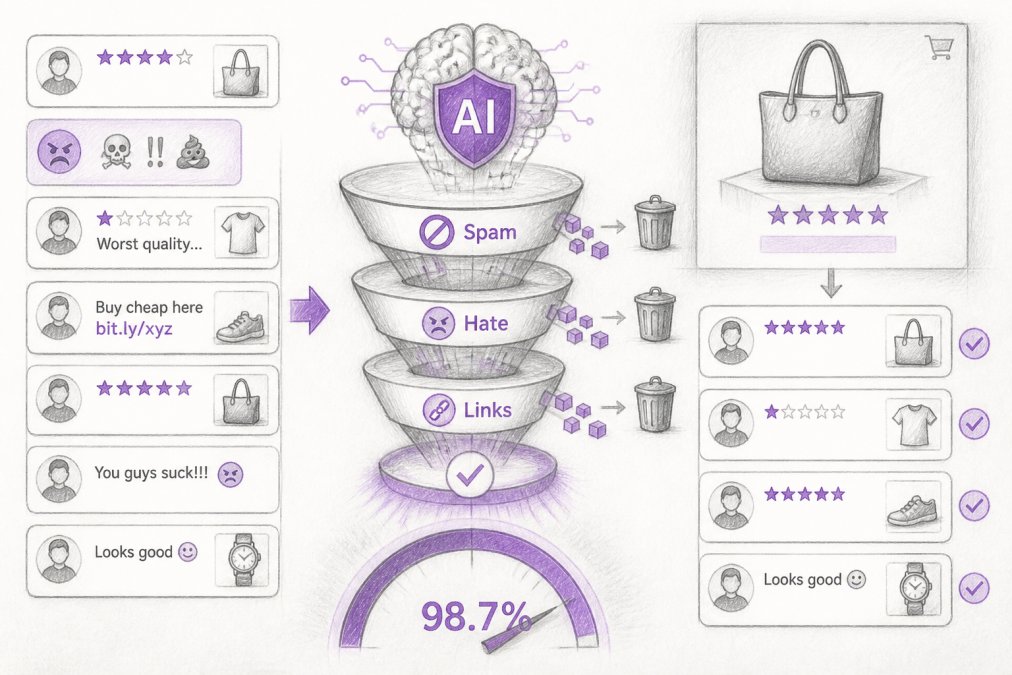
AI comment moderation is not a single filter but a multi-stage pipeline that processes each review through several distinct layers before a decision is made.
Stage 1: Pre-Processing and Normalization
Before classification, the raw text is cleaned and standardized: stripping HTML tags, decoding URL-encoded strings, and normalizing unicode characters. A key step is expanding shorthand and slang, terms like "gr8" or "smh", so downstream models interpret text accurately. This stage also extracts metadata, such as account age, purchase history, and IP address.
Stage 2: Multi-Layer Classification
The core runs several specialized models in parallel, each trained on a different type of risk:
- Spam Detection: This model identifies unsolicited promotional content, affiliate links, and repetitive text. It uses both content-based signals (e.g., presence of "check my bio") and behavioral signals (e.g., a new account posting the same comment on 50 different products).
- Toxicity and Hate Speech Detection: This model flags language that is abusive, discriminatory, or threatening. It is trained on a large corpus of labeled examples and is continuously updated to catch evolving slang and coded language.
- Sentiment and Intent Analysis: This model determines the emotional tone (positive, negative, neutral) and the underlying goal of the commenter (e.g., asking a question, reporting a bug, seeking a refund). This is distinct from simple keyword matching; it uses transformer-based models that understand context. For example, "This is sick!" is classified as positive in a product review context, not as a health concern.
- Policy-Specific Filters: These are custom rules you define. For example, you can create a rule that flags any comment containing competitor brand names or specific profanity lists. These filters are deterministic and provide a predictable baseline.
Each model outputs a confidence score. The system applies a decision matrix based on your configured thresholds: a 0.95 toxicity score is automatically hidden; a 0.60 toxicity score with a high intent-to-help score might be flagged for human review.
Stage 3: Action and Routing
Once classified, the system takes one of four actions:
- Approve: The comment is published immediately.
- Hide: The comment is removed from public view. It is not deleted, but stored for audit purposes.
- Flag for Human Review: The comment is placed in a moderation queue for a human team member to adjudicate.
- Auto-Respond: For approved comments that are questions or complaints, the system can trigger an automated response based on your configured templates.
The Role of Continuous Learning
A static model degrades quickly as new spam tactics, slang, and product-specific issues emerge. Effective systems use a feedback loop: when a human moderator overrides an AI decision, that action is fed back into the model as a training signal. A weekly review of a random sample of AI decisions, plus all human overrides, keeps the system sharp.
A Concrete Example: The "Broken Product" Comment
Consider the comment: "This blender stopped working after 3 uses. Total junk. I want my money back."
- Spam Detection: Low risk (no promotional links or repetitive text).
- Toxicity Detection: Low risk (no abusive language).
- Sentiment Analysis: Highly negative.
- Intent Recognition: High probability of a customer service complaint.
A rules-based system might simply hide this as negative feedback. A well-configured AI system, however, will recognize the intent and route it to your customer service workflow, triggering an automated response that acknowledges the issue and offers a replacement or refund.
Best Practices for Managing Negative Product Reviews with AI
The common instinct is to hide negative feedback, but that backfires. Customers trust reviews more when they see a mix of opinions, and how you respond to criticism often matters more than the criticism itself.
Your moderation policy should distinguish between harmful content and legitimate dissatisfaction. Spam, hate speech, and competitor links warrant immediate removal. Genuine negative experiences deserve a public response.
The workflow that works: let negative reviews post, respond quickly with a solution or request for more information, and offer an escalation path for complex issues.
AI-Powered Customer Response Templates That Preserve Your Brand Voice
Generic automated replies are easy to spot and quickly dismissed. AI-powered templates work because they adapt to context while maintaining consistent quality.
A strong template structure includes three elements: acknowledgment (showing you've read the specific complaint), action (stating what you'll do to resolve it), and invitation (moving the conversation to a private channel).
For a complaint about a damaged item, a template might read: "We're sorry your order arrived damaged. We've opened a replacement request and will email you a shipping label within the hour. If you'd prefer a refund instead, reply here and we'll process it immediately."
The key is training the system on your brand voice. FeedGuardians learns your tone, terminology, and guidelines, so automated responses sound like they came from your team.
Comparing Automated Review Moderation Tools: What to Look For
Not all moderation tools handle the demands of e-commerce equally. The automated review moderation tools you evaluate should meet several baseline criteria.
| Feature | Why It Matters | What to Check |
|---|---|---|
| Accuracy | Reduces false positives and missed spam | Claimed detection rate and testing methodology |
| API Integration | Connects with your commerce platform | Native integrations vs. custom setup |
| Multilingual Support | Filters reviews across markets | Number of languages and dialect handling |
| Escalation Workflows | Routes edge cases to humans | Configurable rules and notification options |
| Response Automation | Replies to customers automatically | Brand voice training and template control |
Accuracy, API Integration, and Multilingual Support
Accuracy is the foundation. A system that flags legitimate questions as spam damages engagement, while one that misses hate speech creates liability. FeedGuardians automatically detects and hides spam, hate speech, and competitor links with 98.7% accuracy.
API integration determines how quickly the tool fits your stack. Look for solutions that connect directly with your e-commerce platform and social channels.
Multilingual support is increasingly essential. If you sell across borders, your moderation tool must understand nuance in every language you operate in, not just translate keywords.
Legal, Compliance, and Data Privacy Considerations
Most guides to AI comment moderation ignore the legal minefield that automated deletion creates. This section addresses the regulatory and compliance risks, giving you a framework for a defensible moderation policy.
The FTC and the Problem of Review Suppression
Under the FTC Act, it is a deceptive practice to distort what consumers think by suppressing negative reviews. The FTC's 2022 Enforcement Policy Statement on Consumer Reviews is explicit: hiding all reviews below a certain star rating, or removing reviews based on negative sentiment alone, likely violates Section 5 of the FTC Act.
This does not mean you cannot moderate. You can remove reviews that contain:
- Obscene or violent content
- Discriminatory language
- Confidential information (e.g., order numbers, personal addresses)
- Clear spam or fake reviews
- Off-topic rants
Your policy must be content-based, not sentiment-based. If your AI hides any review with a negative sentiment score below a threshold, you are engaging in illegal review suppression. The system must distinguish between a legitimate complaint and a policy violation.
Document your moderation policy publicly. State clearly what types of content are removed. If the FTC ever investigates your practices, your documented, content-based policy is your first line of defense.
Section 230 and the Limits of Protection
The Section 230 of the Communications Decency Act provides a strong shield against liability for third-party content, but that shield is not absolute. The protection applies when you are acting as a "publisher" of third-party content. However, if you are found to have created or developed the content, you lose that immunity.
In the context of AI moderation, an automated system that generates responses or edits reviews substantively could be seen as creating new content. If your AI auto-summarizes reviews and publishes that summary, you are the creator of that summary and liable for its accuracy. The safest approach is to use AI for filtering and routing, not for rewriting or generating public-facing content.
Data Privacy: CCPA, CPRA, and Beyond
When your moderation tool processes customer comments, it is handling personal data. The California Consumer Privacy Act (CCPA) and its amendment, the California Privacy Rights Act (CPRA), give California residents specific rights over their data, including the right to know what is collected, the right to delete it, and the right to opt out of its sale or sharing.
Your moderation vendor is a "service provider" under the CCPA, so you must have a contract restricting the vendor from using data for any purpose other than providing the moderation service. You also need to ensure the vendor can respond to a consumer's deletion request.
A common pattern is a data retention policy that automatically deletes raw comment text after a set period (e.g., 30 days), keeping only the moderation decision and the reason code. This minimizes your data footprint and reduces the scope of a potential data breach.
Advertising Platform Policies
Beyond federal and state law, you are bound by the content policies of the platforms where your ads run. Meta, Google, and TikTok all prohibit certain types of content in user comments. If your product page accumulates hate speech or spam, you risk ad account suspension or product listing removal.
Automated moderation that catches violations before they accumulate protects you from platform-level penalties. But you must also ensure your moderation tool itself does not violate platform terms, some platforms restrict third-party tools that auto-post or auto-respond.
Building a Defensible Audit Trail
The most important compliance step is maintaining a complete audit log. For every comment processed, record:
- The original comment text
- The AI's classification scores for each risk category
- The action taken (approved, hidden, flagged)
- The rule or model version that made the decision
- The timestamp
- If a human was involved, their identity and the final decision
This audit trail serves two purposes: demonstrating to regulators that your moderation is content-based and consistent, and identifying biases in your AI. If your system disproportionately hides negative reviews from a specific demographic, you can investigate and retrain the model.
Building a Human-in-the-Loop Workflow for Edge Cases
AI handles the volume, but some comments require human judgment. A human-in-the-loop workflow routes ambiguous cases to your team.
The setup starts with defining escalation triggers, comments threatening legal action, complex product issues, or feedback indicating a safety problem.
FeedGuardians includes a human escalation option, essential for brands that want automation without surrendering control. When the AI encounters a comment it can't confidently classify, it routes it to your queue.
The workflow should also include periodic audits. Review a sample of AI decisions weekly to catch patterns the system might miss, then feed those insights back into the moderation policy.
Conclusion: Implement AI Comment Moderation for E-commerce Product Reviews Today
The volume of product reviews and comments will only grow, and manual processes will continue to fall further behind. AI comment moderation for e-commerce product reviews offers a path to consistent enforcement, faster response times, and better brand reputation protection.
The choice isn't between automation and human judgment; it's between building a system that combines both effectively or leaving your product pages exposed. FeedGuardians provides real-time moderation across Instagram, Facebook, TikTok, and YouTube, with AI-powered replies that save hours daily.
Start with a free trial and see how automated moderation handles your actual comment volume. Get started with FeedGuardians and turn your product reviews into a managed, conversion-driving asset.
Frequently Asked Questions
Can AI comment moderation for e-commerce product reviews distinguish between genuine negative feedback and spam?
Yes. Modern AI comment moderation for e-commerce product reviews uses sentiment analysis and intent recognition to separate authentic criticism from spam, competitor sabotage, or bot-generated content. Genuine negative feedback gets flagged for your team to address, while spam, scam links, and hate speech are hidden automatically. This distinction matters because deleting a real complaint damages trust, while letting spam through pollutes your review section and confuses buyers.
How does real-time AI moderation impact customer trust and conversion rates?
Real-time AI moderation builds customer trust by keeping review sections clean, relevant, and responsive. Shoppers who see prompt, thoughtful replies to both positive and negative feedback report higher confidence in a brand. Faster response times also reduce buyer hesitation at the decision point, which improves conversion rates. FeedGuardians client NiceToMeet saw 5.1x more membership inquiries after implementing automated moderation and replies.
What are the legal implications of using AI to moderate user-generated content on product pages?
Under Section 230 of the Communications Decency Act, platforms are generally not liable for user-generated content they moderate in good faith. However, the FTC requires that you do not delete negative reviews to inflate your rating artificially. AI moderation must enforce a consistent policy that removes only content violating your standards, such as spam, profanity, or harassment. Document your moderation rules to demonstrate compliance if your practices are questioned.
How do AI-powered customer response templates maintain a consistent brand voice?
AI-powered customer response templates learn from your past replies, product descriptions, and tone guidelines. The system analyzes your vocabulary, sentence structure, and emoji usage to generate on-brand responses. FeedGuardians trains on your specific terminology and quirky phrasing so replies sound like they came from your team, not a bot. You can also review and edit templates before they go live, then adjust the AI's learning parameters as needed.
Tired of manually moderating comments?
FeedGuardians automates spam filtering, responds to customers, and protects your brand — setup in 3 minutes.
Frequently Asked Questions
Can AI comment moderation for e-commerce product reviews distinguish between genuine negative feedback and spam?
Yes. Modern AI comment moderation for e-commerce product reviews uses sentiment analysis and intent recognition to separate authentic criticism from spam, competitor sabotage, or bot-generated content. Genuine negative feedback gets flagged for your team to address, while spam, scam links, and hate speech are hidden automatically. This distinction matters because deleting a real complaint damages trust, while letting spam through pollutes your review section and confuses buyers.
How does real-time AI moderation impact customer trust and conversion rates?
Real-time AI moderation builds customer trust by keeping review sections clean, relevant, and responsive. Shoppers who see prompt, thoughtful replies to both positive and negative feedback report higher confidence in a brand. Faster response times also reduce buyer hesitation at the decision point, which improves conversion rates. FeedGuardians client NiceToMeet saw 5.1x more membership inquiries after implementing automated moderation and replies.
What are the legal implications of using AI to moderate user-generated content on product pages?
Under Section 230 of the Communications Decency Act, platforms are generally not liable for user-generated content they moderate in good faith. However, the FTC requires that you do not delete negative reviews to inflate your rating artificially. AI moderation must enforce a consistent policy that removes only content violating your standards, such as spam, profanity, or harassment. Document your moderation rules to demonstrate compliance if your practices are questioned.
How do AI-powered customer response templates maintain a consistent brand voice?
AI-powered customer response templates learn from your past replies, product descriptions, and tone guidelines. The system analyzes your vocabulary, sentence structure, and emoji usage to generate on-brand responses. FeedGuardians trains on your specific terminology and quirky phrasing so replies sound like they came from your team, not a bot. You can also review and edit templates before they go live, then adjust the AI's learning parameters as needed.