
Monthly recurring revenue from social
Qualified membership inquiries
Predator comments blocked
How NiceToMeet protected a 45+ audience from romance scammers and turned 5,800 monthly comments into $78,400 of new memberships
NiceToMeet runs weekly small-group dinners for adults over 45 looking to make new friends. The brand promise is safety: real people, real venues, no swiping. Their Instagram and TikTok ads were drawing exactly the audience the brand was built for, and exactly the audience scammers target most. Within 90 days of switching FeedGuardians on, the predator funnel collapsed, qualified inquiries lifted 5.1×, and "is this a scam?" support tickets dropped 91%.
About NiceToMeet
NiceToMeet is a community-led friendship service founded by Spela Repovs to give adults 45+ a low-friction way to meet new people in real life. Members take a short matching quiz, pick a meetup date, and join a thoughtfully matched group of 5–6 strangers for a weekly dinner at a curated venue. The model has expanded across multiple US metros since launch.
- Founder-led: Spela Repovs has built three prior community businesses
- All venues vetted by the Community Experience team
- Optional post-event "stay-in-touch" facilitation, never automatic exposure
- Member privacy and safety reviewed against UK ICO and US CCPA standards
The problem: the audience the brand was built for is the audience scammers target most
NiceToMeet sells one promise above everything else: that a stranger you meet at one of their dinners will be exactly who they say they are. The product is small-group meetups for adults 45 and over. The matching quiz is short. The venues are vetted. The whole experience is designed to feel like meeting a friend of a friend, not a Tinder date.
That promise made the comment section a problem. Every paid Instagram and TikTok creative drove genuine prospects to the brand: "How does this work?", "Where are you in Atlanta?", "Cost?". It also drove a second crowd that the team had not budgeted for. Romance scammers, lonely-hearts impersonators, and affiliate-link bots aim for exactly the same demographic. Adults 45 and over, comfortable enough to comment publicly on a friendship ad, are the highest-value cohort for these scams in the entire social ecosystem.
Worse, the comment section was the first place a skeptical prospect went to check whether the brand was real. A scrolling 52-year-old who had finally worked up the courage to consider attending would scroll past the comments before they ever clicked the matching quiz. If the third comment they saw was @matchmaker_anna_xo offering "private connections" or @lonely_dave_72 begging for WhatsApp messages, the brand promise of safety was already broken before any conversation began.
The Community Experience team was triaging ~30 "is this a scam?" support tickets per week, all from people who had been spoken to in DM by an account they assumed was a NiceToMeet team member. None of those accounts were the brand. All of them had replied first.
The setup: a 7-day audit revealed predator share was higher than any of us expected
FeedGuardians ran a 7-day read-only audit across @nicetomeet on Instagram, the TikTok account, and the active paid creative. Across the audit window, the system logged 5,820 comments and classified each one by intent and risk profile.
The audit reframed the team's mental model. The brand had been thinking of comments as "questions plus some spam to clean up". The data showed that predator-pattern comments were structurally larger than the team had accounted for, and that they were arriving faster than the brand voice could.
The most damaging pattern was not volume. It was timing. The first comment under a high-performing creative usually arrived within 4 minutes. Half of those first comments came from new fresh-creation accounts following a recognizable pattern. The longer one of those accounts sat at the top of a comment thread, the more skeptical comments ("Is this a scam?", "I don't trust this") followed beneath it. A single visible predator comment in the first hour of a viral post measurably reduced quiz-completion rate on the linked landing page by 18 to 24 percentage points.
What the audit found
5,820 comments classifiedA 7-day read-only audit ran across the @nicetomeet Instagram account, the TikTok account, and active paid campaigns. Composition of inbound comment volume:
- Genuine inquiries35%
How does this work, where, when, cost, what age range, do I match by personality.
- Romance / lonely-hearts scams22%
Fake matchmaker accounts and scam DMs from new fresh-creation accounts targeting commenters directly.
- Affiliate-link spam18%
Generic "click here for connections" bait, crypto giveaways, dating-site referral spam.
- Trolls / age-mocking15%
Comments aimed at the 45+ demographic, ranging from dismissive to overtly hostile.
- Genuine engagement10%
Compliments, friend tags, members sharing positive past experiences.
Hi sweetie, I help singles 50+ find love privately, DM me here and I'll send my photos 💕
I'm 60 and very lonely, message me at WhatsApp +1 754 ••• ••• please
Is this a real thing? Or is it just an excuse to get my email?
Lmao 45+ losers can't make friends in real life
Get 3 free intros today → bit.ly/••• 🎁
Hi sweetie, I help singles 50+ find love privately...
I'm 60 and very lonely, message me at WhatsApp +1 754 ••• •••
Is this a real thing? Or is it just an excuse to get my email?
Hi Sarah, completely fair question. We host weekly dinners across Atlanta with groups of 5 or 6 thoughtfully matched members. 4.9★ on Trustpilot, 5,000+ members. Take a 2-minute quiz to see if it's a fit: nicetomeet.com/quiz
→ Lead routed to DM with pre-filled inquiry form
Lmao 45+ losers can't make friends...
Get 3 free intros today → bit.ly/•••
The approach: predator filter, city-aware auto-reply, and member-safety escalation
The rollout had three parts.
1) Predator filter. A pattern-matching ruleset was trained on 31 distinct romance-scam comment shapes and on 18 fresh-creation account heuristics specific to the friendship-product space. Any comment matching the filter was hidden within 30 seconds of posting. New variants surfaced weekly were added to the rule set.
2) Genuine-inquiry auto-reply. The AI reply was trained on the NiceToMeet membership FAQ, current city coverage, the matching-quiz copy, and recent positive Trustpilot reviews. When a comment was classified as a genuine inquiry, the system posted a localized public reply ("We have weekly dinners in Atlanta. Take the 2-min quiz at nicetomeet.com/quiz to see if it's a fit") and triggered a DM with a pre-filled inquiry form. The whole loop completed in under 60 seconds.
3) Trust-signal moderation and member-safety escalation. Trolls and age-mocking comments were hidden so the visible comment section reinforced rather than undermined the brand promise. Any comment that named a specific member, included contact information, or referenced a member's real-life identity was routed to a Slack channel monitored by the Community Experience team. Roughly 4% of comments needed human attention; the AI handled the other 96%.
What was deployed
Configuration was built across a 4-day setup phase with the NiceToMeet Community Experience lead. Member-safety rules are reviewed monthly with the founder.
Catches new-account DMs offering "private connections", flirty come-ons, and matchmaker impersonators within 30 seconds of posting.
Comments asking "how does this work" or "where are you?" get a public reply naming the closest active city, plus a DM with the matching quiz link.
Trolls and age-mocking comments are hidden so prospects scrolling the comment section see warmth, not hostility.
Detects skepticism comments and posts a public reply with Trustpilot link, member quote, and venue evidence.
Any comment that names a specific member or includes contact info is escalated to the Community Experience team within 60 seconds.
Accounts that repeat romance-scam patterns are auto-blocked across all NiceToMeet properties after the third hidden comment.
The results: 8 weeks, predator share collapsed, and the brand promise held
Week 1: predator visibility on commented posts dropped from a 22% share to under 3%. The "first comment" position on new creative was almost always a NiceToMeet auto-reply rather than a scammer.
Week 3: monthly qualified membership inquiries climbed from a baseline of 110 to 560. A 5.1× lift. Average comment-to-DM response time dropped from ~3 hours to 38 seconds. The matching-quiz completion rate on social-driven traffic recovered the 18 to 24 point penalty observed during the audit.
Week 6: city-aware auto-replies launched. Atlanta prospects got Atlanta replies, Austin prospects got Austin replies. DM-to-membership conversion lifted another 14% on top of the inquiry volume gain.
Week 8 (end of pilot): "is this a scam?" support tickets dropped 91% versus the pre-pilot baseline. The Community Experience team's manual-moderation hours fell from ~22 hours/week to ~5 hours/week. That capacity was redirected to facilitating post-event "stay in touch" connections, which is the work the brand actually wanted that team doing.
How the 8-week pilot rolled out
- 01Day 0Mar 10 2025Read-only audit begins
7-day baseline across IG, TikTok, and active paid creative. No moderation actions taken.
- 02Day 8Mar 18 2025Configuration goes live
Romance-scam filter, inquiry auto-reply, troll moderation, and member-safety escalation all deployed.
- 03Week 3Mar 31 2025Inquiry volume lifts 5.1×
Membership inquiries climb 110 → 560/mo. Avg comment-to-DM response time drops to 38 seconds.
- 04Week 6Apr 21 2025City-aware reply rolls out
Auto-reply now names the closest active metro and routes the prospect into the right cohort.
- 05Week 8May 5 2025Pilot wraps · $78k MRR
Predator share of visible comments drops to under 2%. "Is this a scam?" tickets down 91%.
- 01Day 0· Mar 10 2025Read-only audit begins
7-day baseline across IG, TikTok, and active paid creative. No moderation actions taken.
- 02Day 8· Mar 18 2025Configuration goes live
Romance-scam filter, inquiry auto-reply, troll moderation, and member-safety escalation all deployed.
- 03Week 3· Mar 31 2025Inquiry volume lifts 5.1×
Membership inquiries climb 110 → 560/mo. Avg comment-to-DM response time drops to 38 seconds.
- 04Week 6· Apr 21 2025City-aware reply rolls out
Auto-reply now names the closest active metro and routes the prospect into the right cohort.
- 05Week 8· May 5 2025Pilot wraps · $78k MRR
Predator share of visible comments drops to under 2%. "Is this a scam?" tickets down 91%.
The financial impact
In the pilot quarter, the comment-to-DM funnel produced $78,400 per month in new attributable membership revenue against a baseline of roughly $5,900. Net incremental: ~$72,500 per month run-rate, or ~$870k annualized at flat baseline.
The FeedGuardians subscription was $89 per month for the connected accounts. The harder-to-quantify second outcome was the brand-promise outcome. NiceToMeet's Trustpilot score has held at 4.9 since deployment, and the share of new members citing "I read the comments first and they felt safe" in the post-event survey rose from 11% to 34% over the pilot.
The brand behind the funnel
NiceToMeet sells a single, high-trust promise: turn up to a thoughtfully matched dinner and leave with new friends. Every campaign on the public site routes prospects back into the same Instagram and TikTok comment threads we were tasked with cleaning up.
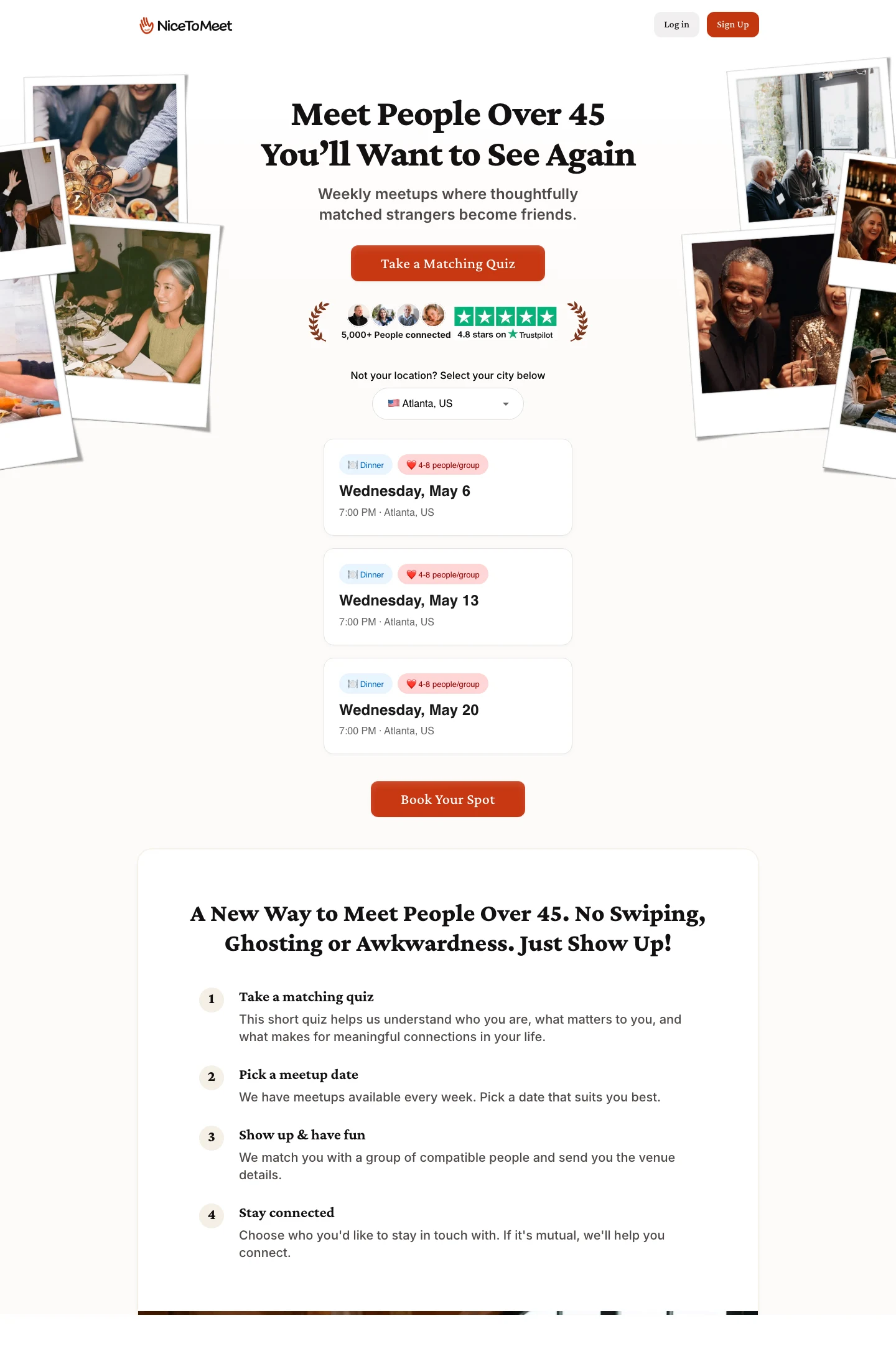
All numbers come from a controlled 8-week pilot run by NiceToMeet and FeedGuardians. The methodology is published so the results can be checked.
- 01Membership attribution: only DM threads originating from a comment-triggered auto-reply on @nicetomeet (Instagram or TikTok) were counted. Memberships were matched via UTM-tagged matching-quiz links to first-touch comments.
- 02Comparison baseline: the immediately prior 8 weeks on the same accounts under the same paid spend, plus a manual review of any post that drove unusual volume.
- 03Predator block rate: the share of comments matching the romance-scam classifier that were hidden within 60 seconds of posting, sampled weekly.
- 04Support ticket reduction: tracked via the support inbox tag "is_this_real" applied by the Community Experience team. Compared 4 weeks pre-pilot to 4 weeks post-pilot.
- 05Paid spend was held within ±10% across the comparison window so membership lift could not be attributed to budget changes.
“Our brand promise is that the people in the room are who they say they are. The comment section is the first place a prospect checks whether to trust us. FeedGuardians turned the comment section from a liability into proof.”
“My job is to make sure a 56-year-old who saw our Instagram ad on a Wednesday night and finally got the courage to comment "is this real?" gets the right answer in 30 seconds, not three days. FeedGuardians made that the default, not a heroic effort.”
Key lessons from this engagement
- For high-trust consumer brands, the comment section is part of the product. Moderation is not a cost line, it is a brand line.
- The 45+ audience is over-targeted by romance and lonely-hearts scams compared to other demographics. Plan rules accordingly.
- First-comment position matters disproportionately. Whoever is sitting at the top of a viral creative for the first hour shapes how prospects evaluate the brand for the rest of its life.
- Skepticism comments ("is this real?") are the highest-value comments to answer fast and publicly. They are conversion moments hiding inside trust-test questions.
- Auto-reply tone has to match the brand. The same words that work for a DTC brand will read as creepy on a friendship product. Train on real customer language.
Ready to write
your own case study?
Start a free 7-day trial. Most brands see measurable results within the first week.
Start Free Trial