
Quick Summary
| Key Insight | What You Need to Know |
|---|---|
| Why Your AI Moderation | Why Your AI Moderation Policy Needs a 2026 Refresh |
| 1. Start With a | 1. Start With a Social Media Moderation Policy TemplateThe 7 Sections Every Template Needs |
| The 7 Sections Every | The 7 Sections Every Template Needs |
| 2. Map the Legal | 2. Map the Legal and Compliance Standards That Apply to You |
| 3. Choose AI Content | 3. Choose AI Content Moderation Tools That Fit Your StackWhat to Look For Before You Buy |
| What to Look For | What to Look For Before You Buy |
Table of Contents
- Why Your AI Moderation Policy Needs a 2026 Refresh
- 1. Start With a Social Media Moderation Policy Template
- 2. Map the Legal and Compliance Standards That Apply to You
- 3. Choose AI Content Moderation Tools That Fit Your Stack
- 4. Build Human-in-the-Loop Moderation Strategies That Scale
- 5. Set Up Bias Detection, Audit Trails, and Policy Versioning
- 6. Train Your Team and Communicate the Policy Internally
- Common Mistakes That Weaken an AI Moderation Policy
- Frequently Asked Questions
Last Updated: September 12, 2026
Why Your AI Moderation Policy Needs a 2026 Refresh
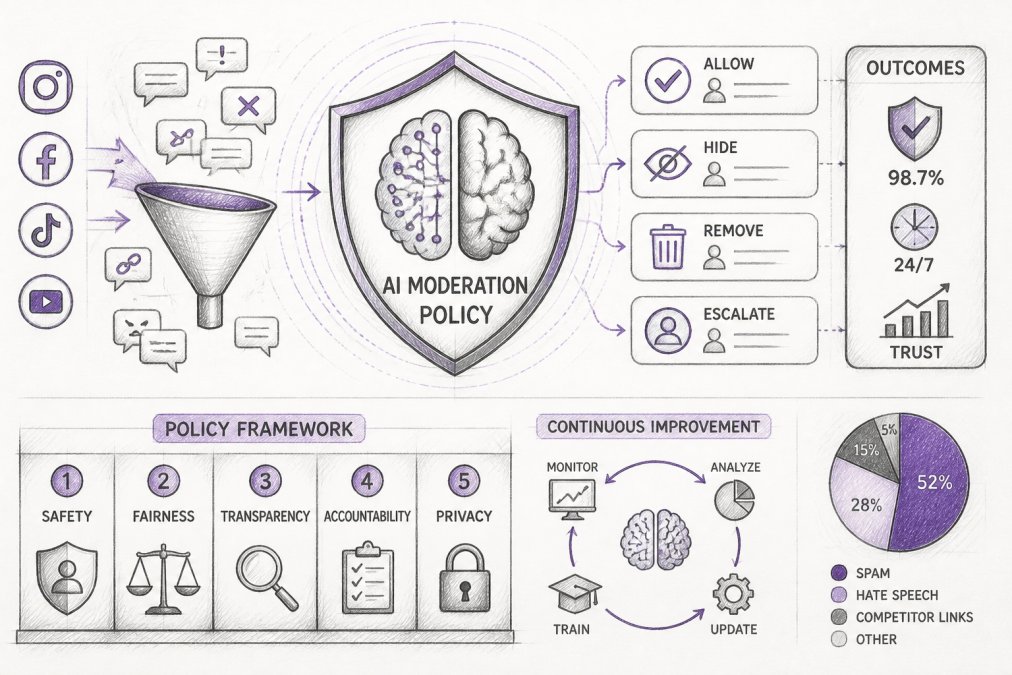
An AI moderation policy is the documented set of rules, thresholds, escalation paths, and review procedures that govern how automated systems screen, hide, flag, or respond to user-generated content on your channels. It is not a settings page inside a tool. It is the written standard your team, your vendors, and your legal counsel all work from.
That distinction matters more in 2026 than it did two years ago. Platforms have tightened their enforcement expectations, state privacy laws have multiplied, and AI systems now generate and screen content at a volume no manual team can match. FeedGuardians works with e-commerce brands and agencies managing high comment volumes across Instagram, Facebook, TikTok, and YouTube, and the pattern we see is consistent: teams that treat moderation as a toggle rather than a policy spend their weeks firefighting.
Below, we break down the best practices for AI moderation policy into seven concrete steps, from template structure to bias auditing, plus the mistakes that quietly weaken otherwise solid policies.
1. Start With a Social Media Moderation Policy Template
A social media moderation policy template gives you a fixed structure so nothing gets forgotten under deadline pressure. Start from a template, then customize every section to your brand, your platforms, and your legal exposure.
The 7 Sections Every Template Needs
- Scope and platforms covered - which accounts, which channels, which content types
- Prohibited content categories - spam, scams, hate speech, harassment, competitor links, off-topic promotion
- Automated screening rules - what AI hides instantly versus what it flags for review
- Human escalation criteria - the exact triggers that route a comment to a person
- Response guidelines - tone, approved language, and when to reply publicly versus privately
- Data handling and retention - what comment data you store, for how long, and who can access it
- Review cadence - who audits the policy, how often, and what triggers an out-of-cycle revision
2. Map the Legal and Compliance Standards That Apply to You
Compliance standards for moderation come from three directions: platform terms of service, privacy law, and advertising regulation. Each imposes different obligations, and your policy needs to name which ones apply to your business.
Platform terms set the floor. If your AI moderation setup hides or deletes content in ways the platform prohibits, you risk account restrictions regardless of how good your internal policy is.
Privacy law governs the data. Comments contain personal information, and automated screening means you are processing it. The FTC guidance on commercial data practices is a reasonable starting reference for how consumer data handling is evaluated, and state-level privacy statutes add their own notice and deletion requirements. Your policy should state what comment data the AI processes, where it is stored, and how a user requests removal.
Advertising regulation covers claims. If your AI replies to comments with product claims, those replies are advertising. The FTC advertising and endorsement guides apply to automated responses the same way they apply to a human posting from your account.
Document which frameworks apply and review that list annually. Regulations change, and a policy that was accurate in 2024 may be incomplete now.
3. Choose AI Content Moderation Tools That Fit Your Stack
AI content moderation tools fall into two groups: general-purpose detection APIs that you wire into your own workflow, and purpose-built comment moderation platforms that handle detection, response, and escalation in one place. The right choice depends on whether you have engineering resources and whether you need replies as well as filtering.
| Tool | Starting Price | Key Strength | Best For |
|---|---|---|---|
| FeedGuardians | Free plan available | Comment moderation plus brand-voice replies | E-commerce brands and agencies on social platforms |
| Hive | Contact for pricing | Visual and text classification at scale | Large platforms with high volume |
| Azure AI Content Safety | Pay-as-you-go | Multi-category detection, severity levels | Teams already on Azure |
| Amazon Rekognition | Pay-as-you-go | Image and video analysis | AWS-based media workflows |
| OpenAI Moderation API | Free | Fast text categorization | Developers filtering text only |
| Sightengine | $10/month | All-in-one visual and text moderation | Startups needing a review dashboard |
What to Look For Before You Buy
- Platform coverage. Confirm the tool works natively on the channels you actually run, not just the ones in the demo.
- Escalation controls. You need a configurable path from automated action to human review, not a binary hide-or-allow switch.
- Response capability. If your team also answers comments, a tool that only filters leaves half the workload untouched.
- Audit output. Ask what the tool logs and whether you can export it for compliance review.
- Accuracy claims you can test. Run a pilot on historical comments before committing.
For most e-commerce brands and agencies, FeedGuardians is the strongest fit because it handles both sides of the job: it detects and hides spam, scams, hate speech, and competitor links with 98.7% accuracy, and it delivers 24/7 replies in your brand voice. The human escalation option means borderline cases still reach a person rather than disappearing silently.
4. Build Human-in-the-Loop Moderation Strategies That Scale
Human-in-the-loop moderation strategies assign AI the high-volume, low-ambiguity work and reserve human judgment for the cases where context decides the outcome. This is the difference between a policy that scales and one that either drowns your team or hides too much.
A workable escalation path looks like this:
- AI screens every incoming comment in real time
- Clear violations are hidden automatically
- Borderline cases are flagged and queued
- A human reviewer approves, overrides, or restores
- Overrides feed back into the model as training signal
The fifth step is the one most teams skip. Without a feedback loop, your AI never learns your specific edge cases, and your reviewers keep making the same corrections forever.
5. Set Up Bias Detection, Audit Trails, and Policy Versioning
Bias mitigation and audit trails are the two areas competitors cover least, and they are where most policies quietly fail. An AI moderation policy without a bias check and a version history is not auditable, and an unauditable policy is hard to defend when a customer or regulator asks why their comment was removed.
Bias detection means testing your moderation rules against content from different groups, dialects, and writing styles to see whether the AI flags some communities more than others. Automated screening models learn from historical data, and historical data carries historical skew. Run a periodic sample: pull flagged comments from the past month and check whether any group is overrepresented.
Audit trails mean every automated action is logged with a timestamp, the rule that triggered it, and the outcome. Model output validation depends on this record. Without it, you cannot tell whether the AI is working as designed or drifting.
Policy versioning means treating the policy document like code. Every change gets a version number, a date, and a note on what changed and why. When a regulator or a client asks what your rules were in March, you can answer precisely.
| Practice | Frequency | Owner |
|---|---|---|
| Bias sample review | Monthly | Moderation lead |
| Audit log export | Monthly | Compliance or legal |
| Policy version update | Quarterly, or on any rule change | Policy owner |
| Full policy review | Annually | Cross-functional team |
6. Train Your Team and Communicate the Policy Internally
Employee guidelines for AI interaction only work if people have read them. A policy that lives in a shared drive and gets opened once during onboarding is not a policy, it is a document.
Training should cover three things: what the AI does automatically, what triggers a human review, and what a team member should do when they disagree with an automated decision. That third item is where most training falls short. Give people a named path for overrides and a person to escalate to.
Stakeholder communication matters too. Social managers, customer support, legal, and whoever owns paid media all interact with comment sections. Each group needs to know which parts of the policy affect their work. A short written summary per team beats a single all-hands walkthrough.
Common Mistakes That Weaken an AI Moderation Policy
The biggest mistake is treating moderation as a tool setting instead of a governed process. Tools change, platforms change, and staff change. A written policy with a version history survives all three.
Other patterns that weaken policies:
- No restore path. Automated hiding without a review queue means legitimate comments vanish with no recourse.
- Skipping the bias check. Unchecked models drift toward over-flagging some communities, which becomes a reputational risk.
- One policy for every platform. Instagram comments, TikTok replies, and YouTube threads carry different norms and different abuse patterns.
- No audit trail. If you cannot show what the AI did and when, you cannot answer a compliance question.
- Setting it and forgetting it. A policy written for last year's platform rules and last year's privacy law is already out of date.
The NIST AI Risk Management Framework is a useful reference for structuring risk assessment and ongoing monitoring around automated systems, and it maps cleanly onto a moderation policy.
Moderation volume does not go down, and platform rules do not get simpler. The teams that stay ahead are the ones with a written policy, a clear escalation path, and a tool that handles the repetitive work so people can handle the judgment calls. FeedGuardians was built for exactly that split: real-time detection that hides spam, scams, hate speech, and competitor links with 98.7% accuracy, 24/7 replies in your brand voice, a human escalation option for borderline cases, and audit-friendly logging that supports your policy reviews. Start for free and see how much of your comment workload the AI absorbs in the first week.
Frequently Asked Questions
What is AI moderation and how does it work for social media comments?
AI moderation uses machine learning models to scan comments for spam, hate speech, scams, and competitor links, then automatically hides or flags them. FeedGuardians applies this across Instagram, Facebook, TikTok, and YouTube with 98.7% accuracy, and it also sends 24/7 replies in your brand voice. The best setups pair automated screening with a human escalation option, so your team only reviews edge cases instead of every comment.
What should be included in an AI moderation policy?
A complete AI moderation policy covers seven areas: the scope of platforms and content types, definitions of prohibited content, escalation and appeals procedures, data confidentiality and retention rules, human-in-the-loop review thresholds, audit trail and reporting requirements, and a versioning schedule. Add an owner for each section and a review date. Pair the written policy with a social media moderation policy template so new team members can follow the same steps from day one.
How do you balance AI automation with human oversight?
Set clear thresholds. Let the AI auto-hide obvious violations like spam and hate speech, then route borderline cases to a human reviewer. Track how often reviewers override the AI; a rising override rate signals the model needs retraining. FeedGuardians includes a human escalation option so your team stays in control of sensitive threads while automation handles the volume. Review override data monthly and adjust thresholds as your community grows.
What are the legal considerations for AI content moderation?
Key issues include data confidentiality, intellectual property, and compliance standards like FTC advertising rules. Document your moderation criteria, keep audit trails of every automated action, and disclose automated moderation in your community guidelines. If you operate in regulated industries, your policy may also need to address reputational risk and legal liability. Consult counsel when your policy touches user data or paid promotion rules.
Tired of manually moderating comments?
FeedGuardians automates spam filtering, responds to customers, and protects your brand — setup in 3 minutes.
Frequently Asked Questions
What is AI moderation and how does it work for social media comments?
AI moderation uses machine learning models to scan comments for spam, hate speech, scams, and competitor links, then automatically hides or flags them. FeedGuardians applies this across Instagram, Facebook, TikTok, and YouTube with 98.7% accuracy, and it also sends 24/7 replies in your brand voice. The best setups pair automated screening with a human escalation option, so your team only reviews edge cases instead of every comment.
What should be included in an AI moderation policy?
A complete AI moderation policy covers seven areas: the scope of platforms and content types, definitions of prohibited content, escalation and appeals procedures, data confidentiality and retention rules, human-in-the-loop review thresholds, audit trail and reporting requirements, and a versioning schedule. Add an owner for each section and a review date. Pair the written policy with a social media moderation policy template so new team members can follow the same steps from day one.
How do you balance AI automation with human oversight?
Set clear thresholds. Let the AI auto-hide obvious violations like spam and hate speech, then route borderline cases to a human reviewer. Track how often reviewers override the AI; a rising override rate signals the model needs retraining. FeedGuardians includes a human escalation option so your team stays in control of sensitive threads while automation handles the volume. Review override data monthly and adjust thresholds as your community grows.
What are the legal considerations for AI content moderation?
Key issues include data confidentiality, intellectual property, and compliance standards like FTC advertising rules. Document your moderation criteria, keep audit trails of every automated action, and disclose automated moderation in your community guidelines. If you operate in regulated industries, your policy may also need to address reputational risk and legal liability. Consult counsel when your policy touches user data or paid promotion rules.