
Quick Summary
| Key Insight | What You Need to Know |
|---|---|
| Unmoderated comments can tank | Unmoderated comments can tank ad performance and reduce click-through rates significantly. |
| Effective brand safety requires three elements | automated detection, brand-voice responses, and clear moderation guidelines. |
| Common unsafe content includes | Common unsafe content includes spam, hate speech, misinformation, adult content, competitor links, and illegal activity references. |
| Brand safety differs from brand suitability | safety removes harmful content, while suitability matches ads to appropriate environments. |
| Moderation workflows require a | Moderation workflows require a documented policy, layered detection combining automation and human review, and weekly measurement of false positives and false negatives. |
| What Is Brand Safety | What Is Brand Safety in User-Generated Content? |
Last Updated: October 23, 2026
Quick Summary
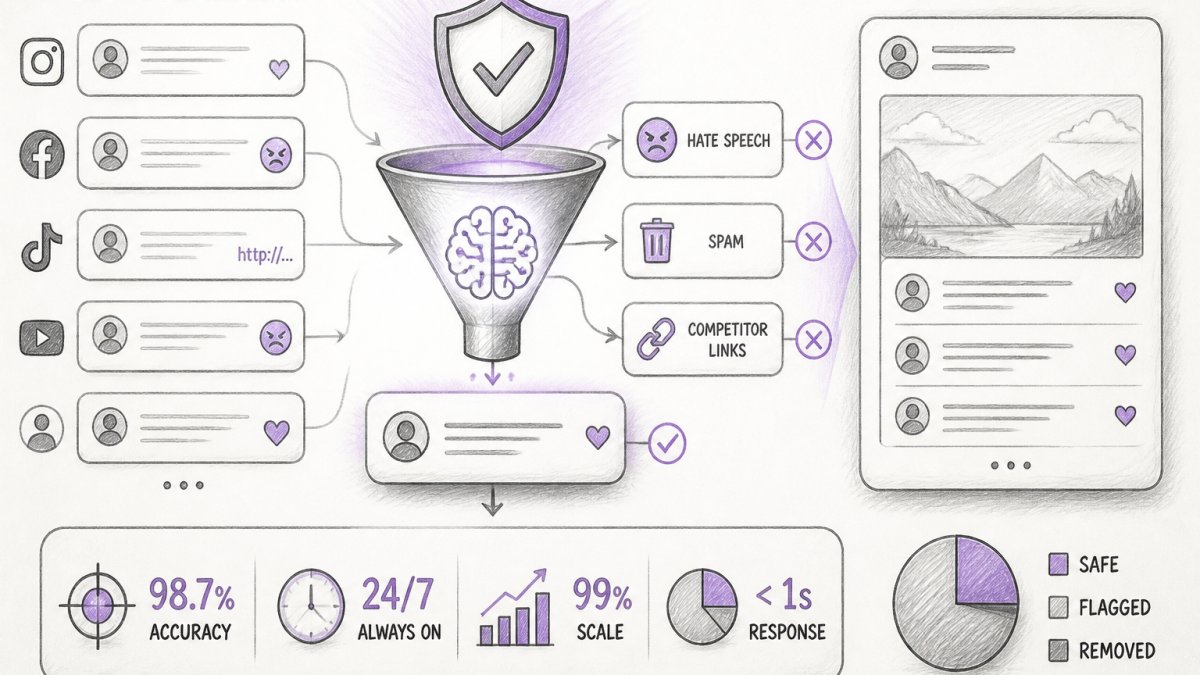
Brand safety user-generated content is the practice of protecting your brand's reputation by controlling which comments, posts, and customer messages appear on your social media accounts. It means stopping spam, hate speech, competitor links, and other harmful content before they damage your brand image or ad performance.
- Unmoderated comments can tank ad performance and reduce click-through rates significantly.
- Effective brand safety requires three elements: automated detection, brand-voice responses, and clear moderation guidelines.
- Common unsafe content includes spam, hate speech, misinformation, adult content, competitor links, and illegal activity references.
- Brand safety differs from brand suitability: safety removes harmful content, while suitability matches ads to appropriate environments.
- Moderation workflows require a documented policy, layered detection combining automation and human review, and weekly measurement of false positives and false negatives.
Table of Contents
- What Is Brand Safety in User-Generated Content?
- Why Brand Safety Matters for Your Advertising
- Common Unsafe Content Categories in UGC
- Brand Safety Versus Brand Suitability: Key Differences
- User-Generated Content Moderation: A Practical Workflow
- Establishing Brand Safety Guidelines for Social Media
- Brand Safety Tools and Detection Methods
- Emerging Risks: AI-Generated and Synthetic UGC
- Frequently Asked Questions
What Is Brand Safety in User-Generated Content?
Brand safety user-generated content is the practice of protecting your brand's reputation by controlling which comments, posts, and customer messages appear on your social media accounts.
User-generated content (UGC), comments, reviews, and messages from your audience, can be a goldmine for engagement and conversions. But it also creates risk. A single hateful comment or spam post can sit on your page for hours, turning away customers and hurting your advertising campaigns.
Unmoderated comments can tank ad performance, a single toxic thread can cut click-through rates. That's why brand safety is non-negotiable for e-commerce brands, agencies, and creators managing high-volume accounts.
Effective brand safety user-generated content means three things working together: detecting harmful content automatically, responding to legitimate comments in your brand voice, and maintaining clear guidelines so your team knows what stays and what goes. It's not censorship, it's keeping spam, hate, and scams from hijacking your feed.
Why Brand Safety Matters for Your Advertising
Your social media feed is part of your advertising real estate. Every comment visible on your posts influences how people perceive your brand and whether they buy from you.
The stakes are higher than reputation alone. studies on social media trust and purchasing show that brand safety directly impacts conversion rates. Customers are more likely to complete a purchase when they see clean, professional comment sections.
Brand safety also protects ad spend.
Protect Brand Reputation on Social: 7 Essential Strategies covers broader reputation strategies, but the tactical foundation is controlling what appears on your page in real time.
Common Unsafe Content Categories in UGC
Not all unwanted comments are the same. Different types of harmful content require different detection approaches.
Spam and scams are the most common: comments promoting fake products, phishing links, or competitor services.
Hate speech and offensive language damage your brand directly.
Competitor links and promotional spam redirect traffic away from your page, stealing engagement and confusing your audience about who they follow.
Illegal activity references, drug sales, counterfeit goods, stolen merchandise, create legal liability.
Brand safety requires understanding the main types of harmful content that appear in user-generated comments and how they damage your brand.
| Content Type | Primary Risk | Example |
|---|---|---|
| Spam and scams | Clutter feed, redirect traffic | Fake product links, phishing URLs |
| Hate speech and offensive language | Damage brand reputation directly | Slurs, discriminatory comments |
| Misinformation | Spreads fast, hard to correct | False health or scam claims |
| Adult content and graphic imagery | Harms family-brand status | Graphic links or embedded media |
| Competitor links and promotion | Steal engagement and traffic | Redirects to competitor pages |
| Illegal activity references | Create legal liability | Drug sales, counterfeit goods offers |
Brand Safety Versus Brand Suitability: Key Differences
Brand safety is about preventing harmful content, hate speech, spam, illegal content, from appearing on your page. It's binary: content either is or isn't safe for your brand.
Brand suitability is about matching your ads to the right content environment, whether your luxury watch ad appears next to a post about budget shopping, or your family product ad runs alongside political debate.
Here's the practical difference: brand safety removes a comment that says "I hate this product and this company." Brand suitability decides whether your ad runs next to political content or sports content based on your target audience.
User-Generated Content Moderation: A Practical Workflow
A moderation workflow for user-generated content (UGC) is not a single tool setting.
Step 1: Write a UGC-specific moderation policy. Translate brand values into testable rules. Avoid vague language like "no hate speech"; instead specify: "We remove comments containing slurs, threats, dehumanizing language, or calls for violence." Separate rules into three tiers:
- Prohibited (remove on sight): illegal content, credible threats, child sexual abuse material, graphic violence, doxxing, spam and phishing links, counterfeit or stolen goods offers.
- Restricted (review required): harassment, misinformation about products or health, competitor promotion, political debate, profanity, adult content links.
- Allowed (engage or leave): genuine questions, complaints, positive feedback, neutral mentions, good-faith criticism.
Document the policy in a shared, versioned file: a one-page policy for reviewers and a longer internal playbook with examples.
Step 2: Classify content by channel. UGC risk differs by platform:
- Social networks (Facebook, Instagram, X, TikTok): high comment volume, fast spread, strong visual risk from image and video replies. Prioritize automated pre-filtering and keyword/domain blocklists.
- Forums and community boards (Reddit, Discord, niche forums): threaded context matters; sarcasm and in-jokes create false positives. Route ambiguous threads to human review.
- Video platforms (YouTube): risk sits in comments, titles, thumbnails, and creator collaborations. Scan comments and monitor creator channels you sponsor.
- Livestreams: real-time chat cannot wait for batch review. Use live chat filters, slow mode, moderator roles, and a kill switch to pause chat or the stream.
- Reviews and marketplaces: fake reviews, review bombing, and competitor attacks require pattern detection (timing clusters, duplicate phrasing) rather than single-comment review.
- Creator and influencer content: contractually require brand-safety clauses, pre-approval for sensitive topics, and takedown rights.
Step 4: Define escalation criteria and review SLAs. Not every flagged comment needs the same response. Create a routing table:
- Tier 1 (auto-remove, log): clear spam, known scam links, slurs. No human needed unless appealed.
- Tier 2 (human review within 1 business hour): harassment, misinformation, competitor promotion, graphic media links.
- Tier 3 (escalate to legal/comms within 30 minutes): threats of violence, doxxing, illegal goods, regulatory issues, potential PR incidents.
Set service-level agreements (SLAs) by channel. Livestream chat needs seconds; review sites can tolerate hours.
Step 5: Build response and appeal paths. Respond to legitimate comments in brand voice using approved templates for common questions (returns, shipping, pricing, availability).
Step 6: Measure and improve weekly. Review a sample of removals and allowed content each week.
Step 7: Prepare an incident response playbook. For a serious unsafe-content event, have a pre-written plan: pause affected campaigns, preserve screenshots and logs, notify stakeholders, remove or hide content, publish a response if warranted, and document the timeline. Afterward, review what failed and update filters and SLAs.
10 Best Comment Moderation Tools in 2026 reviews tools that support this workflow, including filtering, escalation, and reporting features.
Establishing Brand Safety Guidelines for Social Media
Your brand safety guidelines are the rulebook for what your team approves or removes. Without clear guidelines, moderation becomes inconsistent and slow.
Start with your brand values, what you stand for and what kind of community you want to build.
Include context rules: some brands allow political debate or neutral competitor comparisons; others remove them. These are brand choices, not universal rules.
Comments to Conversions: AI Brand Voice vs. Time Savings walks through how to balance automated responses with human judgment while maintaining your brand voice.
Brand Safety Tools and Detection Methods
Brand safety tools for UGC fall into a few categories, each with trade-offs.
Machine learning classifiers. These learn from labeled examples and catch novel spam, harassment, and toxic language that keyword lists miss.
Image and video detection. Visual UGC, memes, screenshots, video replies, carries risks text filters miss: graphic violence, adult content, and manipulated media.
Link and domain reputation. Competitor links, phishing URLs, and malware domains are best caught with domain reputation lists and redirect-chain analysis.
Human review. Automation cannot reliably judge sarcasm, cultural context, satire, or good-faith criticism. Human reviewers handle edge cases, appeals, and high-risk escalations.
False positives, false negatives, and appeals
Overblocking (false positives) suppresses legitimate speech, reduces engagement, and risks PR complaints; underblocking (false negatives) exposes your brand to harmful content and ad-performance damage. Tune thresholds to your risk tolerance: family brands may accept more false positives; community-driven brands may accept more review load. Always provide an appeal path and track outcomes to recalibrate filters.
Measurement and operational KPIs
Define metrics so you can prove the system works:
- Unsafe-impression rate: share of impressions on your content that include flagged unsafe comments before removal.
- Incident response time: median time from detection to removal or escalation, by tier.
- Review coverage: percentage of flagged items reviewed by a human within SLA.
- False-positive rate: share of removed items successfully appealed or overturned on review.
- False-negative rate: share of harmful items found in post-hoc sampling that automation missed.
- Brand-suitability compliance: share of ad placements that meet your contextual guidelines.
Review these weekly and report monthly to stakeholders.
Emerging formats and AI-generated media
AI-generated comments, deepfakes, and synthetic creator content are harder to detect than traditional spam, they mimic real language and can include manipulated media. Defenses: monitor for engagement anomalies (timing clusters, duplicate phrasing), require disclosure for sponsored creator content, use provenance and detection tools where available, and train reviewers to spot inconsistencies. No single tool solves this; combine detection, contractual requirements, and human judgment.
11 Best AI Comment Moderation Tools in 2026 (Compared) breaks down how tools combine these methods and what to ask vendors about accuracy and appeals.
Emerging Risks: AI-Generated and Synthetic UGC
AI-generated comments and synthetic UGC are written by AI, not real people, and designed to look authentic while serving a hidden agenda, promoting a competitor, spreading misinformation, or manipulating your brand.
Why it matters: fake engagement skews your metrics, fake negative comments can damage your reputation if they look authentic, and fake competitor promotion can redirect real customers.
Detection is evolving: tools now flag patterns suggesting AI generation, unusual phrasing, timing clusters, linguistic markers that differ from your real audience, but false positives are common.
AI Moderation for User Generated Content Platforms covers this emerging risk in depth, including how platforms are adapting their moderation strategies.
Frequently Asked Questions
What is brand safety in user-generated content?
Brand safety in UGC refers to protecting your brand reputation and ad performance by controlling which user comments and posts appear alongside your content and ads. It involves filtering harmful content like hate speech, misinformation, and inappropriate material while ensuring your brand appears in safe advertising environments. This protects both consumer trust and your ad spend from being wasted on placements that damage your brand image.
How does brand safety differ from brand suitability?
Brand safety focuses on preventing harmful, illegal, or dangerous content from associating with your brand. Brand suitability goes further, it's about matching your ads to content environments that align with your brand values and target audience. For example, an ad might be safe (not next to hate speech) but unsuitable (appearing in a competitor's post). Both matter for protecting reputation and optimizing ad performance.
What types of user-generated content can harm a brand?
Harmful UGC includes hate speech, violent content, illegal activity promotion, adult material, misinformation, conspiracy theories, competitor promotion, and spam. Comments containing slurs, threats, or false health claims damage trust instantly. Even seemingly minor issues, like spam links or competitor tags, dilute your brand message and waste ad budget. Platform policies and your industry standards determine which content crosses the line for your specific brand.
How can brands moderate user-generated content effectively?
Effective moderation combines automated detection with human review. Start by setting clear brand safety guidelines defining what's acceptable. Use tools with keyword blocking, exclusion lists, and machine learning to catch harmful content in real time. Route flagged items to your team for final approval before hiding or deleting. Monitor false positives (safe content flagged incorrectly) and false negatives (harmful content missed) to refine your system. This hybrid approach scales moderation without losing brand control.
Brand safety in user-generated content isn't optional anymore, it's foundational to protecting your advertising investment and your reputation. The brands winning on social media aren't just creating great content. They're controlling what appears below it. FeedGuardians automates that control with AI-powered detection and brand-voice replies, so your team spends minutes on moderation instead of hours. Start for free and see how clean comments improve your ad performance.

Tired of manually moderating comments?
FeedGuardians automates spam filtering, responds to customers, and protects your brand — setup in 3 minutes.
Frequently Asked Questions
What is brand safety in user-generated content?
Brand safety in UGC refers to protecting your brand reputation and ad performance by controlling which user comments and posts appear alongside your content and ads. It involves filtering harmful content like hate speech, misinformation, and inappropriate material while ensuring your brand appears in safe advertising environments. This protects both consumer trust and your ad spend from being wasted on placements that damage your brand image.
How does brand safety differ from brand suitability?
Brand safety focuses on preventing harmful, illegal, or dangerous content from associating with your brand. Brand suitability goes further—it's about matching your ads to content environments that align with your brand values and target audience. For example, an ad might be safe (not next to hate speech) but unsuitable (appearing in a competitor's post). Both matter for protecting reputation and optimizing ad performance.
What types of user-generated content can harm a brand?
Harmful UGC includes hate speech, violent content, illegal activity promotion, adult material, misinformation, conspiracy theories, competitor promotion, and spam. Comments containing slurs, threats, or false health claims damage trust instantly. Even seemingly minor issues—like spam links or competitor tags—dilute your brand message and waste ad budget. Platform policies and your industry standards determine which content crosses the line for your specific brand.
How can brands moderate user-generated content effectively?
Effective moderation combines automated detection with human review. Start by setting clear brand safety guidelines defining what's acceptable. Use tools with keyword blocking, exclusion lists, and machine learning to catch harmful content in real time. Route flagged items to your team for final approval before hiding or deleting. Monitor false positives (safe content flagged incorrectly) and false negatives (harmful content missed) to refine your system. This hybrid approach scales moderation without losing brand control.