
Quick Summary
| Key Insight | What You Need to Know |
|---|---|
| What Drives the Cost | What Drives the Cost of AI Content Moderation Tools |
| AI Content Moderation API | AI Content Moderation API Pricing Models ExplainedUsage-Based PricingSubscription Tiers |
| Pure AI Moderation | When It Works |
| Pure Human Moderation | When It's Necessary |
| Hybrid Moderation | The Cost-Optimal Model |
| Volume-Based Decision Framework | Volume-Based Decision Framework |
Table of Contents
- What Drives the Cost of AI Content Moderation Tools
- AI Content Moderation API Pricing Models Explained
- Human vs AI Content Moderation Cost Comparison
- Best Practices for Social Media Comment Moderation on a Budget
- Hidden Costs: What Budgets Miss
- How to Calculate Total Cost of Ownership
- Frequently Asked Questions
Last Updated: September 1, 2026
What Drives the Cost of AI Content Moderation Tools
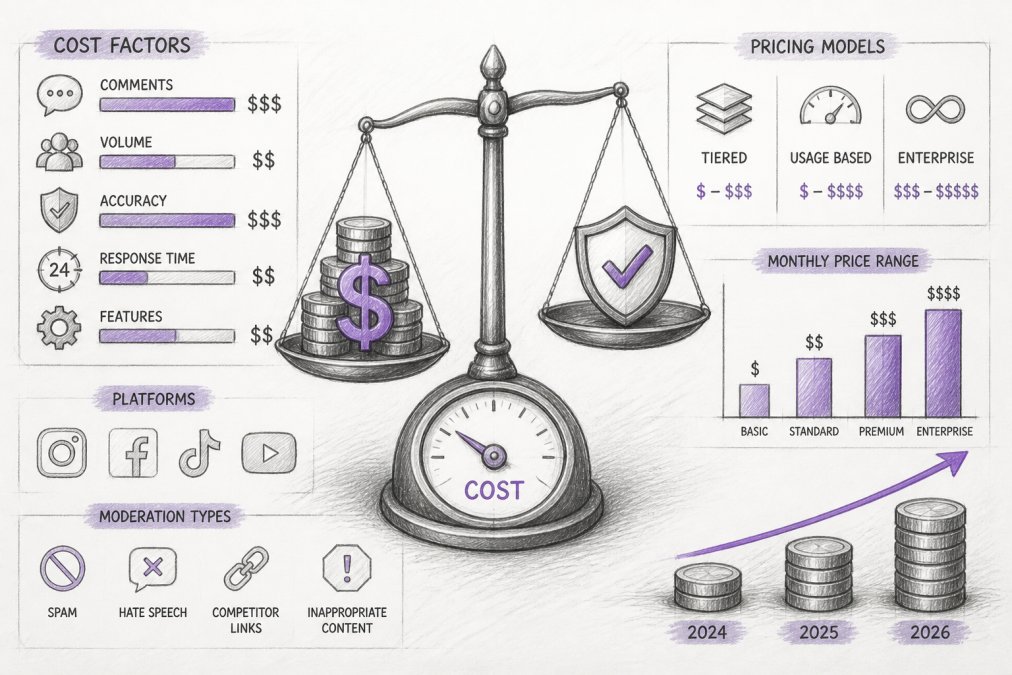
The cost of AI content moderation tools extends far beyond the vendor's pricing sheet. You're deciding between three layers: software subscription, operational overhead, and hidden costs. A $29-per-month tool can cost triple that once you factor in setup time, integration work, and required human oversight.
The biggest cost driver is volume. A brand managing 500 comments daily faces completely different economics than one handling 50,000. Usage-based pricing makes sense at low volumes; flat-rate subscriptions win at scale.
FeedGuardians addresses this by offering automated moderation and AI-powered replies across Instagram, Facebook, TikTok, and YouTube. The platform's 98.7% accuracy in detecting spam, hate speech, and competitor links reduces false positives requiring manual review (peer-reviewed research). At scale, that accuracy difference translates directly into labor savings.
AI Content Moderation API Pricing Models Explained
Two pricing models dominate: usage-based and subscription-based.
Usage-Based Pricing
Usage-based pricing charges per API request, image analyzed, or video processed. You pay only for what you use, making it ideal for unpredictable traffic or seasonal spikes.
The math is straightforward: 1 million requests monthly at $0.50 per 1,000 requests costs $500; 10 million requests costs $5,000. Per-unit costs compound quickly as you scale, and one viral post can spike costs overnight. For agencies managing multiple client accounts on fixed retainers, this unpredictability becomes problematic.
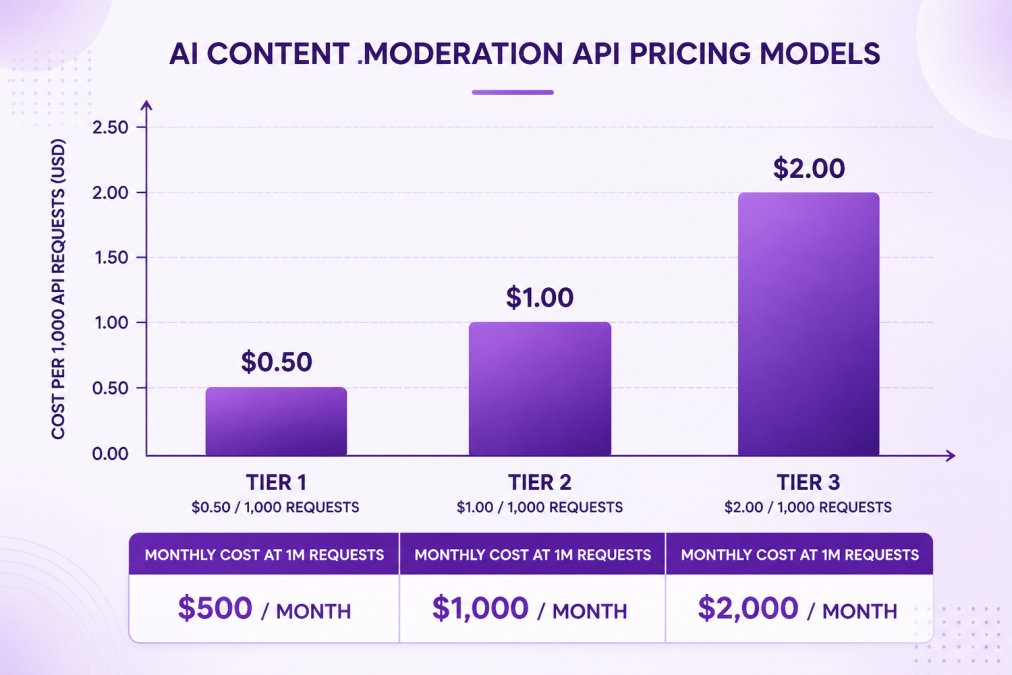
Hive Moderation starts at $0.50 per 1,000 requests for text moderation. Sightengine offers a hybrid approach: a base subscription starting at $29 monthly, then usage overages beyond your tier.
Subscription Tiers
Subscription pricing charges a flat monthly fee for set capacity: defined API calls, moderated comments, or managed accounts. This eliminates billing surprises and simplifies client billing. The trade-off: you pay for capacity you might not use.
Subscription tiers make sense with consistent, predictable volume. Most e-commerce brands, agencies, and creators fit this category. FeedGuardians operates on a subscription model, simplifying budgeting for brands managing multiple social accounts.
Human vs AI Content Moderation Cost Comparison
Most teams assume AI moderation is cheaper than human moderation. The optimal approach for most teams is hybrid: AI handles volume, humans handle edge cases.
Pure AI Moderation: When It Works
AI moderation excels at speed and scale, processing thousands of comments per second at $0.001 to $0.01 per comment (the CDC). Pure AI makes financial sense when your comment volume is low (under 1,000 daily), your content is straightforward (spam, profanity, competitor links), your brand tolerates false positives, and you have no compliance requirements. At these conditions, pure AI costs $500-2,000 annually with minimal management.
Pure Human Moderation: When It's Necessary
Human moderation costs $0.05 to $0.15 per comment but catches nuance AI misses (bls.gov). For 10,000 daily comments, that's $500-1,500 daily ($182,500-547,500 annually). Pure human moderation makes sense only when accuracy requirements are extremely high (99%+), content requires cultural expertise, brand reputation is extremely sensitive, or comment volume is very low (under 100 daily).
Hybrid Moderation: The Cost-Optimal Model
Hybrid moderation, AI handling obvious cases, humans reviewing edge cases, delivers the best cost-benefit balance. If 80% of comments are obvious (spam, off-topic, clearly positive), AI handles these at $0.001-0.01 per comment. The remaining 20% need human review at $0.05-0.15 per comment.
On 10,000 daily comments:
- 8,000 obvious comments: $40 daily
- 2,000 edge cases: $200 daily
- Total: $240 daily ($87,600 annually)
This costs 44-479x more than pure AI but 2-6x less than pure human. The key to hybrid cost-effectiveness is minimizing false positives. A 98.7% accurate tool escalates only 130 comments daily from 10,000, manageable for humans. A 1% accuracy improvement reduces human review workload by 100 comments daily, saving $3,650 annually.
Volume-Based Decision Framework
Under 1,000 daily comments: Pure AI ($500-2,000 annually)
1,000-5,000 daily comments: AI with light escalation ($5,000-15,000 annually)
5,000-20,000 daily comments: Hybrid AI + human ($20,000-60,000 annually)
20,000-100,000 daily comments: Hybrid with tiered escalation ($60,000-200,000 annually)
Over 100,000 daily comments: Hybrid with managed service provider ($200,000-500,000+ annually)
False Positive vs. False Negative Costs
False positives (legitimate comments flagged) increase human review workload. On 10,000 daily comments with 2% false positives, your team reviews 200 comments daily that shouldn't have been flagged, 400 minutes of wasted labor daily.
False negatives (violations missed) create different costs. Spam, hate speech, or competitor attacks that slip through require cleanup after publication, damaging community and customer relationships. Most teams should optimize for low false positives in hybrid models and accept slightly higher false negatives.
Best Practices for Social Media Comment Moderation on a Budget
Start by automating the obvious: spam, profanity, and competitor links. Configure escalation rules for edge cases. Comments from new accounts, messages with URLs, or specific keywords can route to a human queue rather than auto-hiding.
Use platform-specific features where available. Instagram's built-in filtering and YouTube's Community Guidelines enforcement handle some spam. Focus your budget on gaps: competitor detection, brand voice consistency, and converting comments into sales opportunities.
For agencies managing multiple client accounts, consolidate tools. One platform handling 15 client accounts costs less than 15 separate subscriptions. FeedGuardians's multi-account support eliminates cost multiplication per client.
Set up response automation for common questions. If 30% of comments ask "What's your shipping time?", automate these responses in your brand voice. AI-powered replies save hours daily while maintaining consistency.
Monitor your false positive rate monthly. If AI is hiding more than 5% of legitimate comments, adjust rules to be more permissive on edge cases and rely on human escalation for truly risky content.
Hidden Costs: What Budgets Miss
The subscription fee is never the full cost. Most teams underestimate operational overhead that AI moderation tools require.
Implementation and Integration Costs
Integration typically takes 4-8 hours per account. For an agency managing 15 accounts, that's 60-120 hours at $50 per hour: $3,000-6,000 before processing a single comment. Platform fragmentation multiplies costs. A tool covering all four major platforms eliminates this fragmentation cost.
Accuracy-Related Costs
False positives create direct revenue impact. When AI hides a customer's shipping question, they don't convert. On 10,000 daily comments with 2% false positives, that's 200 legitimate comments hidden daily. If 5% result in lost customers at $500 lifetime value, you're losing $500 daily ($182,500 annually).
False negatives require human cleanup after publication. On 10,000 daily comments with 95% accuracy, 500 violations escape detection daily. The difference between 95% and 98.7% accuracy is 370 undetected violations daily (135,050 annually).
Ongoing Tuning and Optimization Costs
AI tools require continuous refinement. During month one, budget 2-4 hours weekly for rule adjustment. After month one, this typically drops to 1-2 hours weekly. For one person managing moderation at $50 hourly, ongoing tuning costs $2,600-5,200 annually.
Compliance and Governance Overhead
Regulated industries impose specific moderation requirements. Configuring compliance takes expertise. Some tools charge extra ($500-2,000 annually); others require custom implementation by legal teams.
Staff Training and Knowledge Costs
Budget 2-4 hours training per team member. Five people touching moderation = 10-20 hours at $50 hourly: $500-1,000.
Building Your Hidden Cost Framework
Implementation Phase (one-time):
- Integration setup: (hours × hourly rate)
- Rule configuration: (hours × hourly rate)
- Initial training: (hours × hourly rate × team members)
- Compliance setup: (hours × hourly rate or vendor fees)
Accuracy Phase (ongoing annual):
- False positive cost: (daily comments × false positive rate × customer lifetime value × conversion impact × 365)
- False negative cost: (daily comments × false negative rate × 5 minutes per violation × hourly rate × 365)
Operations Phase (ongoing annual):
- Tuning and optimization: (hours per week × hourly rate × 52)
- Staff training updates: (hours annually × hourly rate)
A $49-monthly tool requiring 40 hours implementation ($2,000), 10 hours training ($500), five hours weekly ongoing management ($13,000 annually), and 2% false positives on 10,000 daily comments ($182,500 annually) actually costs over $198,000 annually.
Accuracy and platform coverage matter enormously. A 98.7% accurate tool across four platforms with minimal management has dramatically lower TCO than a cheaper tool at 90% accuracy covering only two platforms requiring constant configuration.
How to Calculate Total Cost of Ownership
Total Cost of Ownership (TCO) is the only metric that matters when comparing tools.
Start with software subscription. For usage-based pricing, estimate monthly volume and calculate annual cost. For subscriptions, multiply monthly fee by 12.
Add implementation costs. Estimate setup hours and multiply by your team's hourly rate.
Add training costs. Budget 2-4 hours per team member at your hourly rate.
Add ongoing management. Estimate weekly hours spent configuring rules and optimizing performance, multiply by 52 weeks and hourly rate.
Add false positive costs. If your tool hides 2% of legitimate comments on 10,000 daily comments, that's 200 false positives daily. If 10% result in lost customers at $500 lifetime value, that's $10,000 daily lost revenue ($3.65 million annually).
Add integration gaps. If you need two separate tools because your primary tool doesn't cover all platforms, double software costs and add management overhead.
Accuracy and platform coverage matter most. A 98.7% accurate tool across four platforms with minimal management has dramatically lower TCO than a cheaper tool at 90% accuracy covering only two platforms requiring constant tuning.
Match the tool's capabilities to your actual needs. If you only need Instagram moderation, paying for YouTube coverage adds unnecessary cost. If you only have 1,000 comments daily, paying for enterprise infrastructure is wasteful. Calculate TCO based on your specific situation, not generic pricing comparisons.
The cost of AI content moderation tools is ultimately about choosing the right balance between automation, accuracy, and human oversight for your situation. Most teams overspend by chasing the lowest subscription price without calculating total cost of ownership or considering accuracy trade-offs. Real savings come from picking a tool matching your volume, covering your platforms, and requiring minimal ongoing management. FeedGuardians handles all four major social platforms with 98.7% accuracy and AI-powered replies in your brand voice, eliminating fragmentation and integration costs that inflate TCO for most teams. Start with a free trial to test accuracy on your actual comment volume before committing.
Frequently Asked Questions
What factors influence the total cost of ownership for moderation software?
Total cost includes the platform subscription or API fees, implementation and setup time, staff training, integration with your existing systems, and ongoing maintenance. You should also account for false positives requiring human review, vendor lock-in costs if you switch platforms later, and compliance requirements specific to your industry.
How do usage-based costs for AI moderation compare to human moderation?
Usage-based AI pricing scales with your request volume, you pay per API call or per 1,000 requests, making it ideal for variable workloads. Human moderation typically costs between $15-$30 per hour per moderator, translating to higher per-comment costs as volume grows. However, human moderation catches nuanced context AI misses, so hybrid approaches often balance cost and accuracy.
Are there free tiers available for AI content moderation APIs?
Yes, many platforms offer free tiers or free trials. Some provide free credits for developers to experiment before committing to paid plans. Free tiers typically include limited monthly requests and basic detection features. However, free tiers rarely include advanced capabilities like video moderation, OCR, or AI-generated content detection. If your comment volume exceeds the free tier limits, you'll need to upgrade to a paid plan to avoid service interruptions.
What is the typical pricing structure for AI content moderation tools?
AI content moderation tools use three main pricing models: usage-based (pay per API request or per 1,000 requests), subscription tiers (flat monthly fees for basic plans and scaling to enterprise custom pricing), or hybrid models combining both. The right model depends on your comment volume, platforms, and required features. High-volume platforms benefit from usage-based pricing, while brands with predictable monthly traffic prefer fixed subscription costs.
This article was written using GrandRanker
Tired of manually moderating comments?
FeedGuardians automates spam filtering, responds to customers, and protects your brand — setup in 3 minutes.
Frequently Asked Questions
What factors influence the total cost of ownership for moderation software?
Total cost includes the platform subscription or API fees, implementation and setup time, staff training, integration with your existing systems, and ongoing maintenance. You should also account for false positives requiring human review, vendor lock-in costs if you switch platforms later, and compliance requirements specific to your industry.
How do usage-based costs for AI moderation compare to human moderation?
Usage-based AI pricing scales with your request volume—you pay per API call or per 1,000 requests—making it ideal for variable workloads. Human moderation typically costs between $15–$30 per hour per moderator, translating to higher per-comment costs as volume grows. However, human moderation catches nuanced context AI misses, so hybrid approaches often balance cost and accuracy.
Are there free tiers available for AI content moderation APIs?
Yes, many platforms offer free tiers or free trials. Some provide free credits for developers to experiment before committing to paid plans. Free tiers typically include limited monthly requests and basic detection features. However, free tiers rarely include advanced capabilities like video moderation, OCR, or AI-generated content detection. If your comment volume exceeds the free tier limits, you'll need to upgrade to a paid plan to avoid service interruptions.
What is the typical pricing structure for AI content moderation tools?
AI content moderation tools use three main pricing models: usage-based (pay per API request or per 1,000 requests), subscription tiers (flat monthly fees for basic plans and scaling to enterprise custom pricing), or hybrid models combining both. The right model depends on your comment volume, platforms, and required features. High-volume platforms benefit from usage-based pricing, while brands with predictable monthly traffic prefer fixed subscription costs.