
Quick Summary
| Key Insight | What You Need to Know |
|---|---|
| How to Build a Social Media Community for Ecommerce | Core Strategy Define Your Community Purpose and Target Audience Choose the Right Social Media Platforms for Your Brand |
| Define Your Community Purpose | Define Your Community Purpose and Target Audience |
| Choose the Right Social | Choose the Right Social Media Platforms for Your Brand |
| Ecommerce Community Engagement Strategies | Ecommerce Community Engagement Strategies That Drive Conversions Create Meaningful Social Interaction and Two-Way Conversations Respond to Comments, DMs, and Customer Feedback in Real Time |
| Create Meaningful Social Interaction | Create Meaningful Social Interaction and Two-Way Conversations |
| Respond to Comments, DMs | Respond to Comments, DMs, and Customer Feedback in Real Time |
Table of Contents
- How to Build a Social Media Community for Ecommerce: Core Strategy
- Ecommerce Community Engagement Strategies That Drive Conversions
- Building Ecommerce Brand Loyalty Examples and Tactics
- How to Measure Social Media Community Growth and Retention
- Social Media Community Management Tools and Platform Integration
- Advanced Community Building: What Most Brands Miss
- Common Mistakes When Building a Social Media Community for Ecommerce
- Conclusion
Last Updated: July 10, 2026
How to Build a Social Media Community for Ecommerce: Core Strategy
Building a social media community for ecommerce requires treating your channels as community hubs, not broadcast platforms. According to HubSpot's 2026 State of Marketing Report, brands with engaged communities see 3x higher customer lifetime value. A 500-person community with 80% engagement outperforms a 50,000-person audience with 2% engagement every time.
The difference comes down to intentionality. Winning brands design their entire social strategy around fostering genuine two-way conversation, creating feedback loops with customers, and building systems that scale community management without losing the human touch.
Define Your Community Purpose and Target Audience
Your community needs a reason to exist beyond selling products. Ask yourself: What problem does my community solve for members? Are you building a space for product enthusiasts to share tips? A support network for people with specific needs? A space where customers can influence product development?
Target audience definition goes deeper than demographics. You need psychographics, the values, interests, and pain points that unite your community members. A sustainable fashion brand's community isn't just "women aged 25-40 interested in clothing." It's "women who feel guilty about their environmental impact and want to make better purchasing decisions without sacrificing style."
Document your community purpose in one clear sentence: "A space where [target audience] can [primary benefit] and [secondary benefit]." This becomes your north star for every moderation decision and piece of content you create.
Choose the Right Social Media Platforms for Your Brand
Not all platforms suit all ecommerce businesses. Instagram works for visual products; TikTok drives engagement for younger audiences; LinkedIn serves B2B; Facebook Groups excel at threaded discussions.
Research where your actual customers congregate. Join relevant communities, observe conversations, and see which platforms generate the most meaningful discussions around your product category. Consider the native format of each platform: Instagram prioritizes visual storytelling, TikTok rewards short-form video, Facebook Groups excel at discussions, YouTube works for educational content, and LinkedIn dominates professional communities.
Most ecommerce brands should start with one primary platform (60% of effort) plus one secondary platform (30% of effort).
| Platform | Best For | Content Format | Community Strength |
|---|---|---|---|
| Visual products, lifestyle brands | Images, Reels, Stories | Strong for engagement | |
| TikTok | Younger audiences, trends | Short-form video | Extremely high engagement |
| Facebook Groups | Deep discussions, support | Text, images, long posts | Excellent for retention |
| YouTube | Educational content, storytelling | Long-form video | High authority, lower engagement |
| B2B, professional communities | Articles, insights, industry news | Strong for thought leadership |
Ecommerce Community Engagement Strategies That Drive Conversions
Real engagement happens when community members feel safe sharing opinions, asking questions without judgment, and contributing ideas. A thousand likes means less than ten meaningful comments debating which product variant to choose.
Create Meaningful Social Interaction and Two-Way Conversations
Real community builders ask questions, listen to answers, and build future content around what they hear. Start by asking questions your audience actually wants to answer: "What problem are you trying to solve that we haven't addressed yet?" rather than "Do you like our new product?"
Questions that generate meaningful responses invite personal experience, have no "right answer," and give people permission to disagree. Respond to every comment in the first hour if possible. This signals you're actually present, not running automated responses.
Create discussion threads, polls, and open-ended prompts regularly. On Instagram, use the "Ask" sticker in Stories. On Facebook Groups, post weekly discussion questions. On TikTok, respond to comments with videos that continue the conversation. The goal is making it easy and rewarding for people to participate.
Respond to Comments, DMs, and Customer Feedback in Real Time
Response speed matters more than response perfection. A fast, imperfect answer beats a slow, perfect one. When someone asks a question on your Instagram post, they want acknowledgment within hours, not days.
Set up systems to catch comments and DMs across all platforms. Create response templates for common questions, but personalize each reply. For customer support questions in comments, respond publicly when possible so other community members see the answer. For sensitive issues, move conversations to DMs and follow up publicly with a summary of how you resolved it.
Document patterns in customer feedback. If five people ask the same question this week, create content addressing it. If customers consistently mention a missing feature, add it to your product roadmap and tell them you're working on it.
Building Ecommerce Brand Loyalty Examples and Tactics
Loyalty is built through belonging, not discounts. When customers feel like part of a community rather than just transaction partners, they stick around through price increases and competitive pressure.
Use User-Generated Content and Customer Reviews
User-generated content is the most powerful form of social proof. A customer's honest photo of your product in their home carries more weight than professional product photography. Create systems that make it easy for customers to share. Run hashtag campaigns where community members tag photos using your branded hashtag. Feature customer photos on your main feed and in Stories.
When customers see their content featured, they feel valued, and everyone else sees real people using and loving your products. Respond to every customer review, positive or negative. Thank people for positive reviews and ask what made their experience great. For negative reviews, ask what went wrong and how you can fix it.
According to BrightLocal's 2026 Customer Review Survey, 91% of consumers read reviews before purchasing, and reviews with specific details are 70% more likely to influence buying decisions than generic praise.
Develop Brand Advocacy and Social Proof Programs
Brand advocates are customers who promote your products without being asked. Identify your natural advocates by looking at who's already creating content about your products, leaving detailed reviews, and engaging consistently in your community. Reach out personally and thank them.
Formal advocacy programs work best when they offer genuine value: early access to new products, exclusive discounts, invitations to community events, or a platform to share their story. Create a tiered system where engagement levels unlock different benefits. Document advocate stories and share them in your community, on your website, and in email marketing.
How to Measure Social Media Community Growth and Retention
You can't improve what you don't measure. Real community health metrics tell you whether your community is becoming more engaged, more loyal, and more likely to purchase again.
Track Engagement Metrics and Community Health Indicators
Start with these core metrics: comment rate (comments per post divided by follower count), reply rate (how many comments get responses), and conversation depth (average number of replies per comment thread).
A healthy community has engagement rates of 3-5% or higher. Below 1% indicates your community isn't actually engaged. Track which types of posts generate the most meaningful engagement. Product announcements might get likes but few comments. Discussion questions might get deeper conversations. Optimize toward content that generates the engagement you want.
Measure response time. Communities where brands respond within 2 hours see 40% higher engagement than communities where responses take 24+ hours. Count repeat participants. What percentage of your community members engage more than once per month? Communities with 30%+ repeat participation are healthy.
Monitor Retention-Focused Metrics Beyond Vanity Numbers
Retention rate tells you what percentage of community members from last month are still active this month. A healthy community maintains 40-50% month-over-month retention. Declining retention signals that community purpose isn't being delivered.
Track which cohorts churn fastest. Did members who joined three months ago drop off? This tells you whether your onboarding works and whether you're maintaining engagement long-term.
Measure advocacy metrics. What percentage of community members have referred friends? How many customer reviews does each community member leave? How often do they mention your products on their personal social accounts? These behaviors predict long-term loyalty.
Create a simple community health scorecard that tracks these metrics monthly:
| Metric | Target | Current | Trend |
|---|---|---|---|
| Monthly Active Members | +10% growth | 2,450 | ↑ |
| Engagement Rate | 3-5% | 4.2% | → |
| Response Time | <2 hours | 1.8 hours | ↑ |
| Repeat Participation | 40%+ | 38% | ↓ |
| Month-over-Month Retention | 45%+ | 42% | ↓ |
Social Media Community Management Tools and Platform Integration
Managing a thriving community without tools is impractical once you reach a certain scale. The right tools handle operational load, comment moderation, spam filtering, response automation, analytics tracking, so your team can focus on strategy and genuine relationship building.
Automate Moderation and Community Safety
Spam, hate speech, and competitor interference destroy community culture. Manual moderation doesn't scale. If you're checking every comment by hand, you'll miss things.
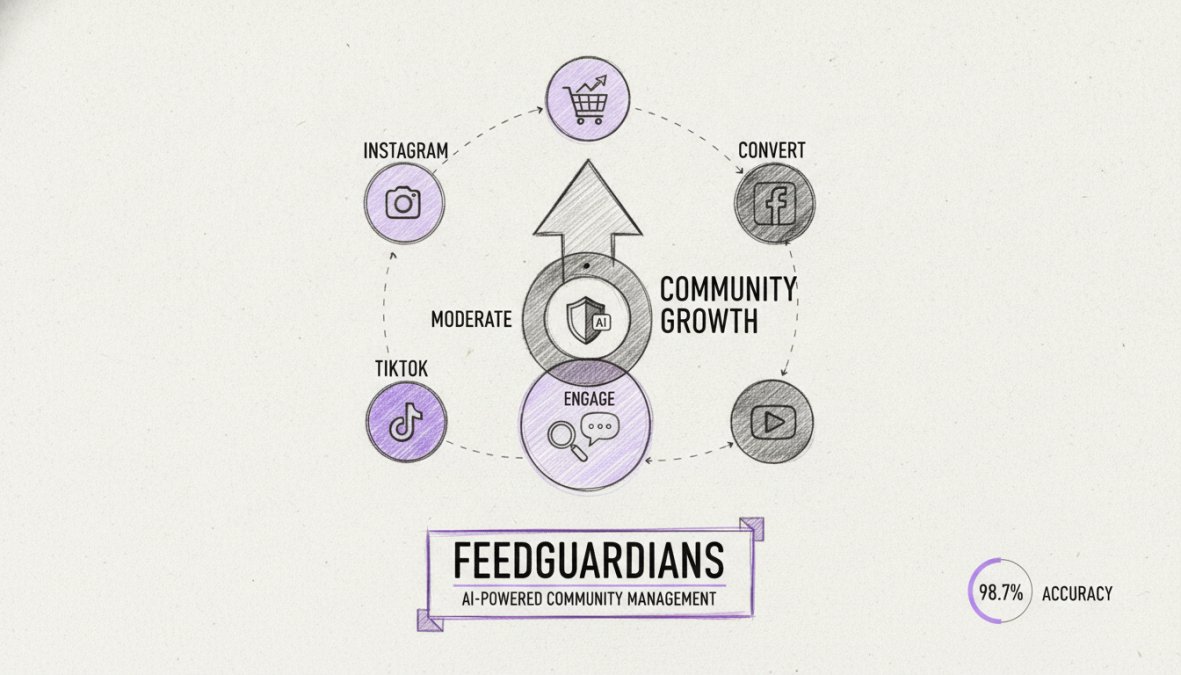
FeedGuardians automatically detects and hides spam, hate speech, and competitor links with 98.7% accuracy. It learns your specific brand voice and guidelines, then delivers intelligent responses to common questions 24/7. This means your community stays clean while you sleep, and customers get answers instantly.
Set clear community guidelines addressing spam, hate speech, harassment, self-promotion, and misinformation. Create an escalation system where automated tools catch obvious violations, your team reviews borderline cases, and serious violations get escalated to platform support.
Simplify Customer Support and Comment Response
Customer support questions in your community should get answered faster than support tickets. Create a support workflow where questions route to your support team, who handle them quickly. If it's a common question, document the answer so future responses are faster.
Use templates for common questions but personalize each response. For complex issues, move the conversation to DMs. Public support conversations should be brief and solution-focused.
Document patterns in support questions. If you're answering the same question five times per week, create content addressing it. A pinned FAQ post, video tutorial, or updated product description might answer the question before people ask.
Advanced Community Building: What Most Brands Miss
The best brands understand community building is actually a product development tool and feedback mechanism that shapes everything from product design to customer service.
Community-Led Product Development and Feedback Loops
Your community knows what they want better than any market research firm. Create formal feedback channels: a monthly poll asking "What feature should we build next?" A dedicated section for feature requests. A quarterly "community council" call with your most engaged members.
When you implement a feature that community members requested, tell them. Feature the person who suggested it. This creates a powerful signal: your community doesn't just talk, they shape your product.
Share product roadmaps with your community. Transparency about what's coming builds anticipation and allows customers to provide input before you build. Some of your best product ideas will come from community members who use your products in unexpected ways.
Crisis Management and Reputation Protection in Online Communities
Every brand faces criticism eventually. How you handle it in your community determines whether you lose customers or deepen loyalty.
The worst response is silence or deletion. The second-worst is defensive. The best response is honest, fast, and action-oriented. Acknowledge the problem, take responsibility, explain what you're doing to fix it, and follow up when resolved.
When a product defect emerges, address it in your community before customers discover it elsewhere. When a customer has a bad experience, resolve it publicly when possible. Create a crisis communication plan before you need it.
Common Mistakes When Building a Social Media Community for Ecommerce
Expecting immediate results. Community building takes 6-12 months to show real momentum. Set realistic expectations and celebrate small wins.
Choosing the wrong platform. Build community where your actual customers congregate, not where you think they should be.
Broadcasting instead of conversing. Every post should invite response, and every response should get acknowledged.
Ignoring negative feedback. Criticism is information. Customers complaining publicly are giving you free market research.
Inconsistent posting. Establish a sustainable posting schedule and stick to it.
Focusing on follower count. A 1,000-person community with 50% monthly engagement beats a 100,000-person audience with 1% engagement.
Failing to moderate. A community without moderation becomes toxic. Invest in moderation tools and processes.
Not integrating community feedback. If you ask for input but never act on it, community members stop participating.
Treating advocates poorly. Your most engaged community members are your best assets. Invest in recognizing and rewarding them.
Automating everything. Use automation to handle routine tasks so your team can focus on genuine relationships.
Conclusion
Building a social media community for ecommerce requires shifting your mindset from "how do we sell more?" to "how do we create a space where our customers feel like they belong?" This shift changes everything, from the content you create to the metrics you track to the tools you use.
The brands winning in 2026 understand that community is their competitive advantage. When customers feel part of something larger than a transaction, they stay loyal through competition, forgive occasional mistakes, and become your best marketers.
Managing a thriving community at scale requires handling hundreds of comments daily while maintaining authentic engagement. FeedGuardians solves this by automatically detecting and hiding spam, hate speech, and competitor links with 98.7% accuracy, while delivering 24/7 AI-powered replies in your unique brand voice. This means your community stays clean and welcoming while your team focuses on strategy instead of moderation. Get started with FeedGuardians and turn your social comments into conversations and conversions.
Frequently Asked Questions
Why is social media community building important for ecommerce?
A strong social media community drives customer retention, increases lifetime value, and creates brand advocates who generate organic reach. Communities provide direct feedback loops for product development, reduce customer acquisition costs through word-of-mouth, and build emotional connections that turn one-time buyers into loyal repeat customers. Additionally, engaged communities boost social proof through user-generated content and reviews, which directly influences conversion rates.
How do you engage an ecommerce community on social media effectively?
Engagement requires consistent, authentic interaction through multiple channels. Respond promptly to comments and direct messages, ask questions that encourage discussion, feature customer stories and user-generated content, and create exclusive community experiences like early access to products or member-only sales. Real-time responsiveness is critical, brands that reply within hours see significantly higher engagement metrics and customer satisfaction. Use tools that automate routine responses while maintaining your unique brand voice.
What are the best platforms for building an ecommerce community?
The best platform depends on your target audience demographics and product type. Instagram and TikTok excel for visual products and younger audiences, Facebook Groups work well for niche communities and direct customer communication, YouTube builds community through long-form content and comments, and LinkedIn suits B2B ecommerce. Most successful brands operate on 2-3 platforms rather than spreading thin across all channels. Choose platforms where your customers already spend time and where your content format naturally fits.
How can social media community management tools improve your ecommerce strategy?
Community management tools streamline moderation, automate routine responses, and protect brand reputation by filtering spam, hate speech, and competitor links in real time. AI-powered solutions learn your brand voice and terminology to deliver consistent 24/7 customer support across platforms. These tools save hours daily on manual comment management, boost ad performance by maintaining clean feeds, and provide analytics on engagement patterns. They enable your team to focus on strategic community building rather than repetitive moderation tasks.
This article was written using GrandRanker
Tired of manually moderating comments?
FeedGuardians automates spam filtering, responds to customers, and protects your brand — setup in 3 minutes.
Frequently Asked Questions
Why is social media community building important for ecommerce?
A strong social media community drives customer retention, increases lifetime value, and creates brand advocates who generate organic reach. Communities provide direct feedback loops for product development, reduce customer acquisition costs through word-of-mouth, and build emotional connections that turn one-time buyers into loyal repeat customers. Additionally, engaged communities boost social proof through user-generated content and reviews, which directly influences conversion rates.
How do you engage an ecommerce community on social media effectively?
Engagement requires consistent, authentic interaction through multiple channels. Respond promptly to comments and direct messages, ask questions that encourage discussion, feature customer stories and user-generated content, and create exclusive community experiences like early access to products or member-only sales. Real-time responsiveness is critical—brands that reply within hours see significantly higher engagement metrics and customer satisfaction. Use tools that automate routine responses while maintaining your unique brand voice.
What are the best platforms for building an ecommerce community?
The best platform depends on your target audience demographics and product type. Instagram and TikTok excel for visual products and younger audiences, Facebook Groups work well for niche communities and direct customer communication, YouTube builds community through long-form content and comments, and LinkedIn suits B2B ecommerce. Most successful brands operate on 2-3 platforms rather than spreading thin across all channels. Choose platforms where your customers already spend time and where your content format naturally fits.
How can social media community management tools improve your ecommerce strategy?
Community management tools streamline moderation, automate routine responses, and protect brand reputation by filtering spam, hate speech, and competitor links in real time. AI-powered solutions learn your brand voice and terminology to deliver consistent 24/7 customer support across platforms. These tools save hours daily on manual comment management, boost ad performance by maintaining clean feeds, and provide analytics on engagement patterns. They enable your team to focus on strategic community building rather than repetitive moderation tasks.