
Quick Summary
| Key Insight | What You Need to Know |
|---|---|
| A defamation claim needs four elements | a false statement of fact, publication, fault, and actual harm or damages. |
| Screenshot the review and | Screenshot the review and the harm it caused before you reply, report, or ask anyone else to look at it. |
| Reply within a day | Reply within a day where you can, keep responses to two or three sentences, and never disclose confidential information. |
| You cannot delete a | You cannot delete a Google review yourself; you can report it and appeal if the first attempt fails. |
| Anti-SLAPP laws may let | Anti-SLAPP laws may let a defendant recover legal fees if a suit targets protected expression. |
| Is the Review Defamatory | Is the Review Defamatory or Just Negative?Opinion vs. a False Statement of FactThe Legal Elements of a Defamation Claim |
Last Updated: November 17, 2026
Quick Summary
A defamatory online review is a false statement of fact, published to a third party, that harms a business's reputation. Preserve evidence first, then respond publicly and factually without arguing, and report the review only if it breaks platform policy. For a possibly actionable defamatory online review, consider a demand letter or counsel before filing suit.
- A defamation claim needs four elements: a false statement of fact, publication, fault, and actual harm or damages.
- Screenshot the review and the harm it caused before you reply, report, or ask anyone else to look at it.
- Reply within a day where you can, keep responses to two or three sentences, and never disclose confidential information.
- You cannot delete a Google review yourself; you can report it and appeal if the first attempt fails.
- Anti-SLAPP laws may let a defendant recover legal fees if a suit targets protected expression.
Table of Contents
- Is the Review Defamatory or Just Negative?
- Defamatory Online Review Examples That Cross the Line
- How to Preserve Evidence Before You Respond
- Responding to Negative Reviews Best Practices
- Negative Review Response Templates You Can Adapt
- How to Remove a Defamatory Google Review
- Legal Threats, Deadlines, and Consumer-Review Protections
- Get a Second Set of Eyes on Your Review Response Plan
- Frequently Asked Questions
Is the Review Defamatory or Just Negative?
A defamatory online review is a false statement of fact, published to a third party, that harms a business's reputation. That definition matters because most negative reviews never meet it.
Angry reviews sting. But anger is not defamation.
The real question is narrower: did the reviewer state something provably false as fact, or just share an opinion?
Below, we walk through how to tell the difference, preserve proof, and respond without escalating a fight you cannot win.
Opinion vs. a False Statement of Fact
A statement of fact can be proven true or false. An opinion cannot. "The food was cold" is a fact claim you can check. "This place is overrated" is an opinion, and opinions are protected.
This is the line that decides most cases.
Watch for these markers:
- Fact claims: "They charged me twice," "The owner lied about the warranty," "This product caused a fire."
- Opinion: "Worst service ever," "I would not recommend this," "Total waste of money."
- Mixed: "They scammed me" blends a fact claim (fraud) with emotion. Treat it as a potential fact claim.
The word "scam" trips up many business owners. It implies fraud, a factual accusation, very different from "I had a bad experience."
The Legal Elements of a Defamation Claim
A defamation claim needs four elements, and missing any one of them sinks it. Defamation is a false statement, presented as fact, that damages reputation. Libel is defamation in written form, which covers online reviews.
The four elements:
- A false statement of fact presented as true, not opinion.
- Publication to a third party, meaning someone other than you and the reviewer saw it.
- Fault, which for a private business usually means negligence.
- Actual harm or damages, such as lost sales or reputational injury.
For a business, actual harm, not just hurt feelings, is a further hurdle. That means documentation, a dip in bookings, lost contracts, or a clear trail of customers citing the review.
Defamatory Online Review Examples That Cross the Line
Some reviews move from bad to legally risky. Here is what those look like in practice.
- False factual accusations: "This business is under investigation for fraud" when it is not.
- Fabricated safety claims: "Their product gave my child a rash" when no such event happened.
- Impersonation: a review written as if from a real customer who never bought anything.
- False statements about staff: naming an employee and accusing them of a crime.
- Competitor plants: fake reviews posted to damage a rival.
Here is the test we use: could a reader verify this claim, and is it false?
Reviews that name individual employees or allege crimes carry more legal weight than vague complaints. Do not treat them like a one-star rating.
If harmful comments are piling up under your paid ads, stop negative comments from killing your ads before they drag down performance.
How to Preserve Evidence Before You Respond
Screenshot everything before you touch the review. A reviewer can edit or delete it in seconds, and platforms rarely hand over deleted content on request.
Treat preservation as a two-track job: capture the review itself, and capture the harm it caused.
Track 1: Capture the review and its context.
- Full-page screenshot showing the review text, the reviewer's display name, the star rating, and the platform's visible date
- The direct review URL, copied as text, not just embedded in the image
- The platform name and, where shown, the reviewer's profile URL and account age
- A screen recording that scrolls from the top of the page to the review and back, so the review is shown in its surrounding context rather than cropped
- The page's HTML saved via your browser's "Save page as" or print-to-PDF function, which preserves text that images can lose
- Your own device timestamp alongside the platform's displayed timestamp
Track 2: Capture the harm.
- Order cancellations, refund requests, or lost leads that reference the review, with dates
- Messages from customers or prospects who cite the review by name or quote it
- Analytics exports showing a traffic, conversion, or booking change around the review's posting date
- Internal notes on staff time spent responding
Make the record harder to challenge. A plain screenshot can be dismissed as edited. Two low-effort steps help:
- Preserve the page as a dated PDF or archive file and keep the original file, not a re-saved copy.
- Generate a file hash (a short digital fingerprint) of each capture using a free utility, and store the hash in a separate log with the capture date. If authenticity is later questioned, the hash shows the file has not changed since capture.
If the harmful content is on Instagram, moderate Instagram comments going forward so you are not documenting the same problem twice.
Responding to Negative Reviews Best Practices
Respond promptly, stay factual, and never argue. A calm public response shows future customers you handle problems well and creates a record that helps if the dispute escalates.
Follow these rules:
- Reply within a day where you can.
- Address concerns directly, not the reviewer's character.
- Avoid confrontation and avoid name-calling. Both read badly to everyone watching.
- Never disclose confidential information, even to defend yourself.
- Keep it short. Two or three sentences is plenty.
The privacy point matters more than most owners realize.
If you want to turn a bad review into a win, learn how to turn negative reviews into marketing opportunities with a response plan that works.
Negative Review Response Templates You Can Adapt
Templates save time and keep your tone steady. Adapt these to your brand voice, and keep placeholders in brackets.
For a factually false claim:
"Thank you for the feedback. We take this seriously, but our records show [specific fact].
For a legitimate complaint:
"We're sorry your experience fell short. You're right that [issue] should not have happened.
For an abusive or clearly fake review:
"We don't have a record of this order.
Notice what none of these do: they never accuse the reviewer of lying in public.
How to Remove a Defamatory Google Review
You cannot delete a Google review yourself. You can report it and ask Google to remove it, and escalate if the first attempt fails. But removal is only one outcome, and the wrong first move for many reviews. Before you report anything, classify the review so you send it down the right path.
Match the review to the right remedy
1. It is a negative opinion. ("Worst experience I've had.") No platform will remove it and no court will treat it as defamation.
**2.
3. It violates platform policy. (Profanity, spam, a conflict of interest, an off-topic rant, or content that reveals private information.) This is the category platforms actually act on.
4. It may be actionable defamation. (A false statement of fact, published, causing identifiable harm.) Preserve evidence first, then consider a demand letter or counsel.
The Google reporting and escalation process
- Flag the review in Google Business Profile and pick the reason that fits, such as false information or a conflict of interest.
- Wait for the decision. Google reviews reported content against its policies.
- Appeal if rejected. You can resubmit with more detail.
- Escalate through the Google Business Profile help channel if the review clearly breaks policy.
A focused report beats a broad one. State the specific policy, quote the exact words that break it, and attach your preserved capture. Reports that read as "this review is unfair" are routinely denied; reports citing specific prohibited content at a specific URL get reviewed on the merits.
Set realistic expectations about outcomes
Reporting outcomes vary by platform and by how clearly the review breaks the rules.
- Clear policy violations are the most likely to be removed.
- Opinion-based negative reviews almost never are.
- Factual disputes usually require legal steps, not platform reports.
If an appeal is denied, do not keep resubmitting the same report.
Watch out: a platform's removal decision is not a legal ruling.
If you are also weighing removal on other platforms, turn off Facebook reviews where that option fits your strategy.
Before reporting a review, classify it so you send it down the right path.
| Review type | Example | Realistic remedy |
|---|---|---|
| Negative opinion | "Worst experience I've had." | Respond publicly, briefly, and move on |
| Factual dispute | "They charged me twice." | Factual public reply and, if harm is real, a demand letter |
| Platform policy violation | Profanity, spam, conflict of interest, off-topic rant | Report it under the specific policy it breaks |
| Possibly actionable defamation | False statement of fact, published, causing identifiable harm | Preserve evidence first, then demand letter or counsel |
Legal Threats, Deadlines, and Consumer-Review Protections
A cease-and-desist letter is often the right first legal step. It is cheaper than a lawsuit and sometimes enough to get a false review taken down.
Deadlines matter too. Defamation statutes of limitation vary by state. Confirm your state's deadline with a licensed attorney. Miss the window and the claim is gone.
Because the rules differ by state, treat general advice as a starting point only.
Get a Second Set of Eyes on Your Review Response Plan
The hardest part of handling a defamatory online review is not the law. It is staying calm while comments pile up and every reply feels high-stakes.
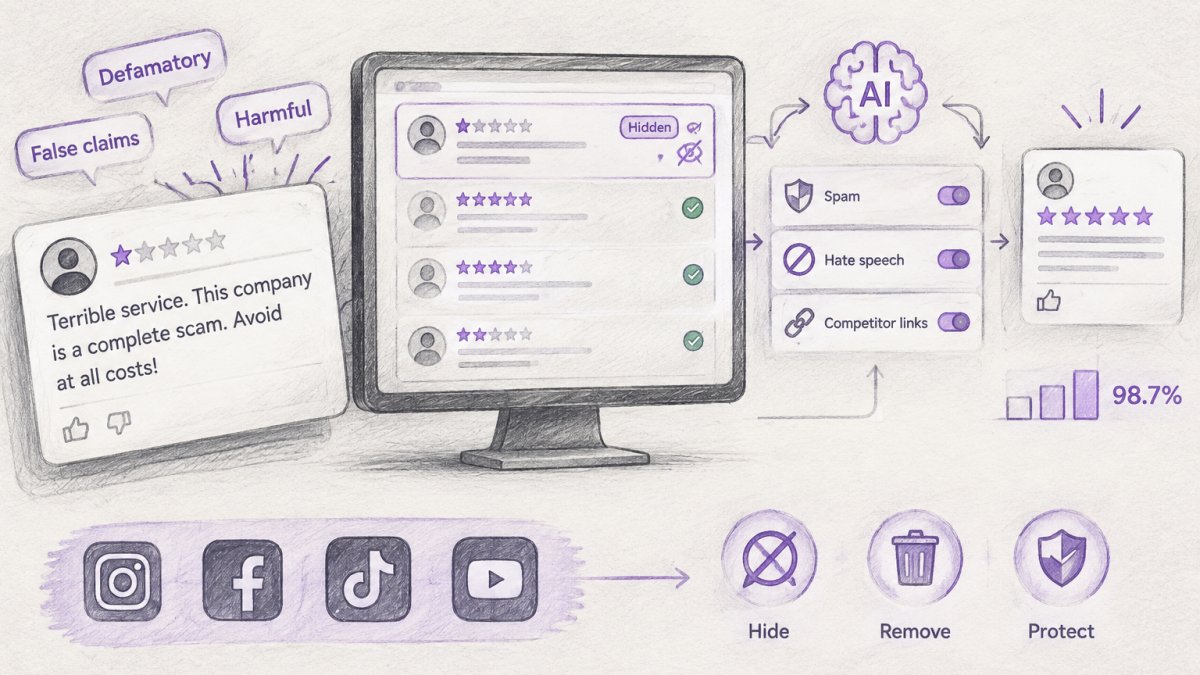
That is where a system beats willpower. FeedGuardians provides real-time comment moderation across Instagram, Facebook, TikTok, and YouTube.
You do not have to choose between responding fast and responding well.
A single false review can cost you customers before you ever see it.
Frequently Asked Questions
Can I get sued for defamation over a Google review?
Yes, in theory. A reviewer can face a defamation claim if they publish a false statement of fact about your business to a third party and it causes actual harm. But opinion, exaggeration, and honest consumer complaints are generally protected, and many states have anti-SLAPP laws that penalize meritless suits. Before you threaten legal action over a defamatory online review, talk to a licensed attorney in your state. A poorly aimed legal threat can backfire and draw more attention to the review.
How can you tell whether an online review is defamatory or just negative?
Look at whether the review asserts a verifiable fact or an opinion. "The food was cold" is an opinion. "The kitchen served us spoiled meat and three people got sick" is a factual claim that can be proven false. A defamatory online review typically makes a specific, false factual assertion, publishes it to a third party, and causes measurable harm such as lost bookings or damages. Harsh tone alone does not make a review defamatory.
What evidence should a business save before responding to an online review?
Capture a full-page screenshot showing the review text, reviewer name, date, star rating, and URL. Save the raw HTML or a timestamped export if the platform allows it, and log the review in a spreadsheet with the date you found it. If the review claims a specific transaction, pull the matching order record, messages, and refund history. Store everything in a shared folder your team can access. This documentation protects you if the review is edited, deleted, or later becomes part of a legal claim.
Should a business respond publicly to a false review?
Often yes, but keep it short and factual. A calm public response shows future customers you take complaints seriously, and it can correct the record without escalating the dispute. Avoid name-calling, sarcasm, or revealing confidential customer details. If the review contains threats, doxxing, or clearly fabricated claims, report it to the platform first and respond only with a brief note that you are looking into it. For high-stakes cases, have your attorney review the reply before you post.

Tired of manually moderating comments?
FeedGuardians automates spam filtering, responds to customers, and protects your brand — setup in 3 minutes.
Frequently Asked Questions
Can I get sued for defamation over a Google review?
Yes, in theory. A reviewer can face a defamation claim if they publish a false statement of fact about your business to a third party and it causes actual harm. But opinion, exaggeration, and honest consumer complaints are generally protected, and many states have anti-SLAPP laws that penalize meritless suits. Before you threaten legal action over a defamatory online review, talk to a licensed attorney in your state. A poorly aimed legal threat can backfire and draw more attention to the review.
How can you tell whether an online review is defamatory or just negative?
Look at whether the review asserts a verifiable fact or an opinion. "The food was cold" is an opinion. "The kitchen served us spoiled meat and three people got sick" is a factual claim that can be proven false. A defamatory online review typically makes a specific, false factual assertion, publishes it to a third party, and causes measurable harm such as lost bookings or damages. Harsh tone alone does not make a review defamatory.
What evidence should a business save before responding to an online review?
Capture a full-page screenshot showing the review text, reviewer name, date, star rating, and URL. Save the raw HTML or a timestamped export if the platform allows it, and log the review in a spreadsheet with the date you found it. If the review claims a specific transaction, pull the matching order record, messages, and refund history. Store everything in a shared folder your team can access. This documentation protects you if the review is edited, deleted, or later becomes part of a legal claim.
Should a business respond publicly to a false review?
Often yes, but keep it short and factual. A calm public response shows future customers you take complaints seriously, and it can correct the record without escalating the dispute. Avoid name-calling, sarcasm, or revealing confidential customer details. If the review contains threats, doxxing, or clearly fabricated claims, report it to the platform first and respond only with a brief note that you are looking into it. For high-stakes cases, have your attorney review the reply before you post.