
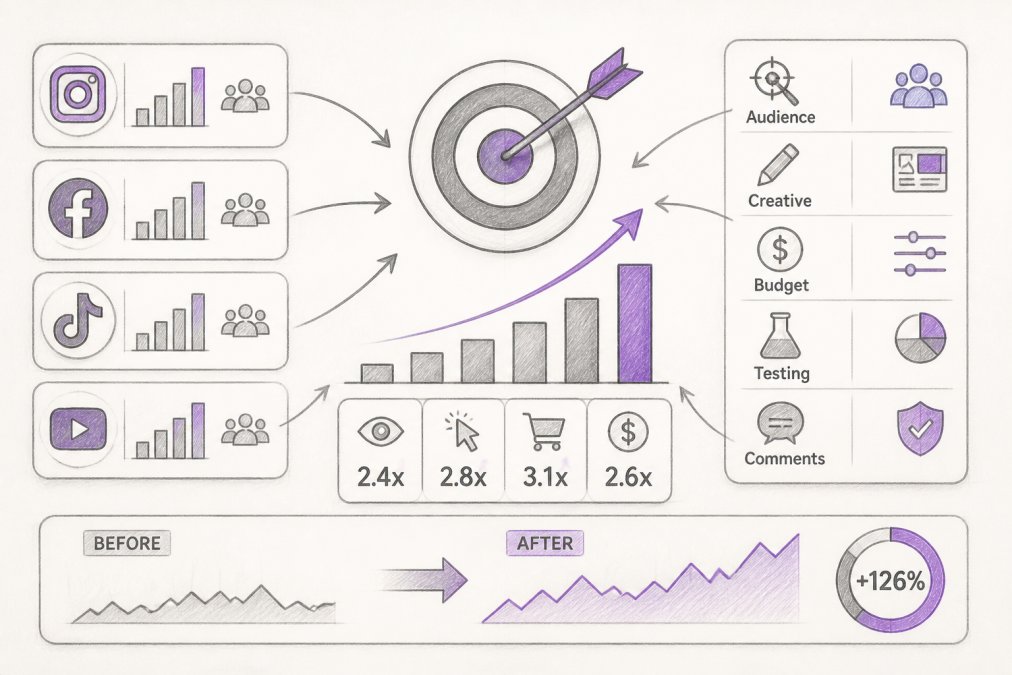
Quick Summary
| Key Insight | What You Need to Know |
|---|---|
| Define Your Campaign Objectives | Define Your Campaign Objectives and Key Performance Indicators |
| Build Detailed Target Audience | Build Detailed Target Audience Personas and Segment Your Audience |
| Social Media Ad A/B | Social Media Ad A/B Testing Examples That Drive Results Testing Ad Copy and Messaging Testing Visual Creative and Ad Formats Testing Audience Segments and Targeting Parameters |
| Testing Ad Copy and | Testing Ad Copy and Messaging |
| Testing Visual Creative and | Testing Visual Creative and Ad Formats |
| Testing Audience Segments and | Testing Audience Segments and Targeting Parameters |
Table of Contents
- Define Your Campaign Objectives and Key Performance Indicators
- Build Detailed Target Audience Personas and Segment Your Audience
- Social Media Ad A/B Testing Examples That Drive Results
- Social Media Advertising Tools for Performance Tracking and Optimization
- Social Media Ad Optimization Best Practices for Scaling
- Allocate Budget Strategically and Scale High-Performing Campaigns
- Navigate Privacy Limitations and Attribution Modeling
- How to Improve Social Media Ad Performance Through Comment Management
Last Updated: August 6, 2026
Define Your Campaign Objectives and Key Performance Indicators
Your social media ad performance starts with clarity about what you're trying to achieve. Without defined objectives and measurable KPIs, you're spending budget on activity rather than results.
Establish specific campaign objectives aligned with your business goals: brand awareness, lead generation, conversions, or engagement. Each requires different targeting, creative approaches, and measurement frameworks. A brand awareness campaign optimizes for reach and impressions, while a conversion campaign optimizes for completed purchases or form submissions.
Define KPIs that measure progress toward your objective. Common KPIs include click-through rate, conversion rate, return on ad spend, and cost per acquisition. For lead generation, cost per lead matters most. For e-commerce, return on ad spend and conversion rate drive decisions. Set baseline targets for each KPI before launching and document them in a shared location so your team operates from the same definition of success.
Build Detailed Target Audience Personas and Segment Your Audience
Precision in audience targeting directly impacts ad performance. Generic targeting wastes budget on people who will never convert.
Build detailed target audience personas based on actual customer data. A persona is a complete picture of your ideal customer: their problems, where they spend time, and what messaging resonates. For B2B software, this might be "Operations Director at mid-market manufacturing companies, responsible for process optimization, frustrated with legacy systems, active on LinkedIn."
Segment your audience into distinct groups based on behavior, demographics, interests, and intent. A single audience of "everyone interested in fitness" performs worse than three separate audiences: "women aged 25-34 interested in yoga," "men aged 35-50 interested in strength training," and "fitness professionals looking for business tools." Each segment receives tailored messaging.
Use platform-specific audience tools to refine targeting. Facebook's Detailed Targeting layers interests, behaviors, and demographics. LinkedIn targets by job titles, industries, and company sizes. TikTok reveals creator preferences and content consumption patterns. YouTube segments by interests, search history, and video watch behavior. Create separate ad sets for each audience segment to set different bids, budgets, and messaging based on expected performance.
Social Media Ad A/B Testing Examples That Drive Results
A/B testing systematically improves ad performance rather than guessing. Every element, copy, creative, audience, placement, can be tested to identify what drives results.
Testing Ad Copy and Messaging
Ad copy directly influences whether someone clicks or scrolls past. Test different value propositions in your headline: "Get Results in 30 Days" versus "Save $500/Month" versus "Join 10,000+ Industry Leaders." Run each to the same audience and measure click-through rate. The winner becomes your control.
Test different calls to action. "Learn More" performs differently than "Start Free Trial" or "Shop Now." For lead generation, "Schedule a Demo" typically outperforms generic CTAs. For e-commerce, "Buy Now" or "Add to Cart" drive more conversions.
Test different pain points and benefits in body copy. One ad highlights the problem: "Tired of Manual Data Entry?" Another highlights the solution: "Automate Your Workflow." A third highlights the outcome: "Reclaim 10 Hours Per Week." Test which resonates with your target audience.
Testing Visual Creative and Ad Formats
Visual creative determines whether your ad gets attention in a crowded feed. Test different creative formats: static image, carousel, video, collection. Video typically generates higher engagement but requires more production effort. Run different formats to the same audience and measure engagement and conversion rates.
Test different visual styles within the same format. Lifestyle photography showing the product in use performs differently than product photography on a clean background or user-generated content from actual customers. E-commerce brands often find that user-generated content outperforms polished product photography because it feels more authentic.
Test different color schemes, layouts, and visual hierarchies. Does bright, high-contrast design outperform minimal design? Does large product imagery outperform lifestyle context? These details compound across millions of impressions.
Testing Audience Segments and Targeting Parameters
Test different audience segments with the same creative. Run one ad set to "women aged 25-34 interested in fitness," another to "women aged 35-44 interested in wellness," and a third to "fitness professionals." Measure cost per acquisition and return on ad spend for each segment and allocate more budget to the best performers.
Test different targeting combinations. Broad targeting reaches more people but at higher cost per conversion. Narrow targeting reaches fewer people but often at lower cost per conversion. Test broad, narrow, and moderate targeting to find the optimal approach for your situation.
Test lookalike audiences based on your best customers. Lookalike audiences often deliver lower cost per acquisition than cold audiences because they're more likely to convert.
Social Media Advertising Tools for Performance Tracking and Optimization
Measuring ad performance requires tools that connect your ad spend to actual business results. Platform-native analytics provide basic insight, but dedicated performance tracking tools give you the complete picture.
Platform-native dashboards, Facebook Ads Manager, LinkedIn Campaign Manager, TikTok Ads Manager, YouTube Ads Manager, show impressions, clicks, and basic conversion data. These are free and essential for day-to-day monitoring, but they don't connect ad performance to downstream business metrics like customer lifetime value or repeat purchase rate.
Third-party analytics platforms integrate data from multiple ad platforms and your business systems (CRM, ecommerce platform, email marketing) to show the full customer journey. These tools reveal which ads drive not just conversions, but profitable conversions.
UTM parameters are your foundation for tracking. Append UTM codes to every ad link: utm_source (platform), utm_medium (ad), utm_campaign (campaign name), utm_content (creative variant). This lets you track which specific ads drive traffic and conversions in your analytics platform.
FeedGuardians integrates with your social media accounts to track how comments on your ads impact overall campaign success. When ads drive engagement, the quality of your comment responses directly influences whether engaged users convert. Real-time comment moderation and AI-powered replies ensure you're capitalizing on every engaged user while protecting your brand reputation.
Social Media Ad Optimization Best Practices for Scaling
Once you've identified what works, scaling requires a systematic approach. Increasing budget on high-performing campaigns without proper optimization leads to diminishing returns.
Manage Creative Fatigue and Refresh Your Ad Library
Creative fatigue happens when the same audience sees the same ad repeatedly. Engagement and conversion rates decline as the audience tires of the creative. Monitor frequency, how often the same user sees your ad. Frequency above 3-4 impressions per week typically leads to declining performance.
Develop a creative production pipeline so you always have new variations ready to test. If your best-performing ad uses lifestyle photography, test new lifestyle photography. If your best-performing copy emphasizes speed, test new ways to communicate speed.
Implement a creative rotation strategy. Don't pause your best-performing creative immediately; instead, gradually increase the proportion of new creative in your mix. A common approach is 70% proven creative, 20% variations on proven creative, 10% experimental creative.
Optimize Post-Click Landing Pages to Maximize Conversions
Your ad performance doesn't end when someone clicks. Where they land determines whether they convert or bounce.
Ensure your landing page matches the ad's promise. If your ad says "Get 50% Off," the landing page should immediately show that offer. Mismatches between ad and landing page create friction and increase bounce rate.
Simplify your landing page. Remove navigation menus, external links, and distractions. The only goal should be getting the user to complete your desired action: make a purchase, fill out a form, or sign up for a trial.
Test different landing page layouts, headlines, and calls to action with the same rigor you test your ads. Sometimes a simple layout outperforms a feature-rich layout. Sometimes a long-form landing page with detailed benefits outperforms a short landing page.
Implement Retargeting Strategies Across Your Funnel
Not everyone converts on their first interaction. Retargeting, showing ads to people who've already engaged with your brand, typically delivers lower cost per acquisition than cold traffic.
Implement retargeting at each stage of your funnel. Retarget website visitors who didn't convert with ads showing your product or special offer. Retarget people who added items to their cart but didn't purchase. Retarget past customers with ads for complementary products or upsells.
Use dynamic retargeting when possible. Instead of showing a generic "Come back to our store" ad, show users the specific products they viewed. Dynamic retargeting typically outperforms static retargeting because it's more relevant to each user.
Set appropriate frequency caps on retargeting campaigns. A frequency cap of 5-8 impressions per week is typical, but test what works for your audience.
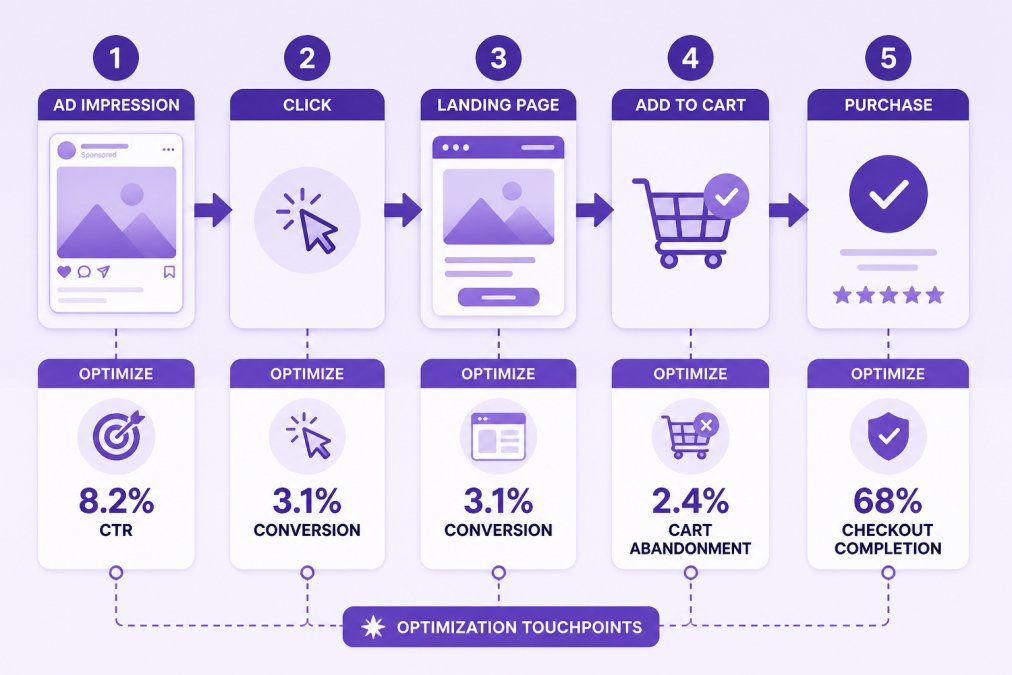
Allocate Budget Strategically and Scale High-Performing Campaigns
Budget allocation determines which campaigns get resources and which get paused. Strategic allocation focuses spending on what works and tests what might work better.
Start with a baseline budget for each campaign large enough to generate statistical significance. A minimum of 50-100 conversions per variation helps you identify real performance differences from random variation.
Monitor performance daily during the first week of a campaign. If a campaign is underperforming dramatically, pause it and redeploy that budget. If a campaign is overperforming, increase budget gradually. Doubling budget overnight often leads to performance decline because you're reaching less-qualified audiences at higher costs.
Implement a budget scaling strategy. Increase budget by 20-30% per week for high-performing campaigns, while decreasing budget for underperforming campaigns. Use your best-performing campaigns to fund testing of new audiences, creatives, or offers.
Navigate Privacy Limitations and Attribution Modeling
Privacy regulations and platform changes have fundamentally altered how you track ad performance. Adapting requires understanding what data is available and using attribution modeling to make decisions with incomplete information.
Apple's App Tracking Transparency and similar privacy initiatives limit the data platforms collect about user behavior. You can no longer track every user action across the web and app ecosystem, meaning your attribution data is incomplete.
Implement first-party data collection to fill gaps left by third-party tracking limitations. Collect email addresses, phone numbers, and customer IDs so you can match ad exposure to actual business outcomes using your own data. This requires proper consent and compliance with privacy regulations like GDPR and CCPA.
Use attribution modeling to estimate the impact of ads you can't directly measure. Multi-touch attribution distributes credit across all touchpoints and typically provides the most realistic picture of how different ads work together to drive conversions.
Understand that platform-reported conversion data is increasingly estimates rather than precise counts. Facebook's Conversion Lift Studies estimate the true impact of your ads by comparing users who saw your ads to a control group that didn't.
How to Improve Social Media Ad Performance Through Comment Management
Your ad performance doesn't end when someone clicks or converts. The comments section is where engaged users ask questions, express concerns, and decide whether to trust your brand. Managing comments effectively directly impacts your return on ad spend.
When someone comments on your ad asking a question, a slow response loses that opportunity. A fast, helpful response builds trust and moves them closer to conversion. The difference between a 2-hour response time and a 24-hour response time is measurable: faster responses lead to higher conversion rates among engaged users.
Implement a comment management system that ensures every comment gets a response. Most brands fail here, they run ads that drive engagement but lack the infrastructure to respond, resulting in wasted ad spend on traffic that could have converted.
FeedGuardians automates comment management across Instagram, Facebook, TikTok, and YouTube with AI-powered replies in your unique brand voice. The system detects questions, concerns, and spam automatically, replying to routine inquiries instantly while escalating complex issues to your team. This ensures engaged users get immediate responses while your team focuses on high-value interactions. Real-time comment moderation also protects your ad performance by removing spam, hate speech, and competitor links before they damage your brand reputation.
Improving social media ad performance requires systematic testing, precise targeting, and continuous optimization across every stage of the customer journey. Define clear objectives and KPIs before launching. Build detailed audience personas and segment your traffic. Test every element to identify what works. Scale high-performing campaigns while managing creative fatigue and implementing retargeting. Navigate privacy limitations with first-party data and attribution modeling. Most importantly, manage the comments your ads generate with the same rigor you manage the ads themselves. FeedGuardians helps you capture the full value of your ad spend by ensuring every engaged user receives immediate, authentic responses that build trust and drive conversions. Start for free and see how improved comment management directly impacts your ad performance.
Frequently Asked Questions
How do I use A/B testing to improve social media ad performance?
Start by testing one variable at a time: ad copy, creative format, audience segment, or call-to-action. Run each test for at least 3-5 days with equal budget allocation to ensure statistical validity. Track click-through rate, conversion rate, and return on ad spend for each variant. Scale the winning version and test the next variable. Most teams see 15-30% performance gains after 2-3 rounds of testing.
What metrics should I track to measure social media ad success?
Track these core metrics: click-through rate (CTR), conversion rate, cost per acquisition (CPA), return on ad spend (ROAS), and engagement metrics like likes and comments. Monitor key performance indicators tied to your campaign objectives, if brand awareness is your goal, track impressions and reach; for lead generation, focus on conversion rate and cost per lead. Use platform-native analytics plus third-party tools to connect ad performance to actual business outcomes.
How does audience targeting affect social media ad performance?
Precise audience targeting directly impacts your return on ad spend and cost per acquisition. Narrow targeting reduces wasted ad spend on irrelevant users but may limit scale. Lookalike audiences expand reach while maintaining relevance. Dynamic audience segmentation based on user behavior, demographics, and interests improves engagement metrics and conversion rates. Test broad targeting against segmented audiences to find the optimal balance for your budget and campaign objectives.
How often should I refresh my social media ad creative to avoid fatigue?
Creative fatigue typically sets in after 2-3 weeks of the same ad running at scale. Refresh your ad library every 7-10 days by rotating new creative variations while keeping top performers active. Monitor engagement metrics closely, when click-through rate drops 20-30% from baseline, it's time to refresh. Most high-performing accounts maintain a content calendar with 4-6 ad variations per campaign to test continuously and prevent audience fatigue.
What role does landing page optimization play in improving ad performance?
Your landing page directly impacts conversion rate and return on ad spend. Post-click optimization means matching your landing page messaging, offer, and design to your ad creative and audience segment. Test landing page headlines, form fields, call-to-action buttons, and load speed. A poorly optimized landing page can waste 40-60% of your ad budget. Implement attribution modeling to track which landing page variations drive the highest-quality conversions, not just clicks.
How can I manage privacy limitations and still track ad performance?
Privacy updates have limited third-party data availability, so focus on first-party data collection. Implement conversion tracking via platform pixels and server-side tracking. Use cohort-based reporting instead of individual user data. Attribution modeling helps estimate which touchpoints drive conversions when individual tracking is restricted. First-party audiences built from your email list, website visitors, and CRM data provide reliable targeting without relying on third-party cookies.
Can AI automation improve my social media ad performance?
AI-driven ad automation handles budget allocation, audience optimization, and bid management in real time, often outperforming manual optimization. Automated tools can test creative variations at scale and pause underperforming ads faster than human teams. However, AI works best when you set clear campaign objectives and provide quality training data. Monitor AI decisions regularly, automation should enhance your strategy, not replace strategic thinking about audience, offer, and creative direction.
This article was written using GrandRanker
Tired of manually moderating comments?
FeedGuardians automates spam filtering, responds to customers, and protects your brand — setup in 3 minutes.
Frequently Asked Questions
How do I use A/B testing to improve social media ad performance?
Start by testing one variable at a time: ad copy, creative format, audience segment, or call-to-action. Run each test for at least 3-5 days with equal budget allocation to ensure statistical validity. Track click-through rate, conversion rate, and return on ad spend for each variant. Scale the winning version and test the next variable. Most teams see 15-30% performance gains after 2-3 rounds of testing.
What metrics should I track to measure social media ad success?
Track these core metrics: click-through rate (CTR), conversion rate, cost per acquisition (CPA), return on ad spend (ROAS), and engagement metrics like likes and comments. Monitor key performance indicators tied to your campaign objectives—if brand awareness is your goal, track impressions and reach; for lead generation, focus on conversion rate and cost per lead. Use platform-native analytics plus third-party tools to connect ad performance to actual business outcomes.
How does audience targeting affect social media ad performance?
Precise audience targeting directly impacts your return on ad spend and cost per acquisition. Narrow targeting reduces wasted ad spend on irrelevant users but may limit scale. Lookalike audiences expand reach while maintaining relevance. Dynamic audience segmentation based on user behavior, demographics, and interests improves engagement metrics and conversion rates. Test broad targeting against segmented audiences to find the optimal balance for your budget and campaign objectives.
How often should I refresh my social media ad creative to avoid fatigue?
Creative fatigue typically sets in after 2-3 weeks of the same ad running at scale. Refresh your ad library every 7-10 days by rotating new creative variations while keeping top performers active. Monitor engagement metrics closely—when click-through rate drops 20-30% from baseline, it's time to refresh. Most high-performing accounts maintain a content calendar with 4-6 ad variations per campaign to test continuously and prevent audience fatigue.
What role does landing page optimization play in improving ad performance?
Your landing page directly impacts conversion rate and return on ad spend. Post-click optimization means matching your landing page messaging, offer, and design to your ad creative and audience segment. Test landing page headlines, form fields, call-to-action buttons, and load speed. A poorly optimized landing page can waste 40-60% of your ad budget. Implement attribution modeling to track which landing page variations drive the highest-quality conversions, not just clicks.
How can I manage privacy limitations and still track ad performance?
Privacy updates have limited third-party data availability, so focus on first-party data collection. Implement conversion tracking via platform pixels and server-side tracking. Use cohort-based reporting instead of individual user data. Attribution modeling helps estimate which touchpoints drive conversions when individual tracking is restricted. First-party audiences built from your email list, website visitors, and CRM data provide reliable targeting without relying on third-party cookies.
Can AI automation improve my social media ad performance?
AI-driven ad automation handles budget allocation, audience optimization, and bid management in real time, often outperforming manual optimization. Automated tools can test creative variations at scale and pause underperforming ads faster than human teams. However, AI works best when you set clear campaign objectives and provide quality training data. Monitor AI decisions regularly—automation should enhance your strategy, not replace strategic thinking about audience, offer, and creative direction.