
Quick Summary
| Key Insight | What You Need to Know |
|---|---|
| Most negative reviews start | Most negative reviews start with a customer who felt ignored while waiting for an answer. |
| Measure detection time, time | Measure detection time, time to first reply, public exposure, and escalation rate for one month. |
| Compare reactive cost and | Compare reactive cost and proactive cost using your own escalation volume and handling rates. |
| A strong first reply | A strong first reply acknowledges the delay and answers the question, then moves details to direct message. |
| Set alert thresholds so | Set alert thresholds so your team only sees signals that need action, not every comment. |
| Why Negative Feedback Usually | Why Negative Feedback Usually Starts Before the Review |
Quick Summary
Preventing negative customer feedback works by catching early warning signs, such as unanswered repeated questions, before a complaint goes public. Track detection time, reply time, and escalation rate, then reply quickly with an acknowledgment and a concrete next step, moving personal details to direct message.
- Most negative reviews start with a customer who felt ignored while waiting for an answer.
- Measure detection time, time to first reply, public exposure, and escalation rate for one month.
- Compare reactive cost and proactive cost using your own escalation volume and handling rates.
- A strong first reply acknowledges the delay and answers the question, then moves details to direct message.
- Set alert thresholds so your team only sees signals that need action, not every comment.
Table of Contents
- Why Negative Feedback Usually Starts Before the Review
- Proactive vs. Reactive Support: Where the Difference Shows Up
- Step 1: Set Up Early Warning Signals
- Step 2: Reach Out Before a Complaint Goes Public
- Proactive Customer Service Examples You Can Copy
- Step 3: Build Complaint Prevention Routines Your Team Can Sustain
- Booking Your First Proactive Comment Audit with FeedGuardians
- Frequently Asked Questions
Why Negative Feedback Usually Starts Before the Review
Most negative reviews don't start with a bad product. They start with a customer who felt ignored while waiting for an answer. By the time that customer posts publicly, the problem has been growing for hours or days.
Negative customer feedback is usually the end of a chain. A delayed reply, a confusing order update, or a comment nobody answered can turn a small problem into a public complaint. Preventing negative customer feedback with proactive support means catching the early signs before they reach that point.
Here is what usually happens:
- A customer asks a simple question on a post and gets no reply
- They ask again, now with more frustration in their tone
- Other people in the comments pile on
- The complaint moves to a review site or a public thread
Each step is avoidable. The earlier you notice the signal, the cheaper the fix.
Proactive vs. Reactive Support: Where the Difference Shows Up
Most comparisons of proactive and reactive support stay qualitative. They say proactive is better and leave the reader to justify the staffing cost. A more useful approach is to measure the gap on the metrics you already track, then put a dollar figure on the difference.
Start with four measurements for a single month of data:
- Detection time: the gap between a comment being posted and someone on your team seeing it
- Time to first reply: how long the customer waits for any acknowledgment
- Public exposure: the number of people who see the thread before it is resolved, which you can approximate from reach or comment count
- Escalation rate: the share of issues that move from a comment to a review site, a chargeback, or a support ticket
Reactive teams usually show long detection times and high escalation rates. Proactive teams usually show shorter detection and fewer escalations, but they also carry a monitoring cost that reactive teams avoid.
A Simple Cost Comparison
To judge whether proactive support pays off, compare the monthly cost of each model using your own figures:
- Reactive cost = (escalated issues per month × average handling cost per escalated issue) + (refunds or credits issued from public complaints)
- Proactive cost = (monitoring tool cost + staff hours spent on monitoring and early replies) + (remaining escalated issues × handling cost)
The difference between these two totals is your monthly return. If your average escalated issue takes a senior agent 45 minutes to close and your loaded hourly rate is $38, each escalation costs about $28.50 in labor before any refund is counted. Ten avoided escalations a month is roughly $285 in labor alone, which is often less than the hours it takes to staff a monitoring routine. The figures will differ for your business, so run the calculation with your own rates rather than these examples.
Watch out: Count only escalations that were genuinely prevented. Issues that would have resolved on their own inflate the savings, and a model built on inflated numbers will not survive a budget review.
Why the Workload Shifts
Reactive teams spend most of their hours on crisis handling, which is expensive per interaction and hard to plan. Proactive teams trade some of that unplanned load for scheduled monitoring and template-based early replies. The total hours do not always fall, but they become predictable, which makes staffing and scheduling easier to defend.
Step 1: Set Up Early Warning Signals
Your first move is to decide what counts as a warning sign. Waiting for angry comments is too late.
Track these signals across your social channels:
- Repeated questions about the same order, product, or policy
- Spam or scam replies that could mislead other followers
- Sudden spikes in comment volume on a single post or ad
- Negative sentiment clustering around one topic
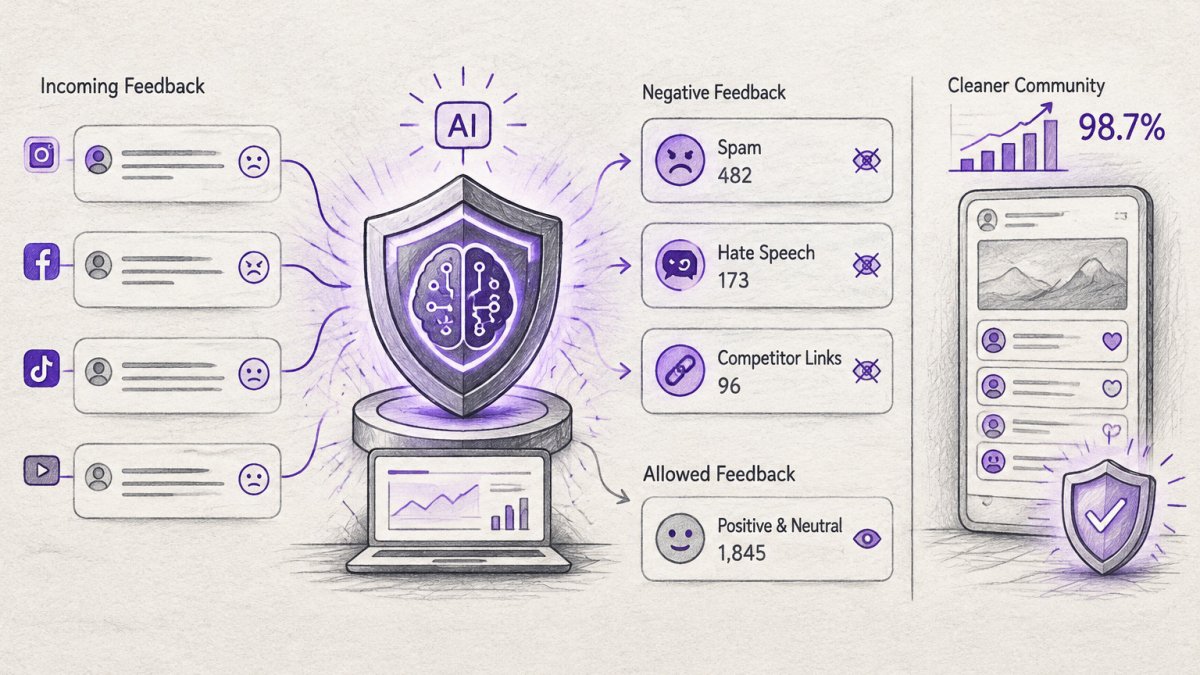
Tools such as FeedGuardians comment health score tool can scan your comment sections and flag spam, toxic comments, and negative sentiment in one view. A dashboard that shows volume trends and spam rates also helps you spot patterns before they become complaints. You can view comment trends, sentiment and spam rates in one place.
Watch out: Alerts that fire on every comment create noise. Set thresholds so your team only sees the signals that need action.
Step 2: Reach Out Before a Complaint Goes Public
An early reply is the cheapest way to stop a complaint from spreading, but it does not always work. Some customers are already past the point where a quick answer helps. The reply itself also needs to be written with the customer's state of mind in mind, not just the facts of their order.
Why Customers Escalate in the First Place
Most negative feedback follows a predictable pattern. The customer asks a simple question, receives no answer, and then reads silence as indifference. Their second message is shorter and more pointed. Once other people in the thread start agreeing with them, the goal shifts from getting an answer to being heard. A reply that ignores the frustration and only gives the fact will often fail, even when the fact is correct. You can generate brand-safe reply options, including a DM redirect from an angry comment in seconds.
This means your first reply should do two things: acknowledge the wait and answer the question. Leaving out either one tends to prompt a follow-up.
The Reply Structure
A reply that works usually has three parts:
- Acknowledgment of the delay or problem, stated plainly and without defensiveness
- The specific answer or next step, with a concrete time frame when you have one
- A redirect to direct message when the issue involves an address, order number, or account detail
"Hi [Name], sorry you've been waiting on this. I've sent you a direct message with your tracking details and a delivery estimate. Reply there if anything else is unclear."
Keep public replies short and warm. For guidance on responding to negative comments professionally, including when to delete or hide feedback, see the full guide. Put any personal detail in the DM. A public reply that asks for an order number is a common cause of a second complaint, because it asks the customer to do work while the thread is still visible.
When the Early Reply Fails
If the customer replies again with more frustration after your first response, do not send a second copy of the same message. Escalate in one of three ways:
- Offer a direct phone or chat callback if the issue is complex and the customer's tone suggests they want a human voice
- Name the specific fix you are making, such as a refund, replacement, or expedited shipment, rather than repeating the apology
- Ask one clear question that moves the case forward, instead of a list of questions that adds to the customer's effort
Watch out: A second apology with no new information usually makes the thread longer, not calmer. Each reply should change something the customer can see.
Using Templates Without Sounding Scripted
Templates speed up early replies, especially when volume is high. The risk is that a customer can tell when they are reading a canned message. Keep a small set of templates for the most common issues, then personalize the first line using the customer's own words. Quoting a detail from their comment shows the reply was written for them.
Hootsuite guide to social media customer service
Proactive Customer Service Examples You Can Copy
Strong proactive support often looks small from the outside. Here are patterns worth copying:
- Order delay notices: Message customers before they ask where their package is
- Product issue alerts: Post a short update when a known problem affects a batch
- Ad comment follow-ups: Answer the top three questions on a paid ad within an hour
- Thank-you replies to praise: Respond to good comments too, so the tone stays positive
Each example works because it answers a question the customer hasn't asked yet.
Step 3: Build Complaint Prevention Routines Your Team Can Sustain
Early alerts only help if someone acts on them. Build a routine that fits your team's size.
A workable setup looks like this:
| Routine | Owner | Frequency | Goal |
|---|---|---|---|
| Check flagged spam and toxic comments | Community manager | Daily | Remove harmful content |
| Review top repeated questions | Support lead | Weekly | Update FAQs and replies |
| Audit reply response times | Team lead | Weekly | Keep replies under target |
| Review sentiment trends | Marketing lead | Monthly | Spot recurring issues |
Automated moderation can handle the repetitive work. Automatically hide spam, insults and scam comments with keyword rules and AI so your team doesn't have to. For example, FeedGuardians automatic comment moderation can hide spam, scams, and competitor links automatically, which frees your team to focus on real customer questions.
Keep a short list of escalation rules too. Any comment that mentions a refund, injury, or legal issue should go to a human right away.
Booking Your First Proactive Comment Audit with FeedGuardians
A comment audit is the fastest way to see where negative feedback is starting. It shows which posts, ads, and platforms generate the most repeated questions and hidden complaints.
FeedGuardians offers a free plan, so you can see how its comment moderation works on your own accounts before committing. Use what you observe to pick one warning signal and one routine to start with this week.
Ready to stop complaints before they go public? Start for Free and see your comment health score in minutes.
Frequently Asked Questions
What is proactive customer support?
Proactive customer support means contacting or helping customers before they ask for help or post a complaint. It relies on monitoring signals such as delayed orders, repeated comments on the same issue, unanswered questions, and sentiment shifts in social comments. The goal is to resolve the problem while it is still private and small. Teams that do this well often start with one or two high-volume issue types, set a clear trigger for outreach, and measure whether complaints on those issues decline over the following weeks.
What are some effective strategies for preventing customer complaints?
The most effective strategies combine early detection with fast, specific communication. Track the issues that generate the most comments or inquiries, then send a message to affected customers as soon as the issue is confirmed, not after they escalate. Keep a standard set of replies for known problems, and include what happened, what you are doing, and when the customer can expect an update. Reviewing complaint themes monthly helps you fix root causes so the same issues do not repeat.
How can businesses identify customer problems before customers complain?
Watch for leading indicators rather than waiting for formal complaints. Useful signals include a spike in questions about one product or shipping status, several comments asking the same thing within a short window, negative sentiment on a specific post, and orders stuck past their expected delivery date. Assign someone to review these signals daily, and set a threshold, such as three similar comments in 24 hours, that triggers a team response. Automated moderation tools can flag these patterns so the review does not depend on manual scanning.

Tired of manually moderating comments?
FeedGuardians automates spam filtering, responds to customers, and protects your brand — setup in 3 minutes.
Frequently Asked Questions
What is proactive customer support?
Proactive customer support means contacting or helping customers before they ask for help or post a complaint. It relies on monitoring signals such as delayed orders, repeated comments on the same issue, unanswered questions, and sentiment shifts in social comments. The goal is to resolve the problem while it is still private and small. Teams that do this well often start with one or two high-volume issue types, set a clear trigger for outreach, and measure whether complaints on those issues decline over the following weeks.
What are some effective strategies for preventing customer complaints?
The most effective strategies combine early detection with fast, specific communication. Track the issues that generate the most comments or inquiries, then send a message to affected customers as soon as the issue is confirmed, not after they escalate. Keep a standard set of replies for known problems, and include what happened, what you are doing, and when the customer can expect an update. Reviewing complaint themes monthly helps you fix root causes so the same issues do not repeat.
How can businesses identify customer problems before customers complain?
Watch for leading indicators rather than waiting for formal complaints. Useful signals include a spike in questions about one product or shipping status, several comments asking the same thing within a short window, negative sentiment on a specific post, and orders stuck past their expected delivery date. Assign someone to review these signals daily, and set a threshold, such as three similar comments in 24 hours, that triggers a team response. Automated moderation tools can flag these patterns so the review does not depend on manual scanning.