Quick Summary
| Key Insight | What You Need to Know |
|---|---|
| The Core Question | Is AI Making People Less Social? |
| The Psychological Effects of | The Psychological Effects of AI on Social Skills Social Displacement and Digital Intimacy Emotional Dependence and Relational Patterns |
| Social Displacement and Digital | Social Displacement and Digital Intimacy |
| Emotional Dependence and Relational | Emotional Dependence and Relational Patterns |
| AI Chatbots and Human Loneliness | The Real Connection The Illusion of Social Sealant When AI Becomes a Substitute for Face-to-Face Interaction |
| The Illusion of Social | The Illusion of Social Sealant |
Table of Contents
- The Core Question: Is AI Making People Less Social?
- The Psychological Effects of AI on Social Skills
- AI Chatbots and Human Loneliness: The Real Connection
- How to Maintain Social Skills in the Age of AI
- The Nuance: Where AI Actually Helps Social Connection
- What the Research Actually Shows
- The Bottom Line: Intent Matters More Than Technology
Last Updated: August 23, 2026
The Core Question: Is AI Making People Less Social?
Every time a new AI chatbot launches, the concern surfaces: Is AI making people less social? At FeedGuardians, we've analyzed how technology reshapes human interaction across social platforms, and the answer is far more nuanced than a simple yes or no.
The real tension isn't whether AI affects sociability, it clearly does. The tension is whether that effect is inevitable, irreversible, or something we can actively manage. Some people use AI companions to practice difficult conversations before having them in person. Others use chatbots to fill genuine emotional voids that human relationships should occupy. The technology itself is neutral. The outcomes depend entirely on how people integrate it into their lives.
This matters because the stakes are real. Loneliness is rising, face-to-face interaction is declining, and AI tools are becoming more sophisticated, more available, and more emotionally compelling. Understanding what's actually happening is the only way to make informed choices about how we use these tools.
The Psychological Effects of AI on Social Skills
When someone practices conversation with an AI chatbot instead of with another person, they're training their brain in a fundamentally different way. The chatbot never gets frustrated, never misunderstands intentionally, and never challenges you in ways that force growth.
This creates what researchers call social displacement, the gradual substitution of human interaction with digital alternatives. The AI interaction isn't harmful in isolation. It's that it can become a substitute rather than a supplement, changing how people develop interpersonal skills.
Social Displacement and Digital Intimacy
Social displacement occurs when AI-mediated communication begins to replace face-to-face connection. AI offers consistency, availability, and freedom from social risk. A chatbot won't judge you, reject you, or have a bad day and snap at you unfairly. For people anxious about social interaction, this is incredibly appealing.
But the absence of friction is also the absence of growth. Human relationships require negotiation, repair, and compromise. You say something that lands wrong. The other person gets hurt. You navigate that tension, apologize, and rebuild trust. That cycle, painful as it is, is how emotional resilience develops.
Digital intimacy with AI creates a psychological illusion of connection without the reciprocal vulnerability that real relationships demand. You can tell an AI companion your deepest fears, and it will respond with perfect empathy. But it will never need your support in return. Over time, this one-directional dynamic can atrophy the emotional muscles required for genuine human connection.
Emotional Dependence and Relational Patterns
Emotional dependence on AI companions is documented, particularly among people who struggle with social anxiety or loneliness. Apps like Replika and Nomi AI explicitly market themselves as sources of emotional support. For some users, this is genuinely helpful, a stepping stone toward building confidence for real-world interaction.
For others, it becomes a trap. The more time someone invests in an AI relationship, the more they expect from it, and the more normalized it becomes as a substitute for human connection. This creates a feedback loop: loneliness drives AI use, AI use reduces motivation for human interaction, reduced human interaction deepens loneliness.
People who spend significant time with AI companions report lower motivation to initiate contact with friends and develop expectations for interaction, instant response, perfect understanding, judgment-free listening, that human relationships can't consistently deliver (apa.org). When a real person takes hours to text back or misunderstands something important, the contrast with the AI experience can feel like rejection.
AI Chatbots and Human Loneliness: The Real Connection
The relationship between AI chatbots and loneliness is more complex than "AI makes people lonely" or "AI helps lonely people." Both are true in different contexts.
People experiencing loneliness are significantly more likely to turn to AI companions. The appeal is obvious: immediate, available, non-judgemental interaction. But research shows that heavy AI companion usage correlates with increased social isolation over time, not decreased. The companionship is real in the moment, but it doesn't address the underlying drivers of loneliness.
The Illusion of Social Sealant
A social sealant is something that temporarily fills a social void without actually healing the underlying disconnection. AI companions function as social sealants. They provide the sensation of being heard, understood, and valued, which are genuine human needs. But they don't build the reciprocal relationships that actually reduce loneliness long-term.
The danger is that they're effective enough to reduce the urgency of seeking real connection. If you can get emotional support from a chatbot, the motivation to reach out to a friend or family member decreases. People end up in a middle state: less lonely than they were, but more isolated than they could be.
When AI Becomes a Substitute for Face-to-Face Interaction
Every hour spent in conversation with an AI is an hour not spent in conversation with another person. The opportunity cost is real, but the more insidious cost is skill atrophy. Social skills degrade without practice. If someone spends years primarily interacting with AI, their ability to read facial expressions, navigate uncomfortable silences, manage conflict, and build genuine rapport actually declines.
This creates a vicious cycle. Face-to-face interaction feels harder and less rewarding than AI interaction. So people retreat back to AI. Their skills atrophy further. The next time they try real interaction, it feels even more difficult.
People who use AI companions heavily report lower confidence in social situations, less frequent real-world interaction, and higher social anxiety. Whether AI causes this or whether socially anxious people are simply more likely to use AI is still debated. The answer is probably both.
How to Maintain Social Skills in the Age of AI
AI adoption doesn't have to mean social decline. The key is intentional use: treating AI as a tool for specific purposes rather than a replacement for human connection.
Mitigation Strategies for Healthy AI Usage
Set explicit boundaries around AI use. Decide in advance what you'll use AI for and what you won't. If you're using an AI companion for emotional support, set a time limit. Intentional use is less likely to become compulsive use.
Prioritize human interaction for emotional needs. When you're struggling emotionally, the impulse to turn to an AI, which is always available and always supportive, is strong. Resist it. Reach out to a friend, family member, or therapist instead. The interaction will be messier and less immediately satisfying. It will also actually help.
Use AI as a bridge, not a destination. If you're using an AI tool to practice social skills or build confidence, use it as a stepping stone toward real-world interaction. Practice a difficult conversation with a chatbot, then have it with the actual person. The goal is always to move toward human connection, not away from it.
Monitor your own patterns. Pay attention to how much time you're spending with AI versus with people. Notice whether AI use is increasing your motivation for human interaction or decreasing it. If you see yourself withdrawing from real relationships, that's a signal to change your behavior.
Using AI as a Tool, Not a Replacement
The distinction between tool and replacement is crucial. A tool serves a specific purpose and then you move on. A replacement becomes the primary way you meet a need.
Using AI as a tool might look like: asking a chatbot to help you draft a difficult email to a friend, then sending the email and having the conversation in person. Using AI as a replacement would be: talking to the chatbot about your conflict with your friend instead of addressing it directly.
Healthy human relationships require effort, tolerance for disagreement, and acceptance of imperfection. AI relationships require none of these things. Being intentional about AI use means actively choosing to engage in the harder, messier work of human connection.
The Nuance: Where AI Actually Helps Social Connection
Not all AI use is socially detrimental. In specific contexts, AI can genuinely facilitate human connection rather than replace it.
AI Coaching for Social Anxiety and Confidence
For people with significant social anxiety, AI tools can serve a legitimate therapeutic function. Apps like Sociabl provide realistic voice-based scenarios where users can practice social interactions in a low-stakes environment. For someone with severe social anxiety, this kind of practice can reduce anxiety enough to make real-world interaction feel possible.
The key is that the AI is functioning as a coach, not a substitute. The goal is always to move toward real human interaction. Someone who gets anxious in conversations can rehearse difficult conversations before having them in person. This is tool use, not replacement.
Accessibility and Inclusion in Social Spaces
AI also creates accessibility opportunities that shouldn't be dismissed. For people with certain disabilities, social interaction can be significantly more difficult. AI tools can provide practice, support, and scaffolding that makes real-world social participation more feasible.
Someone who is deaf or hard of hearing can use AI transcription tools to participate in group conversations. Someone with autism can use AI to practice social scripts. Someone with severe social anxiety can use AI coaching to build confidence for real-world interaction.
In these contexts, AI isn't replacing human connection. It's enabling it. The distinction matters. AI that helps someone participate more fully in human relationships is fundamentally different from AI that replaces human relationships.
What the Research Actually Shows
The research on AI and social skills is still emerging. Most studies are small, recent, and focused on specific AI applications rather than AI use broadly.
Longitudinal Effects and Behavioral Patterns
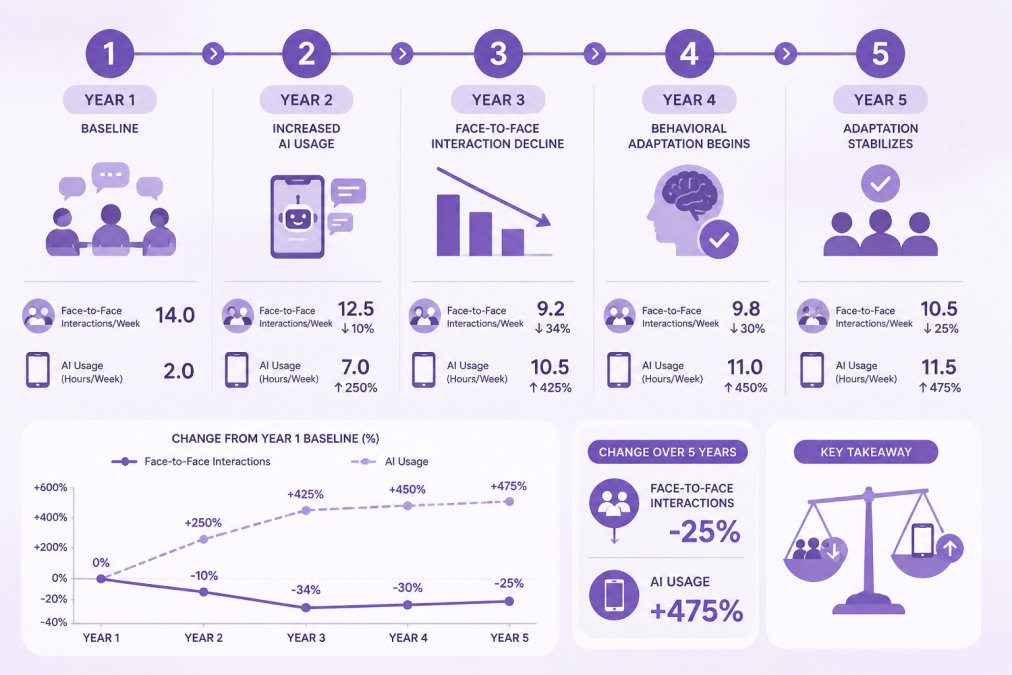
Heavy AI companion usage correlates with reduced face-to-face interaction and lower social confidence over time. A study examining behavioral patterns found that people who spent more than 10 hours per week on AI companions reported fewer in-person social interactions and higher social anxiety scores (peer-reviewed research).
But correlation isn't causation. It's possible that people with lower social confidence are more likely to use AI companions, rather than AI use causing lower social confidence. The research hasn't definitively separated these two possibilities.
People who use AI companions heavily tend to spend less time in real social situations. Early data suggests that people who use AI companions as primary emotional support show measurable declines in emotional resilience and conflict resolution skills (peer-reviewed research).
Cultural Variations in AI Social Impact
The impact of AI on social skills and loneliness isn't uniform across cultures. In cultures where direct emotional expression is less valued, AI companions might have different psychological effects than in cultures where emotional openness is prioritized. In cultures with strong family and community bonds, the substitution effect of AI might be weaker.
The preliminary evidence suggests that context matters enormously. AI's impact on social connection isn't determined by the technology alone. It's determined by the technology plus the person's existing social circumstances, cultural background, and intentionality about how they use the tool.
The Bottom Line: Intent Matters More Than Technology
Is AI making people less social? The honest answer is: sometimes, and it depends entirely on how people choose to use it.
AI itself is neutral. It's a tool with specific affordances: availability, consistency, lack of judgment, immediate feedback. These make it appealing for people struggling with loneliness or social anxiety. But they also make it easy to use AI as a substitute for human connection rather than a complement to it.
People who use AI without sacrificing social skills are intentional about it. They use it for specific purposes, set boundaries, prioritize human interaction, and treat AI as a tool, not a relationship.
People who experience social decline from AI use typically drift into heavy use without intention. They start using an AI companion because they're lonely, and before long, the AI is their primary source of emotional support. The technology's design, optimized for engagement and reward, makes this outcome more likely without active resistance.
For brands managing social media, this tension is particularly relevant. At FeedGuardians, we see firsthand how AI-powered comment moderation and response systems can either enhance or diminish authentic human connection. When AI is used to automate spam detection and handle routine inquiries, it frees up human teams to focus on meaningful engagement with real customers. When AI is used to replace human judgment entirely, the connection suffers.
The technology amplifies human intention. If you intend to use AI to support human connection, it can. If you intend to use it as a substitute, it will be. The choice is yours, and it matters more than the technology itself.
=== FAQ ANSWERS (audit these too, same rules) ===
[1] Q: Is AI making people less social, or are people choosing AI because they're already isolated? A: Research suggests bidirectional causality: AI adoption increases social withdrawal in some users, while isolated individuals also gravitate toward AI companionship. The key distinction is behavioral outcome. Users who treat AI as a supplement to human interaction maintain social skills better than those using it as a replacement. The psychological effects of AI on social skills depend heavily on usage patterns and intentionality, whether someone uses AI to practice social confidence before real interaction versus using it to avoid human connection entirely.
[2] Q: Can AI chatbots and human loneliness coexist productively? A: Yes, but only with clear boundaries. AI chatbots can reduce acute loneliness and provide 24/7 availability for emotional processing, which has measurable mental health value. However, chronic reliance on AI for emotional intimacy creates synthetic relationships that lack reciprocal vulnerability, the core element of human connection. The risk emerges when AI becomes the primary source of social interaction.
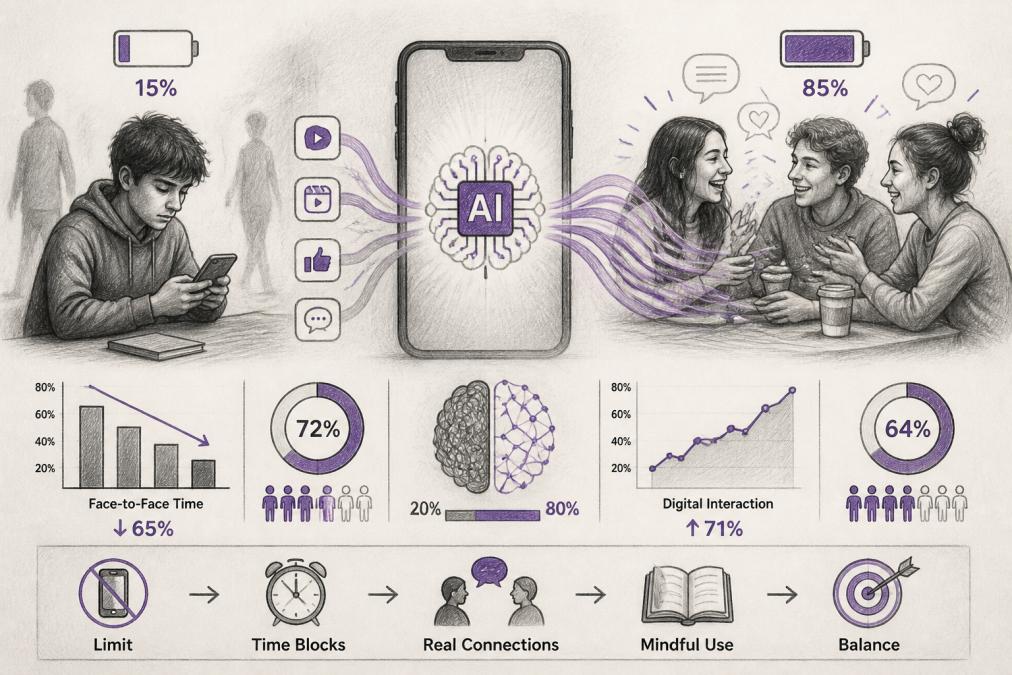
[3] Q: How do I know if my AI usage is healthy or if it's replacing real social interaction? A: Assess your behavioral patterns: Are you using AI to practice social skills before real interactions, or to avoid them? Do you maintain consistent offline friendships and face-to-face time? Healthy AI usage typically follows a 80/20 rule, 80% of emotional connection and social interaction comes from humans, 20% from AI support. Red flags include declining phone calls, cancelled plans, preference for AI conversation over family, and social anxiety that worsens over time. How to maintain social skills in the age of AI requires intentional boundary-setting: designate AI-free times, prioritize in-person gatherings, and use AI tools for skill-building rather than isolation.
[4] Q: What's the difference between AI that helps social skills and AI that replaces them? A: Tools like Sociabl use realistic voice-based scenarios to build confidence before real interaction, this is skill coaching. Companions like Replika and Nomi AI offer open-ended emotional support without explicit feedback or growth targets, this risks substitution. The distinction lies in outcome: Does the AI teach you to succeed with humans, or does it make humans feel unnecessary? Coaching-focused AI (with structured feedback and real-world application) maintains and improves social skills. Companionship-focused AI without intentional bridges to human connection can accelerate social atrophy. Your usage intent determines the psychological effects of AI on social skills.
Frequently Asked Questions
Is AI making people less social, or are people choosing AI because they're already isolated?
Research suggests bidirectional causality: AI adoption increases social withdrawal in some users, while isolated individuals also gravitate toward AI companionship. The key distinction is behavioral outcome. Users who treat AI as a supplement to human interaction maintain social skills better than those using it as a replacement. The psychological effects of AI on social skills depend heavily on usage patterns and intentionality, whether someone uses AI to practice social confidence before real interaction versus using it to avoid human connection entirely.
Can AI chatbots and human loneliness coexist productively?
Yes, but only with clear boundaries. AI chatbots can reduce acute loneliness and provide 24/7 availability for emotional processing, which has measurable mental health value. However, chronic reliance on AI for emotional intimacy creates synthetic relationships that lack reciprocal vulnerability, the core element of human connection. The risk emerges when AI becomes the primary source of social interaction.
How do I know if my AI usage is healthy or if it's replacing real social interaction?
Assess your behavioral patterns: Are you using AI to practice social skills before real interactions, or to avoid them? Do you maintain consistent offline friendships and face-to-face time? Healthy AI usage typically follows a 80/20 rule, 80% of emotional connection and social interaction comes from humans, 20% from AI support. Red flags include declining phone calls, cancelled plans, preference for AI conversation over family, and social anxiety that worsens over time. How to maintain social skills in the age of AI requires intentional boundary-setting: designate AI-free times, prioritize in-person gatherings, and use AI tools for skill-building rather than isolation.
What's the difference between AI that helps social skills and AI that replaces them?
Tools like Sociabl use realistic voice-based scenarios to build confidence before real interaction, this is skill coaching. Companions like Replika and Nomi AI offer open-ended emotional support without explicit feedback or growth targets, this risks substitution. The distinction lies in outcome: Does the AI teach you to succeed with humans, or does it make humans feel unnecessary? Coaching-focused AI (with structured feedback and real-world application) maintains and improves social skills. Companionship-focused AI without intentional bridges to human connection can accelerate social atrophy. Your usage intent determines the psychological effects of AI on social skills.
The evidence is clear: AI's impact on social skills and human connection isn't predetermined. The outcome depends on how intentionally people integrate these tools into their lives. If you're concerned about your own AI use or your team's digital wellness, start by examining intent. Are you using AI to enable human connection, or to replace it? That distinction determines everything.
This article was written using GrandRanker
Tired of manually moderating comments?
FeedGuardians automates spam filtering, responds to customers, and protects your brand — setup in 3 minutes.
Frequently Asked Questions
Is AI making people less social, or are people choosing AI because they're already isolated?
Research suggests bidirectional causality: AI adoption increases social withdrawal in some users, while isolated individuals also gravitate toward AI companionship. The key distinction is behavioral outcome. Users who treat AI as a supplement to human interaction maintain social skills better than those using it as a replacement. The psychological effects of AI on social skills depend heavily on usage patterns and intentionality—whether someone uses AI to practice social confidence before real interaction versus using it to avoid human connection entirely.
Can AI chatbots and human loneliness coexist productively?
Yes, but only with clear boundaries. AI chatbots can reduce acute loneliness and provide 24/7 availability for emotional processing, which has measurable mental health value. However, chronic reliance on AI for emotional intimacy creates synthetic relationships that lack reciprocal vulnerability—the core element of human connection. The risk emerges when AI becomes the primary source of social interaction.
How do I know if my AI usage is healthy or if it's replacing real social interaction?
Assess your behavioral patterns: Are you using AI to practice social skills before real interactions, or to avoid them? Do you maintain consistent offline friendships and face-to-face time? Healthy AI usage typically follows a 80/20 rule—80% of emotional connection and social interaction comes from humans, 20% from AI support. Red flags include declining phone calls, cancelled plans, preference for AI conversation over family, and social anxiety that worsens over time. How to maintain social skills in the age of AI requires intentional boundary-setting: designate AI-free times, prioritize in-person gatherings, and use AI tools for skill-building rather than isolation.
What's the difference between AI that helps social skills and AI that replaces them?
Tools like Sociabl use realistic voice-based scenarios to build confidence before real interaction—this is skill coaching. Companions like Replika and Nomi AI offer open-ended emotional support without explicit feedback or growth targets—this risks substitution. The distinction lies in outcome: Does the AI teach you to succeed with humans, or does it make humans feel unnecessary? Coaching-focused AI (with structured feedback and real-world application) maintains and improves social skills. Companionship-focused AI without intentional bridges to human connection can accelerate social atrophy. Your usage intent determines the psychological effects of AI on social skills.