
Quick Summary
| Key Insight | What You Need to Know |
|---|---|
| Why AI Content Moderation | Why AI Content Moderation Raises Legal Questions |
| Section 230 and AI Moderation | What It Protects |
| Automated Moderation Bias and | Automated Moderation Bias and Discrimination Risks |
| Data Privacy and User | Data Privacy and User Rights in AI Moderation |
| AI Content Moderation Best | AI Content Moderation Best Practices for Compliance |
| Preparing for New AI | Preparing for New AI Regulations |
Table of Contents
- Why AI Content Moderation Raises Legal Questions
- Section 230 and AI Moderation: What It Protects
- Automated Moderation Bias and Discrimination Risks
- Data Privacy and User Rights in AI Moderation
- AI Content Moderation Best Practices for Compliance
- Preparing for New AI Regulations
- Conclusion: Build a Defensible Moderation Strategy
- Frequently Asked Questions
Last Updated: September 9, 2026
Why AI Content Moderation Raises Legal Questions
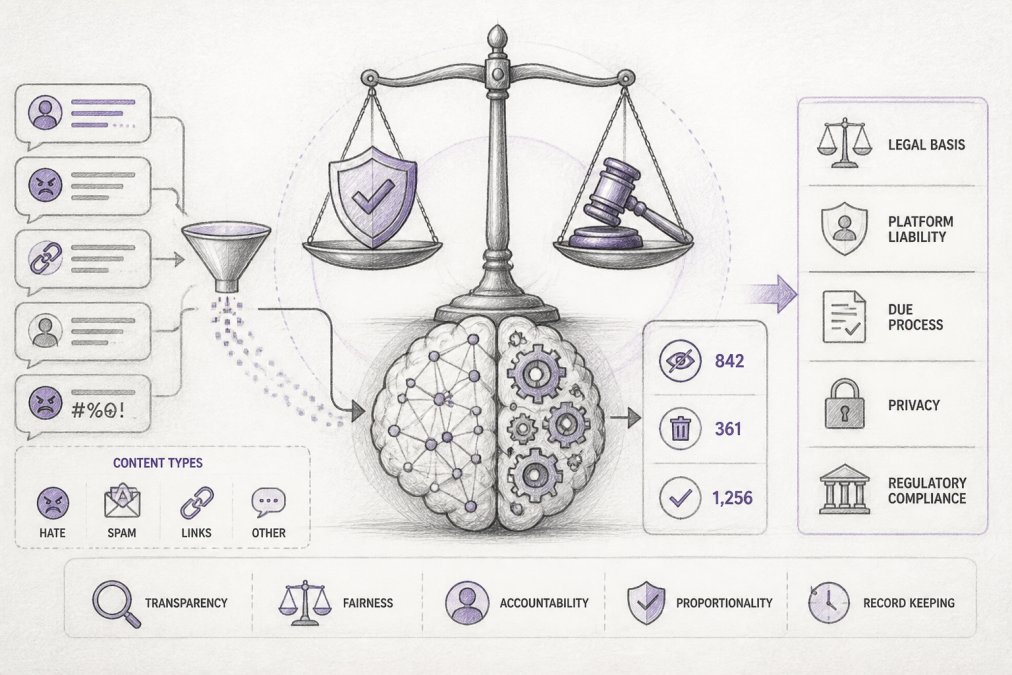
AI content moderation is the automated process of screening user-generated content against platform policies using machine learning models to filter spam, hate speech, and other violations at scale. Every comment your brand hides or leaves visible is a decision with legal weight, and the automation behind that decision introduces risks that manual review never posed. The legal implications of AI content moderation touch liability shields, discrimination law, privacy obligations, and the growing patchwork of AI-specific regulation.
The gap between what platforms promise and what the law requires is widening. A moderation error isn't just a PR problem anymore; it can become a regulatory finding or a lawsuit. Below, we'll show you exactly how to map your moderation pipeline to current legal obligations, starting with the statute that most brands misunderstand.
Section 230 and AI Moderation: What It Protects
Section 230 of the Communications Decency Act (47 U.S.C. § 230) shields interactive computer services from liability for most third-party content they host, and it protects platforms that moderate in "good faith" from civil claims over removal decisions (law.cornell.edu). The protection extends to automated filtering, which courts have generally treated the same as human editorial judgment under the statute. The leading case remains Zeran v. America Online, Inc. (1997), which established that publishers are not liable for republishing third-party content, and Roommates.com, LLC v. Preece (2008), which carved out the "material contribution" exception: if your AI system's design or prompts materially contribute to the unlawfulness of content, the shield does not apply.
The nuance that trips up operators: Section 230 is a defense against liability for user posts, not a free pass for your own conduct. The statute contains explicit exceptions that no moderation system can bypass:
- Federal criminal law: If your AI filters or the content it passes through facilitate federal crimes (child exploitation, terrorism, drug trafficking), Section 230 offers no protection.
- Intellectual property claims: The statute explicitly excludes IP claims, meaning copyright and trademark infringement liability attaches regardless of automation. The DMCA's notice-and-takedown regime operates entirely outside Section 230.
- State laws that run parallel to federal civil rights statutes: The exception in § 230(e)(2) means discrimination claims under state civil rights laws that mirror federal protections (Title VII, Fair Housing Act, ADA) can proceed even against platforms using automated screening.
Courts have also narrowed immunity where platforms materially contribute to the unlawfulness of content, a theory that could implicate poorly designed moderation prompts. In Force v. Facebook, Inc. (2019), the Second Circuit held that Facebook's algorithmic recommendations of terrorist content were not protected by Section 230 because the platform's software "urged" users to view the content, a distinction that matters for any AI system that surfaces, ranks, or suggests content rather than merely hosting it. More recently, the Supreme Court's decision in Twitter, Inc. v. Taamneh (2023) and the remand in Gonzalez v. Google LLC (2023) have left the door open for claims that recommendation algorithms constitute more than neutral tools, though the Court declined to gut Section 230 entirely.
The FOSTA-SESTA amendment (2018) added another carve-out: platforms lose immunity for content that facilitates prostitution or sex trafficking, and the law explicitly removed the "good faith" moderation protection for those claims. If your AI moderation system fails to detect trafficking indicators, you face direct liability that no automation defense can cure.
For brands, the practical takeaway is that the Electronic Frontier Foundation's explainer on Section 230 frames it correctly: the law protects your right to moderate, but it does not immunize the way you build or deploy the moderation system itself. Treat the shield as a baseline, not a strategy. Document your moderation logic, maintain version histories of your filtering rules, and be prepared to show that your AI system operates as a neutral screening tool rather than an active participant in content distribution. The distinction between "hosting" and "recommending" is where your legal exposure lives.
Automated Moderation Bias and Discrimination Risks
Automated moderation bias occurs when machine learning models systematically disadvantage protected groups through false positives, removing legitimate speech from marginalized communities at disproportionate rates. The legal exposure here is not hypothetical; civil rights statutes and state anti-discrimination laws can apply to platforms that operate as public accommodations or engage in conduct that has a discriminatory effect.
A common mistake is assuming bias is only a fairness problem. In practice, biased filtering creates due process failures: users whose content is wrongly removed often have no meaningful avenue to challenge the decision, and that lack of recourse is becoming a legal argument in itself. Some jurisdictions are exploring "meaningful human review" requirements that would force platforms to offer appeals grounded in human judgment.
Risk mitigation requires bias testing across demographic lines before deployment. Audit your training data for representational gaps, measure false positive rates across groups, and document the results. Algorithmic accountability is no longer an ethics talking point; it is becoming a compliance artifact that regulators request during investigations. small business compliance.
Data Privacy and User Rights in AI Moderation
Data privacy law intersects with AI content moderation at the point where moderation systems process user content that is itself personal data. State privacy statutes such as the CCPA in California and the CPA in Colorado grant users rights to access, correct, and delete their data, and those rights extend to content processed for moderation purposes.
The operational conflict is real: you need user content to train and refine your moderation models, but privacy frameworks restrict how you can use that data beyond the original collection purpose. Using public comments to train a moderation model can constitute a secondary use that requires separate notice or opt-out mechanisms, depending on the jurisdiction.
Transparency obligations compound the issue. Many privacy laws require disclosure of automated decision-making that produces legal or similarly significant effects, and content removal can qualify. The guidance from the International Association of Privacy Professionals on AI governance recommends documenting your lawful basis for processing, maintaining deletion protocols, and building user-facing transparency notices that explain moderation logic in plain language.
AI Content Moderation Best Practices for Compliance
Building a defensible moderation pipeline requires layering human oversight onto automated filtering and documenting every decision path. The core principle is that AI handles volume, but humans handle accountability.
| Practice | Implementation | Legal Benefit |
|---|---|---|
| Human escalation queues | Route contested removals and high-impact accounts to trained reviewers | Supports due process and appeal rights |
| Bias auditing | Test false positive rates across demographic segments before launch | Mitigates discrimination claims |
| Transparency logging | Record the rule or model version behind every action | Demonstrates good faith under Section 230 |
| Data minimization | Retain only the content needed for appeals, not full archives | Aligns with state privacy law obligations |
| Policy documentation | Publish clear content rules and appeal procedures | Establishes predictable governance |
Human-in-the-loop oversight is the single most effective compliance measure available. A system that flags high-risk content for human review before final action preserves the argument that your moderation reflects editorial judgment rather than unaccountable automation. Document reviewer training, maintain audit trails of overrides, and track how often human reviewers reverse AI decisions; those metrics become evidence of good faith if challenged.
Preparing for New AI Regulations
The regulatory landscape for AI moderation is shifting from voluntary frameworks to binding obligations, and the most significant development is the European Union's AI Act. While it is not a U.S. statute, its extraterritorial reach captures platforms that serve EU users, meaning American brands cannot ignore it. The AI Act classifies many content moderation systems as high-risk AI, triggering requirements for risk management systems, data governance, technical documentation, and human oversight. Systemic risk obligations apply to general-purpose models, and providers must conduct fundamental rights impact assessments before deployment.
But the more immediate compliance burden for U.S.-based platforms comes from the domestic patchwork that is already in force or moving through state legislatures. The absence of a federal AI law does not mean the absence of regulation; it means fragmented, sometimes contradictory obligations:
- Colorado's AI Act (SB 24-205) takes effect in 2026 and imposes duties on "developers" and "deployers" of high-risk AI systems, including content moderation tools that make decisions with legal or significant effects. It requires impact assessments, risk management policies, and consumer notices. Unlike the EU AI Act, Colorado's law creates a private right of action for discriminatory outcomes, which means a biased moderation model can land you in state court.
- California's proposed AI safety bills and the existing CCPA's automated decision-making provisions (effective 2025 under the CPRA regulations) require pre-use notices and opt-out rights for profiling that produces legal or similarly significant effects. Content removal decisions that block a user's livelihood (e.g., a creator's primary income stream) can qualify.
- New York City Local Law 144 (already in effect) applies to automated employment decision tools, but its auditing and bias-testing framework is becoming the de facto template that plaintiffs' attorneys borrow for moderation discrimination claims.
- Federal agency action: The FTC has made clear through its enforcement actions and policy statements that it will treat deceptive AI claims and algorithmic bias as unfair or deceptive acts under Section 5 of the FTC Act. The FTC's 2023 settlement with a company over its AI-powered screening tool signaled that biased automation is an unfair practice, not merely a technical flaw.
Cross-jurisdictional conflict resolution is the emerging headache that no single compliance manual solves. A removal decision that satisfies U.S. law may violate EU free expression standards, while content that is legal in the U.S. can be illegal under the EU's hate speech or disinformation rules. The EU's Digital Services Act (DSA) imposes its own content moderation transparency and appeal requirements on platforms serving EU users, and its "systemic risk" assessments for very large platforms go beyond anything U.S. law currently demands. Meanwhile, the EU AI Act's prohibition on certain social scoring and manipulation practices could capture moderation systems that U.S. platforms deploy globally.
Building a moderation policy that can express jurisdiction-specific rules is the pragmatic answer, rather than applying one global standard that maximizes legal exposure everywhere. The technical mechanism that works in practice is geo-routing with policy layering:
- Detect jurisdiction at the user or content level (IP, language, declared location, payment method).
- Apply a policy stack that layers EU-specific rules (e.g., manifestly illegal content takedown timelines under the DSA) on top of U.S. baseline rules.
- Log which policy version applied to each decision, so you can produce jurisdiction-specific audit trails when regulators ask.
- Maintain a conflict register that documents where laws diverge and which jurisdiction's rules prevailed in each decision class, with legal counsel sign-off.
A common pattern among platforms that have been through regulatory scrutiny is that they maintain a single moderation engine with jurisdiction-aware policy modules, rather than separate systems per region. This architecture lets you comply with the EU's stricter transparency rules while preserving the Section 230 good-faith defense for U.S. decisions. The legal team's job is to map each policy module to the specific statutory obligation it satisfies, and to update that mapping quarterly as new state laws take effect.
Conclusion: Build a Defensible Moderation Strategy
The legal implications of AI content moderation will only intensify as regulators catch up to the technology, and brands that treat compliance as an afterthought face the steepest costs. Start by documenting your moderation logic, layering in human review, and auditing for bias before problems surface. FeedGuardians provides an AI-powered comment moderation and response solution for brands across Instagram, Facebook, TikTok, and YouTube. It automatically detects and hides spam, hate speech, and competitor links with 98.7% accuracy, while also delivering 24/7 AI-powered replies in your unique brand voice. This real-time moderation and intelligent automation protect brand reputation and turn comments into valuable conversations and conversions. Get started with FeedGuardians and build a moderation workflow that defends your brand legally as well as socially.
Frequently Asked Questions
What are the legal liabilities for brands using AI to moderate user comments?
Brands face liability risks if their AI moderation system violates user rights. This includes claims of discriminatory censorship under civil rights laws, privacy violations from mishandling user data, and potential breach of contract with platform terms. The AI Act and Section 230 provide some protections, but they do not shield brands from all liability. A key risk is wrongful content removal that could lead to defamation claims or accusations of suppressing free expression. Implementing human review processes and clear appeals mechanisms reduces these legal exposure points.
How does Section 230 apply to AI-driven content moderation?
Section 230 generally protects platforms from liability for user-generated content they host, even when they use AI to moderate it. However, this protection has limits. The law does not shield platforms from federal criminal laws or intellectual property claims. There is ongoing debate about whether Section 230 applies when AI creates or substantially edits content rather than simply filtering it. Courts are still defining these boundaries, so brands should not assume blanket immunity. Monitoring legal developments and maintaining transparent moderation policies is essential for managing risk.
Can AI moderation tools lead to claims of discriminatory censorship?
Yes. AI systems trained on biased data can disproportionately flag or remove content from specific groups, creating a risk of discriminatory censorship claims. For example, research shows automated systems often have higher false positive rates for content from minority communities. This can violate civil rights protections and platform policies. To reduce this risk, audit your AI moderation tools regularly for disparate impact across user groups. Document your bias mitigation efforts and provide a clear appeals process for users who believe their content was wrongly removed.
What are the transparency requirements for AI content moderation systems?
Transparency requirements are growing. The AI Act mandates that high-risk AI systems, including many moderation tools, provide clear documentation about how they work. Users also have the right to know when AI makes decisions about their content. Best practice is to disclose AI moderation in your terms of service, explain why content gets removed, and offer a human review process. Keeping detailed records of your AI system's decisions and its accuracy rates helps demonstrate compliance during audits or legal challenges.
Tired of manually moderating comments?
FeedGuardians automates spam filtering, responds to customers, and protects your brand — setup in 3 minutes.
Frequently Asked Questions
What are the legal liabilities for brands using AI to moderate user comments?
Brands face liability risks if their AI moderation system violates user rights. This includes claims of discriminatory censorship under civil rights laws, privacy violations from mishandling user data, and potential breach of contract with platform terms. The AI Act and Section 230 provide some protections, but they do not shield brands from all liability. A key risk is wrongful content removal that could lead to defamation claims or accusations of suppressing free expression. Implementing human review processes and clear appeals mechanisms reduces these legal exposure points.
How does Section 230 apply to AI-driven content moderation?
Section 230 generally protects platforms from liability for user-generated content they host, even when they use AI to moderate it. However, this protection has limits. The law does not shield platforms from federal criminal laws or intellectual property claims. There is ongoing debate about whether Section 230 applies when AI creates or substantially edits content rather than simply filtering it. Courts are still defining these boundaries, so brands should not assume blanket immunity. Monitoring legal developments and maintaining transparent moderation policies is essential for managing risk.
Can AI moderation tools lead to claims of discriminatory censorship?
Yes. AI systems trained on biased data can disproportionately flag or remove content from specific groups, creating a risk of discriminatory censorship claims. For example, research shows automated systems often have higher false positive rates for content from minority communities. This can violate civil rights protections and platform policies. To reduce this risk, audit your AI moderation tools regularly for disparate impact across user groups. Document your bias mitigation efforts and provide a clear appeals process for users who believe their content was wrongly removed.
What are the transparency requirements for AI content moderation systems?
Transparency requirements are growing. The AI Act mandates that high-risk AI systems, including many moderation tools, provide clear documentation about how they work. Users also have the right to know when AI makes decisions about their content. Best practice is to disclose AI moderation in your terms of service, explain why content gets removed, and offer a human review process. Keeping detailed records of your AI system's decisions and its accuracy rates helps demonstrate compliance during audits or legal challenges.