
Quick Summary
Everything you need to know about comment moderation
| Key Takeaway | Why It Matters |
|---|---|
| Definition & Purpose | Comment moderation monitors and manages user comments to protect brand reputation and ensure positive community experiences |
| 4 Main Types | Pre-moderation, post-moderation, reactive, and AI-powered automation—choose based on volume and risk tolerance |
| Business Impact | Prevents reputation damage, ensures legal compliance, and saves 15-25 hours weekly with automation |
| Automation Benefits | AI tools automate 80-90% of moderation tasks with 95%+ accuracy, saving $900-1,700/month in labor costs |
Ever watched a single offensive comment spiral into a PR nightmare, destroying years of brand-building in minutes? You're not alone—with 500+ million daily social media comments worldwide, brands face an impossible challenge: protect your reputation and engage genuine customers while spam, bots, and trolls flood your posts 24/7.
But what if you could automatically filter harmful content, respond to customer questions instantly, and maintain brand standards—all without hiring a moderation team? This comprehensive guide breaks down exactly what comment moderation means, why it's critical for your brand, and how modern AI automation makes it affordable and effective for businesses of all sizes.
What Is Comment Moderation?
Comment moderation is the process of monitoring, reviewing, and managing user-generated comments on social media platforms, websites, blogs, and online communities. It involves filtering spam, removing inappropriate or offensive content, responding to customer questions, and maintaining community standards to protect brand reputation and ensure positive user experiences.
Think of comment moderation as your brand's first line of defense against online toxicity and chaos. Every time someone leaves a comment on your Instagram post, Facebook page, YouTube video, or blog article, that comment represents a potential risk or opportunity:
- • Risk: Spam links, offensive language, competitor advertising, misinformation, harassment, or bot activity
- • Opportunity: Genuine customer questions, positive feedback, valuable discussions, and engagement that builds community
The Evolution of Comment Moderation
Comment moderation has evolved dramatically over the past decade. In the early 2010s, most brands relied entirely on manual moderation—teams of people reviewing every single comment one by one. This worked when comment volumes were low, but became impossible as social media exploded.
Today, 90% of major brands use some form of automated comment moderation, according to UK Online Safety Act compliance research. Modern AI-powered tools can process thousands of comments per minute, automatically filtering spam while flagging edge cases for human review. This hybrid approach combines the efficiency of automation with the nuanced judgment of human moderators.
Real-World Example
Imagine you're an ecommerce brand that just posted a new product launch on Instagram. Within hours, you receive 500 comments. Among them:
- • 200 are spam bots posting "Click here for followers!" links
- • 150 are genuine customer questions about price, shipping, and availability
- • 100 are positive reactions like "Love this!" and emoji
- • 30 are competitor brand mentions trying to steal your audience
- • 15 contain offensive language or harassment
- • 5 are legitimate criticism that requires careful response
Without comment moderation, all 500 comments appear publicly, damaging your brand image and burying genuine customer questions. With effective moderation, spam gets filtered automatically, offensive content gets removed, customer questions receive instant auto-replies, and your team focuses only on the 5 comments requiring nuanced human attention.
Key Definition
Comment moderation is not about censorship—it's about creating a safe, positive environment where genuine conversations can happen while protecting your brand from spam, abuse, and inappropriate content.
Types of Comment Moderation
There are four main types of comment moderation, each with different strengths and use cases. Most successful brands use a hybrid approach combining multiple types.
1. Pre-Moderation (Manual Approval)
How it works: All comments are held for review before appearing publicly. A moderator must manually approve each comment before it's visible to other users.
Best for: High-risk industries (healthcare, finance, legal), controversial topics, or brands with low comment volume but high reputation risk.
Pros: Maximum control, prevents all inappropriate content from appearing, 100% accuracy
Cons: Slow response time (hours or days), discourages engagement, requires significant labor, doesn't scale for viral content
2. Post-Moderation (Automated Publishing)
How it works: Comments publish automatically and appear immediately. Moderators review comments after they're live and remove problematic content as needed.
Best for: Most consumer brands, ecommerce, lifestyle products, and situations where engagement speed matters more than perfection.
Pros: Fast engagement, encourages conversation, scalable, feels more authentic to users
Cons: Inappropriate content appears temporarily, requires monitoring, potential reputation risk during review delays
3. Reactive Moderation (User-Reported)
How it works: Comments publish automatically without review. Moderators only act when users report problematic content through a "report" or "flag" button.
Best for: Large communities with engaged users willing to self-police, platforms with community moderators, or very high-volume environments.
Pros: Minimal labor required, community-driven, scales to massive volumes
Cons: Relies on user participation, slow to catch unreported issues, can miss subtle violations, reactive not proactive
4. AI-Powered Automated Moderation
How it works: Machine learning algorithms automatically analyze comments in real-time, filtering spam, detecting offensive content, and responding to common questions. Human moderators review only edge cases.
Best for: Most modern brands seeking the best balance of speed, accuracy, and efficiency. Ideal for brands with 50+ comments daily.
Pros: 24/7 coverage, processes thousands of comments per second, 90-95% accuracy, saves 80-90% of moderation time, instant responses to customers
Cons: Requires setup and training, occasional false positives/negatives, subscription cost (though typically cheaper than manual labor)
Hybrid Approaches (Recommended)
Most successful brands combine multiple approaches for optimal results:
- • AI + Human Review: AI filters 90% of comments automatically, humans handle complex cases
- • Post-Moderation + AI: Comments publish automatically with AI filtering in real-time, removing spam instantly
- • Tiered Approach: Pre-moderation for sensitive topics, post-moderation with AI for routine content
Tired of manually moderating comments?
FeedGuardians automates spam filtering, responds to customers, and protects your brand — setup in 3 minutes.
Why Comment Moderation Matters for Your Business
Comment moderation isn't optional anymore—it's a business necessity. Here's why protecting and managing your comment sections directly impacts your bottom line:
1. Protecting Brand Reputation
Your comment section is public brand real estate. When potential customers visit your social media or website, they don't just see your content—they see every comment underneath. Unmoderated spam, offensive language, or competitor advertising sends a clear message: "This brand doesn't care about quality or customer experience."
According to research on social media trust, 78% of consumers judge a brand's credibility based on how they manage their social media presence—including comment quality. One viral negative comment can cost thousands in lost sales before you even notice it.
2. Legal Compliance and Regulatory Requirements
Regulations like the UK Online Safety Act and EU Digital Services Act now require platforms to proactively prevent harmful content. While these laws primarily target large platforms, they've created an expectation that all businesses moderate their comment sections responsibly. Failure to do so can result in:
- • Legal liability for hosting illegal or harmful content
- • Regulatory fines for non-compliance (especially in regulated industries)
- • Platform account bans for violating terms of service
3. Preventing Spam and Bot Attacks
Social media spam is growing exponentially. Bots now account for 40-60% of all comments on popular posts, promoting scams, phishing links, fake follower services, and competitor products. Without moderation:
- • Real customer comments get buried under spam
- • Your audience gets redirected to competitor pages or scams
- • Engagement metrics become meaningless (90% bot comments)
- • Platform algorithms may reduce your reach due to low-quality engagement
4. Improving Customer Experience and Engagement
Effective comment moderation isn't just about removing bad content—it's about creating positive experiences. When customers ask questions in comments and receive instant, helpful responses, they're:
- • 3-5x more likely to make a purchase (instant response vs. hours later)
- • 2x more likely to engage with future posts
- • 4x more likely to recommend your brand to others
Modern AI moderation tools don't just filter spam—they automatically respond to common questions about pricing, shipping, availability, and product features, turning every comment section into a 24/7 customer service channel.
5. Building Trust and Community
Well-moderated comment sections foster genuine community. When users know that spam, harassment, and offensive content will be removed quickly, they feel safe participating in discussions. This creates a positive feedback loop:
- • More genuine engagement from real customers
- • Higher-quality discussions and user-generated content
- • Stronger brand loyalty and community identity
- • Better word-of-mouth marketing and referrals
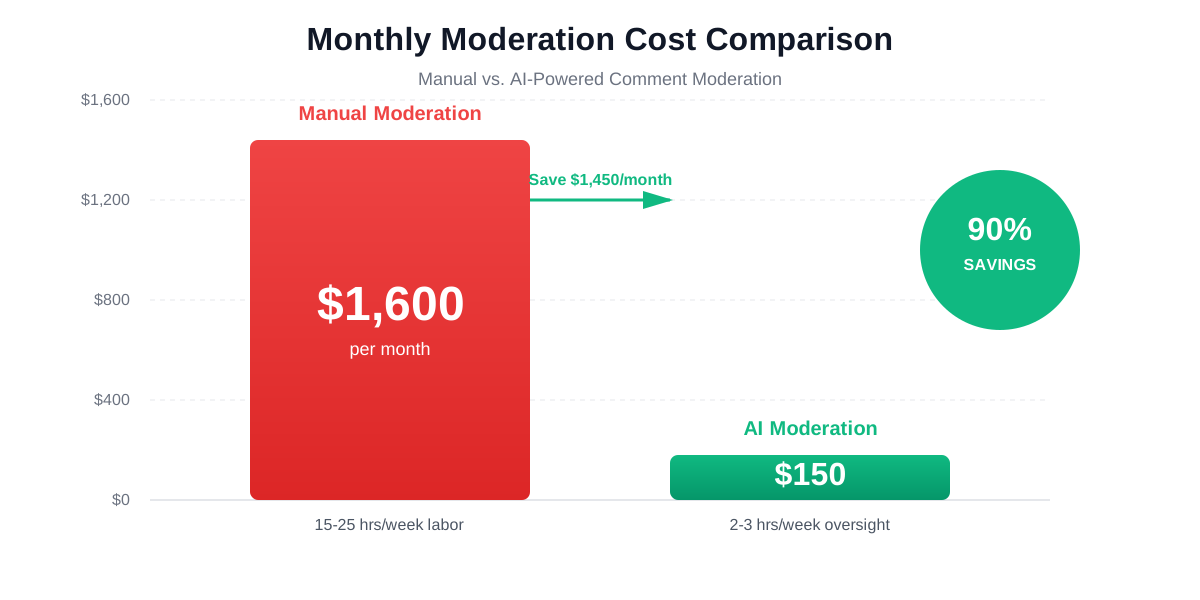
6. ROI and Cost Savings
Manual comment moderation is expensive and doesn't scale:
- • Manual moderation cost: $15-25/hour x 15-25 hours/week = $1,200-2,000/month
- • AI automation cost: $39-299/month depending on volume and features
- • Average savings: $900-1,700/month (75-85% cost reduction)
Plus, AI tools work 24/7 without breaks, preventing reputation damage during nights, weekends, and holidays when manual teams are offline.
Business Impact
Brands that implement effective comment moderation report 45% higher customer satisfaction scores, 60% reduction in negative reviews, and 80-90% time savings compared to manual moderation approaches.

How Comment Moderation Works
Understanding how comment moderation works helps you choose the right approach for your business. Here's the step-by-step process for modern AI-powered moderation:
Step 1: Keyword Filtering
The first line of defense is keyword filtering. You create custom blacklists and whitelists:
- • Blacklist: Words/phrases to automatically hide or flag (profanity, competitor brands, spam patterns like "click here")
- • Whitelist: Words/phrases that should never be filtered (your brand name, product names, common abbreviations)
- • Smart matching: Advanced tools detect variations (misspellings, special characters, emoji substitutions)
Step 2: Sentiment Analysis
AI analyzes the emotional tone of each comment:
- • Positive: Praise, excitement, satisfaction—encourage and respond
- • Neutral: Questions, general statements—provide helpful information
- • Negative: Complaints, frustration, criticism—flag for priority human review
- • Toxic: Harassment, hate speech, extreme negativity—hide or remove immediately
Step 3: Pattern Recognition
Machine learning models identify spam patterns:
- • Repetitive comments from the same account
- • Similar comments across multiple posts
- • Links to known spam domains
- • Newly created accounts with suspicious activity
- • Rapid-fire commenting (bot behavior)
Step 4: Automated Actions
Based on analysis, the system takes automatic action:
- • Approve: Legitimate comments appear normally
- • Auto-reply: Common questions get instant template responses
- • Hide/Delete: Clear spam and violations are removed
- • Flag for review: Edge cases go to human moderators
- • Alert notifications: Critical issues trigger real-time alerts
Step 5: Human Review and Continuous Learning
Human moderators review flagged comments and provide feedback to improve AI accuracy over time. This creates a learning loop:
- • AI flags 10% of comments as uncertain
- • Humans review and make final decisions
- • Feedback trains AI to handle similar cases automatically
- • Accuracy improves from 90% to 95%+ over weeks
Step 6: Team Collaboration
For brands with multiple team members, modern moderation tools include workflow features:
- • Assign specific comments to team members
- • Track who responded to what
- • Escalation rules for priority issues
- • Performance analytics and reports
Comment Moderation Best Practices
Follow these proven best practices to maximize the effectiveness of your comment moderation strategy:
1. Set Clear Community Guidelines
Before you moderate, define what's acceptable. Create clear, public community guidelines that specify:
- • What behavior is encouraged (constructive feedback, questions, positive engagement)
- • What's prohibited (spam, hate speech, harassment, competitor advertising)
- • Consequences for violations (first warning, temporary hide, permanent ban)
- • How users can appeal moderation decisions
2. Start with the Right Moderation Type
Choose your moderation approach based on your specific situation:
- • If you're risk-averse or in a regulated industry: Start with pre-moderation, then transition to post-moderation with AI as you build confidence
- • If you want fast engagement: Use post-moderation with AI filtering from day one
- • If you have low volume (<20 comments/day): Manual moderation may suffice
- • If you have high volume (>50 comments/day): AI automation is essential
3. Customize Your Filters
Generic spam filters miss industry-specific patterns. Spend 30 minutes customizing:
- • Add competitor brand names to blacklist
- • Include industry-specific spam phrases
- • Whitelist your product names and common abbreviations
- • Create auto-reply templates for top 10 customer questions
4. Balance Automation with Human Touch
AI should handle routine work, humans should handle nuance:
- • Let AI auto-filter obvious spam (90% of comments)
- • Let AI auto-respond to simple FAQs
- • Humans review criticism, complaints, and complex questions
- • Humans maintain brand voice in personalized responses
5. Monitor Performance Metrics
Track key metrics monthly to measure effectiveness:
- • Spam catch rate: % of spam successfully filtered (target: 95%+)
- • False positive rate: % of legitimate comments incorrectly hidden (target: <5%)
- • Average response time: How quickly customer questions get answered (target: <5 minutes)
- • Time savings: Hours saved vs. manual moderation
- • Customer satisfaction: Feedback on comment experience
6. Review Edge Cases Weekly
Even the best AI makes mistakes. Dedicate 15 minutes weekly to review:
- • Comments flagged as "uncertain" by AI
- • Any false positives reported by users
- • New spam patterns that got through
- • Emerging trends in customer questions
7. Be Transparent About Moderation
Users appreciate transparency. Consider:
- • Posting a brief "How We Moderate Comments" explanation
- • Providing a way for users to appeal decisions
- • Explaining why a comment was hidden (if possible)
- • Being consistent in enforcement
Comment Moderation Tools & Solutions
Modern comment moderation tools make automation accessible and affordable for businesses of all sizes. Here's what to look for:
Essential Features
- • AI spam detection: Automatically filter obvious spam with 90%+ accuracy
- • Sentiment analysis: Identify positive, negative, and toxic comments
- • Auto-responses: Instantly answer common customer questions
- • Multi-platform support: Manage Instagram, Facebook, TikTok, and more from one dashboard
- • Customizable filters: Create brand-specific moderation rules
- • Team collaboration: Assign comments to team members and track responses
- • Analytics: Monitor performance and identify trends
FeedGuardians: AI-Powered Comment Moderation
FeedGuardians offers comprehensive AI-powered comment moderation for Instagram, Facebook, and TikTok. Key features include:
- • 95%+ spam detection accuracy using advanced machine learning
- • Automated responses to common customer questions (pricing, shipping, availability)
- • Real-time sentiment analysis to flag negative comments for priority review
- • Multi-platform dashboard for managing all social media comments in one place
- • Team collaboration tools with comment assignment and tracking
- • Starting at $49/month with 7-day free trial
Learn more about AI comment moderation tools and how they compare.
When to Use Manual vs. Automated Moderation
Use manual moderation when:
- • You have very low volume (<10 comments/day)
- • Your industry is highly regulated and requires human judgment
- • You're dealing with extremely sensitive content
Use automated moderation when:
- • You receive 50+ comments daily
- • You need 24/7 moderation coverage
- • You want to reduce moderation costs by 75-85%
- • You want instant responses to customer questions
- • You're scaling your social media presence
Pro Tip
Start with a free trial to test automation on your actual content before committing. Every brand's comment patterns are unique, so real-world testing is essential to measure accuracy and ROI.
For platform-specific guidance, check out our guide on Instagram moderation tools.
Frequently Asked Questions
What does comment moderation mean?
Comment moderation is the process of monitoring, reviewing, and managing user comments on social media, websites, and online platforms. It involves filtering spam, removing inappropriate content, responding to customer questions, and maintaining community standards to protect brand reputation and ensure positive user experiences.
What are the main types of comment moderation?
The four main types are: 1) Pre-moderation (comments require approval before publishing), 2) Post-moderation (comments publish automatically then get reviewed), 3) Reactive moderation (responding to user reports), and 4) AI-powered moderation (automated filtering using machine learning). Most brands use a hybrid approach combining automation with human oversight.
Why is comment moderation important for businesses?
Comment moderation protects brand reputation, ensures legal compliance with regulations like the UK Online Safety Act, prevents spam and abuse, improves customer experience, and builds community trust. Unmoderated comments can lead to reputation damage, lost customers, regulatory fines, and platform account bans.
How much time does comment moderation take?
Manual comment moderation typically requires 15-25 hours per week for active brands, costing $1,200-2,000/month in labor. AI-powered moderation tools can automate 80-90% of this work, reducing time to 2-3 hours weekly and saving $900-1,700/month while providing 24/7 coverage.
Can comment moderation be automated?
Yes, modern AI-powered tools can automate 80-90% of comment moderation tasks including spam filtering, sentiment analysis, and automated responses. Tools like FeedGuardians use machine learning to achieve 95%+ accuracy for spam detection while handling routine moderation automatically. Human oversight is recommended for complex or sensitive situations.
Related articles
Compare the top AI-powered moderation tools with verified pricing and features.
Master Instagram comment moderation with platform-specific strategies and tools.
AI-powered Facebook moderation tools and best practices for brands.