
Quick Summary
| Key Insight | What You Need to Know |
|---|---|
| Promotional Spam | This is the most common type. Think endless posts pushing crypto schemes, dropshipping sites, or questionable affiliate links, often disguised as genuine user recommendations. |
| Phishing & Scams | These are more dangerous. The account tries to trick you into clicking a link that steals your login details, personal information, or money. |
| Malware Distribution | The riskiest of all. These accounts spread links that, if clicked, can install harmful software on your device. |
Ever scrolled through your comments and seen something that just felt... off? Maybe it was a generic "Nice pic!" from a profile with a strange username, or an out-of-place link promising a free iPhone. If so, you've met a spam account.
Think of a spam account as a digital ghost in the machine. It's a profile created not for genuine connection, but to blast out unsolicited content, from sketchy ads to flat-out malicious links. It's the modern-day telemarketer, built to broadcast a message to as many people as possible with zero regard for context or community.
What Is a Spam Account, Really?
Spam has moved far beyond your email inbox. Today, these accounts thrive on interactive platforms like Instagram, Facebook, and online forums where the conversation is fast and frequent.
These aren't just one-off annoyances. Spammers often use automation to create thousands of these profiles at once. This army of bots can then be unleashed to flood comment sections, slide into DMs with fake offers, or artificially pump up an account's follower count. They're not people looking to chat; they're tools designed to achieve a specific goal at scale.
The Real Goal: Manipulation
At its core, a spam account is all about manipulation. The goal is to deceive either the platform's algorithm or, more importantly, its human users. This can play out in a few common ways:
Promotional Spam: This is the most common type. Think endless posts pushing crypto schemes, dropshipping sites, or questionable affiliate links, often disguised as genuine user recommendations.
Phishing & Scams: These are more dangerous. The account tries to trick you into clicking a link that steals your login details, personal information, or money.
Engagement Inflation: Ever see a post with thousands of likes but only a handful of nonsensical comments? Bot networks are often used to generate fake likes, follows, and views to make an account or post seem far more popular than it actually is.
Malware Distribution: The riskiest of all. These accounts spread links that, if clicked, can install harmful software on your device.
The endgame is always to exploit attention for profit or disruption. Whether it’s a bot promising guaranteed financial returns or a fake profile leaving identical comments everywhere, the motive is never authentic interaction.
Recognizing a spam account is the first step. They are symptoms of a bigger problem—calculated campaigns that can tarnish your brand's reputation, endanger your audience, and poison the well of your online community. To protect your space, you first have to know what you're up against.
We've all seen them, but sometimes it's hard to put a finger on exactly what makes an account feel fake. This quick checklist breaks down the most common red flags.
Quick Guide to Spotting a Spam Account
| Warning Sign | What to Look For | Why It's Suspicious |
|---|---|---|
| Generic/No Profile Picture | A default avatar, a stock photo, or an image of a celebrity or model. | Real people usually upload personal photos. Spammers use generic images to create profiles in bulk. |
| Nonsensical Username | A random string of letters and numbers (e.g., "user_8kx91p") or a generic name combo. | Automated account creators often generate usernames algorithmically, resulting in these odd handles. |
| Empty or Vague Bio | The bio section is completely blank or filled with spammy links or buzzwords. | Legitimate users typically share a bit about themselves, their interests, or their work. |
| Zero or Low-Quality Posts | The account has no posts, or the few it has are low-resolution images or ads. | Spammers don't invest time in building a real profile; their goal is to spam, not to share. |
| Weird Follower-to-Following Ratio | Following thousands of accounts but has very few followers in return. | This is a classic sign of a bot trying to get follow-backs or find targets for spam. |
| Repetitive, Generic Comments | Leaving the same comment (e.g., "Great post!" or a string of emojis) on many posts. | Humans interact with nuance. Bots are programmed to post generic phrases at scale. |
| Urgent Calls-to-Action | Comments or DMs pushing you to "click the link in my bio now!" for a limited offer. | This creates a false sense of urgency, a common tactic in scams and phishing attempts. |
Keep this checklist in mind next time you're cleaning out your comments or checking a new follower. If an account ticks several of these boxes, you're almost certainly dealing with spam.
The Three Faces of Spam Accounts
Not all spam accounts wear the same disguise. If you want to fight them effectively, you have to know what you’re up against. Thinking of all spam as one big problem is like trying to fix a car without knowing what’s under the hood; you need to identify the specific part that’s broken.
Broadly, spam accounts fall into three main categories. Each has its own playbook and motivations, and telling them apart is the first step toward protecting your brand’s online community.
Automated Bots: The Tireless Workers
First, you have your automated bots. These are the foot soldiers of the spam world. No one is sitting behind a keyboard operating them in real time; they're software scripts built to do simple, repetitive tasks on a massive scale. Think posting comments, liking posts, or creating thousands of new accounts in an hour.
Picture a machine that never sleeps, programmed to drop the same sketchy link across countless comment sections. That's a bot. Their strength is sheer volume, but their weakness is their clumsiness. They often leave obvious breadcrumbs, like generic comments that don't quite fit the conversation or usernames that look like a cat walked across a keyboard.
Fake Human Profiles: The Deceptive Actors
Next up are the fake human profiles, and these are a whole lot sneakier. While some might have a bit of automation behind them, many are manually operated by people trying to look like the real deal. They’ll often use stolen profile pictures, invent a backstory, and curate a feed just to build a paper-thin layer of credibility.
Their game is usually much more targeted than a simple bot's. A fake profile might be used to:
- Run sophisticated scams, building trust with someone before dropping a malicious link.
- Spread targeted disinformation to sway opinions or just sow chaos.
- Post fake negative reviews to tank a competitor’s reputation.
Because they try so hard to mimic real human behavior, these accounts can be tough to spot. They’re the con artists of the spam world, relying on careful deception instead of brute force.
The real difference between a bot and a fake profile comes down to intent. A bot is all about widespread, low-effort noise. A fake profile, on the other hand, is usually playing a longer, more calculated game to manipulate specific people or conversations.
Compromised Accounts: The Unwitting Accomplices
Finally, there are the compromised accounts. These are legitimate profiles that belong to real people—maybe even your own followers—that have been hacked. Once a spammer gets in, they take over the account and use its built-in trust to spread their message.
This is probably the most dangerous type of spam account because it comes from a source people already know and trust. A message from a friend’s hijacked account is far more likely to get clicked, making it a perfect vehicle for phishing attacks. The scale of this is staggering; phishing is still the most common cybercrime, with an estimated 3.4 billion phishing emails sent every single day, many of which come from compromised accounts. You can check out more of these phishing statistics to see just how big the problem is.
Knowing these three faces of spam—the bot, the fake, and the hijacked—is crucial. Each one requires a different strategy for spotting and stopping it.
How to Spot a Spam Account in the Wild
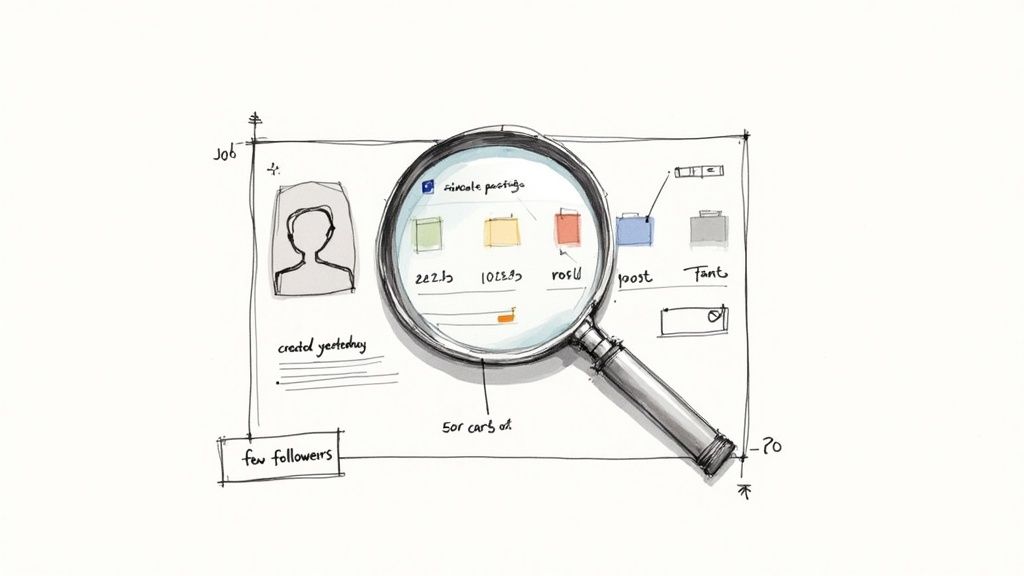
Spam accounts are designed to blend in, but they almost always leave a trail of digital breadcrumbs. Once you know what to look for, spotting them becomes second nature. Think of it like being a detective—the clues are right there if you pay attention.
The best place to start your investigation is the profile itself. Real people tend to put at least a little effort into their digital persona. Spammers, on the other hand, prioritize speed and volume, which usually results in some obvious giveaways.
Analyzing the Profile for Red Flags
A spammer's profile often looks real at a glance, but falls apart under the slightest scrutiny. The username is a great first clue. Does it look like a keyboard smash or a random string of numbers, like "user74920184"? That’s a classic sign of an account spat out by a bot.
From there, look at the profile’s core components. You’ll often find several red flags all in one place:
- Generic Profile Pictures: Spammers love using stock photos, celebrity headshots, or other pictures clearly pulled from a Google search. If an image looks a little too polished or completely out of place, trust your gut.
- Empty or Spammy Bios: The bio section might be totally blank. Or, it could be stuffed with a generic sales pitch and a shady-looking link. Real people usually write something, even if it’s just a few emojis.
- A Lopsided Follower-to-Following Ratio: One of the most telling signs is an account that follows thousands of people but has only a handful of followers. This is a common tactic bots use to get noticed and cast a wide net for potential targets.
When you see these signs together, it paints a pretty clear picture of an account that isn't there to make friends.
Examining Account Activity and Behavior
Even a carefully crafted fake profile betrays itself through its actions. The account’s activity—or lack thereof—is often the final nail in the coffin.
Let's say a new follower comments on your brand's latest post. You click on their profile and see it was created just yesterday, yet it has already blasted out 500 posts. Every single one is a low-quality ad for the same weird product. That kind of hyperactive, unnatural posting is a dead giveaway.
A real person’s feed tells a story over time. A spammer's feed looks more like a billboard, where every post is designed to sell, scam, or push you to another site. There's no personality, just a repetitive, commercial motive.
Another huge indicator is generic, out-of-context engagement. You'll see the same bland comment—like "Great post!" or a string of emojis—pasted across dozens of completely unrelated accounts. Platforms like Medium have reported a huge spike in this kind of non-genuine activity, where accounts spam hundreds of comments just to get clicks on their profile.
This isn't about building a community; it's a cold, calculated numbers game. When you spot these patterns, you can be sure you’ve found a spammer.
The True Cost of Ignoring Spam Accounts
It's easy to dismiss spam accounts as just digital noise—a minor annoyance you can clean up later. You delete a few comments, block a user, and figure you've handled it. But this approach misses the real, often hidden, damage that spam inflicts when it’s allowed to fester in your online communities.
Think of it like weeds in a garden. A few here and there don't seem like a big deal. But if you let them be, they'll eventually choke out everything you’ve worked so hard to grow. In the same way, spam accounts poison the soil of your community, making it impossible for genuine engagement to take root.
Your Brand and Community Suffer
Trust and authenticity are the cornerstones of any strong brand. When your social media posts are overrun with spam, that trust starts to crumble. A potential customer shows up hoping to see real conversations and feedback, but what they find is a wall of scams, sketchy links, and nonsensical bot comments.
This creates a genuinely awful user experience. Your real followers start to hesitate before commenting, knowing their input will just get lost in the junk. Before you know it, the people you actually want to connect with start to drift away, and your once-vibrant community space feels more like a digital ghost town. A tarnished online presence can hit your bottom line hard, and this online reputation management guide shows just how critical a clean, trustworthy digital front is.
The real damage isn't just the spam you see; it's the genuine conversations that never happen because of it. A spam-filled environment signals that a brand doesn't care about its community, which is a reputation killer.
Your Analytics Get Poisoned
Beyond what your followers see, spam accounts are silently wrecking your data behind the scenes. They inflate your metrics—likes, comments, even follower counts—giving you a completely skewed picture of how your content is performing. You might look at the numbers and think a campaign is a runaway success, but what if a huge chunk of that "engagement" is just bots?
This bad data makes it impossible to know what’s actually connecting with people. Are customers loving your new message, or are bots just clouding the results? When you can't trust your analytics, you can't make smart decisions. You end up wasting time and money on strategies that aren't actually resonating with your true audience.
You're Exposed to Serious Security and Financial Risks
The most immediate danger comes from malicious spam. These accounts are often just fronts for phishing scams, malware, and outright financial fraud aimed directly at your audience. The problem is bigger than most people realize. While phishing emails account for only 2.5% of all spam, their consequences are massive—the average cost of a phishing breach recently hit $4.88 million. You can dig into the latest breakdown of spam-related threats on Cleantalk.org to see the scale of the issue.
When one of your followers clicks a shady link in your comments and gets their data stolen, they won't just blame the scammer. They'll remember it happened on your page. Every spam comment you leave up is a potential trap for your customers, and that’s a risk no business can afford to take.
Using Platform Tools to Fight Back
Alright, so you’ve learned how to spot a spam account. Now it's time to roll up your sleeves and fight back. Platforms like Instagram, Facebook, and X (formerly Twitter) have given us some basic tools to help keep our communities clean. Think of these as your first line of defense against these digital pests.
Your two main weapons are reporting and blocking. When you report an account, you’re basically raising your hand and telling the platform's moderators, "Hey, something's not right here." Blocking, on the other hand, is more direct—it puts up a wall so that specific account can't bother you ever again.
The Standard Reporting Process
The exact buttons might be in slightly different places, but the basic drill is pretty much the same everywhere. It's a simple, multi-step process you can pull off in seconds.
- Head to the Profile: First, go to the main profile page of the account you suspect is spam.
- Find the Options Menu: Look for the three dots (...) or a similar icon. It's usually tucked away near the follow button.
- Select 'Report': From the menu that pops up, choose the report option.
- Give a Reason: The platform will ask you for a reason. Just pick the one that fits best, like "It's spam" or "Suspicious or fake."
Doing this sends a signal flare up to the platform, getting your report into their review queue. If you're getting hammered with spam comments on Facebook specifically, our guide on how to disable comments on Facebook offers some more drastic measures you can take.
So what kind of junk are these accounts actually pushing? The infographic below breaks it down pretty clearly.
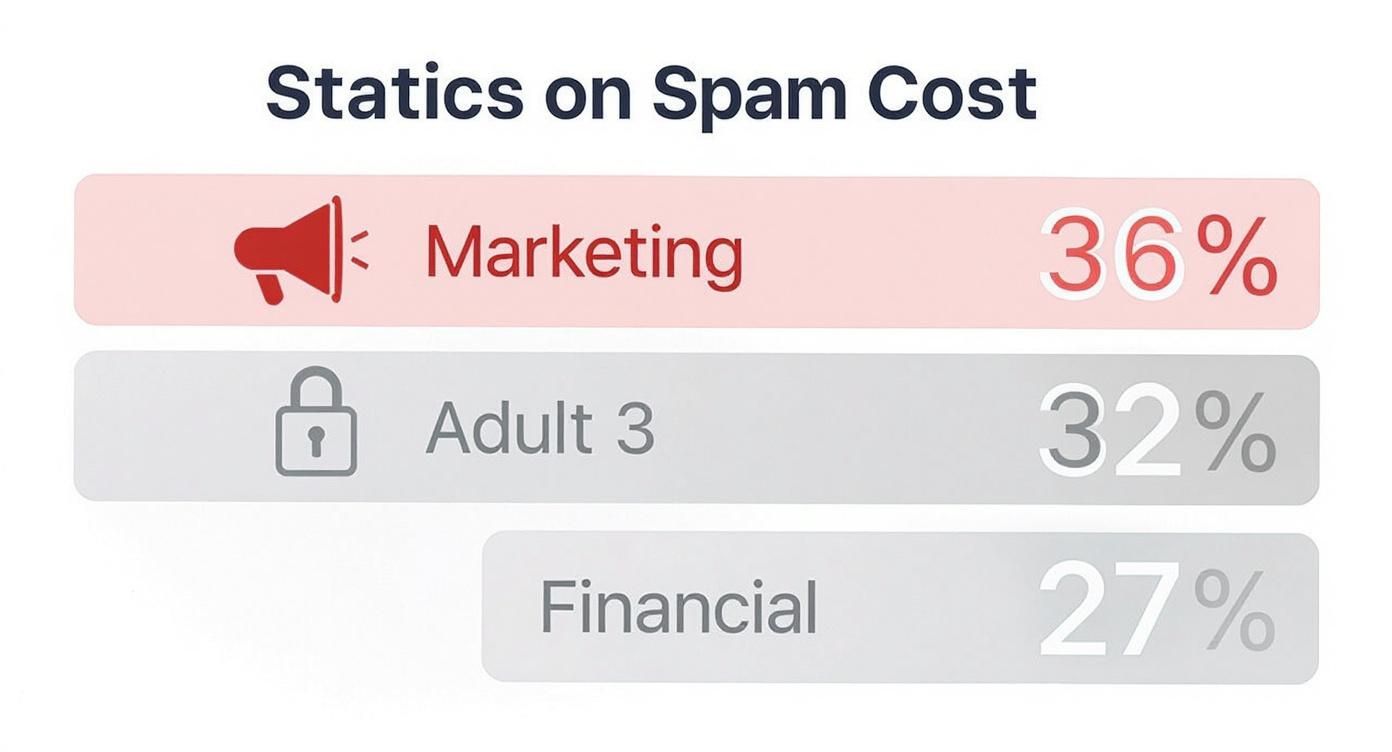
As you can see, almost all of it is driven by money or malice. That’s why being aggressive with that report button is so important for protecting your real audience.
The Limits of Manual Moderation
Here's the catch, though. While these built-in tools are essential, they have some serious limitations. Hitting 'report' doesn't mean the account vanishes instantly. Platform moderators are swamped, and it can take a while to see any action. It often feels like a frustrating game of whack-a-mole; you block one spammer, and two more take its place.
Manually reporting and blocking spam is a necessary but reactive strategy. It helps clean up the mess after it's already appeared, but it doesn't prevent the next wave of attacks from flooding your notifications.
This endless cycle of manual work can chew up a ton of time and energy that your team could be spending on things that actually matter. For any brand with a decent amount of engagement, it's just not a sustainable way to operate. This is exactly why a stronger, automated defense is needed—to protect your brand at scale and stop the spam before it ever messes with your community.
Automating Your Brand's Defense System

If manually reporting a spam account is like putting up a shield, using an automated system is like building an entire fortress around your community. Manual tools are a must-have, but they're reactive by nature. For any brand serious about growing its community without getting bogged down in moderation, a proactive defense is non-negotiable.
This is exactly where AI-powered tools step in, acting as a vigilant, 24/7 guard. Think of it as a system that instantly spots and hides spam comments the moment they're posted, blocks malicious accounts on sight, and hands you clear, actionable data on the attacks you've successfully deflected.
How Automated Protection Works
Imagine you've just launched a new product. Instead of your social media manager frantically deleting a flood of spam comments, an automated system is already handling it, silently and instantly. This isn't just a basic keyword filter, either. Today's sophisticated tools analyze a whole range of signals to understand an account's true intent:
- Behavioral Analysis: Is the account spamming the same link over and over? Is it copy-pasting the same comment at dozens of different users?
- Content Recognition: Does the comment include obvious phishing links, crypto scams, or other malicious content?
- Account History: Is this a brand-new account with zero followers and a history of nothing but spammy activity?
These systems are designed to learn and get smarter over time, adapting to new threats as they emerge. This frees you up to focus on what actually grows your brand: talking to real customers and nurturing a genuinely healthy community. You can dive deeper into the different kinds of AI comment moderation tools for 2025 and see how they fit into a modern social media strategy.
The real power of automation lies in shifting your strategy from cleanup to prevention. You're not just mopping up messes; you're stopping the problem at the source, keeping your community safe and welcoming for everyone else.
And make no mistake, this problem goes far beyond your social media feeds. In the U.S. alone, spam text messages from automated accounts hit an estimated 78 billion in just the first six months of a recent year. The financial damage from these scams climbed to around $13 billion. As spammers become more relentless, an automated defense stops being a luxury and becomes an absolute necessity. You can find more details in these spam and scam statistics.
Frequently Asked Questions About Spam Accounts
Once you start digging into the world of spam accounts, a lot of questions pop up. It's a confusing space, so let's clear up some of the most common ones with quick, straightforward answers.
Why Am I Suddenly Seeing So Much Spam?
If it feels like your accounts are suddenly under siege by spam, there's a good reason. Spammers are opportunists. They often latch onto growing accounts or trending hashtags because that’s where the eyeballs are. A sudden spike in spam can actually be a sign that your content is finally getting the traction it deserves—it just comes with an unfortunate side effect.
This isn't just a "you" problem; it's an industry-wide headache. On some platforms, automated traffic is so rampant it's like trying to have a conversation in a room full of shouting robots. This is exactly why staying on top of moderation is no longer a "nice-to-have," but a critical part of managing any online presence.
Is It Better to Block or Report a Spam Account?
The best approach? Do both. Think of it as a one-two punch.
- Reporting is your contribution to the greater good. You're flagging the account for the platform's review team, which helps them spot patterns and shut down entire networks of bad actors. It protects the whole community.
- Blocking is for your own peace of mind. It immediately stops that specific account from bothering you ever again. It's the instant fix.
When you report and then block, you’re not just solving your own problem—you're helping make the platform safer for everyone else. It’s like weeding your own garden while also letting the city know about an invasive species.
Remember, every report you submit is a crucial data point for the platforms. It might feel like a drop in the ocean, but collectively, these reports are what power the fight against the massive tide of automated spam.
Can Spam Accounts Harm My SEO?
This is a great question with a nuanced answer. Spam comments on your Instagram or Facebook posts won't directly tank your website's Google ranking. Search engines are smart enough to separate the two.
However, the indirect damage can be significant. When your comment sections are a wasteland of spam, it trashes your brand’s reputation and makes real followers hesitant to engage. Over time, that drop in genuine interaction can signal to social media algorithms that your content isn't as valuable, which can hurt your reach and, by extension, the traffic you drive to your site.
Tired of playing whack-a-mole with spammers? FeedGuardians is your 24/7 automated defense. Our AI instantly hides harmful comments and blocks malicious accounts so you can focus on what matters. Protect your brand and get your time back. See how it works at https://feedguardians.com.
Tired of manually moderating comments?
FeedGuardians automates spam filtering, responds to customers, and protects your brand — setup in 3 minutes.