
Quick Summary
| Key Insight | What You Need to Know |
|---|---|
| What Is a YouTube | What Is a YouTube Shorts Music Finder? |
| How to Identify Song | How to Identify Song From a Video Link Using URL Analysis to Extract Audio Metadata AI-Powered Audio Fingerprinting Methods |
| Using URL Analysis to | Using URL Analysis to Extract Audio Metadata |
| AI-Powered Audio Fingerprinting Methods | AI-Powered Audio Fingerprinting Methods |
| Step-by-Step Guide to Song Recognition Step 1 | Copy the YouTube Shorts URL Step 2: Submit to Music Recognition Tool Step 3: Review Metadata and Artist Attribution |
| Step 1 | Copy the YouTube Shorts URL |
Table of Contents
- What Is a YouTube Shorts Music Finder?
- How to Identify Song From a Video Link
- Step-by-Step Guide to Song Recognition
- Finding Trending Audio for YouTube Shorts
- Using Copyright Free Music for YouTube Shorts
- Why Music Identification Fails and How to Fix It
- Copyright and Fair Use Considerations
- Conclusion
Last Updated: August 28, 2026
What Is a YouTube Shorts Music Finder?
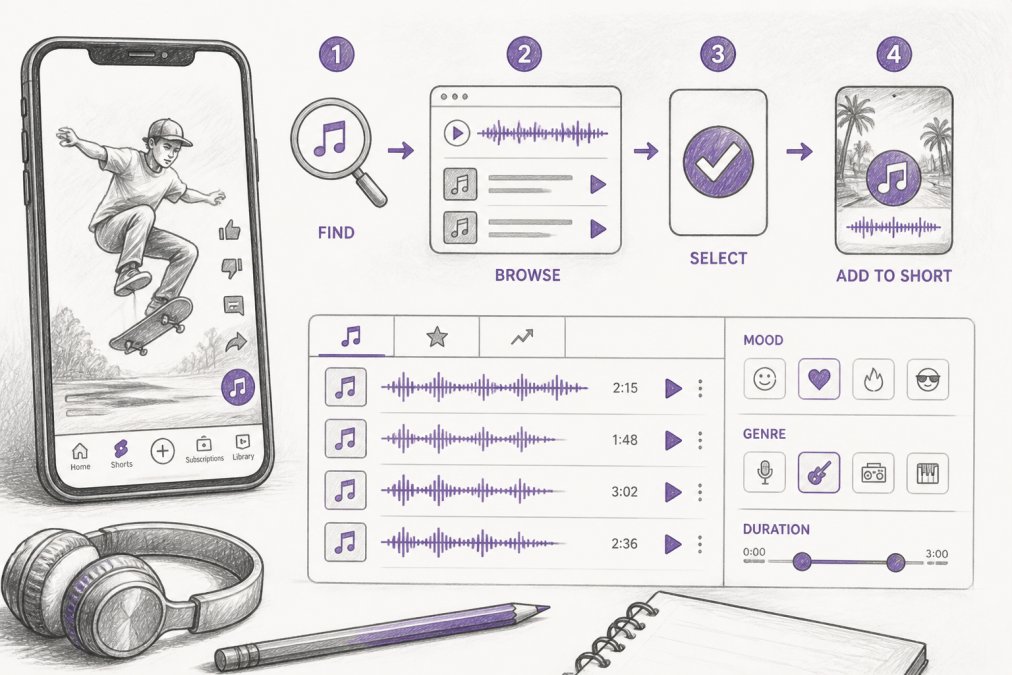
A YouTube Shorts music finder is a tool or method that identifies songs playing in short-form video content by analyzing audio data, metadata, or video URLs. These tools use audio fingerprinting, URL analysis, and AI-powered recognition engines to match audio segments against vast music databases, returning track titles, artist names, and direct links to streaming platforms.
The core challenge is that YouTube Shorts often feature background music, remixed tracks, or audio segments that aren't immediately obvious from the video itself. Creators and social media managers often struggle with this problem regularly, they need to identify music quickly to credit artists, find trending audio for their own content, or verify copyright compliance before posting. A YouTube Shorts music finder solves this by automating what would otherwise require manual searching or guesswork.
Most music identification tools work in real-time, accepting a video URL and returning results within seconds (peer-reviewed research). Some use frequency analysis and waveform matching to identify exact tracks, while others rely on metadata extraction from the video platform itself. The best tools handle edge cases like remixed or slowed/reverb versions, which standard recognition engines often miss.
How to Identify Song From a Video Link
Identifying a song from a YouTube Shorts video link requires understanding two core approaches: URL analysis that extracts embedded metadata, and AI-powered audio fingerprinting that matches audio signatures against music databases.
Using URL Analysis to Extract Audio Metadata
URL analysis works by parsing the video link itself to access metadata YouTube stores about the content, including any music or audio information the platform has indexed. This method is fast because it doesn't require downloading or processing the actual audio file.
When you submit a YouTube Shorts URL to a music recognition tool, the system first checks if YouTube's own database has already identified the audio. YouTube maintains metadata about copyrighted music used in videos, and many recognition tools tap into this data directly. If the track is copyrighted and properly registered, the metadata extraction returns immediate results: track title, artist, album art, and direct links to Spotify, Apple Music, or YouTube Music.
The limitation of URL analysis alone is that it only works for officially registered, copyrighted music. User-generated remixes, independent releases, or obscure tracks may not appear in YouTube's metadata index. For these cases, the tool must fall back to audio fingerprinting.
AI-Powered Audio Fingerprinting Methods
Audio fingerprinting is a digital signal processing technique that creates a compact mathematical representation of an audio segment, essentially a "fingerprint" unique to that track (peer-reviewed research). Unlike traditional fingerprints, audio fingerprints remain consistent even if the audio is compressed, sped up, slowed down, or played at different volumes.
The process works like this: the tool downloads the audio from the YouTube Shorts URL, extracts a 10-30 second sample, and converts it into frequency data. This frequency analysis identifies the dominant pitches, rhythms, and spectral characteristics. The fingerprint is then compared against millions of pre-computed fingerprints in the music database. When a match is found, the tool returns the track metadata.
AI-powered engines improve on basic fingerprinting by learning patterns in music data. They can identify remixed or slowed/reverb versions by recognizing the underlying harmonic structure, even when the tempo or pitch has shifted. Some advanced systems also use machine learning to handle live recordings or acoustic covers, where the audio differs significantly from the studio version.
Step-by-Step Guide to Song Recognition
The process of identifying a song from a YouTube Shorts link follows a consistent workflow. Here's how to do it efficiently.
Step 1: Copy the YouTube Shorts URL
Open the YouTube Shorts video you want to identify. Tap the share icon (usually three dots or a share symbol), then select "Copy link" to grab the full URL. The URL will look like youtube.com/shorts/[video-id] or similar.
Make sure you copy the complete link, not a shortened version. Some music recognition tools work better with the full, unshortened URL because they can extract more metadata directly from YouTube's servers.
Step 2: Submit to Music Recognition Tool
Paste the URL into a dedicated music recognition tool's input field. Most tools have a simple interface: URL input box, submit button, and results display. Hit submit and wait for processing.
The tool will analyze the video's audio and metadata. If the music is in the platform's database, results appear within 10-30 seconds. Results typically include the track title, artist name, album information, and direct links to streaming platforms like Spotify, Apple Music, or YouTube Music.
If the first attempt returns no results, some tools offer a "retry with fingerprinting" option, which runs a deeper audio analysis. This is particularly useful for remixed or slowed/reverb tracks that might not match on the first pass.
Step 3: Review Metadata and Artist Attribution
Once results appear, verify the information. Check the track title and artist name against the video to confirm accuracy. Legitimate music recognition tools display confidence scores, a score above 90% indicates high certainty.
Use the streaming links provided to verify the track on your preferred platform. This double-check ensures you're crediting the correct artist and can properly attribute the music if you plan to reuse it.
If you're using the music for your own YouTube Shorts content, note the artist and track name for proper attribution in your video description or credits. Many platforms require this for copyright compliance.
:::warning If a tool returns multiple possible matches, always verify the top result by listening to a preview on the streaming platform. Misidentification can lead to incorrect attribution or copyright claims on your own content. ::: find viral content.
Finding Trending Audio for YouTube Shorts
Identifying trending audio is different from identifying existing music in a video. Instead of recognizing a specific track, you're discovering what audio is popular among creators right now.
YouTube Shorts itself has a built-in audio library visible when you create a new Shorts video. This library shows trending sounds, categorized by genre and popularity. The most popular audio clips appear at the top, updated daily based on how many creators are using them.
You can also use third-party social media analytics tools to track trending audio. These platforms monitor which sounds are being used most frequently across YouTube Shorts, TikTok, and Instagram Reels, then rank them by engagement and creator adoption. Knowing what's trending helps you create content that resonates with current audience preferences.
Direct links to streaming platforms for trending audio are less useful than the audio library itself, since trending Shorts audio often originates from YouTube's own library or from independent creators. The value is in discovering what sounds are driving engagement, then either licensing that audio for your own content or creating content that complements the trend.
Using Copyright Free Music for YouTube Shorts
Copyright-free music, also called royalty-free or Creative Commons licensed music, eliminates the risk of copyright strikes or takedown notices on your YouTube Shorts content.
Several platforms provide copyright-free music libraries. YouTube Audio Library (built directly into YouTube Studio) offers thousands of free tracks and sound effects. Other services like Epidemic Sound, Artlist, or Free Music Archive provide searchable databases of copyright-free music organized by genre, mood, and length.
When selecting copyright-free music for YouTube Shorts, look for tracks under 60 seconds, since Shorts typically run 15-60 seconds. Shorter tracks loop better and feel less repetitive. Many copyright-free libraries let you filter by duration, making this easier.
Always check the license terms. Some copyright-free music requires attribution in your video description, while others allow commercial use without credit. Reading the license before using the track prevents future disputes.
Direct links to copyright-free music libraries should be bookmarked if you create Shorts regularly. This saves time during your content production workflow, you can quickly find, preview, and download music without navigating multiple sites.
Why Music Identification Fails and How to Fix It
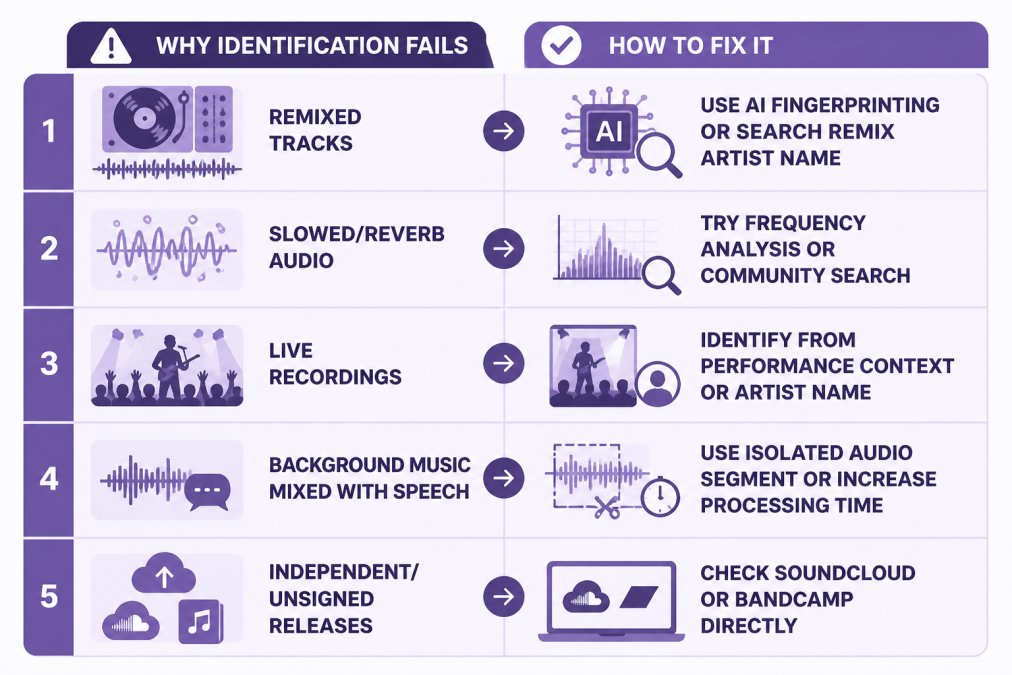
Music identification tools work well for mainstream, studio-recorded tracks in clean audio environments. They struggle when audio is heavily modified, mixed with background noise, or sourced from independent creators.
Handling Remixed or Slowed/Reverb Tracks
Remixed and slowed/reverb versions of songs present a unique challenge for audio fingerprinting. When a track is remixed, the tempo, pitch, or instrumentation changes significantly. When audio is slowed down (common in lo-fi and chill genres), the frequency data shifts, making standard fingerprint matching fail.
Advanced AI-powered recognition engines handle this by identifying the harmonic core of a track, the underlying melody and chord progression, rather than relying solely on tempo or pitch. These systems can recognize that a slowed version of a song is still the same song, even though the fingerprint looks different.
If a tool fails to identify a remixed or slowed track, try these fixes: use a tool specifically designed for remix detection, search for the remix artist's name if visible in the video, or ask in music communities like Reddit's r/tipofmytongue or music-specific Discord servers. Crowdsourced identification often works when automated tools fail.
Mobile-Specific Workflows for Quick Identification
Mobile devices present workflow challenges because copying URLs and submitting them to web-based tools requires switching between apps. The fastest mobile workflow uses dedicated mobile apps for music recognition rather than browser-based tools.
Apps like Shazam, SoundHound, or platform-specific tools often have direct YouTube Shorts integration, allowing you to identify audio without leaving the YouTube app. Some tools include a "listen" or "tap to identify" button that activates your phone's microphone to capture audio directly from the video playing on your screen.
For creators managing multiple YouTube Shorts accounts, mobile workflows become even more efficient when you use a tool that integrates with your account management software. FeedGuardians helps you manage YouTube comments and engagement at scale, and when combined with music identification workflows, it simplifies the entire content creation and moderation process.
The key is reducing app-switching friction. Test a few mobile-friendly tools and stick with whichever requires the fewest steps between identifying a song and getting results.
Copyright and Fair Use Considerations
When identifying music from YouTube Shorts, you're engaging with copyrighted content. Understanding copyright and fair use protects you from legal issues.
Fair use allows limited use of copyrighted material for purposes like commentary, criticism, education, or parody (copyright.gov). Simply identifying and crediting a song is not fair use, it's just attribution. However, using a small audio segment from a copyrighted track in your own Shorts video for transformative purposes (like creating a parody or commentary) may qualify as fair use under certain conditions.
The safest approach is to use copyright-free music for your own YouTube Shorts or to license copyrighted music through YouTube's licensing system. When you use copyrighted music without permission, YouTube's Content ID system automatically detects it (through audio fingerprinting) and either blocks the video, mutes the audio, or claims the revenue for the copyright holder.
If you're identifying music in someone else's Shorts video purely to credit the artist or find the track for personal listening, that's not a copyright concern. You're not reproducing or distributing the work, you're just identifying it.
For creators using music identification tools to audit their own content or ensure compliance before posting, FeedGuardians can help by flagging comments that mention copyrighted music or that might indicate potential copyright issues in your video descriptions. This proactive approach prevents strikes and keeps your account in good standing.
Identifying music from YouTube Shorts links is essential for creators, social media managers, and content curators. Whether you're discovering trending audio, crediting artists, or ensuring copyright compliance, the right combination of tools and workflows saves hours of manual searching. Start with URL-based analysis for quick results on mainstream tracks, then layer in audio fingerprinting for remixes and independent releases. Mobile workflows matter, choose tools that reduce friction between identifying a song and getting results. At FeedGuardians, we understand that managing content at scale requires efficiency across every step, from identifying music to moderating comments and protecting your brand reputation. The faster you can identify and verify audio, the faster you can create and publish Shorts with confidence.
Frequently Asked Questions
How can I identify music from YouTube Shorts?
Use a YouTube Shorts music finder tool by copying the Short's URL and submitting it to an AI-powered music recognition platform. The tool uses audio fingerprinting and frequency analysis to extract the audio segment and match it against a music database. Results typically include the track title, artist name, and direct links to streaming platforms. Most tools also detect remixed or slowed versions of popular tracks.
Can I identify a song from a YouTube Shorts video link directly?
Yes. Many music recognition tools accept video URLs directly. They analyze the embedded audio through metadata extraction and real-time recognition algorithms. Simply paste the YouTube Shorts link into the tool, and it will process the audio without requiring you to download or extract it manually. This works best for original audio and commercially released tracks in the music library.
What's the difference between copyright free music and identifying existing tracks?
Copyright free music is licensed for use without royalty payments, while identifying existing tracks tells you what song is playing. When creating YouTube Shorts, you can use copyright free music from libraries to avoid strikes. However, if you're analyzing someone else's Short or need to credit music in your own, a music finder helps you identify the exact track and artist attribution for proper licensing compliance.
Why might a music finder fail to identify a song?
Identification fails when tracks are heavily remixed, slowed down, or layered with background music. Live audio, user-generated content with multiple sound sources, and obscure or independently released tracks often don't match the music database. Mobile-specific issues like poor audio quality or timestamp precision problems can also affect results. Try isolating the audio segment or using batch processing tools for better accuracy.
This article was written using GrandRanker
Tired of manually moderating comments?
FeedGuardians automates spam filtering, responds to customers, and protects your brand — setup in 3 minutes.
Frequently Asked Questions
How can I identify music from YouTube Shorts?
Use a YouTube Shorts music finder tool by copying the Short's URL and submitting it to an AI-powered music recognition platform. The tool uses audio fingerprinting and frequency analysis to extract the audio segment and match it against a music database. Results typically include the track title, artist name, and direct links to streaming platforms. Most tools also detect remixed or slowed versions of popular tracks.
Can I identify a song from a YouTube Shorts video link directly?
Yes. Many music recognition tools accept video URLs directly. They analyze the embedded audio through metadata extraction and real-time recognition algorithms. Simply paste the YouTube Shorts link into the tool, and it will process the audio without requiring you to download or extract it manually. This works best for original audio and commercially released tracks in the music library.
What's the difference between copyright free music and identifying existing tracks?
Copyright free music is licensed for use without royalty payments, while identifying existing tracks tells you what song is playing. When creating YouTube Shorts, you can use copyright free music from libraries to avoid strikes. However, if you're analyzing someone else's Short or need to credit music in your own, a music finder helps you identify the exact track and artist attribution for proper licensing compliance.
Why might a music finder fail to identify a song?
Identification fails when tracks are heavily remixed, slowed down, or layered with background music. Live audio, user-generated content with multiple sound sources, and obscure or independently released tracks often don't match the music database. Mobile-specific issues like poor audio quality or timestamp precision problems can also affect results. Try isolating the audio segment or using batch processing tools for better accuracy.