
Quick Summary
| Key Insight | What You Need to Know |
|---|---|
| What AI Moderation Actually | What AI Moderation Actually Does for UGC Platforms |
| How AI Moderation Works | From Machine Learning to Real-Time DetectionText, Image, and Video ClassificationThe Human-in-the-Loop Layer |
| Text, Image, and Video | Text, Image, and Video Classification |
| The Human-in-the-Loop Layer | The Human-in-the-Loop Layer |
| Automated Content Moderation Tools | What to Compare |
| Best Practices for UGC | Best Practices for UGC Moderation That Scales |
Table of Contents
- What AI Moderation Actually Does for UGC Platforms
- How AI Moderation Works: From Machine Learning to Real-Time Detection
- Automated Content Moderation Tools: What to Compare
- Best Practices for UGC Moderation That Scales
- AI Content Moderation Challenges: Bias, False Positives, and Latency
- Cost-Benefit Analysis: What AI Moderation Really Saves SMEs
- Privacy and Data Sovereignty: The Overlooked Requirement
- Conclusion
- Frequently Asked Questions
Last Updated: September 11, 2026
What AI Moderation Actually Does for UGC Platforms
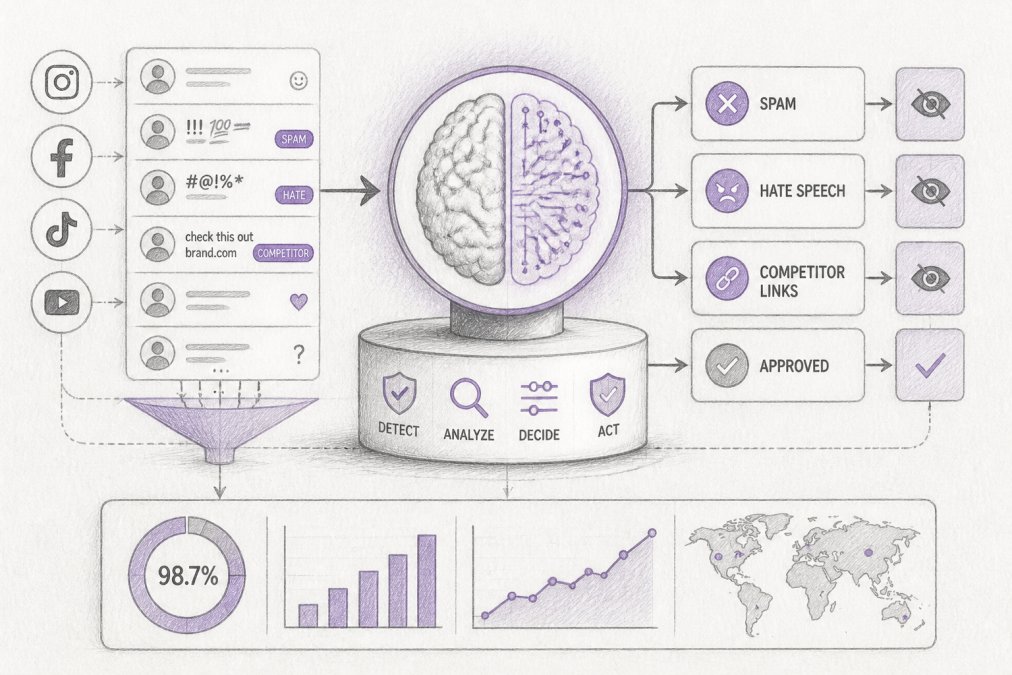
AI moderation for user generated content platforms is the use of machine learning algorithms to automatically detect, classify, and act on harmful content such as spam, hate speech, scams, and competitor links before a human reviewer ever sees it. At FeedGuardians, we've watched this shift move from optional add-on to baseline requirement for any brand running comments at volume. The core job is simple: catch what violates your community guidelines, hide it fast, and leave the legitimate conversation untouched.
That distinction matters more than most teams realize. A moderation system that hides too little lets toxic language and scam links sit under your ads. One that hides too much silences real customers. Below, we'll break down how the technology works, where it fails, and how to build a moderation workflow that scales without wrecking your brand voice.
How AI Moderation Works: From Machine Learning to Real-Time Detection
Automated content moderation tools combine several detection models into one pipeline. Text passes through natural language processing (NLP) models trained on toxic language, hate speech detection datasets, and spam patterns. Images and video frames go through image recognition and classification models. Each output gets a confidence score, and your thresholds decide what happens next: auto-hide, flag for review, or allow.
The key insight: no single model does everything. A comment like "great product, check my link" reads as positive sentiment but functions as spam. That's why sentiment analysis alone is a weak moderation signal.
Text, Image, and Video Classification
Text classification handles the bulk of comment moderation. It flags harassment, threats, and policy violations using models trained on labeled examples. Image recognition catches inappropriate material, banned logos, and visual spam that text filters miss entirely.
Video moderation is the hardest. Most platforms sample frames rather than analyze every second, which means a violation between sampled frames can slip through. Latency climbs as resolution and frame rate increase.
The Human-in-the-Loop Layer
Human-in-the-loop moderation keeps people in charge of edge cases. The AI handles the clear-cut 90% and escalates the ambiguous 10% to a reviewer with context and judgment the model lacks. This hybrid model catches sarcasm, in-group slang, and cultural nuance that pure automation misreads. A common mistake is removing the human layer entirely to cut costs, then discovering the false-positive rate drives customers away.
Automated Content Moderation Tools: What to Compare
Choosing a tool comes down to four criteria: modality coverage, integration depth, customization, and how the system handles your brand voice. Here's how the main options compare.
| Tool | Modalities | Free Tier | Best For |
|---|---|---|---|
| FeedGuardians | Comments across Instagram, Facebook, TikTok, YouTube | Yes | Brands needing moderation plus AI replies |
| Hive AI | Text, image, audio | No | Large platforms with multi-modal needs |
| Azure AI Content Safety | Text, image | Yes | Teams already on Azure infrastructure |
| OpenAI Moderation API | Text only | Yes | Developers needing free text classification |
| AWS Rekognition | Image, video | Yes | Video-heavy platforms |
FeedGuardians stands out because it pairs real-time comment moderation with AI-powered replies in your brand voice, so you're not just hiding bad comments, you're turning good ones into conversations. It detects and hides spam, scams, hate speech, and competitor links with 98.7% accuracy, learns your tone and terminology, and offers a human escalation option when a comment needs a person.
For pure text classification at zero cost, the OpenAI Moderation API is hard to beat. Azure AI Content Safety offers a generous free tier and customizable severity thresholds. AWS Rekognition handles video analysis well but gets expensive at high volume.
Best Practices for UGC Moderation That Scales
Scalable moderation rests on three things: clear community guidelines, tiered enforcement, and continuous tuning. Write your guidelines in plain language, publish them, and enforce them consistently. Tier your responses so a first-time spam comment gets hidden while a repeat offender gets blocked.
- Publish community guidelines in plain language
- Define severity tiers for violations
- Set separate thresholds for auto-hide vs. human review
- Audit flagged content weekly for accuracy
- Route brand-voice replies through a tone check
- Document escalation paths for legal or safety issues
The thing nobody tells you about scaling moderation is that your rules will drift. What counted as spam in month one may be a legitimate product question by month six. Review your flagging systems on a schedule, not just when something goes viral.
AI Content Moderation Challenges: Bias, False Positives, and Latency
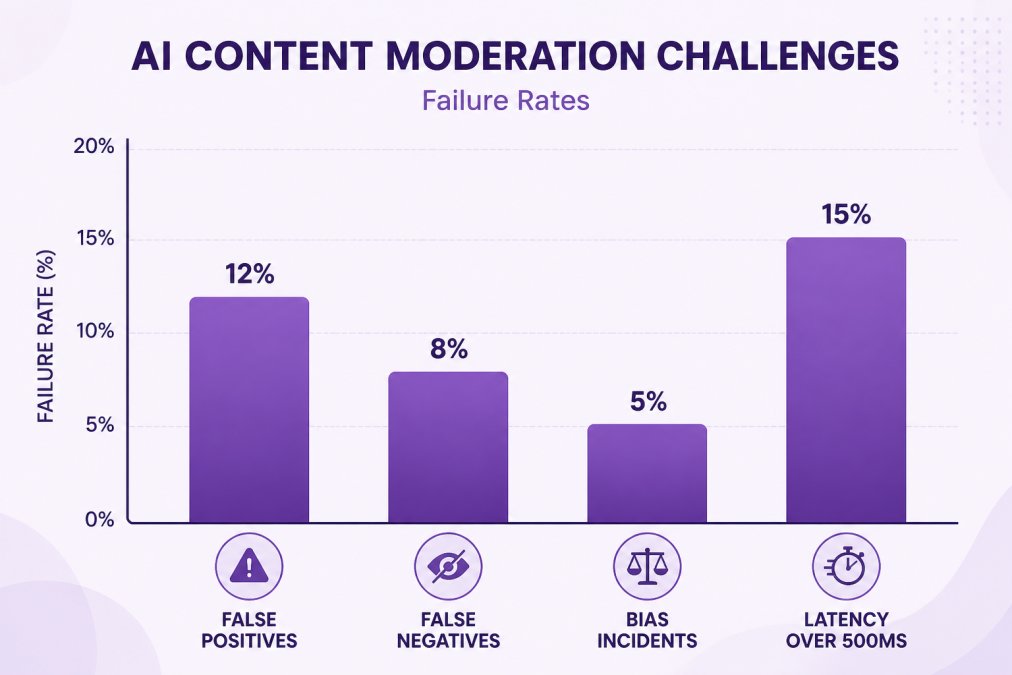
AI content moderation challenges fall into three buckets: algorithmic bias, false positives and false negatives, and latency. Bias creeps in when training data overrepresents certain dialects or communities, causing the model to flag one group's language while letting another's slide (papers.ssrn.com). False positives hide legitimate comments; false negatives let harmful content through. Latency above roughly half a second breaks real-time detection during live events (arxiv.org).
A Practical Bias and Fairness Audit Framework
Most write-ups on AI moderation stop at "bias is a risk." That's not useful when you're the one signing off on a model. Here's a four-step audit you can run quarterly without a dedicated ML team.
1. Build a stratified test set. Pull 200-500 real comments from your own queue and tag each with the demographic or dialect signal you're worried about, for example, African American English markers, Spanish-English code-switching, regional slang, or disability-related phrasing. Don't rely on a vendor's generic benchmark; your audience is the only distribution that matters.
2. Measure per-group error rates, not aggregate accuracy. A model can hit 95% overall accuracy and still flag one dialect at three times the rate of another (peer-reviewed research). Compute false-positive rate and false-negative rate separately for each stratum. The gap between the best and worst group is your fairness delta, that number, not the headline accuracy, is what regulators and journalists will ask about.
3. Inspect the top false positives by hand. Read 50 of them. You'll usually find the model is keying on a specific token, phrase, or spelling variant rather than the actual meaning. This is where you catch the difference between "the model is biased" and "the model has a fixable feature problem."
4. Retrain, reweight, or add a rule. Three levers, in order of effort: add the misclassified examples to your fine-tuning set; reweight the loss function toward the underperforming group; or write a deterministic pre-filter that exempts known false-positive patterns from auto-hide and routes them to human review instead.
Multimodal Moderation Compounds the Problem
Multimodal moderation adds another layer of difficulty. A meme can combine benign text with a problematic image, and single-modality models miss the combined meaning entirely. The same is true for audio: a clip can be flagged as benign transcript text while the tone, music, or background context carries the violation. If your pipeline scores each modality independently and then averages, you'll systematically under-detect cross-modal harm. The fix is a fusion layer that scores the combination, not just the parts, and a human review queue specifically for items where modality scores disagree.
Latency Budgets You Can Actually Hit
Latency above roughly half a second breaks real-time detection during live events. In practice, teams hit that budget by running a cheap first-pass classifier on every item and only invoking heavier models on the borderline band. Caching repeated content (copypasta spam, viral reposts) also cuts p99 latency dramatically. If your vendor can't tell you their p50 and p99 latency separately, ask, the average hides the tail that ruins live chat.
Cost-Benefit Analysis: What AI Moderation Really Saves SMEs
For small and medium businesses, the math favors automation once comment volume passes the point where manual review eats a staff member's day. The real savings come from three places: labor hours redirected to revenue work, ad spend protected from spam and hate sitting under paid placements, and faster response times that convert inquiries into sales.
A Build-vs-Buy Decision Matrix
Most SMEs shouldn't build. But "don't build" is only useful if you know the threshold. Use these four questions as a filter:
- Volume: Are you moderating fewer than ~5,000 comments per month? Buy. Above ~50,000 per month with a stable, narrow content type, the economics of a custom model start to pencil out.
- Modality: Text-only? Buy, the open-source and API options are mature. Heavy video or audio? Buy, unless you already have an ML team, because multimodal pipelines are expensive to maintain.
- Differentiation: Is moderation part of your product, or a cost center? If it's a cost center, buy. If your moderation quality is a selling point (a kids' platform, a mental-health community), building may be justified.
- Compliance: Do you need data to stay in your own infrastructure for state privacy law reasons? That constraint can force a build even when the math says buy.
A Simple Break-Even Formula
You don't need a vendor's ROI calculator to know whether automation pays. Run this:
Monthly manual cost = (comments per month × average seconds per review) ÷ 3,600 × fully loaded hourly rate.
Monthly automated cost = platform subscription + (escalated items per month × average human review seconds ÷ 3,600 × hourly rate) + integration and tuning hours.
Break-even is the comment volume where the two lines cross. For most teams with a single part-time moderator, that's somewhere in the low thousands of comments per month, well below the volume at which a growing brand starts losing sleep over the queue.
What the Savings Actually Look Like
FeedGuardians customers illustrate the pattern. World Discovery protected $1.18M in bookings, Golden Tree safeguarded $440k in ad spend, and Strategic Parenting shielded $400k in ad spend from comment-section damage. NiceToMeet saw a 5.1× lift in membership inquiries after switching to automated replies. Treat these as directional, not universal, your protected-revenue number depends on your ad spend, your average order value, and how visible your comment section is to prospects.
Pricing depends on your volume and platform mix, so check the FeedGuardians pricing page for current plans. There's a free tier if you want to test the moderation accuracy before committing.
The Costs Nobody Puts in the Spreadsheet
Two line items get missed. First, tuning time: expect 10-20 hours in the first month to configure thresholds, seed your brand-voice model, and review the first wave of false positives. Second, switching cost: migrating historical moderation rules and reviewer training to a new tool is real work. Budget for both, or the first month's ROI will look worse than it is.
Privacy and Data Sovereignty: The Overlooked Requirement
Data privacy and regulatory compliance now shape which moderation tools you can legally use. Sending user comments to a third-party API means that content leaves your infrastructure, which triggers obligations under state privacy laws and platform terms. Ask every vendor where data is processed, how long it's retained, and whether it's used for model training.
Platform governance rules add another constraint. Each social platform sets its own requirements for how you moderate comments and what you can automate. Build your moderation workflows to respect both the platform's terms and your users' privacy expectations, and document your data handling so you can answer a regulator's question without scrambling.
Conclusion
Comment sections are where brand reputation is won or lost in real time, and manual moderation can't keep pace with the volume most growing brands face. FeedGuardians handles the heavy lifting with real-time comment moderation, AI-powered replies in your brand voice, competitor protection, and a human escalation option when nuance matters. The platform detects and hides spam, scams, hate speech, and competitor links with 98.7% accuracy, so your team spends its time on conversations instead of cleanup. Get started with FeedGuardians and turn your comments into conversions.
Frequently Asked Questions
What are the primary challenges of using AI for UGC moderation?
The biggest challenges include false positives that hide legitimate comments, algorithmic bias that disproportionately flags certain dialects or communities, and latency issues that delay real-time detection. AI also struggles with sarcasm, cultural nuance, and evolving slang. Most platforms solve this with a human-in-the-loop layer where edge cases get escalated. FeedGuardians, for example, combines 98.7% detection accuracy with a human escalation option so your team reviews borderline cases rather than every comment.
Can AI moderation replace human moderators entirely?
Not yet. AI handles volume and speed, flagging toxic language, hate speech, and spam in milliseconds. But human judgment is still needed for context-dependent decisions, appeals, and policy updates. The practical model is hybrid: AI filters the obvious 90-95%, humans review the gray areas. This keeps costs down while preserving accuracy. Platforms that try full automation often see backlash from false positives that silence legitimate users.
How do AI moderation tools handle nuance and context in user comments?
Modern tools use natural language processing and sentiment analysis to read surrounding context, not just keywords. They can distinguish a reclaimed slur from a hateful one, or a joke from a threat. FeedGuardians learns your brand voice and guidelines, so it flags comments that violate your specific community standards. That said, no system is perfect. Best practices for UGC moderation include regular audits and a clear appeals process to catch context failures.
What is the role of AI in maintaining brand reputation on social media?
AI protects brand reputation by hiding spam, scam links, and hate speech before they pile up under your ads. It also replies 24/7 in your brand voice, turning complaints into conversations. FeedGuardians customers like Golden Tree protected $440k in ad spend by keeping comment sections clean. Faster responses and fewer toxic threads signal to algorithms that your content is safe, which can lower ad costs and improve reach.
Tired of manually moderating comments?
FeedGuardians automates spam filtering, responds to customers, and protects your brand — setup in 3 minutes.
Frequently Asked Questions
What are the primary challenges of using AI for UGC moderation?
The biggest challenges include false positives that hide legitimate comments, algorithmic bias that disproportionately flags certain dialects or communities, and latency issues that delay real-time detection. AI also struggles with sarcasm, cultural nuance, and evolving slang. Most platforms solve this with a human-in-the-loop layer where edge cases get escalated. FeedGuardians, for example, combines 98.7% detection accuracy with a human escalation option so your team reviews borderline cases rather than every comment.
Can AI moderation replace human moderators entirely?
Not yet. AI handles volume and speed, flagging toxic language, hate speech, and spam in milliseconds. But human judgment is still needed for context-dependent decisions, appeals, and policy updates. The practical model is hybrid: AI filters the obvious 90-95%, humans review the gray areas. This keeps costs down while preserving accuracy. Platforms that try full automation often see backlash from false positives that silence legitimate users.
How do AI moderation tools handle nuance and context in user comments?
Modern tools use natural language processing and sentiment analysis to read surrounding context, not just keywords. They can distinguish a reclaimed slur from a hateful one, or a joke from a threat. FeedGuardians learns your brand voice and guidelines, so it flags comments that violate your specific community standards. That said, no system is perfect. Best practices for UGC moderation include regular audits and a clear appeals process to catch context failures.
What is the role of AI in maintaining brand reputation on social media?
AI protects brand reputation by hiding spam, scam links, and hate speech before they pile up under your ads. It also replies 24/7 in your brand voice, turning complaints into conversations. FeedGuardians customers like Golden Tree protected $440k in ad spend by keeping comment sections clean. Faster responses and fewer toxic threads signal to algorithms that your content is safe, which can lower ad costs and improve reach.