
Quick Summary
| Key Insight | What You Need to Know |
|---|---|
| Why Instant Replies Matter | Why Instant Replies Matter for Brand Success |
| How Instant Replies Impact | How Instant Replies Impact Customer Satisfaction and Conversion Rates |
| Social Media Response Time | Social Media Response Time Benchmarks Across Platforms |
| Best Practices for Social | Best Practices for Social Media Auto Replies That Protect Brand Reputation |
| How to Write Professional | How to Write Professional Social Media Response Templates |
| AI-Powered Social Media Customer | AI-Powered Social Media Customer Service Tools and Automation |
Table of Contents
- Why Instant Replies Matter for Brand Success
- How Instant Replies Impact Customer Satisfaction and Conversion Rates
- Social Media Response Time Benchmarks Across Platforms
- Best Practices for Social Media Auto Replies That Protect Brand Reputation
- How to Write Professional Social Media Response Templates
- AI-Powered Social Media Customer Service Tools and Automation
- Balancing Automation With Human Touch: When to Escalate
- Conclusion
Last Updated: August 17, 2026
Why Instant Replies Matter for Brand Success
When a customer posts a comment on your Instagram, Facebook, TikTok, or YouTube channel, they're signaling intent to engage with your brand. The speed of your response shapes customer perception, influences algorithmic visibility, and determines whether a comment thread becomes a conversation or dies in the feed.
At FeedGuardians, we've analyzed thousands of brand interactions across platforms. Brands that reply within minutes see measurably different outcomes than those that wait hours or days. The challenge most brands face isn't willingness to respond quickly, it's volume. A mid-sized e-commerce store might receive hundreds of comments daily. This is where instant replies emerge as essential: not just speed, but consistency and sustainability at scale. The benefits include protecting your reputation, boosting algorithmic performance, and turning comment sections into revenue-generating channels without requiring your team to work around the clock.
How Instant Replies Impact Customer Satisfaction and Conversion Rates
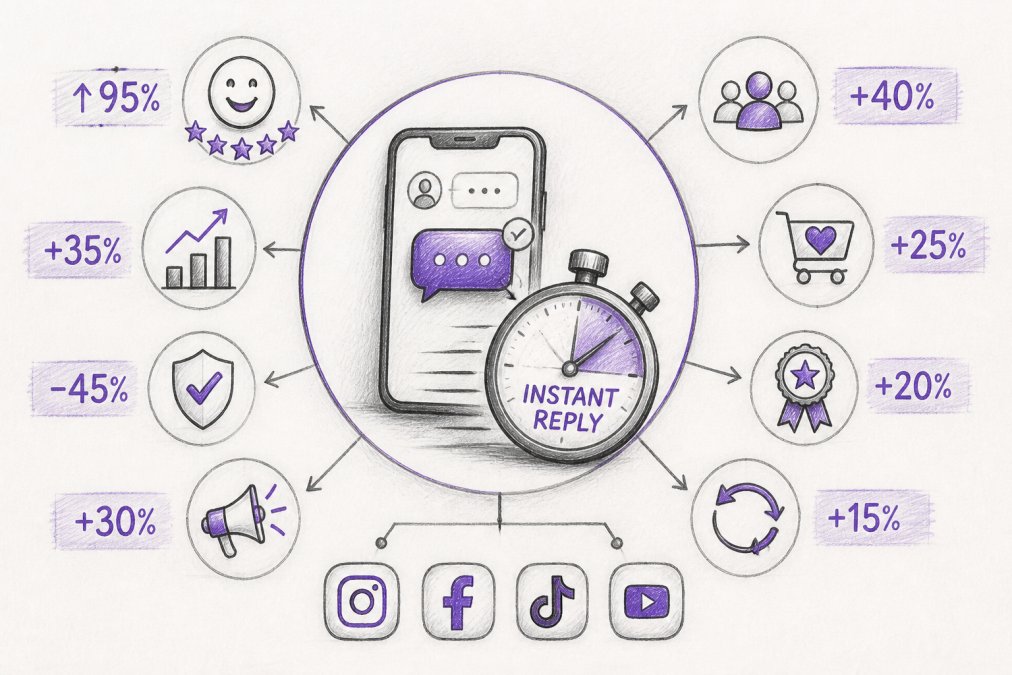
When a customer receives an instant reply, they perceive responsiveness and care. This psychological effect translates directly into measurable business outcomes. A customer who expects a 24-hour response and gets one within 5 minutes doesn't just feel satisfied, they feel delighted. That delight creates stickiness: they're more likely to make a purchase, return, and recommend your brand.
Conversion rates tell a clearer story. When a prospective customer asks a product question in your comments and receives an answer within minutes, they're significantly more likely to complete a purchase. The moment of intent is fresh. The friction is minimal. Brands that prioritize instant replies report higher checkout completion rates from comment-sourced traffic.
Instant replies also signal algorithmic engagement to platform systems. Instagram, Facebook, TikTok, and YouTube track comment response patterns. Posts with active, ongoing conversations where replies happen quickly receive algorithmic boosts. They stay visible longer and appear higher in feeds. This creates a compounding effect: faster replies lead to more visibility, which leads to more comments, which creates more opportunities for instant replies.
Social Media Response Time Benchmarks Across Platforms
Not all platforms expect the same response speed. Understanding platform-specific benchmarks helps you set realistic timelines and allocate resources effectively.
Instagram typically sees customer expectations centered around 1-4 hour response windows for both comments and direct messages. Brands that respond within this range maintain strong engagement. Instagram's algorithm favors active comment threads, so faster replies improve post visibility.
Facebook operates on a slightly longer timeline. Many customers expect replies within 4-24 hours, though faster is always better. The platform's older demographic skews toward patience, but younger users expect faster responses. Brands managing multiple age groups should aim for 2-4 hour response targets.
TikTok is different. The platform's real-time nature and younger audience create higher expectations for speed. Comments on viral videos can number in the thousands within hours. Brands that respond within 30 minutes to an hour maintain momentum. Delayed replies on TikTok feel out of touch.
YouTube operates on the longest timeline. Comments on videos can sit for days before responses are expected, but replying within 24 hours is standard practice. Channels with active comment management see higher subscriber growth and better audience retention.
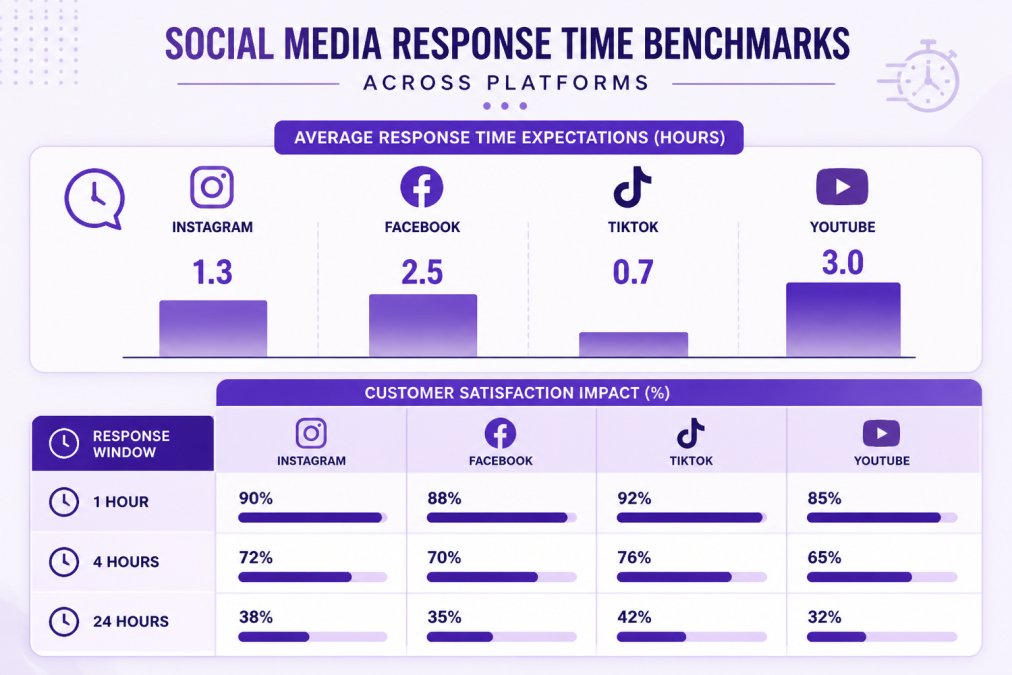
The gap between platform expectations creates a challenge for brands managing multiple channels simultaneously. Tools that consolidate your inbox across platforms help you see all inquiries in one place and respond according to platform-specific benchmarks.
Best Practices for Social Media Auto Replies That Protect Brand Reputation
Automation is powerful, but a poorly written auto-reply can damage your brand faster than no reply at all. The key is creating automated responses that feel authentic, provide genuine value, and know when to escalate to humans.
Your auto-reply must sound like your brand. Generic, robotic responses create distance. The best auto-replies maintain your brand voice while delivering real information. If your brand is playful, your auto-reply should be playful. If you're formal and professional, match that tone.
Provide immediate value. Instead of "Thanks for your comment, we'll get back to you soon," try "Thanks for asking about sizing. Our size guide is here [link]. We'll follow up within 2 hours with more details if you need them." This transforms an auto-reply into a useful tool.
Flag risky comments for human review. Your automated system should instantly reply to straightforward questions and compliments, but recognize comments that require nuance, contain complaints, or involve sensitive topics, and immediately escalate those to your team.
Tone matters enormously. The sweet spot is warm, professional, and helpful. "We appreciate the question! Here's what you need to know..." feels personal without being unprofessional.
Your auto-reply should clearly state when a human team member will follow up and on what timeline. "We've received your message and a member of our team will respond within 2 hours during business hours." This sets expectations and prevents frustration.
How to Write Professional Social Media Response Templates
Creating templates that work across scenarios requires identifying your top comment types. What questions do you answer repeatedly? What compliments do you receive most often? What complaints come up regularly? These categories become your template foundation. For each category, create 2-3 variations so responses don't feel repetitive.
Product questions deserve specific templates: "Great question about [product]. Here's what you need to know: [key feature/benefit]. If you need more details, feel free to DM us or visit [link]."
Shipping and order status questions: "Thanks for checking! Your order is [status]. You can track it here [link]. If you have other questions, we're here to help."
Compliments and positive feedback: "Thank you so much! Comments like this make our day. We're so glad you're loving [product/experience]."
Complaints and negative feedback should never be auto-replied with generic templates. These must escalate to a human immediately. However, you can use an auto-reply to acknowledge the issue: "We're sorry to hear you had this experience. We take feedback seriously and a member of our team will reach out within 2 hours to help resolve this."
The best templates include clear variables and a call to action. Guide customers toward the next step: visiting your website, checking a link, sending a direct message, or waiting for a human follow-up.
AI-Powered Social Media Customer Service Tools and Automation
Modern AI-powered tools excel at pattern recognition. They can identify comment intent, question, complaint, compliment, spam, and either respond automatically or route appropriately. This triage function alone saves teams enormous amounts of time.
These tools learn from your brand voice and guidelines. Rather than sounding generic, AI systems can be trained to match your tone, terminology, and communication style. Real-time moderation is another critical function: AI can instantly detect and hide spam, scams, hate speech, and competitor links while protecting legitimate comments.
Integration with your CRM system is increasingly important. When a comment comes in, the system should check your customer database. Is this a repeat customer? Have they had issues before? This context helps the AI provide more personalized responses and flag important patterns.
AI-powered tools also capture sentiment, track frequently asked questions, and identify product feedback. This intelligence helps you improve products and understand customer needs better.
However, automation has limits. Complex situations, sensitive complaints, and anything requiring judgment should escalate to humans. The best systems handle what they handle well and route everything else to your team with full context.
FeedGuardians exemplifies this approach. It automatically detects and hides spam, hate speech, and competitor links with 98.7% accuracy while delivering 24/7 AI-powered replies in your brand voice. It includes a human escalation option for comments that require judgment. This hybrid approach, automation handling volume, humans handling nuance, delivers the best outcomes.
Balancing Automation With Human Touch: When to Escalate
The solution to the tension between speed and authenticity isn't choosing between automation and human touch, it's knowing when each is appropriate.
Straightforward product questions should be automated. "What's the price of [product]?" deserves an instant, accurate answer. A human isn't needed here.
Compliments and positive feedback can be mostly automated, with a human follow-up option: "Thanks for the kind words! If you'd like to chat more, feel free to DM us."
Anything involving emotion should escalate to a human. If a customer expresses frustration, disappointment, or anger, that comment needs a human response. These moments are where you build loyalty or lose it.
Ambiguous comments deserve human attention. If you're not sure what the customer is asking, don't guess with an automated response. Escalate.
Complaints about specific orders or experiences must go to a human. These aren't generic, they're personal.
Most effective systems use a tiered approach. Tier 1: Instant automated replies to common questions. Tier 2: Automated replies with human follow-up within 2-4 hours for moderate-complexity issues. Tier 3: Immediate human escalation for sensitive or urgent matters.
Conclusion
The benefits of instant replies on social media for brands are measurable and achievable. Response speed directly impacts customer satisfaction, conversion rates, brand reputation, and algorithmic visibility. Brands that master instant replies build stronger customer relationships, protect their reputation more effectively, and unlock algorithmic advantages that increase their reach.
The challenge is executing instant replies at scale without burning out your team. This is where AI-powered solutions become essential. FeedGuardians handles the volume by automatically detecting and hiding spam, hate speech, and competitor links with 98.7% accuracy while delivering 24/7 AI-powered replies in your brand voice. Your team escalates only what requires human judgment. You get instant replies, consistent brand voice, and protected reputation, all without working around the clock. Start for free and see how instant replies transform your social media presence.
Frequently Asked Questions
How do instant replies on social media affect conversion rates?
Instant replies reduce response latency, which directly influences whether customers move forward with a purchase or abandon the interaction. When brands respond within minutes rather than hours, customers feel valued and are more likely to complete transactions. Quick replies also signal to social media algorithms that your account is actively engaged, improving organic reach and visibility. This combination of faster customer inquiry resolution and improved algorithmic performance creates a multiplier effect on conversion rates.
What are the best practices for social media auto replies without sounding robotic?
The most effective auto replies acknowledge the customer's specific comment, use your brand's authentic voice and terminology, and provide clear next steps. Avoid generic templates that sound automated. Instead, train your AI-powered social media customer service tools to learn your brand's tone, language patterns, and communication style. Include personalization elements like mentioning the product or service they're asking about. Always offer a human escalation path for complex inquiries, and use auto-replies primarily for acknowledgment and common questions rather than sensitive issues.
How quickly should brands respond to social media comments to protect brand reputation?
Most customers expect a response within 1-4 hours on platforms like Instagram and Facebook. However, real-time responses (within minutes) significantly boost customer satisfaction and brand loyalty. The faster you respond, the less time negative sentiment has to spread and influence other potential customers. Instant replies also prevent competitors from filling the conversation gap with their own messaging. Brands that respond within the first hour see measurably higher engagement metrics and are more likely to convert inquiries into sales.
Can AI-powered tools really learn my brand voice for automated replies?
Yes, modern AI-powered social media customer service tools are designed to learn your brand's unique voice, terminology, and communication guidelines. These systems analyze your past responses, brand guidelines, and customer interactions to generate replies that sound authentically like your team. The best tools include a human escalation option, so complex or sensitive comments can be reviewed by your team before posting. While AI handles routine inquiries and acknowledgments, your team maintains control over tone and can refine the AI's learning over time.
This article was written using GrandRanker
Tired of manually moderating comments?
FeedGuardians automates spam filtering, responds to customers, and protects your brand — setup in 3 minutes.
Frequently Asked Questions
How do instant replies on social media affect conversion rates?
Instant replies reduce response latency, which directly influences whether customers move forward with a purchase or abandon the interaction. When brands respond within minutes rather than hours, customers feel valued and are more likely to complete transactions. Quick replies also signal to social media algorithms that your account is actively engaged, improving organic reach and visibility. This combination of faster customer inquiry resolution and improved algorithmic performance creates a multiplier effect on conversion rates.
What are the best practices for social media auto replies without sounding robotic?
The most effective auto replies acknowledge the customer's specific comment, use your brand's authentic voice and terminology, and provide clear next steps. Avoid generic templates that sound automated. Instead, train your AI-powered social media customer service tools to learn your brand's tone, language patterns, and communication style. Include personalization elements like mentioning the product or service they're asking about. Always offer a human escalation path for complex inquiries, and use auto-replies primarily for acknowledgment and common questions rather than sensitive issues.
How quickly should brands respond to social media comments to protect brand reputation?
Most customers expect a response within 1-4 hours on platforms like Instagram and Facebook. However, real-time responses (within minutes) significantly boost customer satisfaction and brand loyalty. The faster you respond, the less time negative sentiment has to spread and influence other potential customers. Instant replies also prevent competitors from filling the conversation gap with their own messaging. Brands that respond within the first hour see measurably higher engagement metrics and are more likely to convert inquiries into sales.
Can AI-powered tools really learn my brand voice for automated replies?
Yes, modern AI-powered social media customer service tools are designed to learn your brand's unique voice, terminology, and communication guidelines. These systems analyze your past responses, brand guidelines, and customer interactions to generate replies that sound authentically like your team. The best tools include a human escalation option, so complex or sensitive comments can be reviewed by your team before posting. While AI handles routine inquiries and acknowledgments, your team maintains control over tone and can refine the AI's learning over time.