
Quick Summary
| Key Insight | What You Need to Know |
|---|---|
| Unanswered complaints and scam | Unanswered complaints and scam accusations can make buyers leave before they click. |
| Hide spam, scam links | Hide spam, scam links, and abusive comments, but avoid deleting legitimate concerns. |
| Comments mainly affect ROAS | Comments mainly affect ROAS through buyer confidence, not only through ad delivery. |
| Run a controlled test | Run a controlled test for at least four weeks before attributing ROAS changes to comments. |
| Reply to questions and | Reply to questions and objections, since a helpful reply can turn doubt into a sale. |
| How Negative Comments on | How Negative Comments on Facebook Ads Affect Trust and Purchase Intent |
Last Updated: November 6, 2026
Quick Summary
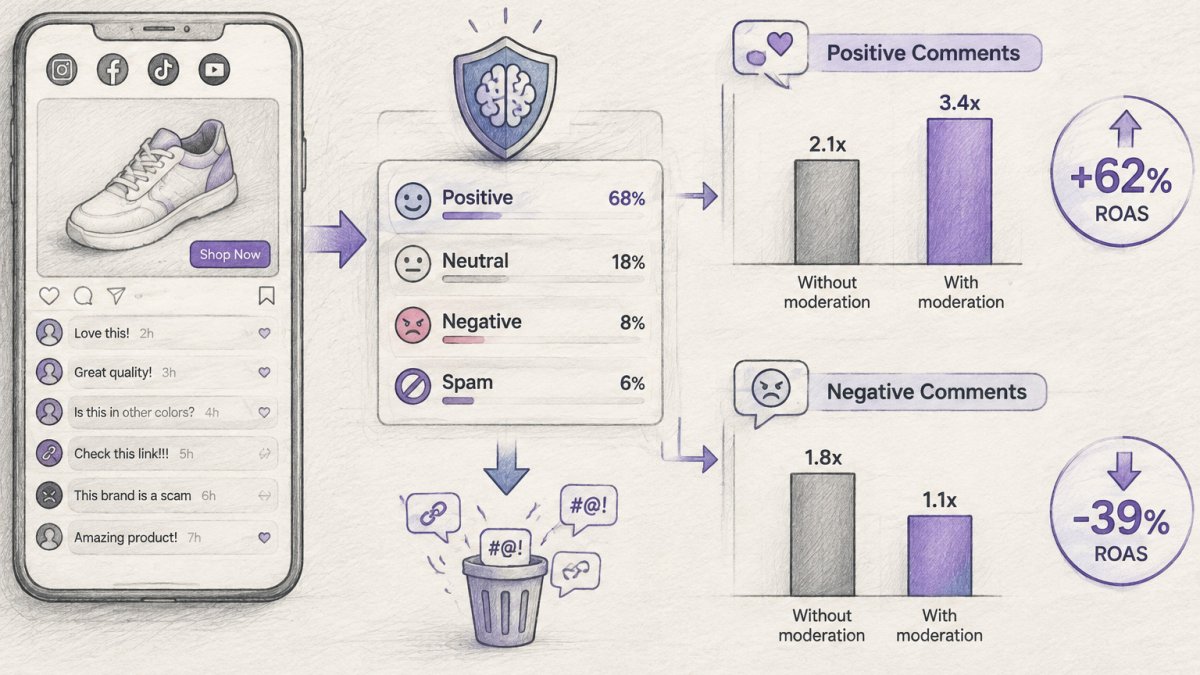
Comments affect ad ROAS mainly through buyer trust: visible complaints, scam accusations, or spam under an ad can lower clicks and conversions even when the landing page is strong. Comments can also influence delivery and cost, but that effect is less predictable. Moderating spam and answering real objections protects both trust and return on spend.
- Unanswered complaints and scam accusations can make buyers leave before they click.
- Hide spam, scam links, and abusive comments, but avoid deleting legitimate concerns.
- Comments mainly affect ROAS through buyer confidence, not only through ad delivery.
- Run a controlled test for at least four weeks before attributing ROAS changes to comments.
- Reply to questions and objections, since a helpful reply can turn doubt into a sale.
Table of Contents
- How Negative Comments on Facebook Ads Affect Trust and Purchase Intent
- The Link Between Comments, Click-Through Rate, CPM, and Delivery
- Facebook Ad Comment Moderation: Hide, Delete, or Reply
- How to Measure Whether Comments Are Changing Your ROAS
- Platform Differences: Facebook Ads Versus Instagram and TikTok
- Setting Up Your Next Moderation Workflow
- Frequently Asked Questions
Most advertisers judge a campaign by its numbers: spend, click-through rate, and return on ad spend. Comments sit off to the side. Yet every comment on a paid post is visible to the same audience you are paying to reach, and FeedGuardians has seen how that public conversation shapes whether a buyer clicks, pauses, or walks away. This guide explains how comments affect ad ROAS and gives you seven concrete ways to protect yours.
Comments are social proof and objections in one place. A buyer reading a thread of praise sees evidence that the product works. A buyer scrolling past a pile of complaints or scam warnings sees the opposite, even if your landing page is strong.
Here is the core idea we will return to throughout the article: the ad does not end at the click. The comment section is part of what the buyer evaluates before they ever reach your store.
How Negative Comments on Facebook Ads Affect Trust and Purchase Intent
Negative comments on Facebook ads can do more damage than advertisers expect. A single unanswered complaint can read as a sign that nobody is watching the account. Hide spam, complaints, and refund-bait under Facebook ads in real time so they don't shape buyer perception.
Shoppers look for signals before they buy. Comments are among the most visible ones.
- A refund complaint with no reply suggests poor service
- A scam accusation with no response suggests the seller is hiding something
- A cluster of spam links suggests the page has been abandoned
Watch out: a hidden criticism that a reader later finds on their own can look worse than the criticism itself. Moderation works best when it removes spam and abuse, not legitimate concerns.
The Link Between Comments, Click-Through Rate, CPM, and Delivery
Most articles say comments "affect" ROAS without explaining how. That vagueness makes comments hard to manage. The useful model separates two pathways: direct effects, where the platform's delivery system responds to comment activity, and indirect effects, where comments change what a buyer thinks and does after the ad is served. ROAS moves through both, but they require different responses.
Direct effects: delivery and cost. Ad platforms use engagement signals, including comments, as one input into how often an ad is shown and what each impression costs. The exact weighting is proprietary and changes over time, so treat comment activity as one input among many rather than a guaranteed lever.
Indirect effects: clicks and conversion rate. This is where most of the ROAS impact actually shows up. Comments are visible social proof and visible objections. A buyer who sees a helpful reply to a shipping complaint may click with more confidence. A buyer who sees an unanswered scam accusation may leave before clicking, which lowers CTR.
What the evidence supports. The direct delivery effect is real but hard to quantify precisely because platforms do not publish their weighting. The indirect trust and conversion effect is better supported by observed patterns: most practitioners find that unanswered negative comments correlate with lower conversion rates on the same creative and audience.
Why all three metrics belong together. CTR tells you whether the ad is getting seen and clicked. CPM tells you what visibility costs. ROAS tells you whether clicks turn into revenue. Comments can move all three, but they move them through different mechanisms. If CTR falls while CPM holds steady, the problem is likely the comment thread's effect on buyer confidence.
Watch out: attributing a CPM increase to comments without checking for audience saturation, creative fatigue, or seasonal auction pressure can send you moderating the wrong thing.
Facebook Ad Comment Moderation: Hide, Delete, or Reply
Every comment gives you three options: leave it, hide it, or reply. Each has a different effect.
- Reply when a comment asks a question or raises an objection you can answer. A helpful reply can turn a doubt into a sale.
- Hide spam, scam links, and abusive content. Hidden comments are invisible to the public but still visible to the commenter, which keeps the thread clean without a public fight. Automatically hide spam comments and scam links with an AI-powered filter.
- Delete only content that breaks your policy or is clearly harmful. Deleting a legitimate complaint can backfire if shoppers notice.
A common mistake is treating every negative comment the same way. A customer saying a shipment arrived late needs a reply. A bot posting a fake giveaway needs to be hidden. Sorting them correctly protects both trust and ROAS.
How to Measure Whether Comments Are Changing Your ROAS
Measuring comment impact is harder than measuring a headline change because many factors move at once. Get real-time sentiment scoring for each comment to catch shifts early. The fix is a controlled test with predefined metrics, a fixed measurement window, and a rule for separating comment effects from normal variation. Without those three elements, you are guessing.
Define the metrics before you start. Track ROAS, CTR, cost per purchase, and conversion rate as your primary outcomes. Add two comment-specific inputs: negative comment share (negative comments divided by total comments) and median reply time. The comment inputs explain the outcome metrics; the outcome metrics tell you whether the change mattered. Record them in the same spreadsheet so you can compare week over week.
Set the measurement window in advance. Run the test for at least four weeks to smooth out weekly patterns, and compare the same days of the week across test and control. Use a consistent attribution window, such as the platform's default seven-day click or one-day view setting, and do not change it mid-test. If you change the window, you cannot compare the two periods.
Separate comment effects from normal variation. Campaign results fluctuate for reasons unrelated to comments: auction competition, creative fatigue, audience saturation, and seasonality. Before you credit comments, check whether the control group moved in the same direction. If both groups rose or fell together, the cause is likely external. If the test group diverged from the control group after the moderation change, that divergence is your evidence. A simple rule: only attribute a change to comments when the test group's movement differs from the control group's movement by more than the normal week-to-week swing you measured before the test.
A Controlled Testing Framework for Comment Moderation
Follow these steps for a clean test:
- Pick one ad with enough volume to produce meaningful data, and record its baseline ROAS, CTR, and cost per purchase for two weeks before the test.
- Duplicate the ad set and split the audience evenly so both groups see the same creative, budget, and placement.
- Apply active moderation and replies to one set and no moderation to the other.
- Run the test for at least four weeks, holding budget, creative, audience, and attribution window constant.
- Compare ROAS, CTR, cost per purchase, and conversion rate between groups, then review the comment logs for context.
- Repeat the test on a second ad before you generalize the result.
Change one variable at a time. If you also change creative or targeting during the test, you will not know what caused the result.
Attribution limits you should accept. Platforms credit conversions using their own rules, and some buyers read comments without clicking at all. Use the test results as directional evidence, not as proof of a precise dollar effect. The goal is to learn whether your moderation policy helps or hurts, and by roughly how much, so you can decide whether to keep it.
Watch out: stopping a test early because the first week looks favorable is the most common way advertisers fool themselves; weekly noise can easily exceed the true comment effect.
Platform Differences: Facebook Ads Versus Instagram and TikTok
Comment behavior varies by platform. Facebook ad comments often include longer questions, product complaints, and detailed objections. Instagram comments tend to be shorter and more emoji-heavy, with more reactions to visual content. TikTok comments move quickly and are often driven by trends, humor, and direct replies between viewers.
Because of these differences, a moderation rule that works on Facebook may need adjusting on TikTok. Review the comment mix on each platform separately before setting thresholds or reply templates. Compare the leading Instagram comment management tools and their moderation features.
Instagram and TikTok also surface comments differently in their feeds, so the same comment can have a larger or smaller effect depending on where the ad runs. Check placement data alongside your comment logs.
Comment behavior differs across platforms, so the mix you see on each one should shape how you moderate.
| Platform | Typical comment style | What to do |
|---|---|---|
| Facebook Ads | Longer questions, product complaints, detailed objections | Reply to objections and review the thread closely |
| Shorter comments, emoji-heavy, reactions to visuals | Check reaction patterns against placement data | |
| TikTok | Fast-moving, trend-driven, humor and viewer-to-viewer replies | Adjust moderation rules rather than reusing Facebook rules |
Setting Up Your Next Moderation Workflow
A moderation workflow turns these ideas into a routine your team can follow. Start with a short checklist:
- Define your spam and abuse rules in writing
- Set an auto-hide rule for known spam patterns and scam links
- Write reply templates for the five most common questions
- Set an escalation path for refund requests and safety concerns
- Set a negative-comment alert threshold based on your baseline
- Schedule a four-week controlled test to measure impact
Start with the rules that remove the most harmful content, then add reply templates as you learn which questions come up most. Review the workflow monthly, because comment patterns shift with campaigns and seasons.
FeedGuardians can handle the routine part of this work by hiding spam, flagging negative sentiment, and drafting replies in your brand voice, while your team handles the cases that need judgment. Start for Free to see how it works.
Frequently Asked Questions
Are comments good for the algorithm?
Comments are an engagement signal, so they can help organic reach, but the effect on paid ads is indirect. Facebook's ad delivery system optimizes for the outcome you choose, such as purchases or link clicks, and comments influence the ad mainly through how people perceive it. Positive, relevant comments can support click-through rate and trust, while spam or hostile replies can depress both. For paid campaigns, the practical goal is not to chase comment volume but to keep the comment section clean, accurate, and useful to prospective buyers.
Do negative comments affect ad performance?
They can. Prospects often read the comment section before clicking, so visible complaints about shipping, product quality, or scams can lower click-through rate and reduce purchase intent, which then shows up as higher cost per result and lower ROAS. The effect depends on volume and on whether the complaints go unanswered. A single complaint with a clear, helpful reply usually does less damage than a thread of unaddressed criticism. Measure this with a holdout test rather than assuming it.
Can replying to ad comments increase conversions?
Replies can answer the objections that stop a buyer from converting, such as sizing, shipping times, or return policy. Answering a question publicly also helps the next person with the same question. The conversion lift depends on the product, the audience, and how quickly replies arrive. Track replied versus unreplied comment threads over a set period and compare conversion rate and ROAS, so you can see whether replies are doing measurable work for your campaigns.
How should brands handle negative comments on Facebook ads?
Start by separating three types: spam or scams, harmful or abusive comments, and legitimate criticism. Hide or delete spam and abuse, since it protects the audience and your account. Keep legitimate criticism visible and reply to it with a factual, calm response that offers a next step, such as a support contact. Deleting valid complaints can look like concealment and can hurt trust more than the complaint itself. Document your moderation rules so the whole team applies them the same way.

Tired of manually moderating comments?
FeedGuardians automates spam filtering, responds to customers, and protects your brand — setup in 3 minutes.
Frequently Asked Questions
Are comments good for the algorithm?
Comments are an engagement signal, so they can help organic reach, but the effect on paid ads is indirect. Facebook's ad delivery system optimizes for the outcome you choose, such as purchases or link clicks, and comments influence the ad mainly through how people perceive it. Positive, relevant comments can support click-through rate and trust, while spam or hostile replies can depress both. For paid campaigns, the practical goal is not to chase comment volume but to keep the comment section clean, accurate, and useful to prospective buyers.
Do negative comments affect ad performance?
They can. Prospects often read the comment section before clicking, so visible complaints about shipping, product quality, or scams can lower click-through rate and reduce purchase intent, which then shows up as higher cost per result and lower ROAS. The effect depends on volume and on whether the complaints go unanswered. A single complaint with a clear, helpful reply usually does less damage than a thread of unaddressed criticism. Measure this with a holdout test rather than assuming it.
Can replying to ad comments increase conversions?
Replies can answer the objections that stop a buyer from converting, such as sizing, shipping times, or return policy. Answering a question publicly also helps the next person with the same question. The conversion lift depends on the product, the audience, and how quickly replies arrive. Track replied versus unreplied comment threads over a set period and compare conversion rate and ROAS, so you can see whether replies are doing measurable work for your campaigns.
How should brands handle negative comments on Facebook ads?
Start by separating three types: spam or scams, harmful or abusive comments, and legitimate criticism. Hide or delete spam and abuse, since it protects the audience and your account. Keep legitimate criticism visible and reply to it with a factual, calm response that offers a next step, such as a support contact. Deleting valid complaints can look like concealment and can hurt trust more than the complaint itself. Document your moderation rules so the whole team applies them the same way.