
Quick Summary
| Key Insight | What You Need to Know |
|---|---|
| False positives versus false | False positives versus false negatives |
| Why Classifiers Flag Harmless | Why Classifiers Flag Harmless ContentReclaimed language and in-group slur usageBias against racial, ethnic, and LGBTQIA+ groups |
| Reclaimed language and in-group | Reclaimed language and in-group slur usage |
| Bias against racial, ethnic | Bias against racial, ethnic, and LGBTQIA+ groups |
| Auditing Your Training Data | Auditing Your Training Data and LabelsClass imbalance and label ambiguity |
| Class imbalance and label | Class imbalance and label ambiguity |
Table of Contents
- False positives versus false negatives
- Why Classifiers Flag Harmless Content
- Auditing Your Training Data and Labels
- Measuring Precision and Recall Before You Tune
- Setting Thresholds and Routing Borderline Cases to Human Review
- Testing Across Domains, Platforms, and Communities
- Monitoring False Positives After Deployment
- Setting Up Your Next Step With FeedGuardians
- Frequently Asked Questions
What False Positives Look Like in Hate Speech Detection
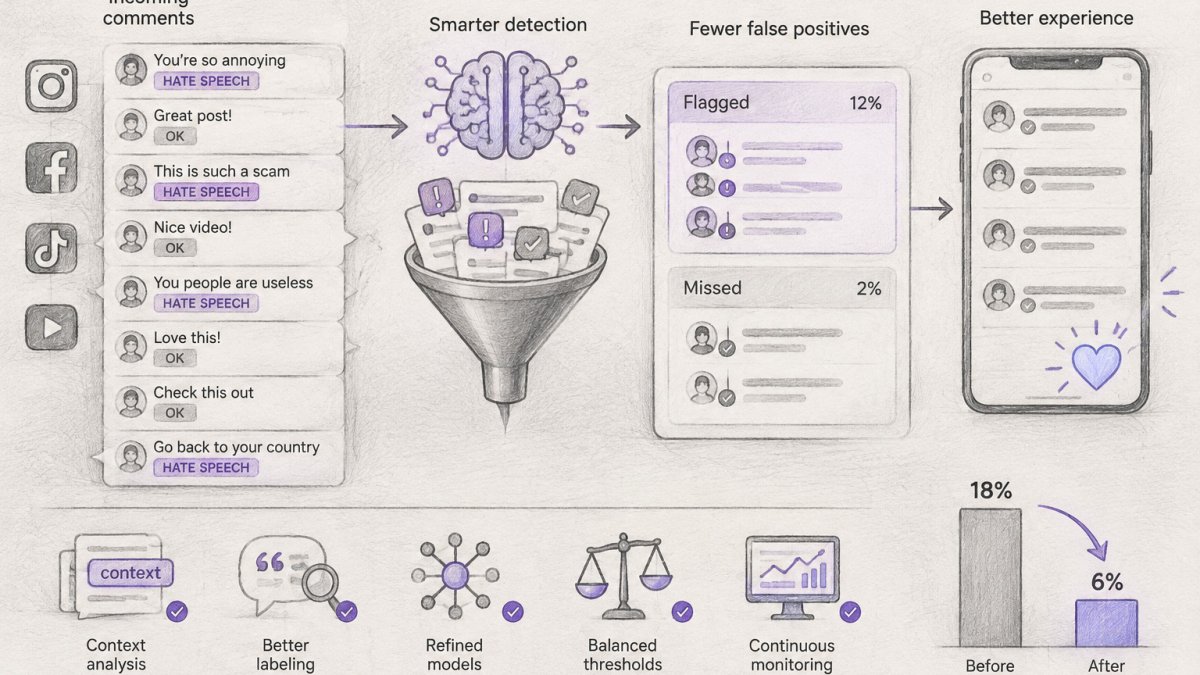
A false positive happens when a moderation system flags a harmless comment as hate speech. A supporter's joke gets hidden. A customer's honest complaint gets removed. Your brand looks like it is censoring people, when the classifier is really making a mistake.
Here is the core of it: how to reduce false positives in hate speech detection is less about buying a better model and more about building a process that catches errors before your audience does, from auditing your data to monitoring results after launch.
False positives versus false negatives
Two kinds of mistakes matter here. Keep them separate in your head.
- False positive: harmless comment flagged as hateful. A fan writes "that look is sick," and it gets hidden.
- False negative: harmful comment missed. A real slur slips through and stays visible.
Most teams tune for one and forget the other. Push hard to catch every slur and you will hide more innocent comments. Relax the filter and harmful comments stay up. Every threshold is a trade-off, so decide which error hurts your brand more before you touch a setting.
Why Classifiers Flag Harmless Content
Classifiers learn patterns from examples, so skewed examples produce skewed patterns. Most false positives trace back to a few predictable causes you can fix before they happen.
Start by recognizing the warning signs in your own queue:
- Comments that quote or mention a slur without using it as an insult
- Posts in dialects or communities where a word has a different meaning
- Identity terms that show up mostly in hateful examples in the training data
Reclaimed language and in-group slur usage
Some communities use words that outsiders would flag as slurs. When members use these terms with each other, the meaning is affectionate or defiant.
Your fix is practical. Build a list of terms your audience uses in-group, and route comments containing them to review instead of auto-hiding them. Do not auto-hide on the word alone.
Bias against racial, ethnic, and LGBTQIA+ groups
Models can learn to associate identity terms with toxicity, even in neutral or positive sentences. A comment praising a Black creator or a gay couple can get flagged simply because the identity word is present.
Test for it directly. Write harmless comments mentioning different identity groups, then check how often each group gets flagged.
Auditing Your Training Data and Labels
Your classifier is only as good as its labels. Before you tune anything, look at the data behind it.
Work through this audit:
- Pull a random sample of 200 to 500 items your system flagged last month.
- Have two reviewers label each item as harmful or harmless, without seeing the model's decision.
- Count the items where the model and your reviewers disagree.
- Group those disagreements by type: reclaimed terms, identity mentions, sarcasm, and so on.
- Fix the labels, then retrain or adjust rules for the biggest group first.
Class imbalance and label ambiguity
Harmful comments are rare in most feeds. If 2 percent of your data is hateful, a model can score well by calling almost everything harmless and still miss real problems.
Label ambiguity is the other trap. Two reviewers often disagree on borderline comments. Record the disagreement instead of forcing one label, those borderline items belong in human review.
Measuring Precision and Recall Before You Tune
You cannot reduce false positives if you do not measure them. Precision and recall give you the numbers to act on.
- Precision: of the comments flagged as hateful, what share really were? Low precision means many false positives.
- Recall: of all the truly hateful comments, what share did the model catch? Low recall means many false negatives.
Build a confusion matrix from your audited sample. For a queue of 1,000 comments, count true positives, false positives, true negatives, and false negatives, then calculate both scores.
Set your targets before you tune.
Setting Thresholds and Routing Borderline Cases to Human Review
A threshold is the score above which a comment gets hidden. Set it too low and you hide more innocent comments; set it too high and harmful comments stay visible.
- High score: hide automatically. These are clear violations.
- Middle score: send to a human reviewer. These are the borderline cases.
- Low score: leave visible. These are clearly harmless.
This middle band is where most false positives get caught. Reviewers see the comments the model is unsure about, and their decisions become new training examples.
How to pick the two cutoffs
Do not guess the cutoffs. Derive them from your audited sample and your risk tolerance.
- Score your audited sample (the 200 to 500 items from the data audit) with the current model and record the raw score for each item alongside the human label.
- Sort by score and walk down the list. For each candidate high cutoff, count how many harmless items would still be auto-hidden (your residual false-positive load) and how many harmful items would be auto-hidden (your caught harm).
- Pick the high cutoff where the residual false-positive count is at or below the number your brand can absorb per week, not per month.
- Pick the middle cutoff where the review band captures the borderline items your reviewers can actually clear in a day.
A common pattern is to set the high cutoff so precision in the auto-hide band stays high, and the middle cutoff so recall across auto-hide plus review stays near your target for serious harm.
Watch out: if you set the high cutoff by precision alone without checking the review band size, you can push so many items into review that the queue backs up and borderline comments sit visible for days, which is its own moderation failure.
Sizing the review band against reviewer capacity
Keep reviewer workload in mind. If the middle band holds 30 percent of your comments, your team cannot keep up. Adjust the band until the queue is manageable.
Estimate capacity before you commit. Count how many items a reviewer can clear per hour (borderline items are slower than clear violations), multiply by reviewer hours per day, and treat that as your daily band budget.
Measuring reviewer agreement
Reviewer decisions become training labels, so disagreement is a data-quality signal, not just a staffing nuisance. Have a sample of borderline items labeled independently by two reviewers and compare their calls. Where they disagree, record both labels and route the item to a senior reviewer or a policy decision rather than forcing a single label.
Turning reviewer decisions into training data
Every reviewed item is a labeled example. Export reviewer decisions on a schedule (weekly is common), deduplicate against your existing training set, and add them to the next training round. Prioritize items where the model and reviewer disagreed. Keep a held-out slice of reviewed items out of training so you can measure whether the retrained model actually improved on borderline cases.
A worked routing example
Suppose your queue receives 1,000 comments a day and your audited sample shows that 2 percent are truly hateful. With a single threshold you either hide a large share of the 980 harmless comments or let a meaningful share of the 20 harmful ones through. With three bands, the high band auto-hides clear violations, the middle band sends uncertain items to reviewers, and the low band leaves clearly harmless comments visible.
The article's three-band routing policy can be summarised as follows.
| Score band | Action | Why |
|---|---|---|
| High score | Hide automatically | Clear violations |
| Middle score | Send to human review | Borderline cases where most false positives get caught |
| Low score | Leave visible | Clearly harmless comments |
Testing Across Domains, Platforms, and Communities
A classifier that works well on one platform can fail on another. Cross-domain generalization is weaker than most teams expect: a model tuned on product reviews may struggle with live-stream chat or short video comments.
Test before you roll out to a new channel:
- Run your audited sample from each platform separately
- Check precision and recall per platform, not just in aggregate
- Include slang and emoji patterns specific to each community
Out-of-domain data will always look different from your training set. Plan for that gap instead of assuming the scores carry over.
Monitoring False Positives After Deployment
Launch is where the real testing starts. Your audience will use language your team never anticipated, and the model's behavior will drift as the conversation changes.
Set up monitoring that answers these questions every week:
- How many comments were hidden, and how many were reversed on appeal or by a reviewer?
- Has precision moved from the level you measured before launch?
- Are any communities or topics getting flagged more often than others?
- Has the mix of language in the queue changed (new slang, new emoji, new topics)?
A reversal rate that climbs is your earliest warning of a false positive problem. Pair the numbers with a quick look at the hidden comments themselves.
Drift detection
Drift is the gap between the language the model was trained on and the language arriving in the queue. Track two signals: the share of incoming comments containing tokens or phrases absent from your training vocabulary, and the share whose model score falls in the middle band. A rising out-of-vocabulary share or a widening middle band usually means the audience has moved and the model has not.
Subgroup error tracking
Aggregate precision hides the errors that matter most. Break your false-positive rate down by the communities and topics in your queue, using the identity and topic tags from your audit. If one group's false-positive rate is materially higher than the overall rate for the same kind of sentence, that is a bias signal, not noise.
Appeals and incident review
Every appeal is a labeled false positive that reached a real person. Log the appeal, the original score, the reviewer decision, and the outcome, and review appeals on a fixed cadence. For incidents where a harmful comment stayed visible or a harmless comment was hidden at scale, run a short incident review: what the model saw, what the policy said, and which band the item fell into.
Retraining triggers
Do not retrain on a calendar alone. Define triggers in advance: a reversal rate above a set level for two consecutive weeks, a subgroup false-positive rate above the overall rate by a set margin, a drift signal that stays elevated, or a policy change redefining what counts as hate speech.
Reporting the trade-offs
Report false-positive rate alongside precision, recall, subgroup performance, and moderation workload (items reviewed per day and reviewer hours). A single number invites tuning that moves errors around instead of reducing them.
Review your thresholds monthly at first, then quarterly once results are stable, feeding new labeled examples back into your audit process each time.
Setting Up Your Next Step With FeedGuardians
Reducing false positives is an ongoing discipline, not a one-time fix. Start with a small audit this week: pull 200 flagged comments, have two people label them, and count the disagreements. That single exercise will show you where your biggest errors live.
Then set two thresholds, route the middle band to human review, and measure precision and recall every week. For teams that want automated moderation and human escalation handled in one place, FeedGuardians offers a free plan to get started. You can also see how a filter detects hate speech in social media comments.
Frequently Asked Questions
How do you calculate the false-positive rate in a hate speech classifier?
Divide the number of harmless comments the classifier flagged as hateful by the total number of harmless comments in your labeled test set. If 40 out of 1,000 harmless comments are flagged, the false-positive rate is 4%. Calculate it separately for each community, language variant, and platform, because an overall average can hide groups that are hit much harder. Use a held-out test set that a human reviewer labeled independently so the result reflects real errors rather than the training data.
What is the difference between precision and recall in content moderation?
Precision measures how many of the comments your system flagged were actually hateful. Recall measures how many of the actually hateful comments your system caught. Lowering false positives raises precision but can lower recall, so the two trade off against each other. Most teams set a target for each and then choose a threshold that meets both, rather than optimizing for accuracy alone, which can look high even when a classifier misses most harmful content in a rare-class dataset.
How can context and reclaimed language reduce mistaken hate speech flags?
Reclaimed slurs and in-group usage are among the most common causes of false positives, because a term that is abusive from an outsider can be used affectionately within a community. Adding labeled examples of in-group usage to training data, and keeping a review path for posts from identified in-group contexts, reduces these errors. Context signals such as the surrounding thread, the author's replies, and the account's history can help, but they should be tested for bias before deployment.
How can human review improve automated hate speech detection?
Route only borderline scores to human reviewers rather than sending everything for manual checks. Reviewers' decisions on those cases become new labeled examples, which show the model where its errors cluster. Track how often reviewers overturn automated flags, and use that rate to adjust thresholds. Clear written guidelines for reviewers keep their decisions consistent, which matters for both accuracy and auditability.

Tired of manually moderating comments?
FeedGuardians automates spam filtering, responds to customers, and protects your brand — setup in 3 minutes.
Frequently Asked Questions
How do you calculate the false-positive rate in a hate speech classifier?
Divide the number of harmless comments the classifier flagged as hateful by the total number of harmless comments in your labeled test set. If 40 out of 1,000 harmless comments are flagged, the false-positive rate is 4%. Calculate it separately for each community, language variant, and platform, because an overall average can hide groups that are hit much harder. Use a held-out test set that a human reviewer labeled independently so the result reflects real errors rather than the training data.
What is the difference between precision and recall in content moderation?
Precision measures how many of the comments your system flagged were actually hateful. Recall measures how many of the actually hateful comments your system caught. Lowering false positives raises precision but can lower recall, so the two trade off against each other. Most teams set a target for each and then choose a threshold that meets both, rather than optimizing for accuracy alone, which can look high even when a classifier misses most harmful content in a rare-class dataset.
How can context and reclaimed language reduce mistaken hate speech flags?
Reclaimed slurs and in-group usage are among the most common causes of false positives, because a term that is abusive from an outsider can be used affectionately within a community. Adding labeled examples of in-group usage to training data, and keeping a review path for posts from identified in-group contexts, reduces these errors. Context signals such as the surrounding thread, the author's replies, and the account's history can help, but they should be tested for bias before deployment.
How can human review improve automated hate speech detection?
Route only borderline scores to human reviewers rather than sending everything for manual checks. Reviewers' decisions on those cases become new labeled examples, which show the model where its errors cluster. Track how often reviewers overturn automated flags, and use that rate to adjust thresholds. Clear written guidelines for reviewers keep their decisions consistent, which matters for both accuracy and auditability.