
Quick Summary
| Key Insight | What You Need to Know |
|---|---|
| How to Scale Social Media Agency Operations | The Core Framework Why Scaling Requires More Than Hiring |
| Why Scaling Requires More | Why Scaling Requires More Than Hiring |
| Define Your Niche and | Define Your Niche and Service Offering Positioning for Recurring Revenue |
| Positioning for Recurring Revenue | Positioning for Recurring Revenue |
| Build Social Media Agency | Build Social Media Agency SOP Templates That Scale Documentation as Your Scalability Foundation |
| Documentation as Your Scalability | Documentation as Your Scalability Foundation |
Table of Contents
- How to Scale Social Media Agency Operations: The Core Framework
- Define Your Niche and Service Offering
- Build Social Media Agency SOP Templates That Scale
- Leverage Automation and AI-Driven Operational Workflows
- Automating Client Onboarding for Agencies
- Best Project Management Tools for Social Media Agencies
- How to Hire Social Media Managers for an Agency
- Implement White-Label Services and Pricing Models
Last Updated: July 8, 2026
How to Scale Social Media Agency Operations: The Core Framework
Scaling a social media agency requires fundamentally different thinking than running a freelance operation. At FeedGuardians, we've observed that agencies attempting to scale without proper systems typically hit a wall around the $50K-$100K monthly revenue mark, where manual processes become the bottleneck rather than client demand. Learning how to scale social media agency operations means building repeatable workflows, defining clear service boundaries, and using automation to free your team from routine tasks.
The difference between an agency that plateaus and one that grows to seven figures comes down to one thing: systems. Most founders try to scale by hiring more people. That's backwards. You scale by building processes that don't require constant founder involvement, then hiring people to execute those processes.
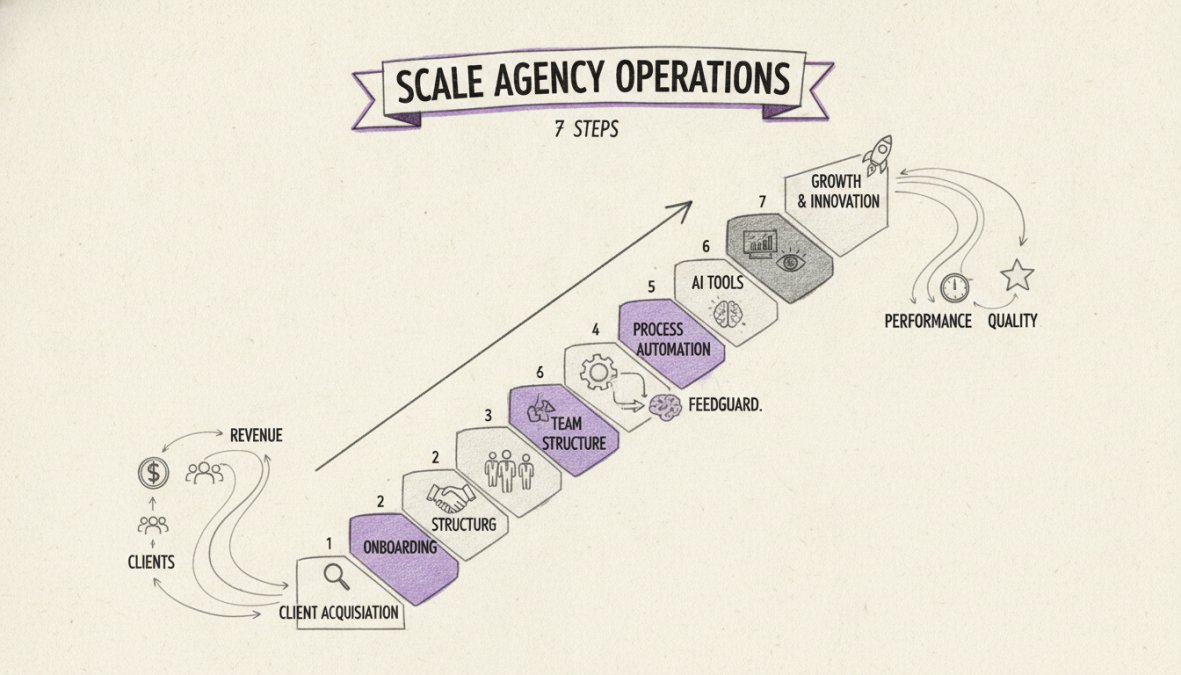
Below, we'll walk through the seven concrete steps that separate agencies that grow from those that stall.
Why Scaling Requires More Than Hiring
Hiring more staff without documented processes creates chaos. You end up training people repeatedly, watching quality inconsistency across clients, and spending more time managing than working on strategy. The real scaling lever is operational efficiency.
Define Your Niche and Service Offering
Generalist agencies struggle to scale. When you try to serve every type of client with every type of service, you become a custom shop, not a scalable business. Specialization is the foundation of operational scaling.
Choose a niche based on three criteria: (1) where you have genuine expertise, (2) where clients have budget, and (3) where the problems are repeatable. An agency serving e-commerce brands on Instagram will develop repeatable processes. An agency serving "anyone who needs social media" will constantly reinvent the wheel.
Your service offering should be narrow enough that you can systematize it, but broad enough to generate real revenue. Most agencies succeed with 2-3 core service packages rather than à la carte everything.
Positioning for Recurring Revenue
Recurring revenue transforms agency economics. Instead of hunting for new clients constantly, you build a predictable revenue base that funds growth. Position your services as retainers, not projects.
A project mindset creates feast-or-famine cycles. A retainer mindset creates stability. Retainers also make your operations more predictable, you know exactly how many hours you're selling each month, which means you can staff accordingly.
Build Social Media Agency SOP Templates That Scale
SOPs (Standard Operating Procedures) are the skeleton of a scalable agency. Without them, every task depends on a specific person knowing how to do it. With them, any competent person can execute consistently.
Your social media agency SOP templates should cover: client onboarding, content calendar creation, post scheduling, community management, reporting, and client communication. Each SOP should be a step-by-step document that a new hire could follow without asking questions.
Start with your most time-consuming workflows. If you spend 8 hours per week on content calendars, that's your first SOP. If community management is eating your time, that's next.
Documentation as Your Scalability Foundation
Documentation is not busywork. It's the most valuable asset your agency owns. When a client fires you and you lose that revenue, the SOP stays. When a team member leaves, the SOP stays. When you want to delegate a task, the SOP is your training tool.
Good SOPs include: the exact steps in order, screenshots showing where to click, common mistakes to avoid, and decision trees for edge cases. They're boring to write and invaluable to have.
Most agencies skip this step because it feels like overhead. That's exactly why most agencies can't scale past $500K in revenue.
use Automation and AI-Driven Operational Workflows
Automation doesn't replace your team. It eliminates the repetitive parts of their jobs so they can focus on strategy and creativity. Comment moderation, response generation, scheduling, and reporting are all candidates for automation.
AI-powered tools now handle tasks that used to require manual work. Real-time comment moderation catches spam and hate speech before it damages brand reputation. Automated response systems reply to common questions 24/7 in your brand voice. Scheduling tools post at optimal times without human intervention.
The agencies winning right now are the ones using AI to compress the time spent on execution, freeing their teams to do higher-value work like strategy and creative direction.
Comment Moderation and Response Automation
Comment sections are where brand reputation gets built or destroyed. Manual moderation is slow and inconsistent. AI-powered moderation detects spam, hate speech, and competitor links in real time, hiding harmful content before customers see it.
FeedGuardians provides AI-powered comment moderation across Instagram, Facebook, TikTok, and YouTube with 98.7% accuracy. The system automatically detects and hides spam while delivering 24/7 AI-powered replies in your unique brand voice. This eliminates the most time-consuming part of community management, responding to every comment, while protecting brand reputation.
For agencies managing 20+ client accounts, automating comment moderation saves 10-15 hours per week per team member. That's capacity freed for strategy work that actually moves the needle for clients.
Automating Client Onboarding for Agencies
Client onboarding is where first impressions happen. Manual onboarding is slow, inconsistent, and error-prone. Automated onboarding is fast, consistent, and scalable.
A good onboarding workflow collects all necessary information upfront, sets expectations clearly, and gets clients producing results quickly. This reduces support tickets and increases client satisfaction from day one.
Your onboarding should include: intake forms (brand voice, target audience, goals), account setup (access to platforms, content calendar setup), kickoff call (strategy alignment), and first 30-day deliverables (content calendar, first posts, initial reporting).
From Manual Handoff to Workflow Automation
The moment a client signs, they should receive an automated sequence that walks them through the onboarding process. No manual emails required. No back-and-forth scheduling. No waiting.
Use tools like Zapier or Make to connect your CRM to your project management system. When a new client is added, automatically create a project, send intake forms, schedule the kickoff call, and generate the first content calendar template.
This automation saves 2-3 hours per new client. For an agency onboarding 4-5 clients per month, that's 10-15 hours of time freed every month.
Best Project Management Tools for Social Media Agencies
Project management tools are where your team coordinates work, tracks progress, and stays accountable. The right tool prevents chaos. The wrong tool creates friction.
For social media agencies, you need: task assignment, deadline tracking, file storage, client communication (or integration with it), and reporting. Most agencies use Monday.com, Asana, ClickUp, or Notion.
The choice depends on team size and complexity. Solo operators often use Notion. Teams of 5-10 typically use Monday.com or Asana. Larger agencies use ClickUp for its deeper customization.
Capacity Planning and Team Alignment
Project management tools also solve capacity planning. You should know at any moment: how many hours are allocated to each client, who is at capacity, and where you have bench time.
Capacity planning prevents over-promising to clients and over-working your team. It also reveals where you need to hire. If your team is consistently at 85%+ capacity, you're one client issue away from burnout. If you're at 60% capacity, you have room to take on new clients.
Team alignment happens when everyone can see the same work. No more "I thought you were handling that" conversations. Everyone sees the task, the deadline, the status, and who's responsible.
How to Hire Social Media Managers for an Agency
Hiring is where most agencies go wrong. They hire for skills when they should hire for systems-thinking and coachability.
A great social media manager doesn't need 5 years of experience. They need to be able to follow a process, execute consistently, and ask smart questions when something doesn't fit the SOP. You can teach social media strategy. You can't teach someone to care about doing things the right way.
Your hiring process should include: a writing test (can they write in your brand voice?), a systems test (can they follow an SOP?), and a values conversation (do they care about the work?). Skip the "years of experience" requirement. It filters out junior talent that might be better than burnt-out veterans.
Contractors vs. Full-Time: Building Your Team Structure
Most agencies start with contractors and transition to full-time as they grow. Contractors are flexible. Full-time employees are committed.
For repeatable, process-driven work (scheduling, community management, reporting), contractors work well. For strategic work (strategy, creative direction, client relationships), full-time is better.
A typical structure at $500K revenue: 1 full-time founder/strategist, 2-3 full-time content creators or managers, 1-2 contractors for scheduling and reporting. At $2M revenue: 1 founder, 2-3 strategists, 5-7 content creators, 2-3 contractors, 1 operations manager.
Implement White-Label Services and Pricing Models
White-label services let you expand revenue without expanding team size. You partner with another agency or freelancer to deliver services under your brand, keeping a markup.
Common white-label services for social agencies: video production, copywriting, paid ads management, graphic design. You position these as your services. The partner delivers them. You keep 20-40% margin.
This works because your client relationships are valuable. Your clients trust you. When you say "we'll handle video production," they believe you. The actual production can happen anywhere.
Profit Margin Optimization Through Outsourcing
Outsourcing low-margin work increases overall profitability. If you're spending 20 hours on content creation per client and only charging $2,000/month, your margin is terrible. Outsource the execution to a contractor at $1,200, and suddenly you're profitable.
The key is knowing which work to outsource. Outsource execution. Keep strategy, client relationships, and quality control in-house.
Your pricing should account for outsourcing costs. If a service costs you $1,200 to deliver, price it at $2,000-$2,500 depending on market rates. This gives you margin to scale while staying competitive.
According to research from McKinsey's agency scaling analysis, agencies that implement outsourcing strategies see 30-40% improvements in profit margins within the first year. The agencies that don't typically cap out at 15-20% margins because they're delivering everything in-house.
Pricing models that work: flat retainers ($2,000-$5,000/month for standard packages), tiered retainers (basic, standard, premium), project-based (for one-off work), and performance-based (you get a percentage of revenue lift). Most successful agencies use retainers because they're predictable and scalable.
The data shows that agencies using documented SOPs and automation platforms experience 25-35% faster project delivery compared to agencies relying on manual processes, according to Forrester's operational efficiency report for service agencies. This efficiency translates directly to margin improvement and team satisfaction.
Scaling a social media agency is possible, but it requires discipline. Most founders skip the hard work of building systems because it feels like overhead. They hire people instead. Then they hire more people. Eventually they're managing 15 people and making less money than when they had 3.
The path forward is clear: document your processes, automate what you can, hire for culture and coachability, and build recurring revenue. FeedGuardians handles the comment moderation piece, detecting spam and hate speech with 98.7% accuracy while delivering 24/7 AI-powered replies in your brand voice. This frees your team from the most repetitive part of community management. Start with FeedGuardians and reclaim 10-15 hours per week of team capacity that you can redirect toward strategy and growth.
Frequently Asked Questions
When should you start scaling your social media agency?
Start scaling when you have consistent client demand, repeatable service delivery processes, and enough revenue to invest in systems and hiring. Most agencies scale when they hit capacity limits, typically 3-5 core clients with predictable workflows. Before scaling, ensure your SOPs are documented and your profit margins can sustain additional overhead. Scaling prematurely without operational efficiency leads to service quality issues and cash flow problems.
What are the biggest challenges in scaling a social media agency?
The top challenges include maintaining service delivery quality while growing, managing cash flow during hiring phases, building scalable systems without losing the personal touch clients value, and finding qualified social media managers. Additionally, many founders struggle with delegation and burnout prevention. Implementing automation, clear SOPs, and project management tools mitigates these risks. Financial health tracking and KPI monitoring help you scale sustainably.
How do you automate social media agency operations without losing brand quality?
Use AI-driven automation for repetitive tasks like comment moderation, spam detection, and initial client responses while maintaining human oversight. Tools can auto-hide hate speech and competitor links with high accuracy, then escalate complex issues to your team. Automation frees your team to focus on strategy and creative work. Document your brand voice and guidelines so automation tools learn your tone, terminology, and client-specific requirements for consistent service delivery.
What roles should you hire first when scaling a social media agency?
Prioritize hiring based on your bottleneck: if content creation is limiting growth, hire content creators or social media managers first. If client management is stretched, hire an account manager or project coordinator. Consider contractors before full-time employees to test roles and manage overhead. Use project management tools to track capacity before hiring. As you scale, build a team structure with specialists (copywriters, designers, analysts) and generalists who can manage multiple client accounts efficiently.
How do you maintain quality control while scaling a social media agency?
Quality control at scale depends on clear SOPs, project management tools that enforce workflows, and KPI tracking. Implement client onboarding automation to ensure consistent setup and expectations. Use CRM systems to track service delivery standards and client satisfaction metrics. Schedule regular audits of client results and team output. Automation tools help maintain consistency, for example, AI-powered comment moderation ensures every client's social channels are protected 24/7. Regular team training and documented best practices keep quality high as you grow.
This article was written using GrandRanker
Tired of manually moderating comments?
FeedGuardians automates spam filtering, responds to customers, and protects your brand — setup in 3 minutes.
Frequently Asked Questions
When should you start scaling your social media agency?
Start scaling when you have consistent client demand, repeatable service delivery processes, and enough revenue to invest in systems and hiring. Most agencies scale when they hit capacity limits—typically 3-5 core clients with predictable workflows. Before scaling, ensure your SOPs are documented and your profit margins can sustain additional overhead. Scaling prematurely without operational efficiency leads to service quality issues and cash flow problems.
What are the biggest challenges in scaling a social media agency?
The top challenges include maintaining service delivery quality while growing, managing cash flow during hiring phases, building scalable systems without losing the personal touch clients value, and finding qualified social media managers. Additionally, many founders struggle with delegation and burnout prevention. Implementing automation, clear SOPs, and project management tools mitigates these risks. Financial health tracking and KPI monitoring help you scale sustainably.
How do you automate social media agency operations without losing brand quality?
Use AI-driven automation for repetitive tasks like comment moderation, spam detection, and initial client responses while maintaining human oversight. Tools can auto-hide hate speech and competitor links with high accuracy, then escalate complex issues to your team. Automation frees your team to focus on strategy and creative work. Document your brand voice and guidelines so automation tools learn your tone, terminology, and client-specific requirements for consistent service delivery.
What roles should you hire first when scaling a social media agency?
Prioritize hiring based on your bottleneck: if content creation is limiting growth, hire content creators or social media managers first. If client management is stretched, hire an account manager or project coordinator. Consider contractors before full-time employees to test roles and manage overhead. Use project management tools to track capacity before hiring. As you scale, build a team structure with specialists (copywriters, designers, analysts) and generalists who can manage multiple client accounts efficiently.
How do you maintain quality control while scaling a social media agency?
Quality control at scale depends on clear SOPs, project management tools that enforce workflows, and KPI tracking. Implement client onboarding automation to ensure consistent setup and expectations. Use CRM systems to track service delivery standards and client satisfaction metrics. Schedule regular audits of client results and team output. Automation tools help maintain consistency—for example, AI-powered comment moderation ensures every client's social channels are protected 24/7. Regular team training and documented best practices keep quality high as you grow.