
Quick Summary
| Key Insight | What You Need to Know |
|---|---|
| How to Stop Spam | How to Stop Spam on Instagram with AI ModerationSetting Up Real-Time Detection for Comment SpamWhat to Do When AI Flags a False Positive |
| Setting Up Real-Time Detection | Setting Up Real-Time Detection for Comment Spam |
| What to Do When | What to Do When AI Flags a False Positive |
| What "Accuracy" Actually Measures | What "Accuracy" Actually Measures |
| Why Category-Level Numbers Matter | Why Category-Level Numbers Matter More Than a Headline Figure |
| The Regulatory Lens on | The Regulatory Lens on Accuracy Claims |
Table of Contents
- How to Stop Spam on Instagram with AI Moderation
- AI Moderation Accuracy Rates: What the Data Shows
- Human-in-the-Loop Moderation Strategies for Safety
- The Real Risks of Automated Moderation Tools
- Is AI Social Moderation Safe to Use for Your Business?
- Conclusion: Balancing Automation and Oversight
- Frequently Asked Questions
Last Updated: September 24, 2026
How to Stop Spam on Instagram with AI Moderation
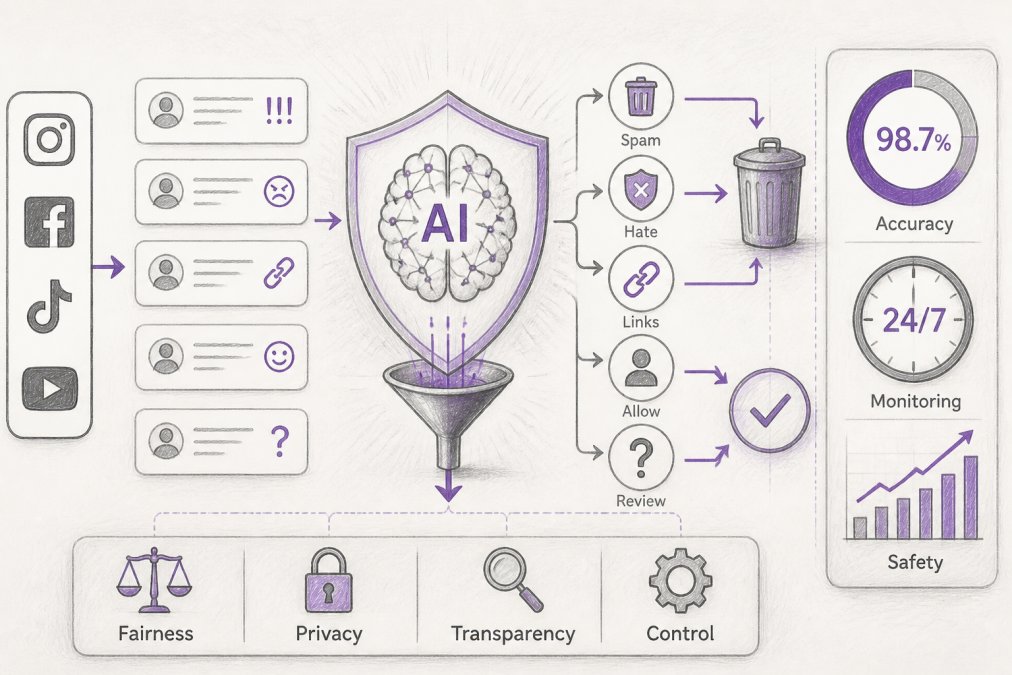
Spam comments are not just annoying. They bury real buyer questions, wreck your ad performance, and hand your audience to competitors. This guide from FeedGuardians shows you exactly how to stop spam on Instagram using AI social moderation, so your team stops drowning in junk and starts having real conversations.
Here is the honest answer up front: AI social moderation is safe to use when you pair automated detection with human oversight. The tools handle volume. People handle judgment.
Below, we will walk through setup, accuracy, and the risks nobody warns you about.
Setting Up Real-Time Detection for Comment Spam
Real-time detection means the system scans every comment the moment it lands, not hours later. Speed matters because spam spreads fast.
Here is the basic setup flow:
- Connect your Instagram account to your moderation tool
- Set rules for spam triggers: link patterns, repeated phrases, banned words
- Turn on automatic hiding for clear violations
- Route borderline comments to a review queue
- Check your queue daily for the first week
FeedGuardians handles this across Instagram, Facebook, TikTok, and YouTube, which matters if you run the same brand everywhere.
What to Do When AI Flags a False Positive
A false positive is a good comment that the system wrongly flags as harmful. It happens to every tool.
When it does:
- Check the comment against your content policy
- Restore it manually if it breaks no rules
- Log why the flag was wrong
- Adjust your keyword rules or thresholds
Do this consistently and your false positive rate drops over time. Skip it, and you will keep hiding real customers.
AI Moderation Accuracy Rates: What the Data Shows
Accuracy rates tell you how often a system gets it right. FeedGuardians reports 98.7% accuracy at detecting and hiding spam, scams, hate speech, and competitor links.
That number sounds impressive. It also deserves scrutiny, because "accuracy" is one of the most abused words in moderation marketing.
What "Accuracy" Actually Measures
A single accuracy percentage hides the trade-off that matters most: precision versus recall.
- Precision is the share of flagged comments that were genuinely violations. Low precision means you are hiding good comments.
- Recall is the share of real violations the system caught. Low recall means toxic content stays visible.
You can push either number up by sacrificing the other. A tool that auto-hides everything gets perfect recall and terrible precision. A tool that hides nothing gets perfect precision and zero recall. A vendor quoting one blended figure is telling you almost nothing about which failure mode you will actually experience.
When you evaluate a tool, ask for the confusion matrix, true positives, false positives, true negatives, false negatives, broken out by content category.
Why Category-Level Numbers Matter More Than a Headline Figure
A busy e-commerce post can pull hundreds of comments in an hour. At that volume, small error rates compound fast.
The Regulatory Lens on Accuracy Claims
If you are a business repeating an accuracy figure in your own marketing, treat it like any other advertising claim. The Federal Trade Commission expects objective claims to be backed by competent and reliable evidence, and it has brought repeated enforcement actions over unsupported performance claims. A vendor's self-reported number is not, by itself, substantiation, you need the methodology behind it.
False Positives vs. False Negatives in Content Filtering
False positives hide good comments. False negatives let bad ones through.
Human-in-the-Loop Moderation Strategies for Safety
Human-in-the-loop moderation means a person reviews the decisions the AI cannot make alone. It is the single most important safety layer you can add.
Building Escalation Protocols That Work
An escalation protocol is a written rule for when a comment goes to a human. Without one, your team guesses.
A simple version:
| Comment Type | AI Action | Human Review |
|---|---|---|
| Clear spam or scam link | Auto-hide | No |
| Hate speech | Auto-hide | Same day |
| Angry but legitimate complaint | Flag | Within 2 hours |
| Competitor mention | Flag | Within 24 hours |
| Ambiguous sarcasm | Flag | Within 4 hours |
Write yours down. Review it monthly.
The Real Risks of Automated Moderation Tools
Automated tools fail in predictable ways. Knowing the failure modes, and what each one costs you, keeps you out of trouble.
The biggest risks, and what to do about each:
- Over-blocking. Tight filters silence real fans. Mitigation: run new rules in shadow mode for a week before they hide anything, and review what they would have caught.
- Context blindness. Sarcasm, in-group humor, and reclaimed language get misread. Mitigation: maintain an allowlist of your community's inside jokes and recurring phrases, and revisit it monthly.
- Bias in training data. Models can flag some groups more than others, often along dialect and identity lines. Mitigation: sample your restore log monthly and check whether flags cluster around particular communities or writing styles.
- Account access. You are handing a third-party tool control of your social accounts. Mitigation: use the narrowest permissions the platform allows, revoke tokens you no longer use, and check what data the tool retains.
- No appeal path. Users with no way to challenge a hidden comment get frustrated fast, and they tell other people.
The Transparency Gap: What Users Never Learn
Most moderation stacks are black boxes to the people they affect. A comment disappears, and the commenter has no idea whether a human or a model made the call, what rule was triggered, or whether they can do anything about it.
A few low-cost practices close most of that gap:
- Tell users when a decision was automated. A short note, "this comment was hidden by an automated filter", costs nothing and removes the guesswork.
- Give a one-click appeal. Route appeals to the same human review queue you already use for borderline comments.
- Explain the rule, not just the outcome. "Links to unverified shops are hidden" is more useful than "your comment violated our guidelines."
- Publish a plain-language summary. A short page describing what you filter, how appeals work, and how long they take builds more trust than any accuracy claim.
FTC guidance on advertising and endorsement claims
A Simple Risk-Assessment Framework
Before you turn on any automated moderation, score yourself on four questions:
| Question | Low Risk | High Risk |
|---|---|---|
| Comment volume | Under a few hundred a month | Thousands per week |
| Content sensitivity | Product questions, light banter | Health, politics, minors, financial advice |
| Regulatory exposure | General commerce | Regulated industry or public-facing platform |
| Team capacity | Someone can review the queue daily | No one owns moderation |
Data Privacy: The Risk Nobody Mentions
When you route comments through a third-party moderation API, you are sending user content, and often usernames and profile data, to a vendor. That creates obligations you may not have thought about.
Ask your vendor:
- Where is the data stored, and for how long?
- Is comment content used to train their models?
- Can you delete user data on request?
- What happens to your data if you cancel?
Is AI Social Moderation Safe to Use for Your Business?
AI social moderation is safe for most businesses when three conditions are met: the tool is accurate, a human reviews edge cases, and you can explain your decisions to users.
Here is a quick way to decide:
- Low volume, low risk? Manual review may be enough.
- High volume or paid ads? AI moderation pays for itself.
- Regulated industry? Keep a human in the loop and document everything.
Conclusion: Balancing Automation and Oversight
The safest moderation setup is not all-AI or all-human. It is both, with clear rules for each.
Frequently Asked Questions
What does AI moderation mean for social media managers?
AI moderation uses machine learning models and natural language processing to automatically flag, hide, or respond to comments across platforms. For social media managers, this means less time manually reviewing spam and hate speech, and more time on strategy. Tools like FeedGuardians handle real-time detection and can escalate edge cases to humans, so your team focuses on community building instead of cleanup.
How accurate is AI at detecting hate speech and spam?
Accuracy depends on the tool and content type. FeedGuardians reports 98.7% accuracy for detecting spam, scams, hate speech, and competitor links. General hate speech detection typically ranges from 85% to 95% because context and sarcasm are hard to parse. Always check a vendor's transparency reports and ask for false positive rates before committing.
What are the risks of using automated moderation tools?
Main risks include false positives that hide legitimate comments, algorithmic bias that disproportionately flags certain groups, and lack of contextual understanding for nuanced discussions. Moderator burnout can also occur if humans must constantly override AI mistakes. Mitigate these by using human-in-the-loop moderation strategies and reviewing escalation protocols regularly.
How can brands combine AI with human oversight for better safety?
Use AI for real-time detection and initial filtering, then route uncertain cases to human moderators. Set clear escalation protocols: AI hides obvious spam instantly, flags borderline content for review, and never auto-bans without human approval. This hybrid approach maintains operational efficiency while protecting against false positives and bias.
Spam, hate speech, and competitor links move faster than any manual team can. FeedGuardians detects and hides them in real time with 98.7% accuracy, replies in your brand voice around the clock, and gives you a human escalation option when a comment needs judgment. Get started with FeedGuardians and turn your comment section into conversations that convert.
Tired of manually moderating comments?
FeedGuardians automates spam filtering, responds to customers, and protects your brand — setup in 3 minutes.
Frequently Asked Questions
What does AI moderation mean for social media managers?
AI moderation uses machine learning models and natural language processing to automatically flag, hide, or respond to comments across platforms. For social media managers, this means less time manually reviewing spam and hate speech, and more time on strategy. Tools like FeedGuardians handle real-time detection and can escalate edge cases to humans, so your team focuses on community building instead of cleanup.
How accurate is AI at detecting hate speech and spam?
Accuracy depends on the tool and content type. FeedGuardians reports 98.7% accuracy for detecting spam, scams, hate speech, and competitor links. General hate speech detection typically ranges from 85% to 95% because context and sarcasm are hard to parse. Always check a vendor's transparency reports and ask for false positive rates before committing.
What are the risks of using automated moderation tools?
Main risks include false positives that hide legitimate comments, algorithmic bias that disproportionately flags certain groups, and lack of contextual understanding for nuanced discussions. Moderator burnout can also occur if humans must constantly override AI mistakes. Mitigate these by using human-in-the-loop moderation strategies and reviewing escalation protocols regularly.
How can brands combine AI with human oversight for better safety?
Use AI for real-time detection and initial filtering, then route uncertain cases to human moderators. Set clear escalation protocols: AI hides obvious spam instantly, flags borderline content for review, and never auto-bans without human approval. This hybrid approach maintains operational efficiency while protecting against false positives and bias.