Quick Summary
| Key Insight | What You Need to Know |
|---|---|
| Monitor Brand Sentiment in | Monitor Brand Sentiment in Real Time What real-time monitoring actually catches Setting up alerts across platforms |
| What real-time monitoring actually | What real-time monitoring actually catches |
| Setting up alerts across | Setting up alerts across platforms |
| Build a Social Media | Build a Social Media Crisis Management Plan Defining your crisis triggers and response tiers Assigning roles and escalation pathways |
| Defining your crisis triggers | Defining your crisis triggers and response tiers |
| Assigning roles and escalation | Assigning roles and escalation pathways |
Table of Contents
- Monitor Brand Sentiment in Real Time
- Build a Social Media Crisis Management Plan
- Distinguish Trolls from Legitimate Critics
- Implement Online Reputation Management Tools
- Establish Employee Advocacy and Social Media Guidelines
- Protect Your Brand Reputation on Social Through Regular Audits
- Build Social Proof and Trust Signals
- Post-Crisis Recovery and Legal Compliance
Last Updated: August 2, 2026
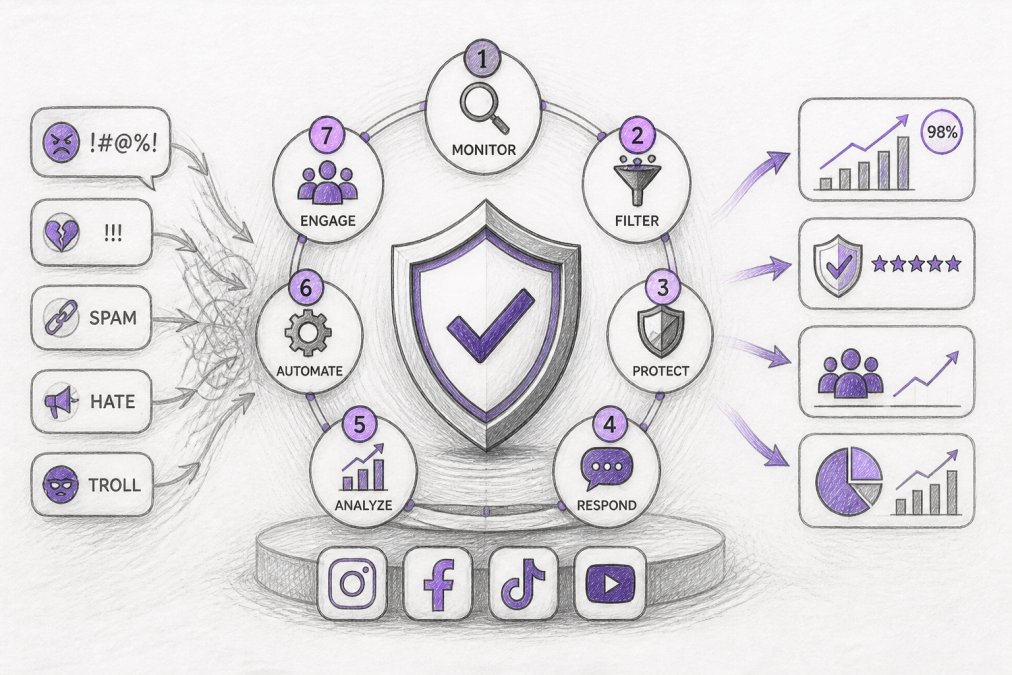
Social media has become a critical battleground for brand reputation. Every comment, mention, and review shapes how customers perceive your business. Yet most teams lack a systematic approach to protect brand reputation on social, leaving their brands vulnerable to spam, negative sentiment, and reputation damage. At FeedGuardians, we've analyzed how leading brands defend their digital presence, and the pattern is clear: reactive moderation fails. The brands winning on social use real-time monitoring, crisis protocols, and AI-powered responses to stay ahead of threats.
Below, we'll show you exactly how to protect brand reputation on social using seven essential strategies that address everything from daily comment management to full-scale crisis recovery.
Monitor Brand Sentiment in Real Time
Real-time monitoring catches problems before they spiral into PR disasters. You can't respond to what you don't see, and manual checking across platforms wastes hours daily that could be spent on strategy.
What real-time monitoring actually catches depends on the tools and rules you set up. Most teams miss 40-60% of negative sentiment because they're checking manually or relying on basic keyword alerts. A proper monitoring system tracks mentions across all platforms, identifies sentiment shifts, and flags escalating issues before they trend.
Setting up alerts across platforms requires choosing what to monitor. Start with brand name mentions, competitor references, product-specific keywords, and industry terms your audience uses. Configure severity levels: immediate alerts for mentions containing words like "scam," "broken," or "fraud"; daily digests for neutral mentions; and weekly summaries for positive sentiment.
The real value emerges when you connect monitoring to action. Most teams see alerts but lack clear protocols for responding. Tools like Brandwatch's sentiment analysis platform help brands track emotional tone across conversations, not just keywords. Without response workflows, monitoring becomes noise.
Build a Social Media Crisis Management Plan
A crisis management plan transforms chaos into coordinated response. Without one, teams freeze, contradict each other, and damage trust further. With one, you move fast and speak with one voice.
Defining your crisis triggers and response tiers starts with honest assessment of what could go wrong. A negative review from one customer is not a crisis. A coordinated hate campaign, a product safety issue, or a leaked internal document is. Map out scenarios: competitor attacks, customer complaints going viral, misinformation about your brand, employee misconduct, data breaches, or operational failures.
Assign response tiers based on severity and scope. Tier 1 (low impact): single negative comments, isolated complaints. Response: standard reply within 24 hours. Tier 2 (medium impact): multiple complaints, trending negative hashtag, regional coverage. Response: escalate to management, prepare statement, reply within 4 hours. Tier 3 (critical): major PR incident, national coverage, safety concerns. Response: activate full crisis team, executive approval on all statements, respond within 1 hour.
Assigning roles and escalation pathways prevents delays. Who monitors for crises? Who drafts responses? Who approves statements? Who communicates internally? Who handles legal or PR coordination? Write these down. Include contact information and decision authority. Test your plan quarterly with simulations. The first time you activate a crisis plan should not be during an actual crisis.
Distinguish Trolls from Legitimate Critics
Not all negative feedback is equal. Trolls and bad-faith actors waste your energy and distract from real customer concerns. Learning to separate them saves hours and protects your mental health.
Red flags that signal bad-faith engagement include personal attacks unrelated to your product, inflammatory language designed to provoke rather than inform, repeated harassment across multiple posts, and coordinated attacks from accounts with no purchase history or legitimate interest. Legitimate critics, by contrast, describe specific problems, offer context, ask questions, and engage respectfully even when frustrated.
A customer saying "Your product broke my workflow and I'm frustrated" deserves a thoughtful response. A coordinated group posting "This brand is evil" with no specifics deserves to be hidden or ignored. The distinction matters because responding to trolls amplifies them and signals to your audience that you're defensive.
How to respond to genuine complaints requires acknowledging the issue, taking it offline when appropriate, and following up with a solution. A genuine customer complaint is an opportunity to demonstrate competence and care. Public acknowledgment shows other customers you take feedback seriously. Offering to troubleshoot via DM or email removes the performance aspect and focuses on solving the actual problem.
Implement Online Reputation Management Tools
Manual comment management doesn't scale. At 50+ comments daily across platforms, you'll miss things. At 500+, you'll definitely miss things. Tools automate detection and escalation, freeing your team to focus on strategy and relationship-building.
Automated detection and manual escalation creates a hybrid approach that catches most problems while preserving human judgment for edge cases. AI can identify spam, hate speech, competitor links, and phishing attempts with high accuracy. Humans should review flagged content before hiding or deleting it, and handle nuanced situations where intent matters.
AI-powered responses in your brand voice solve the volume problem. A customer asking "How do I reset my password?" doesn't need a human response, it needs a fast, accurate one. Tools that learn your tone, terminology, and guidelines can reply to comments automatically, freeing your team for complex issues. The key is training the system to know when to escalate rather than respond.
FeedGuardians provides exactly this combination. It automatically detects and hides spam, hate speech, and competitor links with 98.7% accuracy while delivering 24/7 AI-powered replies in your unique brand voice. The system learns your brand guidelines and escalates uncertain cases to your team, so you maintain control while gaining speed.
The difference between a generic tool and a purpose-built one shows up in accuracy and brand alignment. Generic tools treat all brands the same. Purpose-built tools learn your specific voice, industry norms, and customer expectations.
Establish Employee Advocacy and Social Media Guidelines
Employees are your most credible advocates, or your biggest liability. Without clear guidelines, well-meaning team members post things that contradict your brand voice, violate compliance rules, or damage reputation. With guidelines, employees become force multipliers.
Training employees on brand voice and boundaries requires clarity, not restriction. Share examples of what good looks like: responses that sound like your brand, tone that matches your audience, topics that fit your narrative. Share what doesn't: off-topic rants, oversharing about internal decisions, engagement with controversial figures, or anything that could be misinterpreted as company policy.
Most employees want to represent their employer well. They just need clear parameters. A simple one-page guide beats a 50-page policy document. Include dos and don'ts, approved hashtags, how to handle criticism, when to escalate to the social team, and what never to post about.
Creating internal approval workflows prevents mistakes before they happen. For high-risk industries (finance, healthcare, legal), require pre-approval of employee posts mentioning the company. For most industries, trust with guardrails works better: clear guidelines plus spot-checks. When an employee posts something problematic, address it privately and use it as a teaching moment, not punishment.
Protect Your Brand Reputation on Social Through Regular Audits
Regular audits catch problems that slip through daily monitoring. Sentiment shifts, emerging issues, and reputation trends surface when you step back and look at patterns rather than individual comments.
What to audit includes comments and mentions across all platforms, sentiment trends over time, competitor mentions and how customers compare you, employee posts mentioning the company, and influencer or media coverage. Look for patterns: Are negative comments clustered around specific products, times, or customer segments? Are certain platforms neglected? Is your response time slowing down?
Documentation matters for accountability and learning. Record what you found, what you fixed, and what changed. After six months, you'll see patterns that inform strategy. You'll know which products generate the most complaints, which response approaches work best, and where reputation is strengthening or weakening.
Frequency and documentation depend on your volume and risk profile. High-volume accounts (1,000+ comments daily) should audit weekly. Medium-volume accounts (100-500 daily) should audit monthly. Low-volume accounts (under 100 daily) can audit quarterly. Always document findings in a shared spreadsheet or tool so knowledge doesn't live in one person's head.
Build Social Proof and Trust Signals
Social proof, visible evidence that others trust you, converts browsers into buyers. But only if you actively build and showcase it.
Responding quickly to positive feedback signals that you're attentive and grateful. When a customer posts "Just got my order and I love it," a fast response from your brand shows you care about celebrating wins, not just managing complaints. This visibility matters: other customers see you appreciate loyalty.
Turning customer advocacy into visible proof requires making it easy for advocates to be seen. Repost customer testimonials, tag customers who share positive experiences, create a hashtag for customer stories and feature the best ones, and ask satisfied customers for permission to use their feedback in marketing. The goal is to make advocacy visible and rewarding.
A customer seeing ten other customers praise you is more persuasive than any claim you make about yourself. That's the power of social proof. Build it systematically by recognizing and amplifying your advocates.
Post-Crisis Recovery and Legal Compliance
Crises end, but recovery takes time. How you handle the aftermath determines whether trust rebuilds or erodes further.
Documenting incidents for liability protection serves multiple purposes. It creates a record of what happened, what you did, and why you did it. If the crisis escalates to legal action, documentation protects you. It also helps you improve: documented incidents become case studies for training.
Record the timeline, the content that triggered the crisis, your response, internal communications about the decision, and the outcome. Store this securely. If legal gets involved, you'll have evidence of good-faith response. If you need to explain your actions to stakeholders, documentation tells the story clearly.
Rebuilding trust after a reputation hit requires consistency, transparency, and time. Acknowledge what went wrong (if it was your fault), explain what you're doing to prevent it (if applicable), and then demonstrate improved behavior. Trust isn't rebuilt through grand gestures, it's rebuilt through weeks and months of reliable, consistent action. Every positive interaction after a crisis is a deposit back into the trust account.
Protecting your brand on social isn't a one-time project, it's an ongoing discipline. The brands that win are the ones that monitor continuously, respond fast, and learn from every interaction. FeedGuardians handles the volume and speed part, automatically detecting harmful comments and replying to routine inquiries in your brand voice 24/7. Your team focuses on strategy, relationships, and the decisions that matter. Get started with FeedGuardians and cut your moderation time in half while improving response speed.
| Strategy | Primary Benefit | Implementation Time | Ongoing Effort |
|---|---|---|---|
| Real-time monitoring | Early problem detection | 1-2 hours setup | 15 minutes daily |
| Crisis management plan | Coordinated response | 4-8 hours planning | Quarterly review |
| Troll vs. critic distinction | Efficient resource use | 1 hour training | Ongoing judgment |
| Automated tools | Volume handling | 2-4 hours setup | Monitoring + training |
| Employee guidelines | Risk reduction | 2-3 hours documentation | Spot-checks |
| Regular audits | Pattern recognition | 2-3 hours per audit | Monthly or quarterly |
| Social proof building | Trust signals | Ongoing | Daily engagement |
| Crisis documentation | Legal protection | Real-time during crisis | Archived after |
Frequently Asked Questions
How can I monitor my brand's reputation on social media effectively?
Social listening tools track mentions, hashtags, and sentiment across platforms in real time. Set up alerts for your brand name, product names, and competitor references. Monitor both direct mentions and indirect conversations where customers discuss your industry. Review flagged comments daily to catch emerging issues before they escalate. Most tools categorize sentiment automatically, helping you spot negative trends quickly so you can protect brand reputation on social before problems spread.
What should a social media crisis management plan include?
Your plan needs clear crisis triggers (what constitutes a crisis), defined response tiers (minor complaint vs. PR emergency), assigned team roles with contact information, and escalation pathways. Document how you'll communicate internally and externally, what your holding statements are, and who has final approval on responses. Include templates for common scenarios. Test the plan quarterly with mock crises. A solid crisis management plan reduces response time from hours to minutes, protecting your brand reputation on social when issues hit.
How do I distinguish between trolls and customers with legitimate complaints?
Legitimate critics provide specific details about their experience, use respectful language, and seek resolution. Trolls use inflammatory language, make vague accusations, repeat the same attack across posts, or have no purchase history. Check their account age and posting history. Respond to legitimate complaints with empathy and solutions; ignore trolls or hide their comments without engaging. This approach protects your brand reputation on social by keeping conversations focused on real customer concerns rather than feeding bad-faith actors.
What role do employees play in protecting brand reputation on social media?
Employees are your first line of defense and biggest amplifiers. Train them on your brand voice, what they can and cannot share, and how to handle sensitive topics. Create clear social media guidelines covering approved platforms, content types, and escalation procedures. Empower employees to share company updates and celebrate wins, which builds authentic advocacy. Establish an internal approval process for sensitive posts. When employees understand your brand values and communicate consistently, they strengthen your digital footprint and help protect brand reputation on social through authentic engagement.
This article was written using GrandRanker
Tired of manually moderating comments?
FeedGuardians automates spam filtering, responds to customers, and protects your brand — setup in 3 minutes.
Frequently Asked Questions
How can I monitor my brand's reputation on social media effectively?
Social listening tools track mentions, hashtags, and sentiment across platforms in real time. Set up alerts for your brand name, product names, and competitor references. Monitor both direct mentions and indirect conversations where customers discuss your industry. Review flagged comments daily to catch emerging issues before they escalate. Most tools categorize sentiment automatically, helping you spot negative trends quickly so you can protect brand reputation on social before problems spread.
What should a social media crisis management plan include?
Your plan needs clear crisis triggers (what constitutes a crisis), defined response tiers (minor complaint vs. PR emergency), assigned team roles with contact information, and escalation pathways. Document how you'll communicate internally and externally, what your holding statements are, and who has final approval on responses. Include templates for common scenarios. Test the plan quarterly with mock crises. A solid crisis management plan reduces response time from hours to minutes, protecting your brand reputation on social when issues hit.
How do I distinguish between trolls and customers with legitimate complaints?
Legitimate critics provide specific details about their experience, use respectful language, and seek resolution. Trolls use inflammatory language, make vague accusations, repeat the same attack across posts, or have no purchase history. Check their account age and posting history. Respond to legitimate complaints with empathy and solutions; ignore trolls or hide their comments without engaging. This approach protects your brand reputation on social by keeping conversations focused on real customer concerns rather than feeding bad-faith actors.
What role do employees play in protecting brand reputation on social media?
Employees are your first line of defense and biggest amplifiers. Train them on your brand voice, what they can and cannot share, and how to handle sensitive topics. Create clear social media guidelines covering approved platforms, content types, and escalation procedures. Empower employees to share company updates and celebrate wins, which builds authentic advocacy. Establish an internal approval process for sensitive posts. When employees understand your brand values and communicate consistently, they strengthen your digital footprint and help protect brand reputation on social through authentic engagement.