
Quick Summary
| Key Insight | What You Need to Know |
|---|---|
| Why Most Agency Analytics | Why Most Agency Analytics Strategies Break at Scale |
| Core KPIs and Metrics | Core KPIs and Metrics Your Social Media Analytics Strategy NeedsVanity Metrics vs. Actionable InsightsThe 5 KPIs That Matter Most for Agency Clients |
| Vanity Metrics vs. Actionable | Vanity Metrics vs. Actionable Insights |
| The 5 KPIs That | The 5 KPIs That Matter Most for Agency Clients |
| How to Measure Social | How to Measure Social Media ROI for Clients |
| The Four-Block Agency Report | The Four-Block Agency Report Structure |
Table of Contents
- Why Most Agency Analytics Strategies Break at Scale
- Core KPIs and Metrics Your Social Media Analytics Strategy Needs
- How to Measure Social Media ROI for Clients
- Social Media Reporting Templates for Agencies
- Social Media Management Automation Tools That Scale
- Building a Cross-Platform Data Normalization Process
- Privacy and Compliance in Agency Analytics
- Conclusion
- Frequently Asked Questions
Last Updated: September 21, 2026
Why Most Agency Analytics Strategies Break at Scale
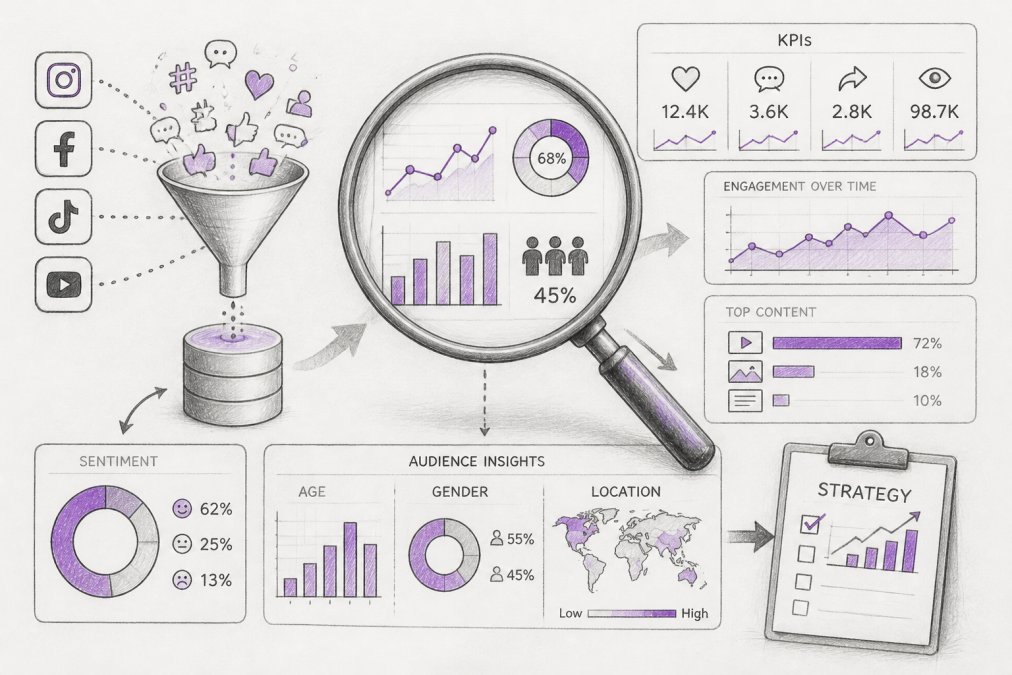
A social media analytics strategy for marketing agencies is the system you use to collect, normalize, and act on performance data across every client account you manage. It breaks at scale for one reason: most agencies build their measurement process for a single brand, then try to run it across fifteen.
Core KPIs and Metrics Your Social Media Analytics Strategy Needs
Your analytics strategy needs five KPIs tied to revenue or retention, not ten tied to vanity. Everything else is supporting context.
| KPI | What It Answers | Best For | Frequency |
|---|---|---|---|
| Conversion tracking | Did social drive a sale or lead? | E-commerce, B2B | Weekly |
| Marketing ROI | Is the spend worth it? | All clients | Monthly |
| Engagement rate | Is content resonating? | Brand awareness | Weekly |
| Click-through rate | Are CTAs working? | Lead generation | Weekly |
| Audience sentiment | How do people feel? | Reputation-sensitive brands | Ongoing |
Vanity Metrics vs. Actionable Insights
Follower growth and impressions are vanity metrics: they rise without telling you whether anyone cared. Actionable insights connect a number to a decision you can make. A client doesn't need to know they gained 4,000 followers. They need to know which post drove the most referral traffic and why.
The 5 KPIs That Matter Most for Agency Clients
The five above cover the three questions every client asks eventually: did it work, was it worth it, and do people like us. Build your dashboard around those, and you'll never scramble for a renewal conversation.
How to Measure Social Media ROI for Clients
Measuring social media ROI for clients means attributing revenue or qualified leads to specific social touchpoints, then comparing that figure to total spend. Attribution modeling is where most agencies get sloppy.
A practical process:
- Define the conversion event with the client (purchase, demo request, form fill)
- Set up conversion tracking on every platform that supports it
- Apply a consistent attribution window across platforms
- Separate organic vs paid performance so you can see what each is doing
- Report the ratio, not just the raw number
Social Media Reporting Templates for Agencies
A reporting template for an agency is not the same artifact as a reporting template for a brand. A brand builds one report for one audience. An agency builds one report architecture that produces fifty different client-facing documents from the same underlying data model. If your template only works for one account, it is not a template, it is a one-off.
The Four-Block Agency Report Structure
Every client report, regardless of industry or platform mix, should resolve into four blocks. This is the structure most agencies converge on once they stop rebuilding reports from scratch each month:
- Executive summary, three headline numbers, one sentence of interpretation each, and a single stated recommendation. One page, always.
- KPI movement, this period versus last period versus the same period a year ago, with the delta shown as a percentage and a direction arrow. Year-over-year matters more than month-over-month for seasonal clients, and most templates omit it.
- Content performance, top three and bottom three posts, each with a stated reason (hook type, format, posting time, paid amplification, or audience mismatch). A post without a reason is just a screenshot.
- Next actions, three specific, owner-assigned recommendations with a due date. "Post more video" is not an action. "Shift 20% of paid budget from static to Reels by the 15th, owned by [name]" is.
Translating Raw Data Into Client-Friendly Language
This is the step where agencies lose renewals. A client does not want to read that engagement rate rose 1.4 percentage points. They want to know what that means for the thing they actually care about, pipeline, foot traffic, retention, or brand safety.
A working translation pattern:
- State the metric and its movement in plain terms.
- State the business consequence in the client's own vocabulary (use the words from their kickoff call, not your dashboard labels).
- State what you are doing about it next month.
Scaling One Template Across Many Clients
A template that scales has three properties:
- Data-source agnostic. The template pulls from a normalized data layer, not from platform-native exports. If a client adds TikTok mid-quarter, the report should not require a redesign.
- Brand-swappable. Colors, logos, and voice are variables, not hardcoded. The structure stays identical across every account so your team builds muscle memory.
- Section-toggleable. Some clients need sentiment. Some need share of voice. Some need neither. Sections should be on/off, not rewritten.
The Retainer-Justification Test
Before you send any report, run it through one question: does this document make the case for next month's retainer without a meeting? If the client has to schedule a call to understand whether they got value, the report failed. The four-block structure above exists specifically to answer that question on page one.
Social Media Management Automation Tools That Scale
Most guides frame automation tools as a scheduling problem. For an agency, scheduling is the easy part. The hard part is automating the workflow that turns raw platform data into a client-ready report and a moderated comment queue across every account you manage, without a human touching each one daily.
The Three Automation Layers an Agency Actually Needs
Layer 1: Publishing and scheduling. This is the layer every tool covers well, and it is the layer least likely to break your agency. If your scheduler fails, you miss a post. Annoying, recoverable.
What "Scales Across 50+ Clients" Actually Requires
A workflow scales when adding a client adds configuration, not labor. Three tests:
- Onboarding time. Adding a new client account to your reporting stack should take under an hour, not a week. If it takes a week, your stack is a collection of one-off setups.
- Exception handling. The system should surface only the items that need human judgment, a spike in negative sentiment, a comment thread escalating, a metric that broke its normal range. Everything else should flow through untouched.
- Failure isolation. One client's API token expiring should not break reporting for the other forty-nine. If your automation is a single script, it will.
Where AI Moderation Fits, and Where It Does Not
AI moderation is good at volume: classifying thousands of comments per day, catching spam and competitor links, flagging sentiment shifts before a human would notice. It is not good at the edge cases that matter most, a sarcastic complaint, a cultural reference, a crisis forming in the replies.
Building a Cross-Platform Data Normalization Process
Cross-platform data normalization is the practice of converting metrics from different platforms into a shared format so they can be compared and aggregated. Without it, your dashboards compare apples to oranges.
- Mapping each platform's metric to your own internal definition
- Standardizing time zones and reporting windows
- Converting all currency to the client's billing currency
- Documenting the mapping so any team member can reproduce it
Privacy and Compliance in Agency Analytics
Privacy compliance in agency analytics means handling client and audience data according to the laws and platform policies that apply to each account. When you manage multiple clients, a single lapse can affect every relationship you hold.
Build a compliance layer into your workflow:
- Track which platforms collect what data and where it's stored
- Follow each platform's developer and data-use policies
- Keep audience segmentation data access restricted to staff who need it
- Document consent where your data collection requires it
Conclusion
Scaling analytics across multiple clients is hard because every account adds a new data source, a new audience, and a new reputation to protect. FeedGuardians handles the comment layer of that equation: real-time moderation, AI replies in each client's brand voice, and protection against spam, hate speech, and competitor links, so your team can focus on the strategy that actually grows accounts.
Frequently Asked Questions
What are the most important KPIs for marketing agencies to track?
Focus on metrics tied to business outcomes: conversion tracking, marketing ROI, engagement rate, click-through rate, and lead generation. For e-commerce clients, add referral traffic and conversion funnel completion. For brand awareness clients, track reach and impressions alongside audience sentiment. The exact mix depends on each client's goals, but avoid reporting follower growth as a primary KPI unless the client has explicitly prioritized audience building.
How do you report social media analytics to clients effectively?
Lead with the metric that maps to their business goal, not the platform. If a client cares about sales, open with conversion tracking and marketing ROI. Use a consistent social media reporting template so clients can compare month over month. Include one clear recommendation per report, not just data. And automate data collection where possible so your team spends time on analysis, not spreadsheet assembly.
What is the difference between vanity metrics and actionable insights?
Vanity metrics look impressive but do not change decisions: raw follower counts, total impressions without context, or likes without conversion data. Actionable insights connect a metric to a next step. For example, 'Instagram engagement rate dropped 2% after we shifted to video, but click-through rate rose 15%' tells you what to do next. Pair every metric with a benchmark and a recommended action.
How can automation tools improve social media reporting accuracy?
Automation removes manual data entry, which is where most reporting errors happen. Tools that pull from multiple platforms into one dashboard reduce transcription mistakes and ensure every client report uses the same calculation method. Automation also handles high-volume tasks like comment moderation, so your team can focus on strategy. The result is faster reports and fewer corrections after sending.
What role does sentiment analysis play in modern social media strategy?
Sentiment analysis shows how audiences feel about your client's brand, not just how many people engaged. It catches early warning signs: a spike in negative comments after a product launch, or confusion about a promotion. For agencies managing multiple clients, sentiment tracking across platforms provides competitive intelligence and helps prioritize which accounts need immediate attention versus routine monitoring.
How do agencies handle privacy and compliance when pulling analytics data?
Agencies should use platform-approved APIs and tools that comply with each platform's terms of service. Never scrape data or store personally identifiable information from comments without client consent. Under U.S. law, the FTC Act gives the FTC authority to enforce against unfair or deceptive data practices, so your data collection and client contracts need to reflect what you actually do with audience data. Document your data flows and get client sign-off.
Tired of manually moderating comments?
FeedGuardians automates spam filtering, responds to customers, and protects your brand — setup in 3 minutes.
Frequently Asked Questions
What are the most important KPIs for marketing agencies to track?
Focus on metrics tied to business outcomes: conversion tracking, marketing ROI, engagement rate, click-through rate, and lead generation. For e-commerce clients, add referral traffic and conversion funnel completion. For brand awareness clients, track reach and impressions alongside audience sentiment. The exact mix depends on each client's goals, but avoid reporting follower growth as a primary KPI unless the client has explicitly prioritized audience building.
How do you report social media analytics to clients effectively?
Lead with the metric that maps to their business goal, not the platform. If a client cares about sales, open with conversion tracking and marketing ROI. Use a consistent social media reporting template so clients can compare month over month. Include one clear recommendation per report, not just data. And automate data collection where possible so your team spends time on analysis, not spreadsheet assembly.
What is the difference between vanity metrics and actionable insights?
Vanity metrics look impressive but do not change decisions: raw follower counts, total impressions without context, or likes without conversion data. Actionable insights connect a metric to a next step. For example, 'Instagram engagement rate dropped 2% after we shifted to video, but click-through rate rose 15%' tells you what to do next. Pair every metric with a benchmark and a recommended action.
How can automation tools improve social media reporting accuracy?
Automation removes manual data entry, which is where most reporting errors happen. Tools that pull from multiple platforms into one dashboard reduce transcription mistakes and ensure every client report uses the same calculation method. Automation also handles high-volume tasks like comment moderation, so your team can focus on strategy. The result is faster reports and fewer corrections after sending.
What role does sentiment analysis play in modern social media strategy?
Sentiment analysis shows how audiences feel about your client's brand, not just how many people engaged. It catches early warning signs: a spike in negative comments after a product launch, or confusion about a promotion. For agencies managing multiple clients, sentiment tracking across platforms provides competitive intelligence and helps prioritize which accounts need immediate attention versus routine monitoring.
How do agencies handle privacy and compliance when pulling analytics data?
Agencies should use platform-approved APIs and tools that comply with each platform's terms of service. Never scrape data or store personally identifiable information from comments without client consent. Under U.S. law, the FTC Act gives the FTC authority to enforce against unfair or deceptive data practices, so your data collection and client contracts need to reflect what you actually do with audience data. Document your data flows and get client sign-off.