
Quick Summary
| Key Insight | What You Need to Know |
|---|---|
| Social Media Marketing vs Email Marketing for Ecommerce | The Core Differences Reach, Retention, and Direct Communication |
| Reach, Retention, and Direct | Reach, Retention, and Direct Communication |
| Email Marketing Conversion Rates | Email Marketing Conversion Rates and ROI for Ecommerce Why Email Delivers Higher Direct Response |
| Why Email Delivers Higher | Why Email Delivers Higher Direct Response |
| Social Media Marketing ROI | Social Media Marketing ROI and Ecommerce Performance Brand Awareness, Community Building, and Discovery |
| Brand Awareness, Community Building | Brand Awareness, Community Building, and Discovery |
Table of Contents
- Social Media Marketing vs Email Marketing for Ecommerce: The Core Differences
- Email Marketing Conversion Rates and ROI for Ecommerce
- Social Media Marketing ROI and Ecommerce Performance
- Ecommerce Email Marketing Best Practices and Automation
- Social Commerce Strategies: Integrating Paid Ads and Community Engagement
- Budget Allocation Framework: When to Invest in Each Channel
- Omnichannel Integration: Email and Social Working Together
- Conclusion: Which Channel Wins for Your Ecommerce Business?
Last Updated: July 29, 2026
Social Media Marketing vs Email Marketing for Ecommerce: The Core Differences
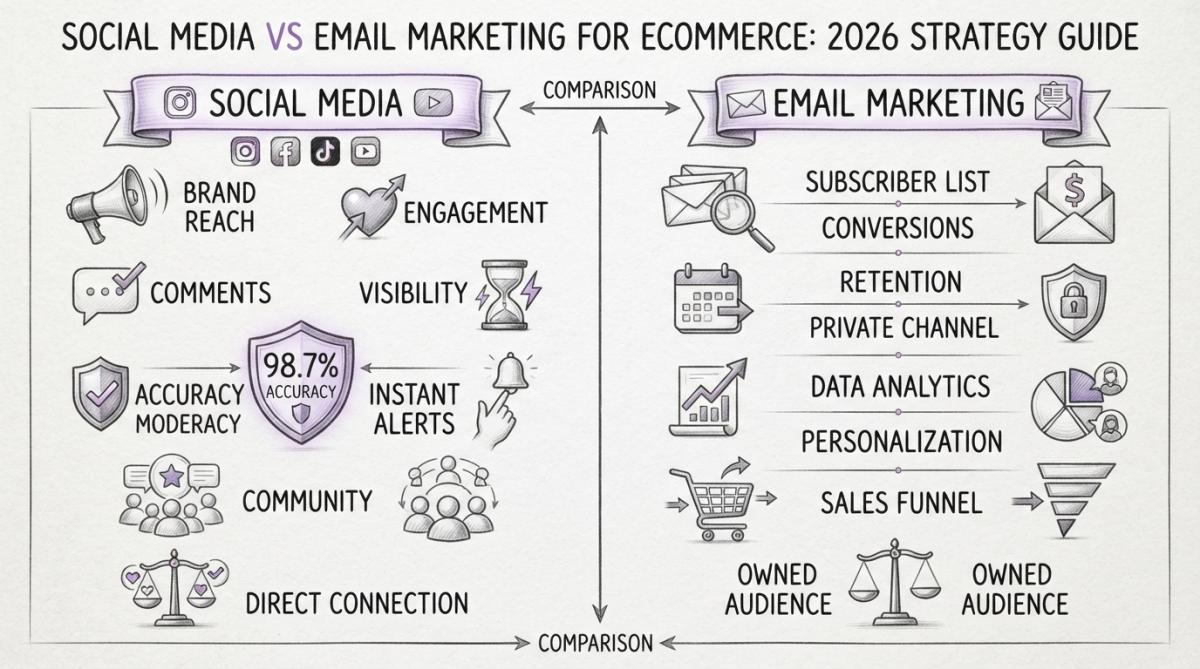
When ecommerce brands ask whether to prioritize social media marketing vs email marketing, they're usually asking the wrong question. Both channels move revenue. The real question is which one moves your revenue more efficiently given your customer base, product type, and budget constraints.
Here's what separates them: email reaches people who've already given you permission to contact them. Social media reaches people who may not know you exist. One is about depth and direct response. The other is about reach and discovery. One costs almost nothing to send once you have an email list. The other often requires paid advertising to cut through platform noise.
Email marketing typically delivers higher conversion rates for direct sales, while social media excels at brand awareness and community building. A D2C cosmetics brand with a strong Instagram presence has different needs than a B2B SaaS company. Your ecommerce model, product category, and customer acquisition stage all determine which channel deserves more budget.
Reach, Retention, and Direct Communication
Email delivers direct communication to a subscriber base you own. Social media delivers reach through algorithms you don't control. This distinction shapes everything about how each channel performs.
With email, your message lands in an inbox. The subscriber chose to receive it. There's no algorithm deciding whether your message appears. You control the timing, frequency, and content.
Social media reach depends entirely on platform algorithms. Post a product announcement on Instagram and it reaches maybe 10-15% of your followers organically. But social media creates community. Comments, shares, and conversations happen in public, generating social proof that influences other potential customers.
Email subscribers are warm leads who've explicitly opted in and are easier to convert. Social media followers are a mixed bag, some highly engaged, others passive observers.
According to research from HubSpot's 2026 Email Marketing Report, email subscribers who receive regular campaigns have a 3x higher lifetime value than passive social followers. But social media followers who engage consistently often convert faster on their first purchase because social proof has already warmed them up.
Email Marketing Conversion Rates and ROI for Ecommerce
Email marketing delivers the highest conversion rates of any digital marketing channel for ecommerce. Conversion rates typically range from 1% to 5% depending on list quality, email design, and offer relevance. Compare that to social media, where conversion rates often fall between 0.5% and 2%. Email wins because of permission and intent.
Why Email Delivers Higher Direct Response
Email marketing automation creates predictable revenue. A welcome series that converts 8% of new subscribers generates reliable income from every new email address. An abandoned cart sequence that recovers 15-20% of lost sales is revenue you wouldn't have captured otherwise.
Email ROI is strong because it's repeatable at scale with minimal incremental cost. Send one email to 10,000 people or 100,000 people, the platform cost is the same. Your marginal cost per email approaches zero. Social media requires paid advertising to reach scale, which means your cost per impression rises as you scale.
Research from Klaviyo's 2026 Ecommerce Automation Report shows that email automation workflows generate 45% of total email revenue for most ecommerce stores. That's from sequences that run automatically whenever a customer takes an action.
The key automation workflows that drive ecommerce ROI:
- Welcome series (triggered on signup): 3-5 emails over 7-10 days introducing your brand and offering a first-purchase discount. Typical conversion: 8-15% of new subscribers.
- Abandoned cart sequence (triggered on cart abandonment): 2-3 emails over 24-72 hours reminding customers about items left behind. Typical recovery: 15-25% of abandoned carts.
- Post-purchase sequence (triggered after purchase): 3-4 emails encouraging reviews and offering complementary products. Typical upsell rate: 10-20% of customers.
- Re-engagement sequence (triggered on inactivity): Emails to subscribers who haven't opened in 90+ days. Typical re-engagement: 5-10% of dormant subscribers.
If you have 50,000 email subscribers and your average customer lifetime value is $120, a 1% improvement in email conversion rates equals $60,000 in additional annual revenue.
Social Media Marketing ROI and Ecommerce Performance
Social media ROI is harder to measure than email ROI, but it's equally important for ecommerce. Most social media conversions aren't direct, they're indirect. A customer sees your Instagram ad, doesn't click it, then searches for your brand on Google and buys. Did social media drive that sale? Technically yes, it created awareness that led to a direct search.
This is why social media ROI often looks worse than it actually is. Brands see a 2:1 ROAS on email and a 1.5:1 ROAS on social media and assume email is better. But if social media is generating the awareness that makes email conversions possible, the combined ROI is actually higher than email alone.
Brand Awareness, Community Building, and Discovery
Social media's real strength is reach. A single Instagram post can reach 100,000 people for the cost of a few dollars in paid promotion. Email can't do that. Your email list has a ceiling, the number of subscribers you've accumulated.
For ecommerce brands in the awareness stage, social media is often the more efficient channel for customer acquisition. You're paying for impressions, knowing that a small percentage will convert now and a larger percentage will convert later after multiple exposures.
When a customer sees your product on social media and notices 500 comments and 5,000 likes, they're more likely to trust it. That social proof is invisible in email.
Community building is another strength of social media. Your most engaged customers become advocates. They comment on your posts, tag their friends, create user-generated content featuring your products. That organic amplification is worth more than any paid ad because it comes from trusted sources.
According to Sprout Social's 2026 Social Media Marketing Report, brands that actively engage with social media comments (responding within 24 hours) see 2.5x higher engagement rates on subsequent posts. For ecommerce, this translates to lower customer acquisition costs over time.
Ecommerce Email Marketing Best Practices and Automation
Building a high-performing email program requires strategy around list building, segmentation, and automation. Most ecommerce brands treat email as a broadcast channel instead of a direct communication channel, sending the same email to everyone. The highest-performing email programs are built on behavioral data and segmentation.
Segmentation, Personalization, and First-Party Data
Segmentation divides your email list into smaller groups based on shared characteristics or behaviors. The simplest segmentation is past purchasers vs. non-purchasers. More sophisticated segmentation might divide your list by product category purchased, purchase frequency, or time since last purchase.
A customer who bought 90 days ago needs a reason to come back. A customer who signed up but never purchased needs to understand why your product is worth buying. Segmentation allows you to send the right message to the right person at the right time.
First-party data is information you collect directly from customers: what they browse on your website, what they purchase, how often they engage with your emails, what they add to their cart but don't buy. Building a first-party data strategy means:
- Collecting behavioral data on your website - Track which product categories customers browse and which products they add to carts.
- Capturing purchase history - Record what customers bought, when they bought it, and how much they spent.
- Monitoring email engagement - Track which customers open emails, click links, and convert.
- Building predictive segments - Use this data to identify customers at risk of churning or most likely to respond to a specific offer.
The brands winning at ecommerce email are building these first-party data foundations. They're using their own data to predict customer behavior and send the right message at the right time.
Social Commerce Strategies: Integrating Paid Ads and Community Engagement
Social media for ecommerce isn't just about organic reach anymore. Most ecommerce revenue from social media comes from paid advertising. But paid ads only work if they're integrated into a broader social commerce strategy that includes community engagement and real-time moderation.
The most common social commerce strategies are:
- Paid product ads - Instagram and Facebook ads that show your product directly and link to your product page or checkout.
- Retargeting ads - Ads shown to people who visited your website but didn't buy.
- Lookalike audience ads - Ads shown to people similar to your best customers.
- Community engagement ads - Ads designed to generate likes, comments, and shares rather than direct clicks.
Retargeting, Social Proof, and Real-Time Moderation
Retargeting is one of the highest-ROI social media strategies for ecommerce because it targets warm leads, people who've already shown interest by visiting your website. A customer lands on your product page, reads the description, then leaves without buying. Retargeting ads remind them about that product and often include a discount to complete the purchase.
Retargeting converts at 2-3x higher rates than cold ads because the customer is already in consideration mode.
Social proof is the secret ingredient that makes retargeting work. When a retargeting ad includes customer reviews, ratings, or comments, conversion rates increase significantly. This is where real-time comment moderation becomes critical. If spam comments, negative reviews, or competitor links appear on your ads, credibility and conversion rates suffer.
FeedGuardians automatically detects and hides spam, hate speech, and competitor links with 98.7% accuracy while providing 24/7 AI-powered replies to comments in your brand voice. This keeps your social proof clean, your community engaged, and your ads effective.
Budget Allocation Framework: When to Invest in Each Channel
The question most ecommerce brands face: should we spend more on email or social media? The answer depends on your current situation.
| Situation | Best Channel | Rationale | Budget Split |
|---|---|---|---|
| Early-stage brand, small email list (<5K) | Social Media | Need reach to build audience | 70% social / 30% email |
| Growing brand, active email list (5K-50K) | Both equally | Email ROI climbs as list grows | 50% social / 50% email |
| Mature brand, large email list (50K+) | Highest ROI, lowest cost per conversion | 30% social / 70% email | |
| High repeat purchase rate (>40%) | Repeat customers have higher LTV | 40% social / 60% email | |
| Low repeat purchase rate (<15%) | Social Media | Need constant new customer acquisition | 60% social / 40% email |
| Seasonal business (holiday peaks) | Automation captures peaks efficiently | 35% social / 65% email | |
| Trend-driven product (fast changes) | Social Media | Trends spread faster on social | 65% social / 35% email |
Email ROI compounds over time as your list grows, while social media ROI stays relatively flat or decreases as you scale. This suggests a dynamic budget allocation strategy: invest more heavily in social media early to build your email list, then gradually shift budget toward email as your list grows.
Customer Acquisition Cost vs. Customer Lifetime Value
The real decision-making framework compares customer acquisition cost (CAC) to customer lifetime value (LTV).
Customer acquisition cost is how much you spend to acquire one new customer. If you spend $1,000 on social media ads and acquire 20 new customers, your CAC is $50.
Customer lifetime value is how much that customer will spend with you over their lifetime. If your average customer makes 5 purchases over 3 years, spending $100 per purchase, your LTV is $500.
A healthy ecommerce business has an LTV:CAC ratio of at least 3:1. Email marketing improves LTV because it increases repeat purchase rates. Social media improves LTV by building community and brand loyalty.
The allocation decision becomes: which channel increases your LTV:CAC ratio more? For most ecommerce businesses, the answer changes over time. Early on, social media is more efficient for customer acquisition. Later, email is more efficient for increasing LTV.
Omnichannel Integration: Email and Social Working Together
The highest-performing ecommerce brands don't choose between email and social media. They integrate both into a unified customer experience.
A customer discovers your brand on Instagram through a paid ad. They click through and browse your product page but don't buy. You retarget them with an Instagram ad for the next 3 days. On day 2, they click the ad and abandon their cart. Now you send them an abandoned cart email with the product, a customer review, and a discount code. They click the email and complete the purchase.
That's omnichannel in action. Each channel reinforces the others.
The integration points:
- Email signup from social - Add a call-to-action on your Instagram profile directing followers to sign up for your email list.
- Abandoned cart retargeting - Send an abandoned cart email AND retarget with social ads. The combination increases recovery rates by 30-40%.
- Post-purchase social - After a customer makes a purchase, add them to a "recent customers" retargeting audience on social media.
- Loyalty rewards across channels - Build a loyalty program that rewards purchases made through any channel.
- User-generated content bridges - Encourage customers to tag your brand on social media. Repost that UGC in your emails as social proof.
Customers who interact with your brand across multiple channels have 3-5x higher lifetime value than customers who interact through a single channel.
Conclusion: Which Channel Wins for Your Ecommerce Business?
Social media marketing vs email marketing for ecommerce isn't a binary choice. Both channels are essential. Early-stage brands should invest 60-70% in social media to build awareness and acquire customers. Mature brands with large email lists should invest 60-70% in email because the ROI is higher. Most brands in the middle should split their budget roughly equally and adjust based on which channel is delivering better LTV:CAC ratios.
The brands winning at ecommerce treat email and social media as integrated channels, not competitors. They use social media to build their email list, retarget customers, and create community. They use email to convert, retain, and increase customer lifetime value. They measure success by business metrics, LTV:CAC ratio, repeat purchase rate, revenue per customer, not vanity metrics.
Most ecommerce brands struggle with social media comment management, spam, negative reviews, and unanswered questions tank ad performance and customer trust. FeedGuardians automatically detects and hides spam, hate speech, and competitor links with 98.7% accuracy while delivering 24/7 AI-powered replies in your brand voice. This keeps your social proof clean, your community engaged, and your ad performance optimized. Get started with FeedGuardians and protect your brand reputation while boosting conversion rates on your highest-performing social campaigns.
Frequently Asked Questions
Which channel has higher conversion rates: email marketing or social media marketing for ecommerce?
Email marketing typically delivers higher direct conversion rates for ecommerce because it reaches customers who have opted in and provided first-party data. Email campaigns achieve direct communication with your subscriber base, while social media excels at brand awareness and discovery. However, social platforms increasingly support commerce features like shoppable posts and checkout, narrowing the gap. The best approach combines both: use email for direct sales and customer retention, social media for audience engagement and paid advertising to drive traffic to your email list.
How should I allocate my ecommerce budget between email marketing and social media?
Budget allocation depends on your ecommerce funnel stage and customer lifetime value goals. If you have an established email list, prioritize email marketing for nurturing and retention, it typically delivers strong ROI with lower customer acquisition costs. For new customer acquisition, invest in social media paid advertising to build your subscriber base. A common framework: 60% email (automation, segmentation, personalization), 40% social (ads, community building, content distribution). Adjust based on your conversion rates and platform dependency risks, relying solely on algorithm-driven social platforms leaves you vulnerable to reach fluctuations.
Can email marketing and social media work together in an omnichannel strategy?
Yes, integration is essential for ecommerce success. Use social media to drive discovery and build your email list through lead generation campaigns and sign-up forms. Segment your email subscribers and retarget them on social platforms with personalized ads based on their purchase behavior and engagement. Layer first-party data from email interactions into social retargeting to improve ad performance. This omnichannel approach maximizes customer lifetime value by reaching prospects at multiple touchpoints, social for awareness, email for conversion and retention.
What role does real-time engagement play in social media marketing ROI for ecommerce?
Real-time engagement directly impacts social media ROI by improving ad performance and building community trust. When you respond quickly to comments and messages, you increase engagement metrics (likes, shares, replies), which signals algorithm favor and extends organic reach. For ecommerce, this means more visibility, more social proof, and higher likelihood of conversions. However, managing comments at scale is challenging, tools that automate responses while maintaining brand voice (like AI-powered comment moderation) allow you to reply 24/7, protect your brand from spam and hate speech, and turn conversations into sales without manual overhead.
How does first-party data collection differ between email and social media marketing?
Email marketing relies on explicit first-party data: customers willingly provide email addresses, purchase history, preferences, and behavior. This data is owned by you, not dependent on platform algorithms, and enables precise segmentation and personalization. Social media data is often platform-dependent, reach, targeting, and audience insights are controlled by the platform's algorithm. To strengthen social media ROI, collect first-party data by driving social followers to your email list, using forms to capture preferences, and building owned communities. This reduces platform dependency and enables AI-driven personalization across both channels using data you control.
This article was written using GrandRanker
Tired of manually moderating comments?
FeedGuardians automates spam filtering, responds to customers, and protects your brand — setup in 3 minutes.
Frequently Asked Questions
Which channel has higher conversion rates: email marketing or social media marketing for ecommerce?
Email marketing typically delivers higher direct conversion rates for ecommerce because it reaches customers who have opted in and provided first-party data. Email campaigns achieve direct communication with your subscriber base, while social media excels at brand awareness and discovery. However, social platforms increasingly support commerce features like shoppable posts and checkout, narrowing the gap. The best approach combines both: use email for direct sales and customer retention, social media for audience engagement and paid advertising to drive traffic to your email list.
How should I allocate my ecommerce budget between email marketing and social media?
Budget allocation depends on your ecommerce funnel stage and customer lifetime value goals. If you have an established email list, prioritize email marketing for nurturing and retention—it typically delivers strong ROI with lower customer acquisition costs. For new customer acquisition, invest in social media paid advertising to build your subscriber base. A common framework: 60% email (automation, segmentation, personalization), 40% social (ads, community building, content distribution). Adjust based on your conversion rates and platform dependency risks—relying solely on algorithm-driven social platforms leaves you vulnerable to reach fluctuations.
Can email marketing and social media work together in an omnichannel strategy?
Yes, integration is essential for ecommerce success. Use social media to drive discovery and build your email list through lead generation campaigns and sign-up forms. Segment your email subscribers and retarget them on social platforms with personalized ads based on their purchase behavior and engagement. Layer first-party data from email interactions into social retargeting to improve ad performance. This omnichannel approach maximizes customer lifetime value by reaching prospects at multiple touchpoints—social for awareness, email for conversion and retention.
What role does real-time engagement play in social media marketing ROI for ecommerce?
Real-time engagement directly impacts social media ROI by improving ad performance and building community trust. When you respond quickly to comments and messages, you increase engagement metrics (likes, shares, replies), which signals algorithm favor and extends organic reach. For ecommerce, this means more visibility, more social proof, and higher likelihood of conversions. However, managing comments at scale is challenging—tools that automate responses while maintaining brand voice (like AI-powered comment moderation) allow you to reply 24/7, protect your brand from spam and hate speech, and turn conversations into sales without manual overhead.
How does first-party data collection differ between email and social media marketing?
Email marketing relies on explicit first-party data: customers willingly provide email addresses, purchase history, preferences, and behavior. This data is owned by you, not dependent on platform algorithms, and enables precise segmentation and personalization. Social media data is often platform-dependent—reach, targeting, and audience insights are controlled by the platform's algorithm. To strengthen social media ROI, collect first-party data by driving social followers to your email list, using forms to capture preferences, and building owned communities. This reduces platform dependency and enables AI-driven personalization across both channels using data you control.