
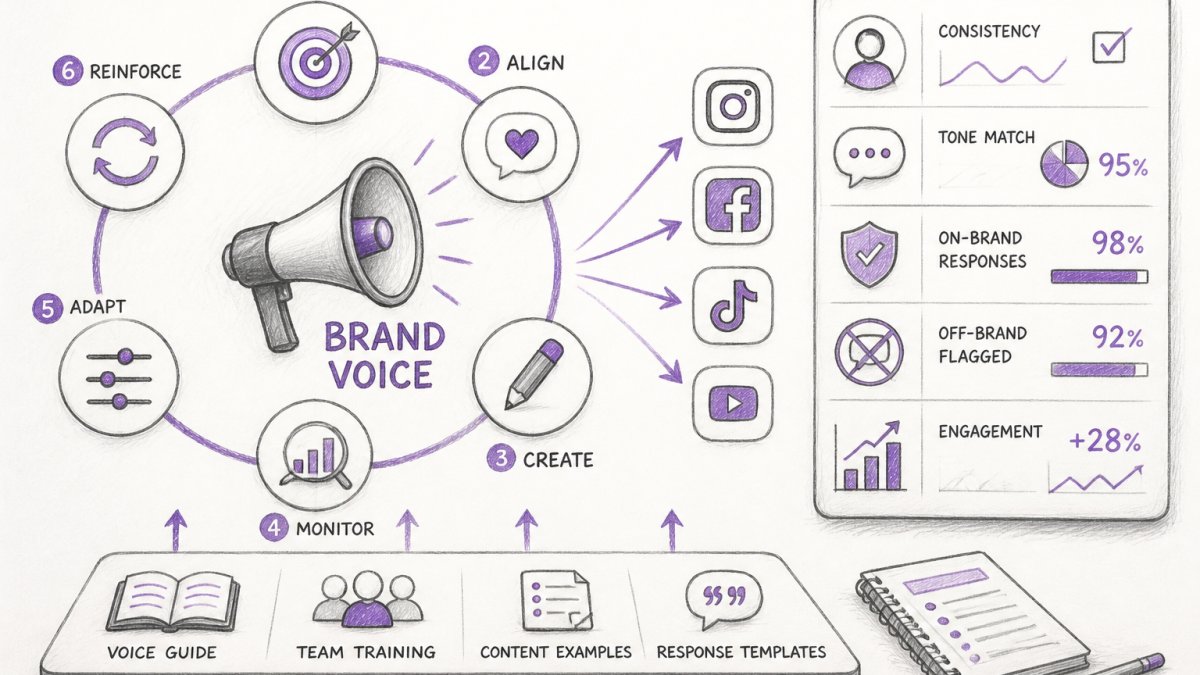
Quick Summary
| Key Insight | What You Need to Know |
|---|---|
| Why Brand Voice Consistency | Why Brand Voice Consistency Matters on Social Media |
| Define Your Brand Voice | Define Your Brand Voice and ToneIdentify Your Brand PersonalityDocument Your Tone and Language Choices |
| Identify Your Brand Personality | Identify Your Brand Personality |
| Document Your Tone and | Document Your Tone and Language Choices |
| Create Brand Voice Guidelines | Create Brand Voice Guidelines Examples That Your Team Can FollowBuild Your Style GuideInclude Real Examples and Do's and Don'ts |
| Build Your Style Guide | Build Your Style Guide |
Table of Contents
- Why Brand Voice Consistency Matters on Social Media
- Define Your Brand Voice and Tone
- Create Brand Voice Guidelines Examples That Your Team Can Follow
- Audit Your Current Social Media Messaging
- Tools for Social Media Brand Consistency and Automation
- Maintaining Brand Reputation on Social Media Across Platforms
- Use Social Media Brand Voice Templates to Scale Across Accounts
- Train Your Team to Protect Your Brand Voice
- Frequently Asked Questions
Last Updated: October 2, 2026
Why Brand Voice Consistency Matters on Social Media
Your brand voice is how customers recognize you, which is why tips for maintaining brand voice on social media are essential to your strategy. It's the personality in your words, the tone in your replies, the values in your choices. When that voice shifts from post to post or platform to platform, people notice. They get confused. They lose trust.
Social media amplifies this problem. Comments arrive constantly. Multiple team members reply. Platforms have different cultures.
The stakes are real. A brand that sounds professional on Instagram but casual on TikTok looks unprepared.
Most teams define a brand voice once, document it, and assume the work is done.
Brands that maintain consistent voice protect their reputation, convert more comments into conversations, build trust faster, and stand out in a crowded feed.
Define Your Brand Voice and Tone
Before you can apply tips for maintaining brand voice on social, you need to know what your voice actually is.
Identify Your Brand Personality
Ask: What would your brand be like as a person, based on your products, customers, and values?
Is your brand the confident expert who explains complex things simply? The friendly neighbor who's always helpful? The bold innovator who challenges the status quo?
Your brand personality should feel natural. If you sell luxury goods but sound quirky and sarcastic, there's a mismatch.
Write down 3-5 personality traits. Be specific:
- Not just "friendly", "approachable and patient"
- Not just "professional", "authoritative but not condescending"
- Not just "fun", "playful without being unprofessional"
Document Your Tone and Language Choices
Tone is how you express personality and changes based on context, your personality stays the same, but your tone shifts when replying to a complaint versus celebrating a win.
Document these tone variations:
- Default tone: How you sound in most situations
- Empathetic tone: How you sound when someone's frustrated or upset
- Celebratory tone: How you sound when praising customers or sharing wins
- Educational tone: How you sound when explaining features or answering questions
Then define your language choices:
- Do you use contractions? (we're vs. we are)
- Do you use emojis? Which ones?
- Do you use industry jargon or simple language?
- Do you use exclamation points? How often?
- Do you use first person (I, we) or third person (the brand)?
- What words do you use repeatedly? What words do you avoid?
Write 2-3 example sentences for each tone. Show the contrast:
Default: "We help brands grow on social media." Empathetic: "We know managing social can feel overwhelming. We're here to make it easier." Celebratory: "Your engagement is skyrocketing! We love seeing your community grow." Educational: "Here's how our moderation works: We scan every comment in real time and flag anything that doesn't fit your brand."
Create Brand Voice Guidelines Examples That Your Team Can Follow
The best guidelines are short, visual, and show examples instead of just explaining rules.
Build Your Style Guide
Your style guide should fit on 2-3 pages, longer and people won't read it; vague and they won't follow it.
Structure it like this:
Section 1: Brand Personality
- List your 3-5 personality traits with a one-sentence explanation for each
- Example: "Confident but not arrogant, we know our stuff, but we're always learning"
Section 2: Voice & Tone
- Show your default tone with 2-3 example sentences
- Show your empathetic, celebratory, and educational tones with examples
- Include a brief note on when to use each tone
Section 3: Language Choices
- Do's: Use contractions, keep sentences short, use "we" and "you"
- Don'ts: Avoid jargon, don't use more than one exclamation point per response, don't sound robotic
- Key phrases you use: "We're here to help," "Let's solve this together"
- Words you never use: "Unfortunately," "Obviously," "Just"
Section 4: Platform Differences
- Note how your voice adapts on different platforms
- Example: "On TikTok, we're more casual and use trending sounds. On LinkedIn, we're more formal and educational."
Include Real Examples and Do's and Don'ts
For each tone, show what good looks like and what bad looks like:
Responding to a product question:
- GOOD: "Great question! Here's what you need to know: [explanation]. Let us know if you need more help."
- BAD: "Please refer to our FAQ for this information."
Responding to a complaint:
- GOOD: "We hear you, and we're sorry this happened. Here's what we're doing to fix it: [solution]. We'll follow up tomorrow."
- BAD: "We regret any inconvenience. Please contact support."
Celebrating a customer win:
- GOOD: "This is amazing! Your growth speaks for itself. We're so glad we could help."
- BAD: "Thank you for choosing our product."
Handling spam or negative comments:
- GOOD: "We don't engage with this kind of content, but we're always open to constructive feedback."
- BAD: [Delete without response]
Create a one-page template your team can print and keep at their desk. Make it visual. Use color. Include 5-10 real comment examples from your actual social media with the "good" response shown.
Audit Your Current Social Media Messaging
Before implementing new guidelines, audit what you're actually saying right now.
Pull 50-100 recent comments and replies from each platform. Look for patterns:
- Are your responses consistent in tone?
- Are you using the same language choices across replies?
- Does your voice match your brand personality?
- Are different team members sounding like different people?
- Do replies on different platforms sound like the same brand?
Track these metrics:
- Percentage of replies that match your defined tone
- Average response time
- Consistency of language (are you using "we're" some times and "we are" other times?)
- Emoji usage (are some replies emoji-heavy while others have none?)
- Length variation (are some replies one sentence while others are paragraphs?)
This audit shows where drift is happening, perhaps Instagram is consistent but TikTok isn't, or one team member's replies sound different from others.
Once you know the gaps, your guidelines become targeted instead of generic.
Tools for Social Media Brand Consistency and Automation
Manual consistency is impossible at scale, multiple team members, platforms, or high comment volume make drift inevitable.
AI-Powered Reply Systems That Learn Your Voice
AI tools can learn your brand voice and reply to comments automatically, sounding like you instead of robotic.
FeedGuardians is built specifically for this. It learns your tone, terminology, and guidelines, then delivers 24/7 AI-powered replies in your unique brand voice.
Generic AI replies destroy brand voice.
Training is key: the more examples you provide, the better it learns your language patterns, emoji usage, and tone shifts.
Real-Time Moderation and Brand Protection
Consistency includes what you allow on your posts.
Real-time moderation tools scan every comment instantly, catch spam before customers see it, remove hate speech automatically, and protect ad performance by hiding competitor links.
FeedGuardians detects and hides spam, hate speech, and competitor links with 98.7% accuracy, works 24/7, and escalates borderline content to humans.
This creates a consistent brand experience. Customers see a clean, on-brand comment section. They see replies that match your voice. They don't see the noise.
Maintaining Brand Reputation on Social Media Across Platforms
Managing multiple platforms is harder because each has different culture, audience, and norms.
Adapt Your Voice Without Losing Identity
Your core brand personality stays the same everywhere. But how you express it changes.
On TikTok, you might be playful and use trending sounds.
Teams often go too far, thinking "adapt to the platform" means "sound like a completely different brand." It doesn't.
Here's the difference:
Same brand, different platforms:
- TikTok: "POV: You're about to save hours on comment management 🎬"
- Instagram: "Comment management that actually works. See how in our latest post."
- LinkedIn: "Simplifying comment management across platforms improves team efficiency and customer response times."
Too different (loses brand identity):
- TikTok: "yo fam we're vibing 🔥"
- Instagram: "Please engage with our content"
- LinkedIn: "Synergistic solutions for optimized engagement"
The first set sounds like the same brand across platforms. The second sounds like three different companies.
Document your platform rules explicitly:
- What's different about your voice on each platform?
- What stays the same?
- What emojis do you use on each platform?
- How formal or casual are you?
- What hashtags do you use?
Handle Crisis Communication with Consistency
When something goes wrong, a product issue, customer complaint, or negative viral post, your brand voice matters most and consistency builds or destroys trust.
A crisis response that contradicts your normal voice looks inauthentic; one that matches your personality, tone, and values looks like you actually care.
If your brand voice is "approachable and helpful," your crisis response should acknowledge frustration and show you're working to fix it, human and committed, not robotic or dismissive.
Train your team on crisis communication before you need it. Show them examples of good crisis responses that match your brand voice. Give them a framework:
- Acknowledge the problem
- Take responsibility (if appropriate)
- Explain what you're doing to fix it
- Give a timeline
- Offer next steps
All in your brand voice. All consistent with how you normally sound.
Use Social Media Brand Voice Templates to Scale Across Accounts
If you manage multiple accounts, templates are your friend.
Template for responding to product questions:
"Thanks for asking! [Specific answer to their question]. If you need more help, [next step].
Template for responding to complaints:
"We're sorry this happened. [Acknowledge their specific issue]. Here's what we're doing: [Solution].
Template for celebrating customer wins:
"[Specific praise for what they did].
Template for handling spam/off-topic comments:
"We keep our comments focused on [what your comments are for]. Thanks for understanding."
Store these templates where your team can access them.
Train Your Team to Protect Your Brand Voice
Guidelines don't enforce themselves, your team does, so training is non-negotiable.
Here's what effective training looks like:
Step 1: Share your guidelines (30 minutes) Walk through your brand voice document. Explain the personality, the tones, the language choices. Show examples.
Step 2: Analyze real examples (30 minutes) Pull 10 recent comments from your social media.
Step 3: Role-play responses (30 minutes) Give team members scenarios.
Step 4: Set expectations (15 minutes) Make it clear: consistency is non-negotiable.
Step 5: Create accountability (ongoing) Review replies weekly. Spot-check for consistency. Celebrate good ones.
Tools like FeedGuardians help here.
Frequently Asked Questions
How do you ensure brand voice consistency when multiple people manage social accounts?
Create a detailed brand voice guidelines document that all team members can reference. Include specific examples of how your brand responds to different comment types, the vocabulary it uses, and the tone it adopts on each platform. Use AI-powered tools that learn your brand's unique voice and can automatically generate replies that match your style, reducing variation caused by different writers. Schedule regular audits of posted comments and replies to catch inconsistencies early, and conduct quarterly training sessions with your team to reinforce guidelines.
What are the essential elements of a brand voice guideline?
Effective brand voice guidelines include your brand personality (traits like friendly, professional, or witty), tone variations for different situations (customer complaints versus product inquiries), a preferred vocabulary and phrases your brand uses, platform-specific adaptations (TikTok voice differs from LinkedIn), examples of good and bad responses, and guidance on how to handle sensitive topics. Include real comment examples with annotated responses so your team understands not just the rules but the reasoning behind them. Document your brand pillars and values so responses stay aligned with what your brand stands for.
How does AI-powered moderation help maintain brand voice?
AI moderation tools learn your brand's specific tone, terminology, and response patterns by analyzing your past comments and guidelines. They automatically detect harmful comments, spam, and competitor links while preserving authentic customer feedback. More importantly, they generate replies in your exact voice 24/7, ensuring consistency even outside business hours. This prevents the generic, robotic responses that damage brand reputation. Tools like FeedGuardians offer 98.7% accuracy in detecting problematic content while maintaining your brand's personality in every reply, turning comment moderation from a time drain into a brand-building opportunity.
How often should you audit your social media brand voice?
Conduct a full brand voice audit quarterly to catch drift before it becomes a pattern. Monthly spot-checks of recent comments and replies help you identify inconsistencies quickly. If your brand undergoes a major pivot, refresh your audience strategy, or expands to new platforms, audit immediately. After major events or crises, review how your team applied your voice guidelines to ensure responses were appropriate and on-brand. Use these audits to update your guidelines based on what's working and what customers respond to, so your voice evolves intentionally rather than accidentally.
Your brand voice is your competitive advantage. It's what makes customers recognize you, trust you, and come back. Protecting it across social media, across platforms, across your team, takes intentional effort. But the payoff is worth it: a brand that sounds like itself, customers who feel seen, and a reputation that holds up under pressure.
Tired of manually moderating comments?
FeedGuardians automates spam filtering, responds to customers, and protects your brand — setup in 3 minutes.
Frequently Asked Questions
How do you ensure brand voice consistency when multiple people manage social accounts?
Create a detailed brand voice guidelines document that all team members can reference. Include specific examples of how your brand responds to different comment types, the vocabulary it uses, and the tone it adopts on each platform. Use AI-powered tools that learn your brand's unique voice and can automatically generate replies that match your style, reducing variation caused by different writers. Schedule regular audits of posted comments and replies to catch inconsistencies early, and conduct quarterly training sessions with your team to reinforce guidelines.
What are the essential elements of a brand voice guideline?
Effective brand voice guidelines include your brand personality (traits like friendly, professional, or witty), tone variations for different situations (customer complaints versus product inquiries), a preferred vocabulary and phrases your brand uses, platform-specific adaptations (TikTok voice differs from LinkedIn), examples of good and bad responses, and guidance on how to handle sensitive topics. Include real comment examples with annotated responses so your team understands not just the rules but the reasoning behind them. Document your brand pillars and values so responses stay aligned with what your brand stands for.
How does AI-powered moderation help maintain brand voice?
AI moderation tools learn your brand's specific tone, terminology, and response patterns by analyzing your past comments and guidelines. They automatically detect harmful comments, spam, and competitor links while preserving authentic customer feedback. More importantly, they generate replies in your exact voice 24/7, ensuring consistency even outside business hours. This prevents the generic, robotic responses that damage brand reputation. Tools like FeedGuardians offer 98.7% accuracy in detecting problematic content while maintaining your brand's personality in every reply, turning comment moderation from a time drain into a brand-building opportunity.
How often should you audit your social media brand voice?
Conduct a full brand voice audit quarterly to catch drift before it becomes a pattern. Monthly spot-checks of recent comments and replies help you identify inconsistencies quickly. If your brand undergoes a major pivot, refresh your audience strategy, or expands to new platforms, audit immediately. After major events or crises, review how your team applied your voice guidelines to ensure responses were appropriate and on-brand. Use these audits to update your guidelines based on what's working and what customers respond to, so your voice evolves intentionally rather than accidentally.