
Quick Summary
| Key Insight | What You Need to Know |
|---|---|
| Online conflict is public | Online conflict is public and searchable, so every reply is judged by prospects scrolling past. |
| The five-step sequence is | The five-step sequence is acknowledge, apologize, ask, act, and move the thread to a private channel. |
| Agents should send a | Agents should send a holding message within the first minute of a live chat. |
| Role-play pairs score each | Role-play pairs score each other on tone, speed, and clarity using real anonymized threads. |
| Track resolution time, first-contact | Track resolution time, first-contact resolution, repeat contacts, and QA scores before and after rollout. |
| Why Online Conflict Needs | Why Online Conflict Needs Its Own Training ProgramHow Online Conflict Differs From Phone and In-Person Support |
Last Updated: November 16, 2026
Quick Summary
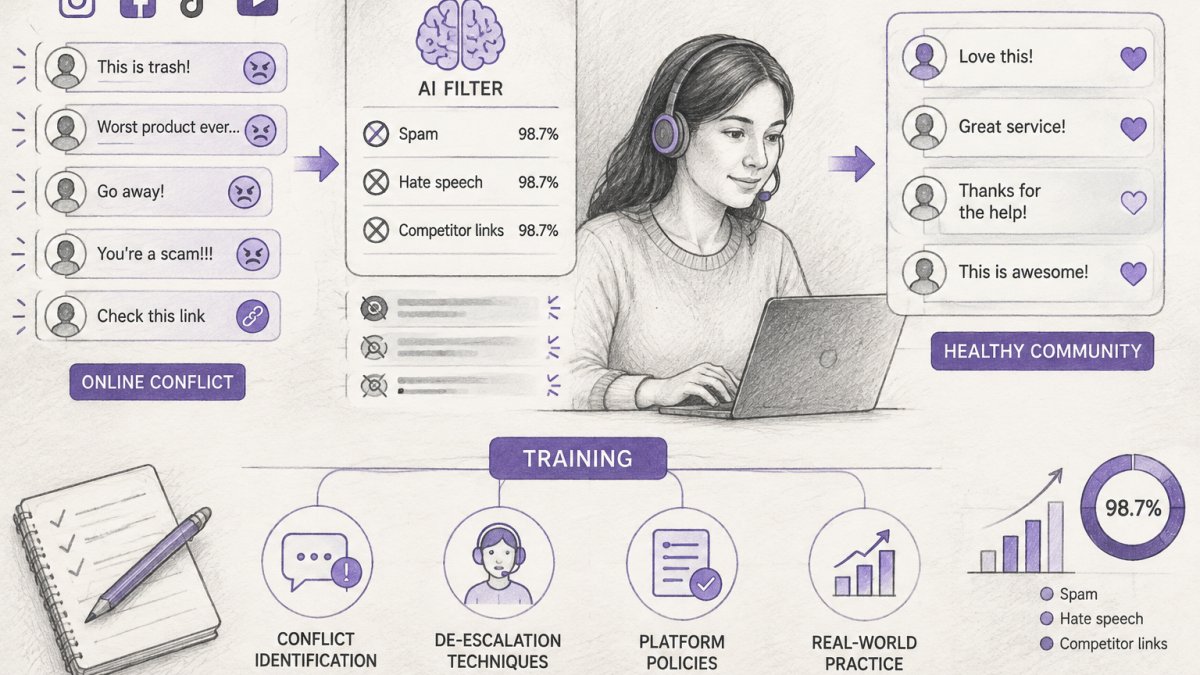
Train customer support teams to manage online conflict by running four weeks of short, repeated sessions covering tone, the five-step de-escalation sequence, role-play scenarios, and live shadowing. Agents practice writing calm, short replies that acknowledge the issue and move sensitive details to a private channel.
- Online conflict is public and searchable, so every reply is judged by prospects scrolling past.
- The five-step sequence is acknowledge, apologize, ask, act, and move the thread to a private channel.
- Agents should send a holding message within the first minute of a live chat.
- Role-play pairs score each other on tone, speed, and clarity using real anonymized threads.
- Track resolution time, first-contact resolution, repeat contacts, and QA scores before and after rollout.
Table of Contents
- Why Online Conflict Needs Its Own Training Program
- Online Customer Service De-Escalation Techniques That Work in Writing
- Core Communication Principles to Drill Into Every Agent
- Customer Conflict Resolution Examples Your Team Can Practice
- Customer Support Response Templates for Angry Customers
- Building a Conflict Management Training Course and Rollout Plan
- Measuring Whether the Training Actually Changed Anything
- Supporting Agents After Abusive Interactions and Setting Escalation Boundaries
- Frequently Asked Questions
Why Online Conflict Needs Its Own Training Program
Most support training treats conflict as one skill. It isn't. Training teams to manage online conflict is a different craft than phone work, because the audience is watching.
Online conflict is a written, public, permanent dispute between a customer and a brand, conducted in front of an audience that may include prospects. Every reply has two readers: the customer and everyone scrolling past.
How Online Conflict Differs From Phone and In-Person Support
Phone conflict is private and temporary. Online conflict is public and searchable. Three differences change how you train:
- No tone of voice. Warmth has to come from word choice, not vocal cues.
- An audience is scoring you. Other buyers judge your reply, not just the customer.
- Screenshots outlive the thread. A bad reply gets shared. A good one gets cited.
Agents need practice writing calm, clear replies under pressure, a trainable skill, not a personality trait.
If your team handles high comment volume, AI comment moderation for customer support teams shows how the tooling side fits alongside the training.
Online Customer Service De-Escalation Techniques That Work in Writing
Effective online customer service de-escalation techniques are short, specific, and fast. Written de-escalation works when agents lower the temperature in the first two sentences, then move details to a private channel. When a public thread keeps drawing hostile replies, agents need to recognize when de-escalation must give way to consistent boundaries for managing toxic online communities.
- Reply quickly. Speed signals care more than perfect wording.
- Name the problem in one sentence. Show you understood it.
- Skip the policy lecture. Save terms for the private follow-up.
A common mistake is over-explaining. Long replies look defensive. Short, steady ones look in control.
How De-Escalation Changes by Channel
Most conflict training treats online support as one channel. It isn't.
Live chat. The clock is the enemy.
Email. The audience is private but the record is permanent.
Public comments and social posts. The audience is the real reader.
Video and screen-share support. Tone of voice returns, but so does the risk of a visible reaction.
Review sites and app stores. These are the least conversational and most permanent.
A Five-Step De-Escalation Sequence for Chat, Comments, and Email
Drill this sequence until agents can run it without thinking:
- Acknowledge the specific issue in plain language.
- Apologize for the experience, not the blame.
- Ask one clarifying question if facts are unclear.
- Act by stating the next step and the timeline.
- Move the thread to DM, email, or a call.
Each step is one or two sentences. Anything longer loses the reader.
Two adjustments make the sequence work across channels. In public threads, compress steps one through three into a single reply and move to step five immediately. In email, expand step four with a numbered next-steps list. In chat, keep a holding message ready for the gap between step one and step four.
Written De-Escalation Phrases That Lower the Temperature
Agents freeze because they reach for the wrong register. Give them a short bank of phrases to adapt rather than copy:
- Acknowledging without admitting fault: "That's not the experience we want you to have, and I can see why you're frustrated."
- Buying time without stalling: "I'm checking the shipment record now, I'll have an answer for you in a few minutes."
- Moving to private: "So we can look at your account details safely, I've sent you a DM."
What agents should avoid is just as important: "per our policy," "calm down," "as I already said," and any sentence that begins with "Unfortunately." Those phrases read as dismissive in writing even when the agent means well.
If your team handles high comment volume, AI comment moderation for customer support teams shows how the tooling side fits alongside the training.
Core Communication Principles to Drill Into Every Agent
Four principles carry most of the weight: empathy, active listening, a calm tone, and clear communication. These are soft skills, and they are built through repetition.
Train agents to:
- Paraphrase before solving. "So the order arrived damaged and you've waited a week for a reply."
- Use solution-focused language. "Here's what we can do" beats "Unfortunately, our policy..."
- Keep a calm tone in writing. Short sentences, no exclamation marks, no sarcasm.
Emotional intelligence matters here as much as product knowledge. An agent who reads frustration accurately can often defuse it in one reply.
Customer Conflict Resolution Examples Your Team Can Practice
Real customer conflict resolution examples are often more useful than theory alone. Build a scenario bank from your own inbox and comment history, then have agents write replies before they face a live thread.
Good practice scenarios:
- The public refund demand. A buyer posts a complaint and asks for a refund in the comments.
- The competitor tag. Someone tags a rival brand under your ad.
- The repeat complainer. A customer returns to the same thread three times.
For a deeper walkthrough of one high-stakes channel, how B2B brands should respond to negative LinkedIn comments gives readers a concrete professional-network example to study.
Agents should write their reply, read it aloud, and cut it by a third. Shorter almost always lands better.
Customer Support Response Templates for Angry Customers
Templates give agents a floor to stand on.
Three templates worth drilling:
Public acknowledgment:
"Hi [name], we're sorry the [product] arrived [issue]. That's not the experience we want for you. We've sent you a DM so we can fix this today."
Fact-finding reply:
"Thanks for flagging this, [name]. So we get it right: was the order number [number]?
Boundary-setting reply:
"We hear you, [name], and we want to help. To protect your details, we'll continue this in DM.
Templates should include a clear next step and a real timeframe. Vague promises like "soon" make customers angrier.
Building a Conflict Management Training Course and Rollout Plan
A conflict management training course works best as four weeks of short, repeated sessions. Long one-off workshops fade fast; weekly practice sticks. The gap most plans leave is the middle layer: the learning objectives, facilitator moves, and assessment that prove the training landed.
Set clear learning objectives first. Each objective should be observable, so a facilitator can tell whether an agent hit it:
- Write a calm, on-brand reply to a hostile public comment in under three minutes
- Run the five-step de-escalation sequence from memory in chat, email, and public threads
- Recognize when to escalate to a human lead and hand off without losing context
Learning Objectives, Role-Play Exercises, and a Four-Week Schedule
Here is a schedule you can run as-is:
| Week | Focus | Exercise | Output |
|---|---|---|---|
| 1 | Core principles and tone | Rewrite 10 past replies | Tone guide v1 |
| 2 | De-escalation and templates | Build 5 approved templates | Template library |
| 3 | Role-play scenarios | Paired practice with peer scoring | Scored scenario log |
| 4 | Live shadowing | Shadow a senior agent, then solo | First quality review |
Role-play is where the learning lands. Pairs take turns playing the angry customer and the agent, then score each other on tone, speed, and clarity. Seed each role-play with a real thread from the team's history, stripped of customer details, so practice mirrors the work.
Facilitator Guidance for Each Week
The schedule only works if someone runs it. A team lead or senior agent can facilitate all four weeks with about two hours of prep per session.
Week 1, Core principles and tone. Open with two contrasting replies to the same complaint: one defensive, one calm. Ask the group to name what changed. Then hand out ten past replies and have agents rewrite them against a one-page tone guide.
Week 2, De-escalation and templates. Walk through the five-step sequence once, then have agents build five templates from real scenarios. The facilitator's job is to cut, not add: most first drafts are twice as long as they should be. Approve the template library at the end so agents leave with something usable the next day.
Week 3, Role-play scenarios. Pair agents and give each pair a scenario card. The customer player should escalate once mid-scenario to test composure.
Week 4, Live shadowing. Agents shadow a senior agent for a shift, then handle threads solo with a reviewer on standby.
Follow-Up Practice After the Four Weeks
Training that ends in week four decays by week eight. Keep the skill alive with a short weekly ritual: one real thread, anonymized, reviewed by the team in fifteen minutes. Rotate who presents. The point is not to grade the agent but to keep the vocabulary fresh, so the five-step sequence and tone guide stay in working memory.
A monthly refresher works well for new hires who joined after the initial rollout. Pair them with a trained buddy for their first two weeks on conflict threads, and review their first ten replies against the same rubric used in week three.
Assessing Agents Without Grading Them
Assessment should answer one question: can the agent handle a hostile thread without escalating it unnecessarily? Use a short rubric scored by a lead or peer:
- Did the reply acknowledge the specific issue in the first two sentences?
- Did it avoid defensiveness, policy language, and matching emotion?
- Did it state a next step and a real timeframe?
Score each item pass or revise, not on a scale. Scales invite arguments about whether something is a three or a four; pass-or-revise keeps the conversation on the reply itself. Watch out: if every agent passes on the first try, the rubric is too soft, and the training is probably not changing behavior.
Once agents are trained, a unified comment management inbox lets the team triage, assign, and reply to conflicts across platforms in one place.
Measuring Whether the Training Actually Changed Anything
Training that isn't measured is just a workshop. Track four numbers before and after rollout: resolution time, first-contact resolution, repeat contacts, and quality-assurance scores.
What to watch:
- Resolution time should drop as agents get faster at defusing.
- First-contact resolution should rise as replies get clearer.
- Repeat contacts should fall if customers feel heard the first time.
Watch out: a drop in repeat contacts can also mean customers gave up. Pair the numbers with a short read of recent threads.
Teams also want to know how much volume automation can absorb. How to handle most Instagram DM support tickets without a human shows a realistic benchmark for deflecting routine messages so agents can focus on real conflict.
Supporting Agents After Abusive Interactions and Setting Escalation Boundaries
Abuse wears agents down. Hate speech, threats, and pile-ons are not normal customer complaints, and teams need a plan for them before they happen.
Set escalation boundaries in writing:
- Define what counts as abuse. Slurs, threats, and doxxing go straight to a lead.
- Give agents permission to stop. No one should keep replying to a threatening thread.
- Build a handoff rule. Any thread that crosses the line moves to a manager.
AI and automation help here too. For the bigger picture on protecting a brand when conflict goes public, online reputation management covers escalation and recovery in depth.
FeedGuardians can help with this part of the job.
Training a support team to handle online conflict is not a one-time project.
FeedGuardians makes that easier. FeedGuardians' AI-powered replies learn your tone, terminology, and guidelines. Real-time moderation hides abusive comments, and a human escalation option keeps you in control.
Frequently Asked Questions
What are the 5 C's of conflict management for support teams?
The five C's are communication, collaboration, compromise, consistency, and commitment. In an online support setting, communication means plain written language with no jargon; collaboration means pulling in the right teammate instead of guessing; compromise means offering a workable fix rather than winning the argument; consistency means every agent applies the same escalation rules; commitment means following through on the promised next step. Build each one into your conflict management training course as a separate scored exercise so agents practice them rather than just read them.
How do you de-escalate an angry customer online without a phone call?
Written channels remove tone of voice, so agents must supply calm deliberately. Use a five-step sequence: acknowledge the specific problem in the customer's own words, apologize for the experience without admitting fault you cannot verify, ask one clarifying question, state exactly what happens next and when, then confirm the resolution in writing. Avoid defensiveness, avoid matching the customer's intensity, and keep replies short. Public comments should move to a private channel quickly, which lowers the audience pressure that keeps online conflict going.
When should an online customer complaint be escalated to a manager?
Set written escalation rules before training starts. Escalate when the customer mentions legal action or a regulator, when the complaint involves a safety or refund decision above an agent's limit, when the same customer has contacted you three or more times about one issue, when the message contains threats or abusive language, or when a public thread is gaining visible traction. Everything else should stay with the frontline agent. Clear thresholds cut resolution time and stop agents from escalating out of uncertainty.
How can AI moderation support trained agents during online conflict?
AI handles the volume layer so trained agents can handle the judgment layer. A tool like FeedGuardians detects and hides spam, scams, hate speech, and competitor links with 98.7% accuracy across Instagram, Facebook, TikTok, and YouTube, and sends 24/7 replies in your brand voice. Agents then step in on the cases that need empathy or a decision. Keep a human escalation option switched on, review a sample of automated replies weekly, and feed any tone corrections back into the training material.

Tired of manually moderating comments?
FeedGuardians automates spam filtering, responds to customers, and protects your brand — setup in 3 minutes.
Frequently Asked Questions
What are the 5 C's of conflict management for support teams?
The five C's are communication, collaboration, compromise, consistency, and commitment. In an online support setting, communication means plain written language with no jargon; collaboration means pulling in the right teammate instead of guessing; compromise means offering a workable fix rather than winning the argument; consistency means every agent applies the same escalation rules; commitment means following through on the promised next step. Build each one into your conflict management training course as a separate scored exercise so agents practice them rather than just read them.
How do you de-escalate an angry customer online without a phone call?
Written channels remove tone of voice, so agents must supply calm deliberately. Use a five-step sequence: acknowledge the specific problem in the customer's own words, apologize for the experience without admitting fault you cannot verify, ask one clarifying question, state exactly what happens next and when, then confirm the resolution in writing. Avoid defensiveness, avoid matching the customer's intensity, and keep replies short. Public comments should move to a private channel quickly, which lowers the audience pressure that keeps online conflict going.
When should an online customer complaint be escalated to a manager?
Set written escalation rules before training starts. Escalate when the customer mentions legal action or a regulator, when the complaint involves a safety or refund decision above an agent's limit, when the same customer has contacted you three or more times about one issue, when the message contains threats or abusive language, or when a public thread is gaining visible traction. Everything else should stay with the frontline agent. Clear thresholds cut resolution time and stop agents from escalating out of uncertainty.
How can AI moderation support trained agents during online conflict?
AI handles the volume layer so trained agents can handle the judgment layer. A tool like FeedGuardians detects and hides spam, scams, hate speech, and competitor links with 98.7% accuracy across Instagram, Facebook, TikTok, and YouTube, and sends 24/7 replies in your brand voice. Agents then step in on the cases that need empathy or a decision. Keep a human escalation option switched on, review a sample of automated replies weekly, and feed any tone corrections back into the training material.