
Quick Summary
| Key Insight | What You Need to Know |
|---|---|
| The Immediate Business Impact | The Immediate Business Impact of Ignoring Customer Messages |
| How Response Time Affects | How Response Time Affects Customer Loyalty and Retention |
| Social Media Response Time Benchmarks | What Your Customers Expect |
| The Reputation Damage | Why Ignored Messages Become Public Complaints |
| Customer Service Response Templates | Customer Service Response Templates for Social Media That Scale |
| Social Media Customer Service | Social Media Customer Service Best Practices to Prevent Message Neglect |
Table of Contents
- The Immediate Business Impact of Ignoring Customer Messages
- How Response Time Affects Customer Loyalty and Retention
- Social Media Response Time Benchmarks: What Your Customers Expect
- The Reputation Damage: Why Ignored Messages Become Public Complaints
- Customer Service Response Templates for Social Media That Scale
- Social Media Customer Service Best Practices to Prevent Message Neglect
- Tools for Managing Social Media Comments at Scale
- Conclusion
Last Updated: August 18, 2026
The Immediate Business Impact of Ignoring Customer Messages on Social Media
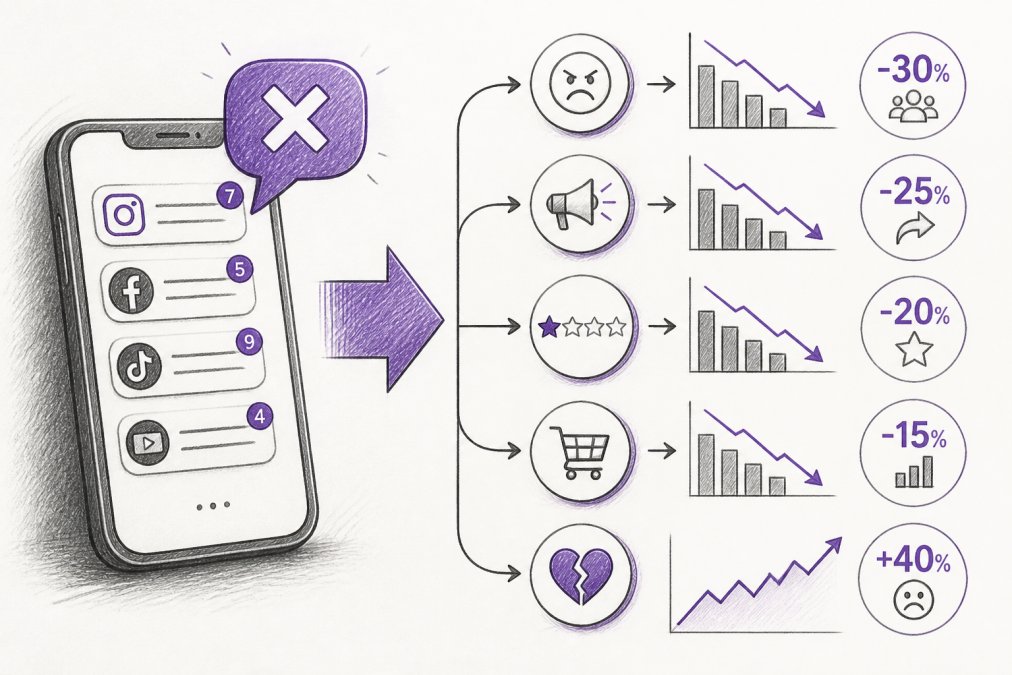
Every unanswered message represents a moment where a potential customer decides whether to stay loyal or move to a competitor. A customer ready to buy but needing clarification receives no response. By the time you see the message 12 hours later, they've purchased elsewhere or abandoned their cart. That lost transaction is just the beginning.
The ignored customer doesn't leave quietly. They leave negative reviews, post about their bad experience, and become advocates for your competitor instead of your brand. The cost ripples outward in ways difficult to measure but impossible to ignore.
FeedGuardians recognizes this challenge at scale. When brands manage thousands of comments and direct messages across Instagram, Facebook, TikTok, and YouTube, the risk of missing critical customer inquiries multiplies. A single ignored message from a high-value customer can cost thousands in lost lifetime value. A pattern of slow or missing responses damages brand reputation in ways that take months to repair.
The hard truth: ignoring customer messages on social media isn't a minor operational oversight. It's a business decision with measurable consequences.
How Response Time Affects Customer Loyalty and Retention
Response time is the single most important factor in how customers perceive your brand on social media. A response within an hour signals that they matter. A response within 24 hours suggests you're organized but not prioritizing them. A response after 48 hours tells them they're not important. No response at all tells them to find a brand that cares.
Research shows that customer retention is directly tied to how quickly you acknowledge inquiries. Customers who receive fast responses are significantly more likely to make repeat purchases, recommend your brand, and remain loyal even when competitors offer similar products. Conversely, customers who experience slow or missing responses are primed to switch.
A prospect messaging you on Instagram with a question about sizing or shipping is already interested and in your sales funnel. A quick, helpful response closes that sale. A slow response loses it. The difference between a 2-hour response time and a 24-hour response time can mean the difference between a 40% conversion rate and a 15% conversion rate on those warm leads.
Customers internalize slow responses as rejection. They assume you don't value their business. This negative perception persists even if you eventually respond. The damage to your brand perception has already been done.
For social media managers overwhelmed by comment volume, this creates a real dilemma. You can't manually respond to thousands of messages fast enough. But ignoring them isn't an option. This is where automated response systems become essential. Tools like FeedGuardians deliver 24/7 AI-powered replies in your unique brand voice, ensuring no customer inquiry goes unanswered while your team focuses on complex issues that require human judgment.
Social Media Response Time Benchmarks: What Your Customers Expect
Customer expectations for response time have shifted dramatically. In 2026, a customer who messages your brand on social media expects a response much faster than they did five years ago.
Most customers expect a response within 4 hours. Many expect it within 1 hour. This is the baseline expectation. If your brand is consistently responding in 24 hours, you're already behind customer expectations.
E-commerce brands face the highest expectations because customers are actively shopping and need quick answers to complete their purchase. A question about product availability, sizing, or shipping can't wait 24 hours. Service-based businesses have slightly more flexibility because their sales cycle is longer.
For e-commerce specifically, a 1-4 hour response window is the competitive standard. Brands responding faster see measurably higher conversion rates on social messages. Brands responding slower lose sales to faster competitors.
The practical challenge is volume. A brand with 100,000 followers receives hundreds of messages per day. A brand with a million followers receives thousands. Meeting the 4-hour response benchmark at scale requires either a large customer service team or automation.
The best approach combines both: immediate automated acknowledgment followed by a human response within the promised timeframe.
The Reputation Damage: Why Ignored Messages Become Public Complaints
Ignored messages have a way of becoming public spectacles. A customer who doesn't get a response doesn't just move on. They post about it. They tag your brand. They leave a review. What was a private customer service failure becomes a public reputation crisis.
This escalation happens because ignored customers are frustrated customers. Frustration seeks an outlet. Social media is the perfect outlet. It's public, it's visible, and it holds brands accountable.
The damage compounds because other potential customers see these public complaints. They read the negative comments. They see that your brand didn't respond. They assume that's how you treat all customers. They take their business elsewhere. One ignored message generates one negative comment, which influences dozens of potential customers, which results in lost sales across your entire customer base.
Brand reputation is fragile on social media. It takes months to build and hours to damage. A single viral complaint about being ignored can undo weeks of positive brand building.
Ignored messages also affect your ad performance. Platforms like Facebook and Instagram use engagement metrics and community sentiment to determine ad reach and cost. Brands with high negative sentiment see their ads reach fewer people and cost more to run. Ignored messages contribute to negative sentiment, which directly impacts your ad performance and increases your cost per acquisition.
A competitor sees that ignored customer's comment. They respond. They offer to help. They win that customer. This happens constantly. Competitors actively monitor social media for brands with poor response times because they know those customers are ripe for conversion.
Customer Service Response Templates for Social Media That Scale
Responding to every message personally becomes impossible at scale. A response template system allows you to maintain consistency, speed, and quality across thousands of interactions while keeping messages personal, not robotic.
Effective templates follow a simple structure: acknowledge the specific issue, provide relevant information, and direct the customer to the next step. They should reference the customer by name and address their specific concern.
Template 1: Product Question "Hi [Name], thanks for reaching out! [Specific answer to their question about product features/sizing/availability]. If you need more details, [link to resource or offer to connect with specialist]. We're here to help!"
Template 2: Order Status "Hi [Name], I found your order [order number]. It's currently [status] and expected to arrive [date]. You can track it [link]. Let me know if you have any other questions!"
Template 3: Complaint/Issue "Hi [Name], I'm sorry you experienced [specific issue]. That's not the experience we want for you. I'm escalating this to our team right now, and [specific person/team] will follow up within [timeframe] with a solution."
Template 4: Feedback/Compliment "Hi [Name], thank you so much for the kind words! Feedback like yours drives us to keep improving. We'd love to stay in touch, follow us for [specific content/updates]."
Templates are fast but not impersonal. A human team member can customize a template in 30 seconds and send it, maintaining the 1-4 hour response window while keeping the message authentic.
Complex issues, escalations, and sensitive complaints require human judgment and personalized responses. A hybrid approach works best: automated templates handle 70-80% of routine inquiries, while your team focuses on the 20-30% that need human attention.
FeedGuardians automates the template process further by using AI to generate responses in your brand voice. Instead of manually selecting and customizing templates, the system learns your tone, terminology, and guidelines and generates appropriate responses automatically.
Social Media Customer Service Best Practices to Prevent Message Neglect
Preventing ignored messages requires a systematic approach that combines process, tools, and team accountability. Without a clear system, messages fall through the cracks.
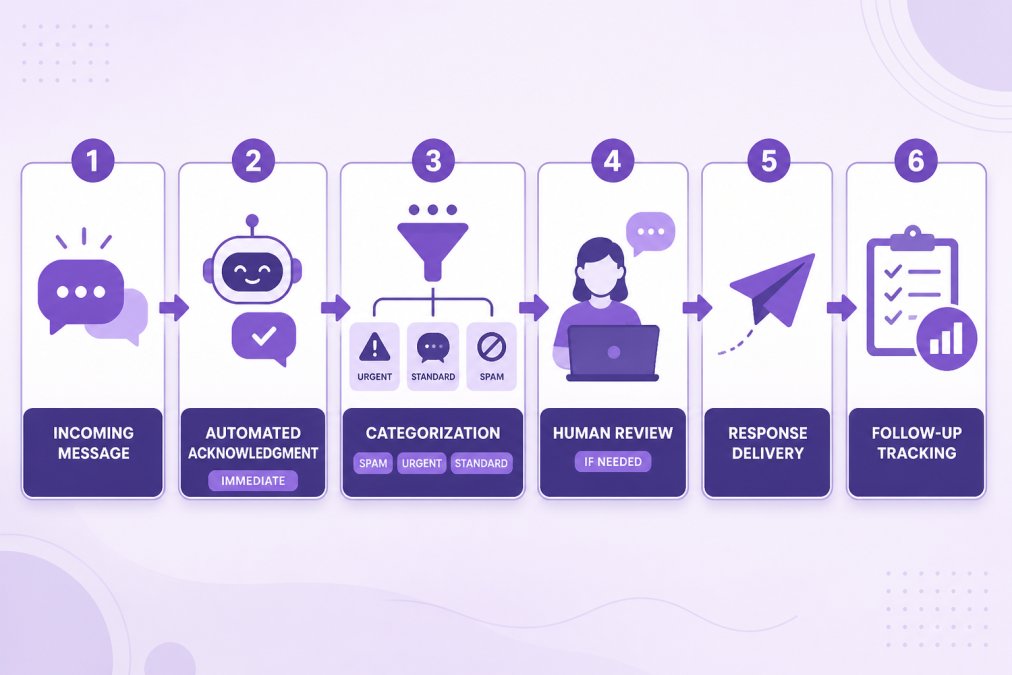
Establish a single inbox for all messages across all platforms. Instagram messages, Facebook messages, TikTok messages, YouTube comments, they all need to funnel into one place. When messages are scattered across different platforms, some inevitably get missed.
Implement an automated acknowledgment system. The moment a customer sends a message, they should receive an immediate response: "Thanks for reaching out. We'll respond within [timeframe]." This confirms receipt and sets expectations.
Categorize messages by urgency and type. A customer asking about product sizing differs from one reporting a billing error. Automated systems can categorize messages instantly based on keywords. Your team then focuses on high-priority messages first.
Assign clear ownership. Every message should be assigned to a specific team member with a clear deadline. When responsibility is distributed, messages get missed. When responsibility is specific, accountability increases.
Monitor response metrics. Track how many messages you receive daily, how many you respond to, your average response time, and what percentage go unanswered. These metrics reveal patterns and guide process improvements.
Establish escalation pathways for complex issues. Some messages require human judgment, specialist knowledge, or authority to make exceptions. A clear escalation path ensures these messages don't languish in the queue.
Tools for Managing Social Media Comments at Scale
When managing social media for multiple brands, multiple accounts, or multiple platforms, manual comment management becomes impossible. Tools become essential operational necessities.
The right tool should handle three core functions: comment moderation, message management, and response automation. Comment moderation filters out spam, hate speech, and competitor links. Message management aggregates messages from multiple platforms into a single inbox. Response automation delivers replies 24/7 without requiring your team to be online.
FeedGuardians combines all three functions. It detects and hides spam, hate speech, and competitor links with 98.7% accuracy, automatically protecting your brand. It aggregates messages from Instagram, Facebook, TikTok, and YouTube into a unified inbox. It delivers 24/7 AI-powered replies in your unique brand voice, ensuring no customer message goes unanswered.
The accuracy of automated moderation matters enormously. A tool that catches 90% of spam still lets 10% through, which compounds into hundreds of spam comments on high-volume accounts. A tool that catches 98.7% of spam catches almost everything while minimizing false positives.
Generic AI responses sound robotic and damage brand perception. FeedGuardians learns your tone, terminology, and guidelines, generating responses that sound like your brand, not a chatbot. Customers can tell when they're talking to AI. If that AI sounds like your brand, they're usually fine with it.
The scalability of the tool matters when managing multiple accounts. Setup should be straightforward. The tool should handle 100 accounts as easily as 10 accounts. Pricing should scale with volume.
Ignoring customer messages on social media damages your brand reputation, reduces conversion rates, and costs you customers to faster competitors. The consequences compound over time, affecting not just individual sales but your entire customer retention and ad performance.
The solution isn't hiring more people to respond manually. The solution is implementing a system that catches every message, acknowledges it immediately, categorizes it appropriately, and delivers a response in your brand voice 24/7. FeedGuardians automates this entire process, ensuring no customer inquiry goes unanswered while your team focuses on complex issues that require human judgment. Start for free and see how much faster your response times become.
Frequently Asked Questions
How quickly do customers expect a response on social media?
Most customers expect a response within 4 hours on platforms like Instagram and Facebook, with 30-40% expecting replies within 1 hour. On TikTok and YouTube, expectations vary by content type, but timely engagement signals active brand presence. Responses within 24 hours are now the bare minimum to avoid appearing neglectful. Slower response times correlate directly with lower customer satisfaction and reduced likelihood of conversion.
What are the consequences of ignoring customer complaints on social media?
Ignored complaints escalate publicly. Frustrated customers tag friends, leave negative reviews on third-party sites, and share their experience across multiple platforms. This multiplies the damage: one ignored message can trigger 5-10 additional negative posts. Brands that ignore complaints see measurable drops in engagement, increased churn, and reduced ad performance as algorithms suppress content from accounts with poor community interaction metrics.
Can ignoring messages lead to negative reviews?
Yes. Ignored social media messages frequently result in negative reviews on Google, Trustpilot, and industry-specific platforms. Customers who feel dismissed on social media are 3x more likely to post negative reviews elsewhere. These reviews damage SEO, reduce conversion rates, and create a compounding reputation problem that takes months to recover from. One ignored message can cost thousands in lost sales.
How does slow response time affect brand loyalty?
Response latency directly impacts customer retention. Brands responding within 1 hour see 20-30% higher customer lifetime value compared to those responding after 24 hours. Slow response times signal low priority to customers, eroding trust and loyalty. Customers who experience delayed responses are more likely to shop competitors on their next purchase, even if your product is superior. Speed communicates care.
This article was written using GrandRanker
Tired of manually moderating comments?
FeedGuardians automates spam filtering, responds to customers, and protects your brand — setup in 3 minutes.
Frequently Asked Questions
How quickly do customers expect a response on social media?
Most customers expect a response within 4 hours on platforms like Instagram and Facebook, with 30-40% expecting replies within 1 hour. On TikTok and YouTube, expectations vary by content type, but timely engagement signals active brand presence. Responses within 24 hours are now the bare minimum to avoid appearing neglectful. Slower response times correlate directly with lower customer satisfaction and reduced likelihood of conversion.
What are the consequences of ignoring customer complaints on social media?
Ignored complaints escalate publicly. Frustrated customers tag friends, leave negative reviews on third-party sites, and share their experience across multiple platforms. This multiplies the damage: one ignored message can trigger 5-10 additional negative posts. Brands that ignore complaints see measurable drops in engagement, increased churn, and reduced ad performance as algorithms suppress content from accounts with poor community interaction metrics.
Can ignoring messages lead to negative reviews?
Yes. Ignored social media messages frequently result in negative reviews on Google, Trustpilot, and industry-specific platforms. Customers who feel dismissed on social media are 3x more likely to post negative reviews elsewhere. These reviews damage SEO, reduce conversion rates, and create a compounding reputation problem that takes months to recover from. One ignored message can cost thousands in lost sales.
How does slow response time affect brand loyalty?
Response latency directly impacts customer retention. Brands responding within 1 hour see 20-30% higher customer lifetime value compared to those responding after 24 hours. Slow response times signal low priority to customers, eroding trust and loyalty. Customers who experience delayed responses are more likely to shop competitors on their next purchase, even if your product is superior. Speed communicates care.