
Quick Summary
| Key Insight | What You Need to Know |
|---|---|
| Hiding spam and scam | Hiding spam and scam links keeps the comment thread healthy for real visitors. |
| Hidden customer questions remove | Hidden customer questions remove public answers and the engagement that supports reach. |
| Track false positives by | Track false positives by sampling hidden comments each week. |
| Test any filter on | Test any filter on 500 to 1,000 of your own comments before going live. |
| Use auto-hide for clear | Use auto-hide for clear spam, flag borderline cases, and leave civil criticism visible. |
| What Automated Comment Moderation | What Automated Comment Moderation Does to Your Comment Section |
Quick Summary
Comment filtering affects brand reach because platforms read comment activity as a signal of post value. Hiding spam helps keep the thread healthy, but hiding real questions and replies can lower engagement and shrink organic distribution. The key is to filter harmful comments while keeping useful conversation visible.
- Hiding spam and scam links keeps the comment thread healthy for real visitors.
- Hidden customer questions remove public answers and the engagement that supports reach.
- Track false positives by sampling hidden comments each week.
- Test any filter on 500 to 1,000 of your own comments before going live.
- Use auto-hide for clear spam, flag borderline cases, and leave civil criticism visible.
Table of Contents
- What Automated Comment Moderation Does to Your Comment Section
- How Automated Comment Filtering Works, Step by Step
- How Comment Filtering Changes Organic and Paid Reach
- Social Media Moderation Best Practices That Protect Reach
- False Positives in Content Moderation and Their Cost to Reach
- Choosing Between AI Comment Moderation Tools and Human Review
- Setting Up and Testing Your Filter Before You Trust It
- Frequently Asked Questions
Automated comment filtering sits at the center of a trade-off most social media teams never measure. Hide too little and spam, scams and hostile replies drag down the page.
Comment filtering is the process of automatically reviewing incoming comments against rules or AI models, then hiding, flagging or leaving them visible. Brand reach is the number of unique people who see your content, organic or paid.
Meta's documentation on comment and content moderation tools
What Automated Comment Moderation Does to Your Comment Section
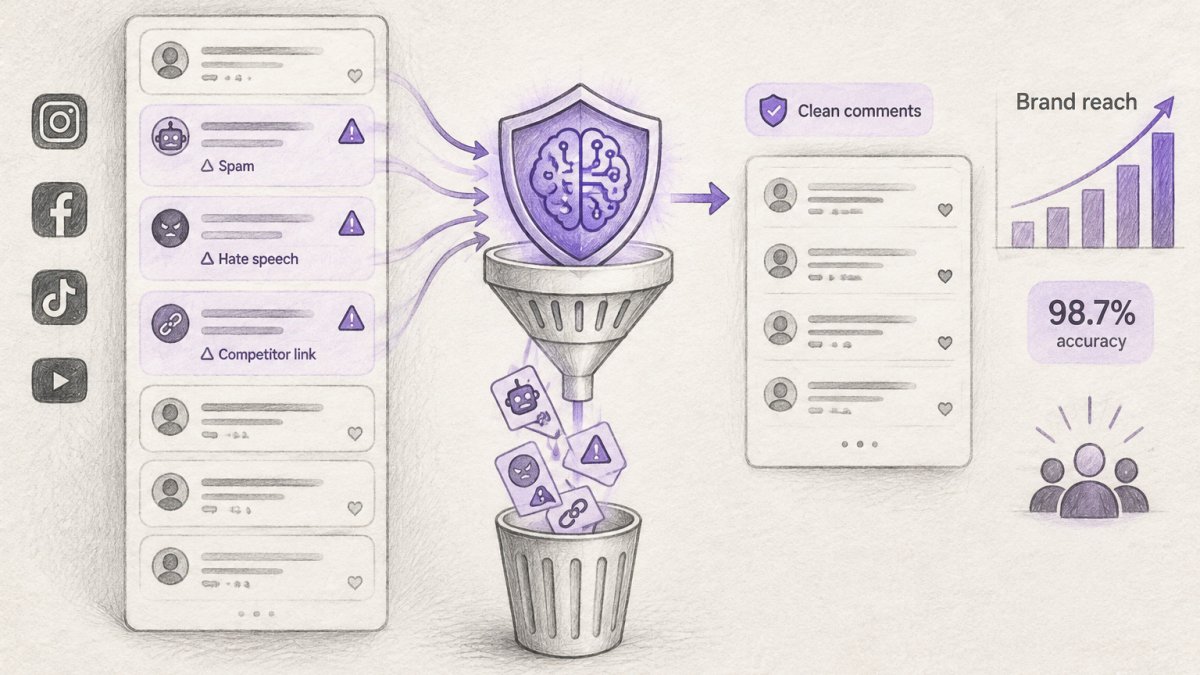
Automated comment moderation reviews every new comment in near real time. It decides which comments stay visible, which get hidden for review, and which get removed. Most systems look at spam signals like repeated links, fake giveaway wording and bot-style patterns.
The effect is immediate: spam stops crowding out real questions and visitors see a cleaner thread. The hard part is that "cleaner" and "more active" are not the same thing, and reach depends on the second.
- Spam and scam links get hidden before most users see them
- Hostile comments get routed away from the public thread
- Genuine questions stay visible when rules are tuned well
- Staff time shifts from scrolling to answering
How Automated Comment Filtering Works, Step by Step
Most filters follow the same basic path. Knowing each step tells you where things can go wrong.
- Intake. The platform sends each new comment to the filter.
- Scoring. Rules and AI models check for links, keywords, repeated text and tone.
- Decision. The comment is left visible, hidden, or sent to a review queue.
- Logging. The action is recorded so you can audit it later.
- Escalation. Borderline comments go to a human reviewer.
Each step adds a failure point. A rule that is too broad can hide a customer asking about shipping; one that is too narrow lets a scam link through. The fix is not the "smartest" tool but clear thresholds and reviewed results.
Watch out: a keyword rule that blocks a common word can hide dozens of harmless comments in one day.
How Comment Filtering Changes Organic and Paid Reach
Organic and paid reach respond to moderation through different mechanisms, and treating them as one number is the fastest way to misread your results.
Organic delivery is driven by early engagement signals: replies, reactions, shares, saves and watch time. A comment section that looks alive gives new visitors a reason to join, and those joins feed the signals that decide whether the post travels further.
Paid delivery works differently. Ad systems optimize against predicted engagement and relevance, and comment activity is one input among many.
Why hidden comments can reduce reach
Hidden comments lower reach through three paths. Fewer visible replies mean fewer engagement signals for the ranking system, shrinking organic distribution. A hidden customer question removes the public answer other buyers would have seen, so social proof disappears with it. And customers whose comments vanish sometimes stop commenting altogether, reducing activity over weeks rather than hours.
The opposite failure is just as costly. Filtering quickly enough to protect a post without hiding legitimate discussion is part of the broader balance between automation and brand perception explored by Rain Visual Strategy / Design.
Platform differences across Instagram, Facebook, TikTok and YouTube
Each platform surfaces comments and weighs engagement differently, so the same filter setting produces different reach effects.
- Instagram: Hidden comments are removed from public view for most users, so a keyword rule on a post or ad can silently strip the conversation that supports Explore and Reels distribution. Review hidden comments on any post you are promoting.
- Facebook: Comment threads carry meaningful weight in feed ranking, and replies between users can extend a post's life. Filtering that empties real conversation matters more here than on platforms where comments are secondary.
- TikTok: Fast-moving comment sections reward visible, lively replies, and creators often use comment activity to decide whether to make follow-up content. Over-filtering is especially costly because the comment section is part of the content.
- YouTube: Held-for-review queues can delay public comments for hours, so review speed directly affects how long a video's discussion stays thin. On a new upload, a slow queue can suppress the early comment activity that supports recommendations.
The takeaway is not to memorize platform rules but to test each platform separately against a baseline, because the same threshold that protects reach on one channel can suppress it on another.
Measuring the reach trade-off
A measurement plan turns moderation from a guess into a decision. Pick a baseline period, then track these metrics before and after any filter change:
- Impressions and reach to see whether distribution moved.
- Engagement rate (reactions, replies, shares divided by reach) to see whether the conversation thinned.
- Comment visibility rate (visible comments divided by total comments) to see how much you are hiding.
- Click-through rate on any link in the post or ad to see whether real questions were being answered.
- Conversions or sales attributed to the post to connect moderation to revenue.
Run the comparison on matched posts, not across a whole account, because campaign timing and audience shifts will otherwise swamp the moderation effect. A common pattern is a small dip in comment visibility paired with flat or rising engagement, which usually means the filter is removing noise rather than conversation.
Instagram's help center on hidden words and comment controls
Social Media Moderation Best Practices That Protect Reach
Good moderation protects reputation without suppressing the signals that help content travel. A few practices make the biggest difference.
- Start with spam and scam rules, then add harassment rules later
- Review hidden comments every day for the first two weeks
- Keep a short allowlist of brand terms and customer questions
- Reply to genuine questions quickly, since replies add engagement
- Log every rule change so you can trace a sudden reach drop
Federal Trade Commission guidance on consumer reviews and endorsements
Social media moderation best practices work best as a routine, not a one-time setup. Revisit your rules after each campaign.
False Positives in Content Moderation and Their Cost to Reach
A false positive happens when a filter hides a comment that should have stayed visible. In social media moderation, false positives are the hidden cost most teams overlook.
False positives also erode trust: customers who see their comments disappear may stop commenting, reducing the activity that supports reach over time.
Measure false positives by sampling hidden comments each week and counting how many should have been visible. Track that rate alongside your spam catch rate.
Research on automated content moderation accuracy and error rates
Choosing Between AI Comment Moderation Tools and Human Review
AI tools handle volume. Human reviewers handle nuance. For most brands, the right answer is a mix.
| Approach | Best For | Main Risk |
|---|---|---|
| Keyword rules | Known spam phrases | Over-blocking common words |
| AI moderation | High-volume comment sections | Misreading tone or sarcasm |
| Human review | Borderline and high-stakes comments | Slow response times |
| Hybrid | Most brands with steady volume | Requires clear escalation rules |
FeedGuardians is built for the hybrid approach. For a dedicated tool that uses keyword rules and AI on Instagram posts and ads, see how it works.
For most brands running steady comment volume, the hybrid model is a practical choice. Pure automation is faster but misses context; pure human review is accurate but cannot keep up with a busy launch.
Setting Up and Testing Your Filter Before You Trust It
Test before you trust, and test against a baseline. A filter can look excellent in a demo and still misfire on your audience, so prove it on your own comment history before it touches live posts.
- Export a sample. Pull 500 to 1,000 recent comments from your strongest organic post and from your ad comments, including at least one launch week and one quiet week.
- Label them. Mark each comment as spam, harmful, legitimate or unsure. Have a second person label a subset so you know how much your own judgment varies.
- Run the filter. Apply your rules to the sample without going live.
- Compare. Count false positives and false negatives separately. A filter that catches most spam but hides real questions is not passing.
- Adjust thresholds. Tighten or loosen rules until false positives stay low, then re-run the sample.
- Go live in stages. Start on one platform and one post type, compare against the baseline metrics from the previous section, and expand only after a full week of stable results.
A decision framework for auto-hide, flag or leave visible
Most teams get better results by sorting comments into three buckets rather than treating filtering as on or off:
- Auto-hide: clear spam, scam links, repeated promotional text and known bot patterns. These have low false-positive risk and high user annoyance.
- Flag for review: borderline tone, competitor mentions, complaints and anything involving money, health or safety. These need a human within a defined response window, often the same business day.
- Leave visible: genuine questions, criticism that is civil, and replies that add context. Hiding civil criticism is the most common cause of lost trust and lost social proof.
Set response-time thresholds by risk. High-risk comments (threats, safety claims, refund disputes) should reach a reviewer within hours; low-risk borderline comments can wait a day. Write the thresholds down so reviewers apply them consistently.
Bias, transparency and appeals
Automated filters misread dialect, sarcasm and sensitive topics unevenly, and the effect is not random: criticism and nonstandard phrasing get caught more often than praise.
Watch out: a keyword rule that blocks a common word can hide dozens of harmless comments in one day, and without an appeals path you will never learn which ones.
A useful test checks whether any filter handles your product names and common customer phrasing correctly before you commit to a full rollout.
Frequently Asked Questions
How can automated comment filtering affect a brand's reach?
Automated comment filtering can affect reach in two directions. Removing spam and harmful comments keeps threads readable, which can encourage genuine discussion and protect ad performance. However, when filters hide legitimate comments, the thread may look quieter, fewer people may join the conversation, and some engagement signals that platforms use to distribute content can drop. Brands should track reach before and after changing filter rules, and review hidden comments regularly so useful feedback is not lost.
Can social media platforms reduce the visibility of posts with filtered comments?
Platforms do not publish exact rules about how comment activity affects distribution, so no brand can be certain of the effect on a given post. What can be observed is that comment activity is one of several engagement signals. Hiding a large share of comments can change how active a post appears to users and to ranking systems. Brands should test filter settings on comparable posts and measure reach, engagement rate and click-through rate, rather than assuming a single effect.
How can brands prevent genuine comments from being hidden?
Start with narrow rules that target clear spam, scams and abusive language, rather than broad keyword blocks that catch ordinary words. Review the hidden-comment queue daily during the first weeks, and set up an appeal or restore step so staff can release comments that were filtered by mistake. Keep a list of common false positives, such as product names or slang, and exclude them. Human review of borderline cases remains important for complaints and questions.
How should brands measure the effect of comment moderation on reach?
Compare posts from a period before filtering with posts from a period after, using the same platform and similar content types. Track organic reach, paid reach, engagement rate, comment count, hidden-comment count and conversions from the post. Note when filter rules change so results can be linked to specific settings. Where possible, run a split test by applying different rules to similar posts. Look for patterns over several weeks rather than single posts, because one post rarely shows a reliable trend.

Tired of manually moderating comments?
FeedGuardians automates spam filtering, responds to customers, and protects your brand — setup in 3 minutes.
Frequently Asked Questions
How can automated comment filtering affect a brand's reach?
Automated comment filtering can affect reach in two directions. Removing spam and harmful comments keeps threads readable, which can encourage genuine discussion and protect ad performance. However, when filters hide legitimate comments, the thread may look quieter, fewer people may join the conversation, and some engagement signals that platforms use to distribute content can drop. Brands should track reach before and after changing filter rules, and review hidden comments regularly so useful feedback is not lost.
Can social media platforms reduce the visibility of posts with filtered comments?
Platforms do not publish exact rules about how comment activity affects distribution, so no brand can be certain of the effect on a given post. What can be observed is that comment activity is one of several engagement signals. Hiding a large share of comments can change how active a post appears to users and to ranking systems. Brands should test filter settings on comparable posts and measure reach, engagement rate and click-through rate, rather than assuming a single effect.
How can brands prevent genuine comments from being hidden?
Start with narrow rules that target clear spam, scams and abusive language, rather than broad keyword blocks that catch ordinary words. Review the hidden-comment queue daily during the first weeks, and set up an appeal or restore step so staff can release comments that were filtered by mistake. Keep a list of common false positives, such as product names or slang, and exclude them. Human review of borderline cases remains important for complaints and questions.
How should brands measure the effect of comment moderation on reach?
Compare posts from a period before filtering with posts from a period after, using the same platform and similar content types. Track organic reach, paid reach, engagement rate, comment count, hidden-comment count and conversions from the post. Note when filter rules change so results can be linked to specific settings. Where possible, run a split test by applying different rules to similar posts. Look for patterns over several weeks rather than single posts, because one post rarely shows a reliable trend.