
Quick Summary
| Key Insight | What You Need to Know |
|---|---|
| Multimodal analysis reads text | Multimodal analysis reads text, images, audio, and video together to catch coded insults and threatening memes. |
| Tiered action hides clearly | Tiered action hides clearly harmful comments, holds ambiguous ones for review, and lets benign posts through. |
| Ask vendors for disaggregated | Ask vendors for disaggregated performance data by dialect and demographic group, not a single accuracy figure. |
| AI handles volume and | AI handles volume and speed while humans handle nuance, appeals, and decisions with real consequences. |
| Victim-side tools filter abuse | Victim-side tools filter abuse before exposure, preserve timestamped evidence, and summarize pile-ons into a short list. |
| How AI Detects Online | How AI Detects Online Harassment in Real TimeFrom Keyword Filters to Multimodal Analysis |
Last Updated: November 4, 2026
Quick Summary
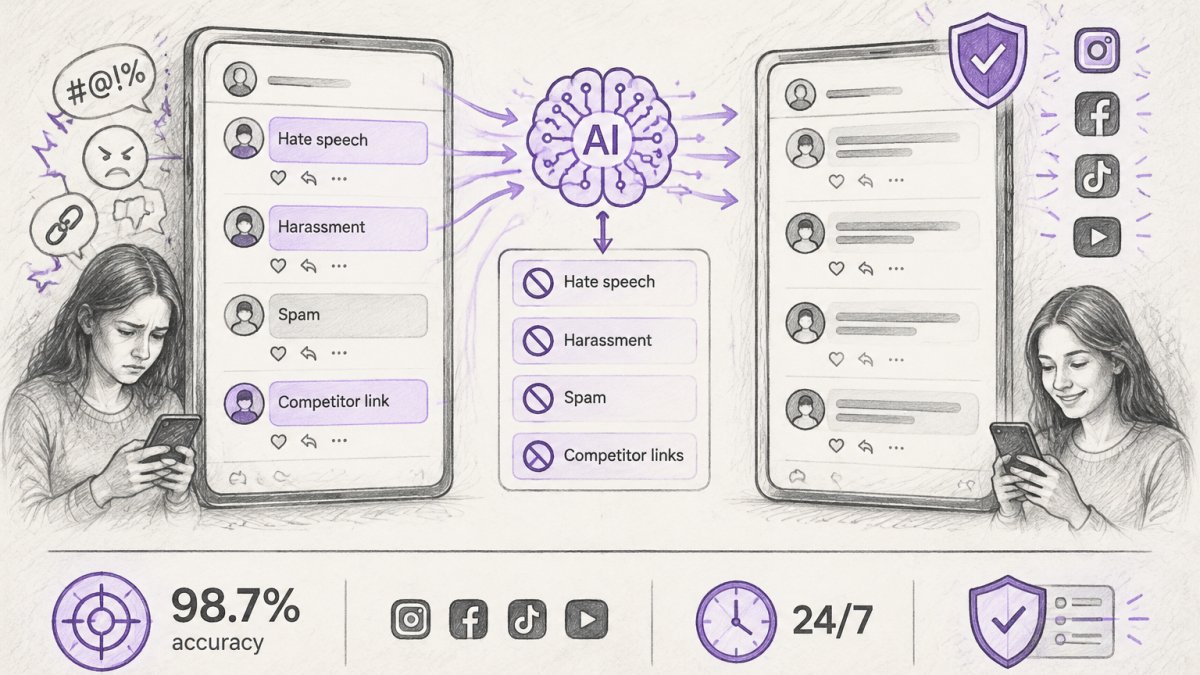
AI can stop online harassment before it spreads by detecting and scoring harmful comments in milliseconds, before they reach a wide audience. Layered models read intent, account history, and context, then hide, flag, or escalate each post instantly instead of waiting for human review.
- Multimodal analysis reads text, images, audio, and video together to catch coded insults and threatening memes.
- Tiered action hides clearly harmful comments, holds ambiguous ones for review, and lets benign posts through.
- Ask vendors for disaggregated performance data by dialect and demographic group, not a single accuracy figure.
- AI handles volume and speed while humans handle nuance, appeals, and decisions with real consequences.
- Victim-side tools filter abuse before exposure, preserve timestamped evidence, and summarize pile-ons into a short list.
Table of Contents
- How AI Detects Online Harassment in Real Time
- Where AI Moderation Still Falls Short
- AI-Powered Comment Moderation Tools for Brands
- AI vs Human Moderation for Social Media: Who Does What
- Best Practices for Online Community Management
- How AI Can Support Victims, Not Just Remove Comments
- Start Protecting Your Comment Sections Today
- Frequently Asked Questions
How AI Detects Online Harassment in Real Time
Modern detection stacks several models on top of each other. A first pass uses natural language processing to read intent, tone, and target. A second pass checks the account itself: how new it is, how often it posts, whether it has a history of removals.
That layered approach matters because harassment rarely looks like a single slur. It looks like a coordinated pile-on, a coded insult, or a meme with a threatening caption. Real-time monitoring catches the pattern, not just the word.
From Keyword Filters to Multimodal Analysis
Keyword filters were the first generation, and they were brittle. Block the word and the abuse shifts to a misspelling, a symbol, or an image. Multimodal analysis is the answer: models that read text, images, audio, and video together and judge the combination. For a deeper look at how this works across languages, see our breakdown of how hate speech is detected in multilingual posts.
The practical difference is large. A plain keyword filter misses sarcasm, dog whistles, and harassment delivered as a picture. A multimodal system weighs the caption against the image and catches what neither would flag alone.
Where AI Moderation Still Falls Short
No detector is perfect, and any vendor claiming otherwise is selling you a story. The honest limits fall into four buckets: context, sarcasm and reclaimed language, dialect and code-switching, and disparate impact on the communities a model was never trained to protect. A community that uses a term affectionately will trip a naive filter, while an abuser who knows the model's blind spots can slip through for weeks. The harder problem is that the same model can be simultaneously too aggressive toward one group and too permissive toward another, and most vendors do not publish the data that would let you see it.
The False Positive Dilemma
Every moderation system faces a trade-off between catching everything and silencing no one. Tighten the threshold and you hide harmless banter, which frustrates loyal followers and can read as censorship. Loosen it and abuse lingers long enough to do damage.
The fix is not a single threshold. It is tiered action: hide the clearly harmful, hold the ambiguous for review, and let the benign through untouched. Track your false positive rate monthly and tune it against real examples from your own audience, not a generic benchmark.
Bias, Disparate Impact, and the Regulatory Backdrop
Bias in moderation AI is not a hypothetical. When automated systems fail to distinguish between genuine abuse and the nuanced communication of marginalized groups, victims are often left to navigate the complexities of investigating cyber harassment on their own.
This is no longer only an ethical concern; it is a legal one. Platforms operating in the United States sit inside a patchwork that includes Section 230 of the Communications Decency Act, which shields platforms from liability for most user content but does not shield them from their own moderation decisions, and a growing set of state-level online safety statutes that impose transparency and reporting duties on large platforms.
The Judgment Gap
The other limit is judgment. AI can classify a comment as hostile, but it cannot decide whether a long-time customer is venting or threatening, whether a teenager is joking with a friend, or whether a public figure has effectively invited the pile-on. That call still belongs to a human, which is why escalation paths matter as much as detection thresholds.
Watch out: if your escalation queue has no service-level target, ambiguous threats will sit behind benign appeals and the worst comments will stay visible longest, which is precisely the outcome the system was bought to prevent.
AI-Powered Comment Moderation Tools for Brands
The best AI-powered comment moderation tools for brands combine detection, response, and reporting in one place, so a social team is not stitching three dashboards together. FeedGuardians detects and hides spam, scams, hate speech, and competitor links with 98.7% accuracy, replies 24/7 in your brand voice, and offers a human escalation option.
Choosing well comes down to a short list of criteria:
- Accuracy on your audience, not a generic benchmark
- Coverage across platforms you actually post on
- Response capability in your brand voice, not canned templates
- Escalation controls so a person can override the AI
- Reporting that shows what was hidden and why
Before you commit, compare the field side by side in our roundup of the best AI comment moderation tools. It is the fastest way to see where each option fits.
AI vs Human Moderation for Social Media: Who Does What
AI vs human moderation for social media is not a contest, it is a division of labor. AI handles volume, speed, and pattern recognition at scale. Humans handle nuance, appeals, and decisions with real consequences.
| Task | AI Handles | Human Handles |
|---|---|---|
| Scanning every comment | Continuous, all platforms | Impossible at volume |
| Spam and scam removal | Instant, automated | Spot checks only |
| Sarcasm and in-group language | Struggles without context | Reads intent well |
| Brand-voice replies | 24/7, consistent | Slow, limited hours |
| Appeals and bans | Flags for review | Final decision |
| Crisis judgment | Raises the alert | Sets the response |
The mistake we see most often is treating AI as a replacement for the team. It is a filter that lets the team spend its hours on the comments that actually need a person.
Best Practices for Online Community Management
Strong online community management starts with written rules the AI can learn from. Publish a clear comment policy, define what counts as harassment, and feed those definitions into your moderation settings so the model applies your standards rather than a generic ones.
From there, a few habits separate calm communities from chaotic ones:
- Respond to good comments, not just bad ones, so the tone stays positive.
- Review your hidden-comment log weekly and correct false positives.
- Escalate threats to a human immediately, never to an automated reply.
- Train the model on your own examples of spam and abuse.
- Report patterns, not just individual comments, so you spot coordinated attacks early.
Watch out: leaving a single threatening comment visible while you wait for review signals to the community that the behavior is tolerated, and pile-ons grow fast once that signal lands.
How AI Can Support Victims, Not Just Remove Comments
Removal is the floor, not the ceiling. The more useful role for AI is protecting the person on the receiving end, and that is where most moderation coverage stops short. Platform-side systems are built to protect the platform; victim-side tools are built to protect the person, and the two have different success metrics. A platform counts removed comments. A victim counts hours not spent reading threats.
The practical toolset is already emerging, and it falls into four categories:
- Filtering before exposure. Client-side and third-party filters can intercept abusive replies, mentions, and direct messages before the victim sees them, so the abuse is contained at the inbox rather than after the fact. This is meaningfully different from platform moderation because the victim controls the threshold.
- Evidence preservation. Harassment cases often hinge on documentation, and screenshots are easy to lose, alter, or have dismissed. Tools that timestamp, hash, and export message threads into a consistent record make it far easier to file a report with a platform, an employer, or law enforcement. The mechanics matter: a hash plus a timestamp establishes that a record existed at a given moment, which is the part a plain screenshot cannot prove.
- Flood summarization. When a pile-on produces hundreds of hostile messages, a victim does not need a dashboard of every insult; they need a summary that separates credible threats from noise and surfaces the worst of it to someone who can act. Summarization is the single highest-leverage feature for a person in the middle of an attack, because it converts an unreadable volume into a short list.
- Threat triage and escalation. Real-time sentiment scoring and intent classification can flag escalating threats for review by a human moderator, an employer's security team, or law enforcement, and can distinguish a credible threat from generalized abuse. You can see how real-time sentiment scoring turns raw comments into an early-warning signal.
AI-Driven Psychological Support
The gap competitors miss most consistently is what happens after the abuse lands. Harassment produces measurable psychological harm, anxiety, sleep disruption, withdrawal from public life, and the first hours after an attack are when a victim is most isolated.
Watch out: victim-side tools that store message content on a vendor's servers create a new exposure, a harassment archive is itself sensitive data, and a breach or subpoena can turn a protective tool into a second harm.
The user-centric angle is where most guides stop short, and it is also where the market is moving. The next generation of moderation is not only about what platforms remove; it is about what victims can control.
Start Protecting Your Comment Sections Today
The gap between a calm comment section and a brand crisis is usually a few hours of unattended abuse. Closing that gap means automated detection running continuously, a human escalation path for the hard calls, and reporting that shows what your moderation is actually doing.
That is exactly what FeedGuardians is built for. Our system hides spam, scams, hate speech, and competitor links in real time with 98.7% accuracy, replies in your brand voice around the clock, and offers a human escalation option. Brands using it can protect their brand reputation and turn comments into conversations. If you want the full case for acting now, read the benefits of real-time social media spam detection.
Frequently Asked Questions
How can AI be used to detect and prevent cyberbullying?
AI detects cyberbullying by scanning comments and messages for patterns linked to online harassment: insults, threats, repeated targeting, and coordinated pile-ons. Natural language processing reads tone and intent, while multimodal analysis checks images and video frames. Once flagged, the system can hide, escalate, or reply automatically. Real-time monitoring catches abuse within seconds, before it spreads across threads. Tools built for brands, like FeedGuardians, report 98.7% detection accuracy and offer a human escalation option.
What are the limitations of AI in identifying online harassment?
AI struggles with sarcasm, in-group slang, and cultural context, so it can misread constructive criticism as an attack or miss coded harassment. Algorithmic bias can also skew results if training data underrepresents certain groups. That is why the strongest setups pair automated triage with human review. AI handles volume and speed; people handle nuance. Treat any detection score as a starting point, not a final verdict, and keep a clear escalation path for ambiguous cases.
Can AI distinguish between constructive criticism and online harassment?
Often yes, but not perfectly. Modern models weigh intent, repetition, targeting, and language severity rather than flagging isolated negative words. A single critical review usually passes; a campaign of insults aimed at one person does not. The false positive dilemma remains the hardest part: over-filtering erases legitimate feedback, under-filtering lets abuse through. Brands should tune thresholds to their audience and review flagged comments regularly to correct drift.
How does AI-powered moderation improve brand safety?
Harassment and spam in comment sections can drive away buyers. AI-powered comment moderation tools hide hate speech, scams, and competitor links in real time, keeping the public thread clean without constant manual checks. That helps protect reputation and keeps conversations open for real customers. FeedGuardians also replies 24/7 in your brand voice. A free plan is available to test detection on your own accounts.
The abuse will not slow down on its own, and every hour a hostile comment sits visible costs you trust and reach. FeedGuardians gives your team real-time moderation, 24/7 brand-voice replies, and a human escalation option so nothing slips through. Get started with FeedGuardians and put your comment sections on autopilot.

Tired of manually moderating comments?
FeedGuardians automates spam filtering, responds to customers, and protects your brand — setup in 3 minutes.
Frequently Asked Questions
How can AI be used to detect and prevent cyberbullying?
AI detects cyberbullying by scanning comments and messages for patterns linked to online harassment: insults, threats, repeated targeting, and coordinated pile-ons. Natural language processing reads tone and intent, while multimodal analysis checks images and video frames. Once flagged, the system can hide, escalate, or reply automatically. Real-time monitoring catches abuse within seconds, before it spreads across threads. Tools built for brands, like FeedGuardians, report 98.7% detection accuracy and offer a human escalation option.
What are the limitations of AI in identifying online harassment?
AI struggles with sarcasm, in-group slang, and cultural context, so it can misread constructive criticism as an attack or miss coded harassment. Algorithmic bias can also skew results if training data underrepresents certain groups. That is why the strongest setups pair automated triage with human review. AI handles volume and speed; people handle nuance. Treat any detection score as a starting point, not a final verdict, and keep a clear escalation path for ambiguous cases.
Can AI distinguish between constructive criticism and online harassment?
Often yes, but not perfectly. Modern models weigh intent, repetition, targeting, and language severity rather than flagging isolated negative words. A single critical review usually passes; a campaign of insults aimed at one person does not. The false positive dilemma remains the hardest part: over-filtering erases legitimate feedback, under-filtering lets abuse through. Brands should tune thresholds to their audience and review flagged comments regularly to correct drift.
How does AI-powered moderation improve brand safety?
Harassment and spam in comment sections can drive away buyers. AI-powered comment moderation tools hide hate speech, scams, and competitor links in real time, keeping the public thread clean without constant manual checks. That helps protect reputation and keeps conversations open for real customers. FeedGuardians also replies 24/7 in your brand voice. A free plan is available to test detection on your own accounts.