
Quick Summary
| Key Insight | What You Need to Know |
|---|---|
| Social Media Agency Pricing Models 2026 | Overview and Trends Why Pricing Models Matter in 2026 |
| Why Pricing Models Matter | Why Pricing Models Matter in 2026 |
| Monthly Retainer Pricing Models | Monthly Retainer Pricing Models Explained How Retainer Structures Work Pros and Cons of Monthly Retainers |
| How Retainer Structures Work | How Retainer Structures Work |
| Pros and Cons of | Pros and Cons of Monthly Retainers |
| Project-Based Pricing Structures and | Project-Based Pricing Structures and Scope of Work Defining Scope and Deliverables |
Table of Contents
- Social Media Agency Pricing Models 2026: Overview and Trends
- Monthly Retainer Pricing Models Explained
- Project-Based Pricing Structures and Scope of Work
- Hourly Rate Benchmarks for Social Media Agencies
- Social Media Management Pricing Packages and Service Tiers
- Average Cost of Social Media Marketing Per Month
- Performance-Based Social Media Marketing Pricing Models
- Social Media Agency Rate Card Template and Hidden Costs
Last Updated: July 9, 2026
Social Media Agency Pricing Models 2026: Overview and Trends
Understanding social media agency pricing models is critical for businesses deciding whether to hire external expertise or manage channels in-house. According to Gartner's 2026 Marketing Services Report, nearly 68% of enterprises now use multiple pricing models from their agencies rather than committing to a single structure.
Agencies have moved beyond simple monthly retainers into hybrid models that blend hourly rates, performance incentives, and project-based fees. The shift reflects a fundamental change in how brands measure value: instead of paying for hours worked or arbitrary monthly commitments, forward-thinking agencies now tie compensation directly to outcomes.
This guide breaks down every major social media agency pricing structure you'll encounter, including pros and cons, hidden costs to watch for, and how to negotiate terms that align with your business goals.
Why Pricing Models Matter in 2026
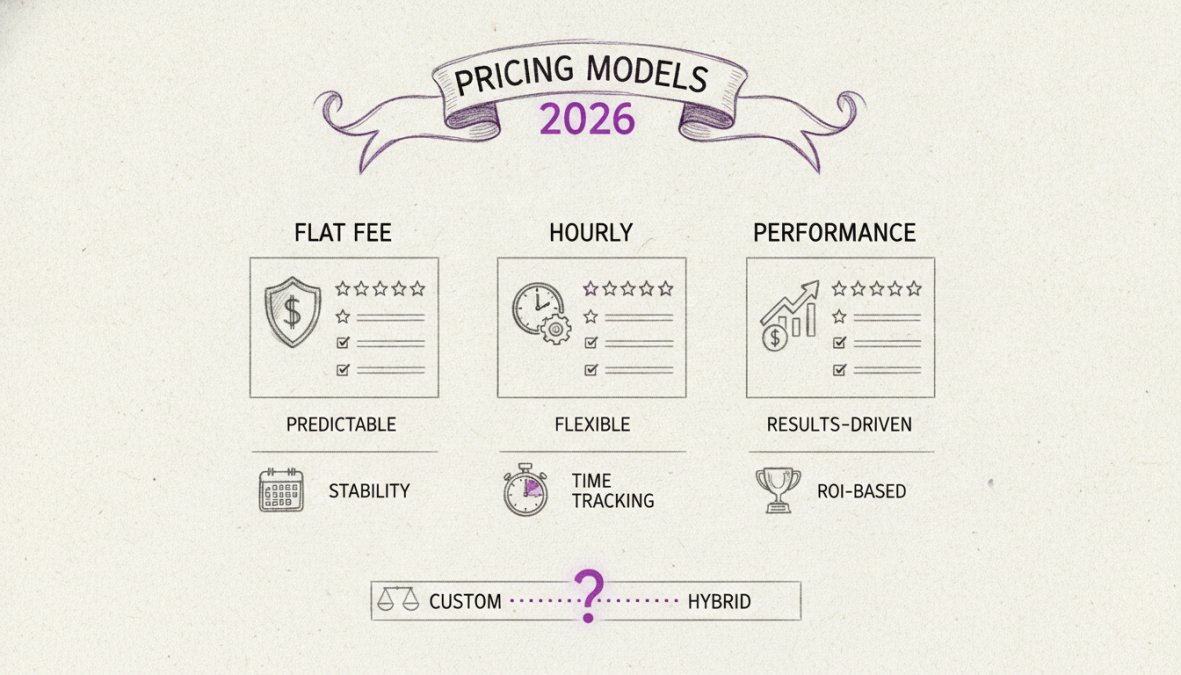
The pricing model you choose determines not just your budget, but your agency relationship itself. A monthly retainer creates accountability for consistent output. A project-based structure works best for one-off campaigns. Performance-based pricing aligns incentives but introduces risk for both parties.
In 2026, agencies increasingly publish rate cards online and offer tiered service packages instead of custom quotes. This transparency benefits you: you can compare options faster and spot overpriced services immediately. Social media now directly impacts revenue for most businesses, making it critical to choose a pricing model that aligns incentives and ensures accountability.
| Pricing Model | Best For | Contract Length | Typical Range |
|---|---|---|---|
| Monthly Retainer | Ongoing management & consistency | 6-12 months | $1,500-$15,000/mo |
| Project-Based | Campaign launches, one-time work | 1-3 months | $2,500-$50,000 per project |
| Hourly Rate | Consulting, audits, training | As-needed | $75-$300/hour |
| Performance-Based | Results-driven campaigns | 3-12 months | Fee + % of revenue/ROI |
| Hybrid Model | Most common in 2026 | 6-12 months | Base retainer + project fees |
Monthly Retainer Pricing Models Explained
The monthly retainer remains the most common structure, accounting for roughly 55% of social media contracts in 2026. You pay a fixed fee each month for a defined scope of work: content creation, community management, analytics reporting, and strategy development across specified platforms.
How Retainer Structures Work
A typical monthly retainer includes 8-12 pieces of original content per month, daily community management, weekly performance reports, monthly strategy calls, and management of 2-3 social platforms. Boutique agencies charge $3,500/month for this package. Enterprise firms charge $8,000-$25,000/month and add influencer outreach, paid media management, and dedicated account teams.
The advantage is simplicity: you know exactly what you're paying and what you're getting. The agency has incentive to keep you happy because losing you means losing recurring revenue.
Pros and Cons of Monthly Retainers
Pros:
- Fixed monthly budget makes forecasting easy
- Consistent output and brand presence
- Agency has skin in the game
- Easier to build long-term strategy with continuity
- Discounts available for longer commitments (6-12 months)
Cons:
- You pay whether results happen or not
- Can feel expensive for low-revenue businesses
- Minimum commitments lock you in even if the agency underperforms
- Hidden costs often appear: rush fees, additional platform management, paid media spend management
Many agencies quote a "base retainer" but add 15-30% in extra fees for paid social management, crisis communication, or additional platform monitoring. Ask specifically whether your retainer includes paid media management or if that's billed separately.
Project-Based Pricing Structures and Scope of Work
Project-based pricing makes sense for specific deliverables with defined endpoints: product launches, rebrand announcements, or seasonal campaigns. Agencies quote a fixed price for the entire project, with scope defined in a detailed work document.
Defining Scope and Deliverables
A strong scope of work includes specific deliverables ("5 Instagram Reels, 12 TikTok videos, 20 carousel posts"), revision limits (typically 2 rounds; additional revisions billed separately), timeline with milestone dates, success metrics, and what's explicitly not included.
Research from Project Management Institute's 2026 Benchmarking Report shows that 43% of project overruns stem from unclear scope definitions. In agency work, this translates to budget overruns and relationship damage.
Project-based pricing typically ranges from $2,500 for small campaigns to $50,000+ for enterprise-level work. Boutique agencies charge $5,000-$15,000 per project. Mid-market firms charge $15,000-$40,000. Enterprise agencies start at $40,000 and up.
Hourly Rate Benchmarks for Social Media Agencies
Hourly rates exist primarily for consulting, audits, training, and custom work. Junior social media managers charge $50-$100/hour. Mid-level strategists charge $100-$200/hour. Senior strategists and creative directors charge $200-$300/hour.
Most agencies prefer retainers or project fees because they're more profitable and predictable. When hourly rates do apply, expect a minimum engagement (typically 10-20 hours) and a retainer structure that converts to a monthly fee if work becomes ongoing.
Social Media Management Pricing Packages and Service Tiers
Most agencies now offer tiered packages that align with business size and budget.
Starter Tier ($1,500-$3,000/month):
- 1-2 social platforms
- 4-6 posts per week
- Basic community management (response within 24 hours)
- Monthly report
- Best for: solopreneurs, small local businesses, early-stage startups
Growth Tier ($4,000-$8,000/month):
- 3-4 social platforms
- 8-12 posts per week
- Daily community management
- Weekly performance reviews
- Paid social management (up to $2,000/month ad spend)
- Monthly strategy call
- Best for: mid-market businesses, growing e-commerce, B2B SaaS
Enterprise Tier ($10,000-$25,000+/month):
- All platforms
- 15+ posts per week
- 24/7 community management and crisis response
- Dedicated account team (3-5 people)
- Paid media management (unlimited budget)
- Weekly strategy calls
- Custom reporting and integrations
- Best for: large corporations, multi-brand operations, high-volume e-commerce
Boutique vs. Enterprise Firm Pricing
Boutique agencies typically charge 30-40% less than enterprise firms for comparable work due to lower overhead. A boutique agency might charge $3,500/month for content creation and community management across 2-3 platforms, while an enterprise firm charges $7,000-$10,000 for the same deliverables.
For most mid-market businesses, boutique agencies deliver better ROI through dedicated attention and faster turnaround. Enterprise agencies make sense if you need integrated services or manage multiple brands simultaneously.
Average Cost of Social Media Marketing Per Month
For a small business with a single social platform and basic content needs, expect $1,500-$3,000/month. For a mid-market business managing 3-4 platforms with integrated strategy, budget $4,000-$8,000/month. For enterprise-level operations, $10,000-$25,000/month is standard.
Cost Variations by Platform and Service Level
Platform choice affects pricing. Managing Instagram and TikTok costs more than managing LinkedIn and Twitter because video content requires more production resources. Paid social management adds 20-35% to your monthly cost. Real-time engagement matters more for ad performance, so agencies charge premium rates for 24/7 coverage.
Within the same tier, these factors change pricing:
- Video production: Add $500-$2,000/month for weekly video content
- Influencer outreach: Add $1,000-$5,000/month for relationship management and negotiation
- Paid media management: Add 10-20% of your ad spend
- Crisis management: Add $2,000-$5,000/month for 24/7 monitoring and rapid response
- Advanced analytics: Add $500-$1,500/month for custom dashboards and predictive analysis
Performance-Based Social Media Marketing Pricing Models
Performance-based pricing ties agency compensation directly to results. You pay a base fee plus a percentage of revenue generated, leads captured, or engagement metrics achieved.
How Performance Incentives Work
A typical structure includes a base retainer of $3,000/month for core services plus 5-15% of revenue attributed to social media campaigns. The agency tracks conversions using UTM parameters, pixel tracking, or direct attribution. If social campaigns generate $100,000 in revenue, the agency earns an additional $5,000-$15,000 that month.
This requires sophisticated tracking. E-commerce businesses can measure revenue directly. B2B companies measure qualified leads. SaaS companies measure trial signups or demo requests.
Advantages and Risks
Advantages:
- Agency has maximum incentive to drive results
- Your costs scale with success
- Forces agencies to focus on ROI, not vanity metrics
- Reduces risk of overpaying for underperformance
Risks:
- Attribution is messy and disputed
- Agencies may focus only on high-revenue campaigns and neglect brand building
- If results don't materialize, you're stuck paying base retainer for poor performance
- Requires strong tracking infrastructure
- Agencies often inflate the performance percentage to offset risk
Social Media Agency Rate Card Template and Hidden Costs
Most agencies publish rate cards that break down pricing by service. Understanding what's included prevents surprise bills.
Common hidden costs include:
Onboarding fees: $500-$2,500 for initial setup, strategy development, and platform audit.
Setup costs: Creating ad accounts, installing tracking pixels, setting up analytics dashboards. Agencies often charge $500-$1,500 for this one-time work.
Ad spend management: If the agency manages your paid social budget, they typically take 10-20% of ad spend as a management fee.
Rush fees: Expedited content creation or emergency campaign setup typically costs 25-50% more than standard rates.
Revision overages: Most contracts limit revisions to 2 rounds. Additional revisions cost $150-$300 per round.
Platform expansion: Adding a new platform mid-contract often costs extra.
Reporting customization: Custom dashboards or advanced analytics cost $500-$2,000/month extra.
Understanding Onboarding Fees, Setup Costs, and Ad Spend Management
Onboarding is where agencies invest 20-40 hours on discovery, strategy development, and platform setup. Charging $1,500-$2,500 is reasonable, but it should be transparent. The best agencies include onboarding in the first month's retainer.
Ad spend management fees are the biggest hidden cost. If you're running $10,000/month in paid social ads and the agency takes 15% management fee, that's $1,500/month you weren't expecting. Research from the American Advertising Federation's 2026 Agency Pricing Study found that 61% of clients were surprised by hidden costs, with ad spend management fees (27%), revision overages (19%), and platform expansion costs (15%) being most common.
How to Choose the Right Pricing Model
Use monthly retainers if:
- You need consistent, ongoing social media presence
- You want predictable budgets
- You're building long-term brand strategy
- You can commit to 6+ months
Use project-based pricing if:
- You have specific campaigns with defined endpoints
- You want one-time work
- You prefer paying for results rather than time
- You want to test an agency before committing to a retainer
Use hourly rates if:
- You need consulting or strategy advice
- You want to audit your current efforts
- You're doing most work in-house and need expert guidance
Use performance-based pricing if:
- Your business can accurately track social media revenue
- You want maximum alignment with the agency
- You have sophisticated attribution infrastructure
Use hybrid models if:
- You want a base retainer plus performance bonus
- You need core services plus variable project work
- You want cost predictability with upside potential
Most growing businesses benefit from hybrid models: a base retainer for core services plus project fees for campaigns and additional services.
Choosing a social media agency means understanding what drives pricing. The most transparent agencies break down costs by service, disclose hidden fees upfront, and align pricing with your business goals. When evaluating agencies, request detailed proposals that specify deliverables, revision limits, timeline, and all costs including retainer, setup, management fees, and add-ons.
The right agency partnership saves you time, protects your brand reputation, and drives measurable results. FeedGuardians helps agencies deliver better community management by automating 24/7 replies in your brand voice and detecting spam, hate speech, and competitor links with 98.7% accuracy. This means agencies can focus on strategy and content creation while FeedGuardians handles real-time engagement work. Start for free and see how AI-powered comment management transforms your social media ROI.
Frequently Asked Questions
What are the most common social media agency pricing models in 2026?
The primary social media agency pricing models include monthly retainers, project-based pricing, hourly rates, performance-based fees, and value-based pricing. Monthly retainers remain most popular for predictable budgeting. Project-based pricing works well for one-time campaigns or strategy development. Performance-based pricing ties agency compensation to KPIs like conversions or ROI. Value-based pricing reflects the actual business impact delivered. Many full-service agencies now blend these models, combining a retainer base with performance incentives or add-on fees for paid media management.
How much should I budget for social media management pricing packages monthly?
Average costs vary significantly by agency type and service level. Boutique agencies typically charge lower monthly retainers than enterprise firms. Factors affecting pricing include platform management scope (Instagram, Facebook, TikTok, YouTube), content creation frequency, analytics reporting depth, and community management intensity. Contract length influences per-month cost, longer commitments often secure better rates. Setup costs and onboarding fees may apply upfront. For specific pricing, consult individual agency rate cards, as costs depend on your scope of work, business size, and desired service tiers.
How does performance-based social media marketing pricing work?
Performance-based pricing ties agency fees directly to measurable results and KPIs. Common structures include a base monthly retainer plus bonus fees when targets are hit (e.g., lead generation, conversion rates, engagement metrics). Some agencies use cost-plus models where they manage ad spend and take a percentage margin. Others tie compensation entirely to ROI achieved. This approach aligns agency incentives with client success but requires clear, agreed-upon metrics upfront and robust analytics reporting. Contract terms should specify which KPIs drive compensation and how performance is measured to avoid disputes.
What hidden costs should I expect in social media agency contracts?
Beyond base retainer fees, watch for onboarding fees, setup costs, and platform management surcharges. Many agencies charge separately for paid media ad spend management (often as a percentage of spend). Content creation beyond agreed limits, influencer marketing, and analytics reporting upgrades may incur extra fees. Some contracts include minimum contract lengths with early termination penalties. AI-integrated services or emerging platform management (short-form video, creator economy) may cost more. Always review the scope of work carefully and ask about potential add-ons before signing to understand true total cost.
Should I choose hourly rates or monthly retainers for social media services?
Monthly retainers offer predictability and are better for ongoing social media management, content creation, and community management. Hourly rates work well for project-based work, consulting, or strategy development. Retainers encourage agencies to optimize long-term results and build client relationships. Hourly billing can lead to scope creep and unpredictable costs. Most agencies now favor retainers for social media work because it supports consistent platform management, analytics reporting, and strategic planning. Consider your needs: ongoing management suggests retainer; one-time projects suggest hourly or project-based pricing.
This article was written using GrandRanker
Tired of manually moderating comments?
FeedGuardians automates spam filtering, responds to customers, and protects your brand — setup in 3 minutes.
Frequently Asked Questions
What are the most common social media agency pricing models in 2026?
The primary social media agency pricing models include monthly retainers, project-based pricing, hourly rates, performance-based fees, and value-based pricing. Monthly retainers remain most popular for predictable budgeting. Project-based pricing works well for one-time campaigns or strategy development. Performance-based pricing ties agency compensation to KPIs like conversions or ROI. Value-based pricing reflects the actual business impact delivered. Many full-service agencies now blend these models, combining a retainer base with performance incentives or add-on fees for paid media management.
How much should I budget for social media management pricing packages monthly?
Average costs vary significantly by agency type and service level. Boutique agencies typically charge lower monthly retainers than enterprise firms. Factors affecting pricing include platform management scope (Instagram, Facebook, TikTok, YouTube), content creation frequency, analytics reporting depth, and community management intensity. Contract length influences per-month cost—longer commitments often secure better rates. Setup costs and onboarding fees may apply upfront. For specific pricing, consult individual agency rate cards, as costs depend on your scope of work, business size, and desired service tiers.
How does performance-based social media marketing pricing work?
Performance-based pricing ties agency fees directly to measurable results and KPIs. Common structures include a base monthly retainer plus bonus fees when targets are hit (e.g., lead generation, conversion rates, engagement metrics). Some agencies use cost-plus models where they manage ad spend and take a percentage margin. Others tie compensation entirely to ROI achieved. This approach aligns agency incentives with client success but requires clear, agreed-upon metrics upfront and robust analytics reporting. Contract terms should specify which KPIs drive compensation and how performance is measured to avoid disputes.
What hidden costs should I expect in social media agency contracts?
Beyond base retainer fees, watch for onboarding fees, setup costs, and platform management surcharges. Many agencies charge separately for paid media ad spend management (often as a percentage of spend). Content creation beyond agreed limits, influencer marketing, and analytics reporting upgrades may incur extra fees. Some contracts include minimum contract lengths with early termination penalties. AI-integrated services or emerging platform management (short-form video, creator economy) may cost more. Always review the scope of work carefully and ask about potential add-ons before signing to understand true total cost.
Should I choose hourly rates or monthly retainers for social media services?
Monthly retainers offer predictability and are better for ongoing social media management, content creation, and community management. Hourly rates work well for project-based work, consulting, or strategy development. Retainers encourage agencies to optimize long-term results and build client relationships. Hourly billing can lead to scope creep and unpredictable costs. Most agencies now favor retainers for social media work because it supports consistent platform management, analytics reporting, and strategic planning. Consider your needs: ongoing management suggests retainer; one-time projects suggest hourly or project-based pricing.