
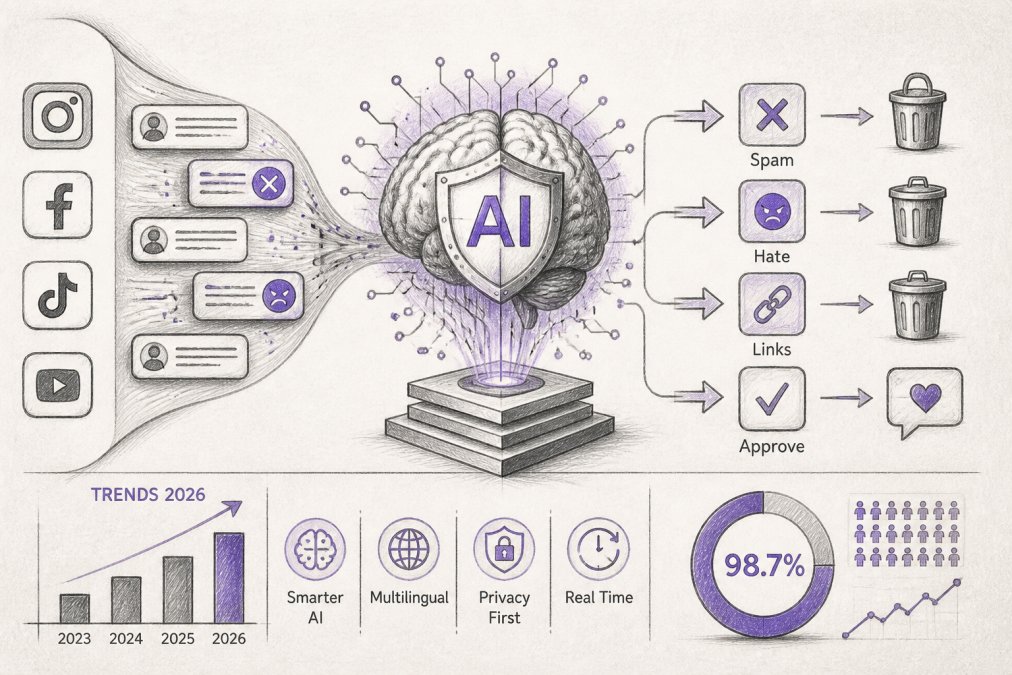
Quick Summary
| Key Insight | What You Need to Know |
|---|---|
| Generative AI and Synthetic Content | The Moderation Challenge Ahead |
| Real-Time Detection and Low-Latency | Real-Time Detection and Low-Latency Moderation Systems |
| AI Content Moderation Tools | Multimodal Capabilities and Scalability |
| Human-in-the-Loop Content Moderation | Why Hybrid Approaches Win |
| Automated Comment Moderation Best | Automated Comment Moderation Best Practices for 2026 |
| Regulatory Compliance and Governance | Regulatory Compliance and Governance in AI Moderation |
Table of Contents
- Generative AI and Synthetic Content: The Moderation Challenge Ahead
- Real-Time Detection and Low-Latency Moderation Systems
- AI Content Moderation Tools: Multimodal Capabilities and Scalability
- Human-in-the-Loop Content Moderation: Why Hybrid Approaches Win
- Automated Comment Moderation Best Practices for 2026
- Regulatory Compliance and Governance in AI Moderation
- Addressing Moderator Burnout and Algorithmic Bias
- Conclusion
- Frequently Asked Questions
Last Updated: September 17, 2026
Generative AI and Synthetic Content: The Moderation Challenge Ahead
The emergence of generative AI and synthetic content represents the defining challenge for AI content moderation in 2026. Deepfakes, AI-generated text, and synthetic media now flood social platforms faster than human moderators can review them. This isn't a distant threat, it's happening now, and it's reshaping how brands protect their communities.
The core problem: traditional detection systems were built to flag human-created spam and abuse. They struggle with synthetic content because it mimics legitimate patterns. A deepfake video can look authentic. AI-generated comments can sound like real customers. The result is a growing gap between what moderation systems catch and what actually gets posted.
Brands managing high-volume comment sections face a hard choice. Manual review becomes impossible at scale. Automated systems miss nuance. The answer lies in hybrid approaches that combine machine learning models trained on synthetic content patterns with human reviewers who can spot what algorithms miss. FeedGuardians is evolving to detect not just harmful content, but content that's been artificially generated, flagging it for review rather than assuming it's authentic.
The practical implication: if your moderation strategy doesn't account for synthetic content, you're already behind. Competitors who implement detection systems now will have a significant advantage in maintaining authentic, trustworthy comment sections by mid-2026.
Real-Time Detection and Low-Latency Moderation Systems
Real-time moderation isn't optional anymore, it's the baseline expectation. Users expect harmful content to disappear within seconds, not hours. Platforms that can't deliver real-time detection lose user trust and face regulatory scrutiny.
Low-latency systems process comments as they're posted, making instant decisions about visibility. This requires infrastructure that can handle thousands of concurrent requests without delay. Modern systems target sub-100ms response times, which means the comment appears, gets evaluated, and either stays visible or hides before the user even refreshes the page.
The technical challenge is significant. Real-time systems must make complex decisions, distinguishing between sarcasm and genuine hate speech, recognizing context-dependent threats, evaluating competitor links, in milliseconds. False positives multiply quickly. A system that incorrectly hides 2% of legitimate comments will suppress thousands of real customer interactions every day on a high-volume brand account.
FeedGuardians achieves this balance through pre-trained models that handle common cases instantly, while escalating edge cases to human review. Brands see reduced spam and abuse visible to their audience, which directly protects ad performance and customer trust.
AI Content Moderation Tools: Multimodal Capabilities and Scalability
The next generation of AI content moderation tools must handle text, images, video, and audio simultaneously. Single-modality systems are becoming obsolete. A comment might include text, an embedded image, and a linked video, all of which need evaluation in the same decision.
Multimodal detection works like this: text analysis flags potential policy violations, image recognition identifies visual content that may violate community standards, and video analysis detects deepfakes or policy-breaking footage. The system combines signals from all three to make a final decision. A comment with text that seems harmless but an image that violates policy gets flagged. A video with audio that contains hate speech gets caught even if the visual content appears clean.
Scalability is where most tools break. Multimodal analysis is computationally expensive. Processing video at scale requires either massive server infrastructure or aggressive optimization. Many platforms compromise by analyzing only a percentage of video content, which leaves gaps in moderation coverage.
The platforms winning in 2026 are those that scale multimodal detection without sacrificing speed or accuracy. This requires distributed processing, smart caching, and models optimized for inference speed rather than training accuracy. FeedGuardians handles multimodal content across Instagram, Facebook, TikTok, and YouTube by prioritizing detection efficiency, catching policy violations without the latency penalty.
The practical reality: if you're managing multiple platforms, you need a tool that processes multimodal content natively. Bolting together separate text, image, and video tools creates operational overhead and detection gaps. Unified platforms are faster, cheaper, and more reliable.
Human-in-the-Loop Content Moderation: Why Hybrid Approaches Win
Pure automation fails. Pure human moderation doesn't scale. The winning strategy for 2026 is human-in-the-loop content moderation, where AI handles routine decisions and humans review edge cases, complex policy decisions, and appeals.
Here's how it works in practice: AI systems flag comments as safe, uncertain, or policy-violating with confidence scores. High-confidence decisions (safe or violating) are executed automatically. Medium-confidence decisions go to human reviewers. This approach lets a small team handle volume that would require dozens of manual moderators.
The key advantage is efficiency. The human focuses on judgment calls, is this sarcasm or genuine hate speech? Is this competitive but acceptable commentary or policy-violating spam? These are decisions where human context matters.
But human-in-the-loop only works if the AI is trustworthy. If the system sends reviewers 30% false positives, they'll waste hours evaluating comments that should have been auto-approved. If it misses 5% of actual violations, you're still getting moderation failures. The system must be well-calibrated, accurate enough that human review feels valuable, not like cleaning up after a broken algorithm.
FeedGuardians integrates human escalation into its workflow. Comments that fall into uncertainty zones get routed to your team for review, with AI reasoning displayed so humans can make informed decisions quickly. This hybrid approach lets brands maintain control while gaining speed.
Automated Comment Moderation Best Practices for 2026
Implementing automated comment moderation requires discipline. Common mistakes include over-relying on keyword lists, ignoring context, and failing to adapt policies as your community evolves.
Start with clear policies.
Regulatory Compliance and Governance in AI Moderation
Regulation is coming. The landscape is already shifting with Section 230 reform discussions, state-level content moderation bills, and EU Digital Services Act requirements. Brands need moderation systems that can adapt to changing compliance requirements.
- Audit trails: Every moderation decision should be logged with the reason, confidence score, and who reviewed it (if human). This creates accountability and helps defend against regulatory challenges.
- Policy documentation: Maintain clear records of your moderation policies, how they're enforced, and why they changed. Regulators want to see that decisions are deliberate, not arbitrary.
- Appeal processes: Users should be able to challenge moderation decisions. Your system should make appeals easy and track outcomes. This demonstrates good faith compliance.
- Bias monitoring: Test your system regularly for algorithmic bias. If your detection system disproportionately flags content from certain groups, you have a compliance problem and an ethical problem.
Addressing Moderator Burnout and Algorithmic Bias
Moderator burnout is a silent crisis. Human reviewers exposed to toxic content, hate speech, and violent imagery experience psychological harm. Turnover rates exceed 50% annually at many platforms. This creates a vicious cycle: experienced moderators leave, inexperienced ones make inconsistent decisions, quality drops, and more moderators burn out.
Addressing bias requires:
- Diverse training data: Ensure your training set represents different communities, dialects, and cultural contexts. A model trained primarily on English-language data will struggle with code-switching or cultural references.
- Regular bias audits: Test your system's performance across demographic groups. If it flags content from certain communities at higher rates, you have a bias problem.
- Human review of edge cases: Don't let AI make final decisions on borderline cases. Have humans review and correct systematic errors.
- Transparency about limitations: Be honest about what your system can and can't do. If it struggles with sarcasm or cultural context, say so and build safeguards.
Conclusion
The future of AI content moderation isn't about replacing humans or automating everything. It's about building systems intelligent enough to handle volume while maintaining human judgment where it matters most. Brands that implement multimodal detection, real-time processing, and human-in-the-loop workflows now will have significant operational and competitive advantages by end of 2026.
Frequently Asked Questions
How is AI changing the future of content moderation?
AI content moderation is shifting from reactive deletion to proactive threat detection. Machine learning models now analyze text, images, video, and audio simultaneously, a capability called multimodal moderation. The biggest change is speed: systems detect harmful content in milliseconds rather than hours, and they learn from patterns across millions of posts. However, the real advancement is human-in-the-loop collaboration, where AI flags suspicious content and humans make final decisions, reducing both false positives and moderator fatigue.
What are the main limitations of current AI content moderation tools?
Current AI content moderation tools struggle with context, sarcasm, and cultural nuance. A system might flag a reclaimed slur used positively or miss subtle hate speech. Synthetic content, deepfakes and AI-generated text, is outpacing detection capabilities. False positives remain high, leading to legitimate comments being hidden. Additionally, algorithmic bias in training datasets means systems often over-flag content from minority communities. Adversarial attacks, where bad actors deliberately craft prompts to fool the AI, are becoming more sophisticated.
Will AI replace human content moderators?
No. The trend is toward human-in-the-loop content moderation, not replacement. AI handles volume and speed; humans handle judgment calls. Moderator burnout increases when humans must review too many false flags. The future involves AI catching 95%+ of obvious violations automatically, escalating edge cases to humans, and providing moderators with explainability tools so they understand why the AI flagged something. This hybrid model protects both brand safety and moderator wellbeing.
How do automated comment moderation best practices protect brand reputation?
Automated comment moderation best practices focus on three areas: speed, consistency, and transparency. Real-time detection hides spam and hate speech before customers see it, protecting ad performance and brand perception. Consistent enforcement, applying the same rules to all users, builds trust and reduces legal exposure. Transparency matters too: brands that explain why a comment was removed (via automated reasoning) face fewer complaints. The best systems also escalate borderline cases to humans rather than making binary delete-or-keep decisions, ensuring nuanced policy enforcement that reflects brand values.
Tired of manually moderating comments?
FeedGuardians automates spam filtering, responds to customers, and protects your brand — setup in 3 minutes.
Frequently Asked Questions
How is AI changing the future of content moderation?
AI content moderation is shifting from reactive deletion to proactive threat detection. Machine learning models now analyze text, images, video, and audio simultaneously—a capability called multimodal moderation. The biggest change is speed: systems detect harmful content in milliseconds rather than hours, and they learn from patterns across millions of posts. However, the real advancement is human-in-the-loop collaboration, where AI flags suspicious content and humans make final decisions, reducing both false positives and moderator fatigue.
What are the main limitations of current AI content moderation tools?
Current AI content moderation tools struggle with context, sarcasm, and cultural nuance. A system might flag a reclaimed slur used positively or miss subtle hate speech. Synthetic content—deepfakes and AI-generated text—is outpacing detection capabilities. False positives remain high, leading to legitimate comments being hidden. Additionally, algorithmic bias in training datasets means systems often over-flag content from minority communities. Adversarial attacks, where bad actors deliberately craft prompts to fool the AI, are becoming more sophisticated.
Will AI replace human content moderators?
No. The trend is toward human-in-the-loop content moderation, not replacement. AI handles volume and speed; humans handle judgment calls. Moderator burnout increases when humans must review too many false flags. The future involves AI catching 95%+ of obvious violations automatically, escalating edge cases to humans, and providing moderators with explainability tools so they understand why the AI flagged something. This hybrid model protects both brand safety and moderator wellbeing.
How do automated comment moderation best practices protect brand reputation?
Automated comment moderation best practices focus on three areas: speed, consistency, and transparency. Real-time detection hides spam and hate speech before customers see it, protecting ad performance and brand perception. Consistent enforcement—applying the same rules to all users—builds trust and reduces legal exposure. Transparency matters too: brands that explain why a comment was removed (via automated reasoning) face fewer complaints. The best systems also escalate borderline cases to humans rather than making binary delete-or-keep decisions, ensuring nuanced policy enforcement that reflects brand values.