
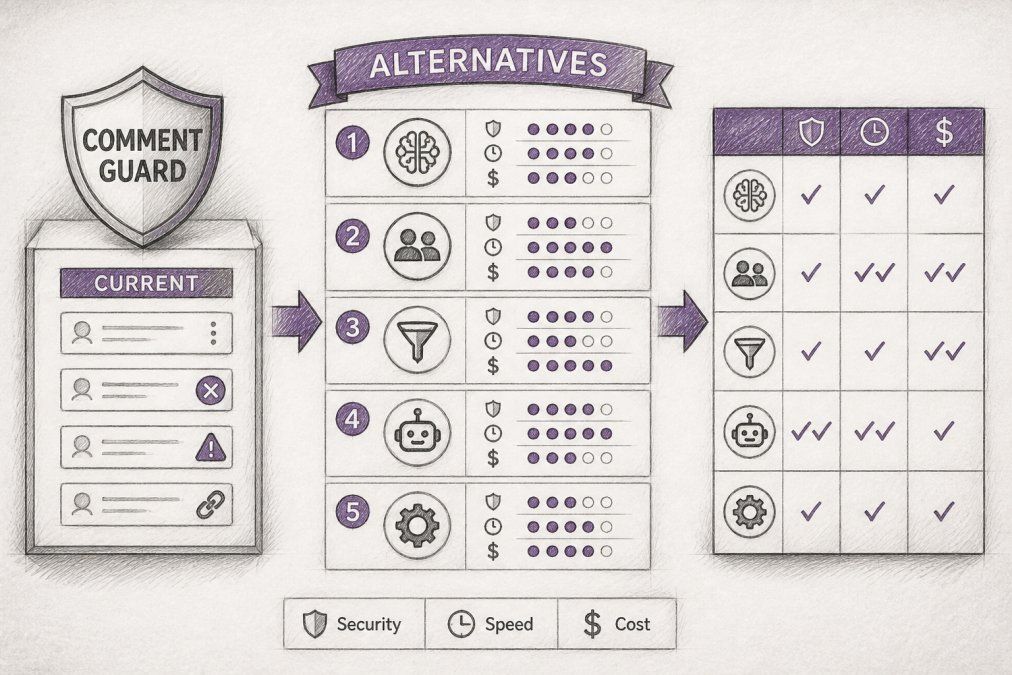
Quick Summary
| Key Insight | What You Need to Know |
|---|---|
| Why E-Commerce Brands Are | Why E-Commerce Brands Are Moving Beyond CommentGuard |
| FeedGuardians | AI-Powered Moderation and Replies |
| MyComments.io | Built for Performance Marketers |
| Brandwise | E-Commerce Spam Defense |
| ReplyBox | Budget-Friendly Moderation |
| Feature Comparison | Moderation Software at a Glance |
Table of Contents
- Why E-Commerce Brands Are Moving Beyond CommentGuard
- Top CommentGuard Alternatives for E-Commerce
- Feature Comparison: Moderation Software at a Glance
- How an AI Comment Reply Tool Boosts Ad Performance
- Moderation Workflow: Deleting Comments on Facebook and Beyond
- Calculating ROI for Comment Moderation Tools
- Which CommentGuard Alternative Should You Pick?
- Final Take: Protect Your Brand and Ad Spend
- Frequently Asked Questions
Last Updated: September 5, 2026
CommentGuard alternatives for e-commerce brands are shifting from simple spam filters to full-spectrum engagement tools. Social media comment moderation software now handles the complete lifecycle of a comment, from threat detection to automated replies that protect ad spend. At FeedGuardians, we have analyzed the moderation landscape to help you pick the right defense for your Facebook, Instagram, TikTok, and YouTube channels.
Why E-Commerce Brands Are Moving Beyond CommentGuard
The biggest shift in comment moderation is the move from reactive deletion to proactive engagement, hiding spam is only half the battle; the other half is turning legitimate buyer questions into conversions.
Brands overwhelmed by manual moderation often find their response times lag, directly hurting ad performance. When a potential customer hears nothing back for hours, that lead often goes cold, which is why many teams seek a commentguard alternative with automated replies, not just blocking tools.
Unmoderated comment sections can fill with competitor links and scam offers, degrading trust and diverting your most expensive asset, paid traffic, to bad actors.
Top CommentGuard Alternatives for E-Commerce
Several platforms handle high-volume comment management. The best choice depends on whether you need simple filtering or a system that also generates revenue through automated conversations.
FeedGuardians: AI-Powered Moderation and Replies
Our top pick is FeedGuardians because it combines real-time moderation with AI-powered replies in your unique brand voice. It automatically detects and hides spam, scams, hate speech, and competitor links with 98.7% accuracy, ensuring your ad comments stay clean without manual oversight (arxiv.org).
What sets FeedGuardians apart is the ability to reply 24/7 automatically. The AI learns your tone, terminology, and guidelines, so customers get instant answers without knowing they are talking to a bot. For e-commerce brands, this turns ad comments into conversations and conversions rather than dead ends.
The platform includes a human escalation option for complex queries and protects your brand reputation across Instagram, Facebook, TikTok, and YouTube. Real customers have reported significant results, including one brand that protected $400k in ad spend and another that generated 5.1× membership inquiries.
MyComments.io: Built for Performance Marketers
MyComments.io is designed specifically for performance marketers running Facebook and Instagram ad campaigns, with a dashboard optimized for ad comment management and engagement metrics tied directly to campaigns.
It offers automated moderation rules for spam and keywords, plus keyword blacklisting and automated replies, though its feature set is more limited than enterprise tools.
This is a solid option for teams inside Meta's ecosystem needing a performance-focused dashboard, but multi-platform support for TikTok and YouTube is lacking.
Brandwise: E-Commerce Spam Defense
Brandwise focuses on brand safety for e-commerce with automated filtering tailored to threats like competitor link dropping and scam offers that plague high-volume ad campaigns.
Integration with social advertising workflows is a key strength, filtering threats before they damage customer experience.
While reliable for filtering, Brandwise lacks the AI-driven response generation of some competitors. If you want to automate replies to legitimate questions, you will need a complementary tool.
ReplyBox: Budget-Friendly Moderation
ReplyBox simplifies communication without a steep learning curve, offering a centralized dashboard with keyword-based filtering and automated moderation rules.
It is the most accessible entry-level pricing option for small to medium-sized businesses, with a simple interface and quick setup for brands just starting to see comment volume grow.
The trade-off is a lack of advanced AI-driven response features, ReplyBox handles blocking well but leaves replying to your team.
Feature Comparison: Moderation Software at a Glance
Choosing the right moderation tool requires comparing features side by side. The table below summarizes the core capabilities of each platform to help you match a tool to your specific workflow needs.
| Feature | FeedGuardians | MyComments.io | Brandwise | ReplyBox |
|---|---|---|---|---|
| AI-Powered Replies | Yes | Limited | No | No |
| Multi-Platform Support | IG, FB, TikTok, YT | FB, IG | FB, IG | Web, FB |
| Spam & Hate Detection | 98.7% Accuracy | Keyword Rules | E-Comm Focus | Keyword Rules |
| Brand Voice Learning | Yes | No | No | No |
| Human Escalation | Yes | No | No | No |
How an AI Comment Reply Tool Boosts Ad Performance
An AI comment reply tool boosts ad performance by eliminating the lag between a buyer's question and your answer. Social algorithms prioritize high engagement, and unanswered questions signal low-quality content.
Instant, relevant replies improve engagement metrics, triggering a positive feedback loop that shows your ad to more people and lowers your cost per result, you are not paying to show ads to people who saw a spam-filled comment section and scrolled past.
Blocking spam protects your brand, but replying to real customers grows revenue. A tool that learns your brand voice ensures automated replies do not sound generic, which is critical for authenticity in customer support automation.
Moderation Workflow: Deleting Comments on Facebook and Beyond
The native Facebook process for deleting a comment, navigating, hovering, selecting delete, works for single comments but is impossible for ad campaigns generating hundreds per hour.
Automation changes the game: set up moderation rules that automatically hide spam keywords, competitor links, or hate speech, with an AI tool handling triage in real time.
The workflow: a comment is posted, the AI scans it against your guidelines, and it hides the threat, replies to the query, or escalates to a human, ensuring nothing falls through the cracks even when your team is offline.
The Platform API Reality Check
What most vendor comparison articles skip is the hard constraint of platform APIs. Meta's Graph API, which powers all third-party Facebook and Instagram moderation tools, has undergone significant changes in recent years (developers.facebook.com). Most notably, Meta has restricted the comment_id field access for Pages that do not meet specific business verification thresholds. What this means for your workflow is that a tool promising "full Facebook moderation" may actually be operating on a polling basis (checking every 30-60 seconds) rather than via real-time webhooks, unless the vendor has maintained special access status.
TikTok's Comment API is even more restrictive. As of the current developer documentation, TikTok only grants comment read/write access to Enterprise-level API partners who have passed a rigorous review process. This means that many tools advertising TikTok support are actually only offering manual flagging queues or browser-extension-based automation, not true API-level moderation. When you are evaluating a commentguard alternative, ask the vendor directly: "Do you use webhooks or polling for Facebook? Do you have TikTok Enterprise API status?" The answer will tell you more about your real-world moderation latency than any feature checklist.
Connecting Moderation to Your Customer Support Desk
For D2C brands, the biggest bottleneck is routing legitimate customer questions to the right team. A comment asking "Does this dress run true to size?" is a pre-sales ticket that deserves a spot in your helpdesk queue.
Most moderation tools treat every comment as spam or safe, leaving your social media manager copy-pasting questions into Gorgias or Zendesk manually, reintroducing the exact latency you tried to eliminate.
Advanced commentguard alternatives now offer native helpdesk integrations: the AI detects a question with purchase intent, creates a ticket in Gorgias with the comment text, user handle, and post link, then sends an automated reply or assigns it to a human agent with a 15-minute SLA. When the agent resolves the ticket, the response is pushed back to the comment thread automatically.
If a tool lacks native integration, check for webhook or Zapier support. A common pattern is using Zapier to watch for comments flagged as "question" and create a Gorgias ticket, a workaround that adds latency and can break when Meta changes its payload, but is better than manual copy-paste.
The Escalation Path That Actually Works
A well-designed moderation workflow has three lanes: auto-hide for clear spam and hate speech, auto-reply for factual questions with high-confidence answers, and human escalation for nuanced comments requiring judgment, like a product defect complaint or order status question.
The critical failure point is lane three. If your tool flags a comment and emails you, you have created an inbox nobody checks. Escalation should feed directly into your existing support queue with a priority tag, the moderation tool should plug into Gorgias or Zendesk, not create a parallel system.
For high-volume campaigns, this three-lane workflow is the difference between a chaotic comment section and a well-staffed storefront. The best commentguard alternatives are not just spam filters; they are the first line of customer support, triaging comments before your team even logs in.
Calculating ROI for Comment Moderation Tools
Measuring ROI requires looking beyond subscription cost. The primary metric is ad spend efficiency, if spam diluted engagement quality, calculate how much spend was wasted.
Track the value of protected ad spend. If a tool prevents competitors from hijacking a $10,000 monthly campaign, it pays for itself many times over, one FeedGuardians customer protected $440k in ad spend.
Factor in manual labor costs. Two hours daily of deleting spam and replying to FAQs is roughly 40 hours per month; automating replies frees that time for strategy and creative work.
The Three-Bucket ROI Model
Most vendor blogs stop at "it saves you time." To build a defensible business case, quantify three distinct buckets of value.
Bucket 1: Protected Ad Spend. This is the value of preventing bad actors from hijacking your paid traffic. Start with your monthly ad spend on social platforms. Estimate the percentage of comments that are spam, scam offers, or competitor links, most high-volume e-commerce campaigns see 15-30% of comments fall into this category. Now, apply a conservative conversion assumption: if even 2% of your engaged users would have been influenced by a scam comment before converting, that is 2% of your ad budget effectively wasted. For a brand spending $50,000 monthly on Meta ads, that is $1,000 per month in directly protected spend, just from spam removal.
Bucket 2: Recovered Revenue from Speed-to-Lead. This is the value of answering legitimate buyer questions faster. Industry benchmarks from inside sales consistently show that responding to a lead within 5 minutes makes you 9 times more likely to convert that lead compared to responding after 30 minutes (hbr.org). Social comments are not identical to inbound leads, but the principle holds. If your campaign generates 500 comments per day and 20% are questions with purchase intent, that is 100 potential leads daily. Without automation, your team might answer 30 of those within an hour. With an AI reply tool, you answer all 100 within 60 seconds. If your average order value is $75 and your comment-to-purchase conversion rate is 3%, the recovered revenue from those 70 additional fast responses is roughly $157 per day, or $4,700 per month.
Bucket 3: Labor Cost Avoidance. This is the most straightforward calculation. Track the hours your community manager or social media coordinator spends on comment triage. At a fully loaded cost of $35 per hour for a social media coordinator, two hours per day of manual moderation costs $210 per week, or roughly $910 per month. If the moderation tool eliminates 80% of that manual work, you have saved approximately $728 per month in labor.
Building Your Own ROI Spreadsheet
Here is a simple model you can adapt to your own numbers:
| Input | Your Value | Example |
|---|---|---|
| Monthly ad spend (Meta + TikTok) | $50,000 | $50,000 |
| % spam comments | 20% | 20% |
| % engaged users influenced by spam | 2% | 2% |
| Protected ad spend (A) | = Ad spend × spam% × influence% | $200/month |
| Daily comments on ads | 500 | 500 |
| % questions with purchase intent | 20% | 20% |
| % questions answered within 5 min (manual) | 30% | 30% |
| % questions answered within 5 min (automated) | 100% | 100% |
| Average order value | $75 | $75 |
| Comment-to-purchase conversion rate | 3% | 3% |
| Recovered revenue (B) | = Daily comments × question% × (auto% - manual%) × AOV × conv% × 30 days | $4,725/month |
| Hours/day on manual moderation | 2 | 2 |
| Fully loaded hourly cost | $35 | $35 |
| % time saved by automation | 80% | 80% |
| Labor savings (C) | = Hours × cost × 20 days × % saved | $1,120/month |
| Total monthly ROI (A+B+C) | $6,045/month |
The Intangible ROI: Brand Safety and Algorithmic Favor
A fourth bucket is harder to quantify but matters long-term: a comment section filled with spam signals to Meta's and TikTok's ranking systems that your content attracts bot traffic, suppressing organic reach and increasing cost per result over time.
When presenting this model, lead with Bucket 2 (recovered revenue), the largest and most revenue-tied number. Bucket 1 is your risk mitigation argument; Bucket 3 is your operational efficiency story. Together, they make the case that a moderation tool is a revenue-generating layer, not a cost center.
Which CommentGuard Alternative Should You Pick?
The right choice depends on your platform mix and need for reply automation. For brands running ads across multiple platforms, FeedGuardians covers Instagram, Facebook, TikTok, and YouTube with a single integration.
Strictly a Meta advertiser? Test MyComments.io. Pure spam defense without automated replies? Brandwise offers solid protection. Budget-constrained? ReplyBox gets you started with basic filtering.
The deciding factor is your customer feedback loop. Losing sales because you cannot answer fast enough? You need moderation with AI replies. Spam is your only issue? A filtering tool may suffice.
Final Take: Protect Your Brand and Ad Spend
Your comment section is the front line of your brand reputation. Every spam comment missed and question unanswered chips away at trust. Choosing the right moderation software protects the return on every advertising dollar.
Frequently Asked Questions
What are the best CommentGuard alternatives for Facebook and Instagram?
The best CommentGuard alternatives for e-commerce brands include FeedGuardians, MyComments.io, Brandwise, and ReplyBox. FeedGuardians stands out with AI-powered replies in your brand voice and real-time moderation across Instagram, Facebook, TikTok, and YouTube. MyComments.io focuses on ad comment management for Facebook and Instagram. Brandwise offers e-commerce-specific spam detection, while ReplyBox is a budget-friendly option for smaller businesses.
How do AI-powered comment moderation tools improve ad performance?
AI comment moderation protects your ad spend by hiding spam, hate speech, and competitor links in real time. This keeps your comment section clean, which improves engagement metrics and prevents negative sentiment from influencing potential buyers. Automated replies also respond instantly to questions, increasing the likelihood of conversion. FeedGuardians, for example, has protected $440k in ad spend for clients by filtering harmful content before it escalates.
What features should I look for in social media comment moderation software?
Key features include real-time spam filtering, hate speech detection, keyword blacklisting, and multi-platform support. For e-commerce, look for an AI comment reply tool that learns your brand voice and offers automated replies 24/7. Workflow integration is also critical: the tool should route complex questions to your customer support team. Finally, check for a human escalation option and clear analytics to measure the impact on engagement and conversion.
Is it worth paying for a third-party comment moderation tool?
For e-commerce brands with high comment volume, yes. Manual moderation wastes hours daily and leaves your brand exposed to spam and toxic comments on ads. Third-party tools automate this process, protecting your reputation and freeing your team. They also boost ad performance by keeping comment sections clean and engaging. The ROI comes from saved labor hours, protected ad spend, and higher conversion rates from timely, on-brand replies.
FeedGuardians offers the most complete solution for e-commerce brands that need to stop spam, hide hate speech, and reply to customers automatically in their own brand voice. The AI learns your terminology and guidelines, ensuring automated replies feel human while the 98.7% detection accuracy keeps your comment sections safe. Get started with FeedGuardians and turn your ad comments into a reliable source of conversations and conversions.
This article was written using GrandRanker
Tired of manually moderating comments?
FeedGuardians automates spam filtering, responds to customers, and protects your brand — setup in 3 minutes.
Frequently Asked Questions
Q: What are the best CommentGuard alternatives for Facebook and Instagram?
A: The best CommentGuard alternatives for e-commerce brands include FeedGuardians, MyComments.io, Brandwise, and ReplyBox. FeedGuardians stands out with AI-powered replies in your brand voice and real-time moderation across Instagram, Facebook, TikTok, and YouTube. MyComments.io focuses on ad comment management for Facebook and Instagram. Brandwise offers e-commerce-specific spam detection, while ReplyBox is a budget-friendly option for smaller businesses.
Q: How do AI-powered comment moderation tools improve ad performance?
A: AI comment moderation protects your ad spend by hiding spam, hate speech, and competitor links in real time. This keeps your comment section clean, which improves engagement metrics and prevents negative sentiment from influencing potential buyers. Automated replies also respond instantly to questions, increasing the likelihood of conversion. FeedGuardians, for example, has protected $440k in ad spend for clients by filtering harmful content before it escalates.
Q: What features should I look for in social media comment moderation software?
A: Key features include real-time spam filtering, hate speech detection, keyword blacklisting, and multi-platform support. For e-commerce, look for an AI comment reply tool that learns your brand voice and offers automated replies 24/7. Workflow integration is also critical: the tool should route complex questions to your customer support team. Finally, check for a human escalation option and clear analytics to measure the impact on engagement and conversion.
Q: Is it worth paying for a third-party comment moderation tool?
A: For e-commerce brands with high comment volume, yes. Manual moderation wastes hours daily and leaves your brand exposed to spam and toxic comments on ads. Third-party tools automate this process, protecting your reputation and freeing your team. They also boost ad performance by keeping comment sections clean and engaging. The ROI comes from saved labor hours, protected ad spend, and higher conversion rates from timely, on-brand replies.