
Quick Summary
| Key Insight | What You Need to Know |
|---|---|
| What AI Comment Moderation | What AI Comment Moderation Does for Small Businesses |
| How AI Detects Spam | How AI Detects Spam, Hate Speech, and Brand-Damaging Content |
| How to Handle Negative | How to Handle Negative Comments on Social Media |
| Native Platform Tools vs | Native Platform Tools vs. Third-Party Solutions |
| Choosing the Right Approach | Choosing the Right Approach for Your Business |
| Core Features to Evaluate | Core Features to Evaluate in Third-Party Tools |
Table of Contents
- What AI Comment Moderation Does for Small Businesses
- How AI Detects Spam, Hate Speech, and Brand-Damaging Content
- How to Handle Negative Comments on Social Media
- Social Media Moderation Tools for Small Business: What to Look For
- Automated Comment Response Software: Real-Time Replies in Your Brand Voice
- Privacy, Compliance, and False Positives: What Small Businesses Need to Know
- Getting Started: Setup, Scaling, and ROI
- Frequently Asked Questions
Last Updated: September 18, 2026
What AI Comment Moderation Does for Small Businesses
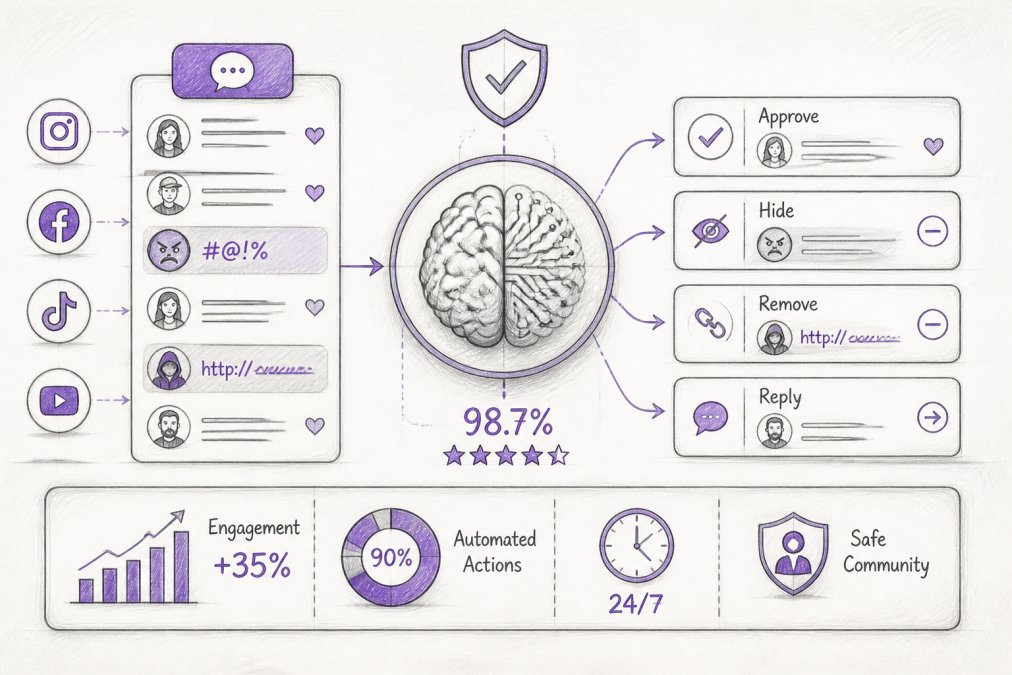
AI comment moderation is the automated process of detecting, filtering, and managing user-generated content on social media platforms in real-time. For small businesses managing high comment volumes across Instagram, Facebook, TikTok, and YouTube, AI comment moderation eliminates hours of manual review work while protecting brand reputation from spam, hate speech, and competitor interference.
Small business owners face a constant challenge: comments flood in faster than any team can handle. Without automated systems, toxic comments sit visible for hours, damaging brand perception. Manual moderation also burns through team capacity that could be spent on sales, customer service, or content creation.
FeedGuardians addresses this directly by providing real-time AI comment moderation that automatically detects and hides harmful content while delivering 24/7 replies in your brand voice. The system learns your specific tone, terminology, and community guidelines, then applies that knowledge across all your social channels simultaneously. This means you're protecting brand reputation around the clock, even when your team is offline.
How AI Detects Spam, Hate Speech, and Brand-Damaging Content
AI moderation systems use natural language processing and machine learning to classify comments into categories: spam, hate speech, competitor links, scams, and safe engagement. The system analyzes text patterns, word combinations, and contextual signals that human moderators would need hours to evaluate manually.
The system identifies obvious spam (repetitive messages, suspicious links, bot patterns), offensive language and hate speech, competitor links and promotional spam, while allowing legitimate customer questions and feedback through to your team or AI reply system.
FeedGuardians delivers 98.7% accuracy on this classification task. This matters because mistakes, hiding legitimate complaints or approving hate speech, damage trust. The system improves over time as it learns patterns specific to your brand and industry.
How to Handle Negative Comments on Social Media
Not all negative comments deserve hiding. A customer complaint about a product defect is negative but valuable feedback. The difference between harmful content and legitimate criticism determines your strategy.
Real-time moderation should prioritize responding to negative comments quickly rather than deleting them. If your team can't respond manually, AI-powered replies in your brand voice keep the conversation moving and turn potential reputation damage into an opportunity to demonstrate customer care.
Set your moderation rules to flag negative sentiment for human review rather than auto-hiding it. This preserves legitimate feedback while your team or AI system responds with empathy and solutions.
Social Media Moderation Tools for Small Business: What to Look For
Small businesses have two paths to AI comment moderation: native platform tools built into Instagram, Facebook, TikTok, and YouTube, or third-party standalone moderation software. Each approach has trade-offs in cost, control, and capability.
Native Platform Tools vs. Third-Party Solutions
Native platform moderation (built-in):
Instagram, Facebook, TikTok, and YouTube all offer free or low-cost moderation features:
- Instagram and Facebook: Meta's "Comment Filters" and "Keyword Blocking" allow you to auto-hide comments containing specific words or phrases. You can also enable "Restrict" mode, which hides comments from specific accounts without notifying them. Meta's AI also auto-hides comments it detects as spam or hate speech, though you cannot see the detection rules or adjust sensitivity.
- TikTok: TikTok's "Comment Management" tool lets you block keywords, filter by account age (hide comments from new accounts), and enable "Restrict" mode. TikTok's AI also filters spam automatically, but transparency is limited.
- YouTube: YouTube's "Community Guidelines Enforcement" auto-hides comments violating its policies. You can also set keyword filters and hold comments from new channels for manual review.
Native tools: Free, no third-party data sharing, integrated interface. But they offer limited customization, no cross-platform dashboard, no automated replies, limited reporting, and no control if platform rules change.
Third-party moderation software:
Tools designed specifically for social media moderation offer deeper customization and cross-platform management. These typically integrate with your social accounts via API, monitor comments across multiple platforms from a single dashboard, and allow you to define custom moderation rules.
Third-party tools: Customizable AI, cross-platform dashboard, automated replies, detailed reporting, vendor support. But they cost $50-$500+/month, involve third-party data processing, depend on platform APIs, and require more setup effort.
Choosing the Right Approach for Your Business
Start with native tools if: Budget is minimal, you operate on one or two platforms, comment volume is low (under 50/day), and you want to avoid third-party data sharing. Upgrade to third-party tools if: Comment volume is high (100+/day), you operate on three+ platforms, you want automated replies, or you need detailed reporting and custom rules.
Core Features to Evaluate in Third-Party Tools
Real-time filtering: Comments should be evaluated within seconds of posting. Ask vendors: "What is your average detection latency?" Under 5 seconds is acceptable; under 1 second is ideal.
Multi-platform integration: Verify the tool supports all platforms you use and monitors comments, replies, and direct messages. You want a single dashboard showing all activity without separate logins.
Customizable moderation rules: The tool should let you define what "harmful" means for your brand, hiding specific keywords, filtering new accounts, flagging negative sentiment, etc. Ask vendors: "Can I create custom rules without coding?" The answer should be yes.
Sensitivity adjustment: The tool should let you set the confidence threshold. A high threshold (95%+) means fewer false positives but more harmful content slips through. A low threshold (70%+) means more false positives but better coverage. You should set different thresholds for different categories (spam vs. hate speech vs. competitor links).
Human escalation and review queue: The tool should flag borderline cases for your team to review. Most small business teams can handle 20-50 flagged comments per day without bottleneck.
Automated replies: Verify the tool can learn your brand voice from past comments. Ask: "Can I preview and edit replies before posting?" You should always have final approval.
Reporting and audit trails: You should export reports showing which comments were hidden, flagged, or approved, and why.
Platform-Specific Configuration Walkthrough
Instagram and Facebook: Connect via Meta's API, define keyword filters, set AI sensitivity threshold (90% for auto-hide, 70% for flag-for-review), create response templates, enable auto-hide for spam, and flag negative sentiment for review. Test in flagged-only mode first to audit false positives.
Cost-Benefit Analysis for Small Budgets
If you're managing fewer than 100 comments per day across all platforms, native tools may be sufficient. If you're managing 100-500 comments per day, a mid-tier third-party tool ($50-$150/month) typically pays for itself in 5-10 hours of labor saved per week. If you're managing 500+ comments per day, a full-featured tool ($200-$500/month) is likely necessary to prevent moderation from becoming a full-time job.
Automated Comment Response Software: Real-Time Replies in Your Brand Voice
Automated comment response software generates replies in your brand voice by learning from past comments. It handles common scenarios, thanking customers, acknowledging complaints, answering FAQs, while your team handles complex issues. Faster response times increase satisfaction, reduce complaint escalation, and boost engagement.
Privacy, Compliance, and False Positives: What Small Businesses Need to Know
AI moderation systems access your social accounts and comment data, which raises legitimate concerns about privacy, regulatory liability, and the risk of blocking legitimate customers. Understanding these risks and how to mitigate them is essential before implementation.
Data Privacy and Regulatory Compliance
When you connect an AI moderation tool to your social accounts, the system processes user-generated comments, triggering data protection obligations under state and federal law.
False Positives: The Hidden Cost of Over-Aggressive AI
False positives, when AI incorrectly hides or flags a legitimate comment, are the most common complaint from small businesses using AI moderation. Customers feel unheard, support tickets increase, and negative word-of-mouth spreads. Over-aggressive filtering creates more customer frustration than under-moderation.
Transparency and Customer Trust
Consider disclosing AI use to customers. Transparency builds trust. Options: add "AI-powered moderation" to your bio, state in community guidelines that you use AI to detect spam, or add "[AI-assisted response]" to automated replies.
Liability and Escalation Protocols
When AI makes a moderation decision, you are liable if it's wrong. To minimize liability: document your moderation rules, audit the system weekly, maintain an appeals process for wrongly hidden comments, and keep logs of all moderation actions.
Getting Started: Setup, Scaling, and ROI
Implementation takes hours, not weeks. Most small businesses can configure FeedGuardians and begin moderation within a single day. When comment volume doubles, your team workload doesn't double because the AI handles volume automatically. Start with your highest-volume platform and expand gradually.
Frequently Asked Questions
How accurate is AI comment moderation, and what does 98.7% accuracy actually mean?
AI comment moderation systems detect harmful content by analyzing patterns in text, user behavior, and context. The 98.7% accuracy figure represents the percentage of spam, hate speech, and brand-damaging content correctly identified and hidden. This means out of 1,000 harmful comments, approximately 987 are caught automatically. Accuracy depends on how well the system learns your brand's specific guidelines and moderation rules. Real-world performance improves as the system processes more comments and receives feedback on edge cases.
Can AI comment moderation tools really learn my brand voice well enough for authentic replies?
Yes, modern AI systems can learn your brand voice through training on your past responses, tone guidelines, and brand terminology. The system analyzes your communication style, vocabulary, humor, and values to generate replies that sound natural to your audience. However, setup matters: the more examples you provide and the clearer your brand guidelines, the better the AI performs. Most small businesses see authentic-sounding replies within the first few weeks as the algorithm refines its understanding of your voice.
What happens if AI comment moderation makes a mistake and hides a legitimate comment or replies incorrectly?
Responsible AI moderation platforms include human escalation options and review workflows. If the system flags a comment for manual review or makes an error, team members can override the decision, unhide comments, or edit AI replies before posting. False positives decrease over time as the system learns your moderation preferences. Most platforms also provide audit logs showing which comments were hidden and why, protecting your brand from liability. Always maintain the ability to review and approve critical interactions before the AI publishes them.
How does automated comment moderation boost ad performance?
Faster response times improve engagement metrics that platforms use to rank your content and ads. When AI replies appear instantly, you maintain conversation momentum, which increases comment volume and dwell time. Removing spam and toxic comments improves your comment section's quality, encouraging more customers to engage. Additionally, protecting your brand from competitor links and misinformation preserves trust, which reduces customer friction during the buying process. Better engagement and lower bounce rates signal platform algorithms that your content deserves wider reach, improving ad performance.
Tired of manually moderating comments?
FeedGuardians automates spam filtering, responds to customers, and protects your brand — setup in 3 minutes.
Frequently Asked Questions
How accurate is AI comment moderation, and what does 98.7% accuracy actually mean?
AI comment moderation systems detect harmful content by analyzing patterns in text, user behavior, and context. The 98.7% accuracy figure represents the percentage of spam, hate speech, and brand-damaging content correctly identified and hidden. This means out of 1,000 harmful comments, approximately 987 are caught automatically. Accuracy depends on how well the system learns your brand's specific guidelines and moderation rules. Real-world performance improves as the system processes more comments and receives feedback on edge cases.
Can AI comment moderation tools really learn my brand voice well enough for authentic replies?
Yes, modern AI systems can learn your brand voice through training on your past responses, tone guidelines, and brand terminology. The system analyzes your communication style, vocabulary, humor, and values to generate replies that sound natural to your audience. However, setup matters: the more examples you provide and the clearer your brand guidelines, the better the AI performs. Most small businesses see authentic-sounding replies within the first few weeks as the algorithm refines its understanding of your voice.
What happens if AI comment moderation makes a mistake and hides a legitimate comment or replies incorrectly?
Responsible AI moderation platforms include human escalation options and review workflows. If the system flags a comment for manual review or makes an error, team members can override the decision, unhide comments, or edit AI replies before posting. False positives decrease over time as the system learns your moderation preferences. Most platforms also provide audit logs showing which comments were hidden and why, protecting your brand from liability. Always maintain the ability to review and approve critical interactions before the AI publishes them.
How does automated comment moderation boost ad performance?
Faster response times improve engagement metrics that platforms use to rank your content and ads. When AI replies appear instantly, you maintain conversation momentum, which increases comment volume and dwell time. Removing spam and toxic comments improves your comment section's quality, encouraging more customers to engage. Additionally, protecting your brand from competitor links and misinformation preserves trust, which reduces customer friction during the buying process. Better engagement and lower bounce rates signal platform algorithms that your content deserves wider reach, improving ad performance.