
Quick Summary
| Key Insight | What You Need to Know |
|---|---|
| Core AI Capabilities | We'll dive into how AI handles things like comment moderation, sentiment analysis, and automated replies. |
| Real-World Use Cases | You'll see concrete examples of how e-commerce and performance marketing teams are using AI to drive sales and engagement. |
| Practical Implementation | Get a clear, step-by-step process for choosing the right tools and getting them up and running. |
| Best Practices and Ethics | Learn the dos and don'ts of maintaining your brand's voice and handling the ethical side of automation. |
AI in social media management isn't some far-off idea anymore. It's here, and it's a game-changer. It works by automating the grind of repetitive tasks, digging into audience data, and helping you create content faster and smarter. Think of it as the ultimate assistant, clearing your plate so you can focus on big-picture strategy and creative campaigns.
The New Reality of Social Media Management
The job of a social media manager has completely changed. The old days of manually crafting every post, scheduling content by hand, and personally replying to every single comment are fading. We've entered an era of intelligent automation, and it's not about replacing people—it’s about making them better at their jobs.
Here's a good way to think about it: A traditional social media manager is like a lone librarian, meticulously organizing every book by hand. An AI-powered manager is that same librarian, but now they have a team of lightning-fast assistants who instantly categorize books, find any title in seconds, and recommend the perfect read to every visitor. This frees up the librarian to focus on what really matters: curating amazing collections and connecting with the community on a much deeper level.
A New Strategic Partnership
This guide will break down AI for social media management into simple, practical terms. We’ll show you exactly how to weave it into your daily work to get real results, fast. Consider this your roadmap, taking you from the basic building blocks to more advanced strategies that can give your brand a serious leg up.
Here’s what you can expect to learn:
- Core AI Capabilities: We'll dive into how AI handles things like comment moderation, sentiment analysis, and automated replies.
- Real-World Use Cases: You'll see concrete examples of how e-commerce and performance marketing teams are using AI to drive sales and engagement.
- Practical Implementation: Get a clear, step-by-step process for choosing the right tools and getting them up and running.
- Best Practices and Ethics: Learn the dos and don'ts of maintaining your brand's voice and handling the ethical side of automation.
The explosive growth in this space tells you everything you need to know. The market for AI in social media is projected to leap from $2.69 billion to an expected $9.25 billion in just a few years—that’s a jump of over 244%. This isn't just a trend; it's a fundamental shift.
This is about more than just saving time. It’s about gaining a competitive edge. AI can spot patterns, trends, and opportunities buried in your social data that a human could easily miss, turning your social channels into powerful engines for growth.
By handing off the mundane tasks to AI, you get to pour your energy into what truly drives value: strategy, creative direction, and building authentic relationships with your audience. For instance, freeing yourself from tedious comment filtering lets you focus on creating a genuinely safe and engaging community, a crucial part of modern social media content moderation. Our aim is to show you just how valuable this human-AI partnership can be and how you can tap into its full potential right away.
Understanding How Social Media AI Actually Works
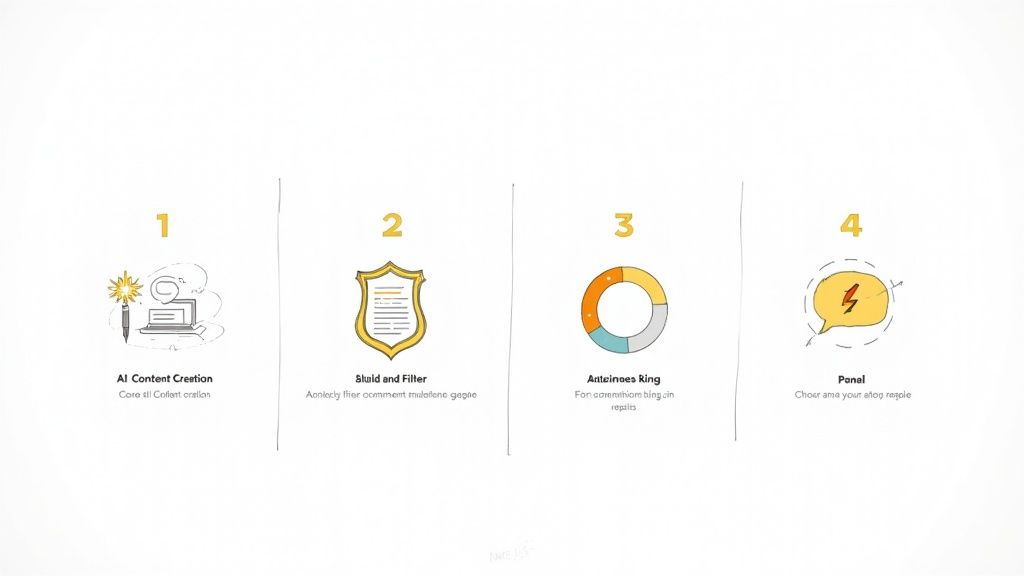
To really grasp the value of AI in social media management, it helps to pop the hood and see what’s running the show. This isn't just about scheduling posts a bit faster; it's a collection of powerful tools designed to automate the heavy lifting that used to bog down social media teams. When these tools work together, they create a much smarter and more responsive workflow.
Think of it like a professional kitchen. You don't have one chef doing everything. You have specialists—one for prep, another for the grill, another for plating. Social media AI works the same way, with different functions handling content creation, community moderation, and audience analysis. Each piece plays a specific, vital role.
AI Powered Content Creation
Coming up with fresh, engaging content day in and day out is a grind. This is where AI acts as a creative partner, analyzing trends, performance data, and your brand's voice to suggest ideas that will actually land with your audience. It can draft snappy copy, find relevant hashtags, and even help you source user-generated content to fill out your calendar.
This isn’t about replacing your team’s creativity; it’s about amplifying it. And the numbers show it works. A massive 79% of social media professionals say AI helps them create more content faster, with 65% of marketers now using AI for at least half of their posts. You can find more data on AI's impact on social media marketing on amraandelma.com.
- Before AI: Your social media manager spends hours brainstorming, writing a dozen drafts, and digging for the right visuals.
- After AI: They plug in a topic, and the AI spits out several post options—complete with copy, image ideas, and hashtags—in just a few minutes.
Intelligent Comment Moderation
The comment section is where your community lives, but it can also be a magnet for spam, trolls, and negativity that can poison your brand's reputation. For any account with a decent following, manually filtering every single comment is simply impossible.
This is where intelligent comment moderation comes in, acting as a 24/7 security guard for your page. Using Natural Language Processing (NLP), it instantly identifies and hides spam, offensive language, and other content that violates your rules. This keeps your community safe and lets your team focus on having real conversations with real customers.
This kind of automation is crucial for protecting your brand at scale. Instead of scrambling to delete a harmful comment after hundreds of people have seen it, AI stops it before it ever causes damage.
If you want to go deeper, we've put together a guide on the top AI comment moderation tools available in 2025.
Audience Sentiment Analysis
How do people really feel about your latest product launch? Relying on a few random comments is just guesswork. Sentiment analysis is like a mood ring for your entire audience, giving you a big-picture view of the emotions driving the conversation around your brand.
The AI scans thousands of comments, mentions, and posts, sorting them into positive, negative, or neutral buckets. This gives you concrete feedback, helping you see how you're perceived, spot a potential PR fire before it spreads, and actually measure the emotional resonance of your campaigns.
- Before AI: A manager scrolls through comments, trying to get a "vibe" for the reaction, which is often biased and incomplete.
- After AI: The AI dashboard shows a 92% positive sentiment for a new ad campaign, providing hard data to prove it was a hit.
Automated Chatbots and Replies
When customers reach out on social media, they expect answers—fast. Making them wait hours for a reply is a surefire way to create frustration and lose a potential sale. AI-powered chatbots and automated replies offer that instant first line of support.
These bots can immediately handle common questions like, "Where's my order?" or "What are your store hours?" If the issue is more complex, they can intelligently route the conversation to a human agent. This means every customer gets a quick response, which boosts satisfaction and frees up your team to tackle the trickier problems that require a human touch.
Putting AI to Work in Your Campaigns
Knowing the theory behind AI is one thing, but seeing it deliver real-world results is what actually matters. So, how are businesses using these tools to move the needle on their goals? It all comes down to applying specific AI capabilities to solve concrete marketing problems.
Let's shift from the "what" to the "how" and look at some practical use cases in two areas where AI is truly changing the game. Think of these as mini case studies that show the tangible value AI brings to the table.
Boosting Sales for E-Commerce Brands
E-commerce is a cutthroat world. Customer experience and ad performance can make or break a business. For online stores, AI for social media management isn't just a shiny new toy; it's a workhorse that drives sales and builds lasting customer loyalty.
Imagine an online fashion retailer trying to keep up. Here's a common scenario:
- The Problem: Manually creating unique social media posts for hundreds of different products is a logistical nightmare. On top of that, their social media team is drowning in repetitive customer questions like, "Where is my order?" and "Do you have this in blue?" This bottleneck results in slow replies and generic, uninspired content.
- The AI Solution: The brand brings in an AI tool that plugs directly into its product catalog. This system automatically generates dynamic, eye-catching posts for new arrivals and best-sellers, complete with compelling copy and on-point hashtags. At the same time, an AI-powered chatbot takes over, instantly handling 90% of those routine customer questions.
- The Business Result: Their content calendar is suddenly packed with fresh, product-centric posts, which leads to a direct lift in click-through rates and sales from social media. Customer satisfaction shoots up thanks to instant support, freeing the human team to focus on bigger things like community building and creative strategy.
Think of the AI as a hyper-efficient sales associate for your social channels. It works 24/7, answering questions, showcasing products, and guiding customers toward a purchase without ever getting tired.
Maximizing ROI for Performance Marketing
For performance marketers, life is all about the numbers—especially return on ad spend (ROAS). The entire goal is to squeeze every last drop of value from the budget. AI is the perfect tool for this job, letting them test, learn, and optimize at a speed and scale that’s simply impossible for a human.
Let's look at a performance marketing agency launching a new mobile app:
- The Problem: To find the winning ad, the team needs to test hundreds of creative variations—different images, headlines, and calls-to-action—across multiple platforms. Doing this manually is slow, expensive, and often produces muddy results. They risk burning through their client's budget before they ever find what truly works.
- The AI Solution: They adopt an AI platform built for large-scale creative testing. The AI generates dozens of ad variations on its own and uses predictive analytics to forecast which ones will perform best. It then automatically shifts the budget in real-time, funneling more money toward the ads that are actually delivering results.
- The Business Result: The agency finds its highest-converting ad combinations 75% faster than they could with manual A/B testing. This rapid optimization slashes the cost per acquisition (CPA) and gives their client's ROAS a massive boost.
These examples make it clear: AI isn't just about making things a little more efficient. It's about deploying intelligent systems to solve core business challenges, whether that's unclogging a customer service bottleneck or making every ad dollar work harder.
Digging into a comparison of social media automation tools can help you see which platforms have the specific features needed to get these kinds of results. The trick is to identify your biggest pain point first and then find an AI solution built to fix it.
How to Integrate AI into Your Workflow
Bringing AI into your daily social media grind doesn't mean you have to flip the table on your entire strategy overnight. The smartest way to start is to think small and build from there. Take a hard look at your current workflow and find the spots that make your team groan—the repetitive, time-sucking tasks that feel like a constant drag.
Is your team staring at a blank screen for hours trying to dream up new content? Are you drowning in a sea of customer comments and DMs? These are your golden opportunities. By targeting these specific bottlenecks first, you can use AI to turn your biggest headaches into quick, satisfying wins.
Finding the Right AI Solution
Once you know what you want to fix, it's time to go tool shopping. The market is flooded with options, and they're definitely not all the same. Some tools are brilliant for whipping up creative content, others are masters of automating customer service, and a few are built purely for crunching numbers and optimizing ads.
The right choice comes down to your specific needs, your budget, and the tools you’re already using. Here's what to keep in mind:
- Core Job: Does the tool actually solve your main problem? Whether it’s generating post ideas, moderating comments, or A/B testing ad creative, make sure it’s built for that.
- Plays Well with Others: Can it seamlessly connect with your social media accounts and other marketing software? Bad integrations are a recipe for frustration.
- User-Friendliness: Is the interface something your team can pick up quickly, or will it require a week-long training course? A steep learning curve can kill adoption before it even starts.
This infographic lays out a simple, effective way to think about measuring the impact of any new AI tool you bring on board.
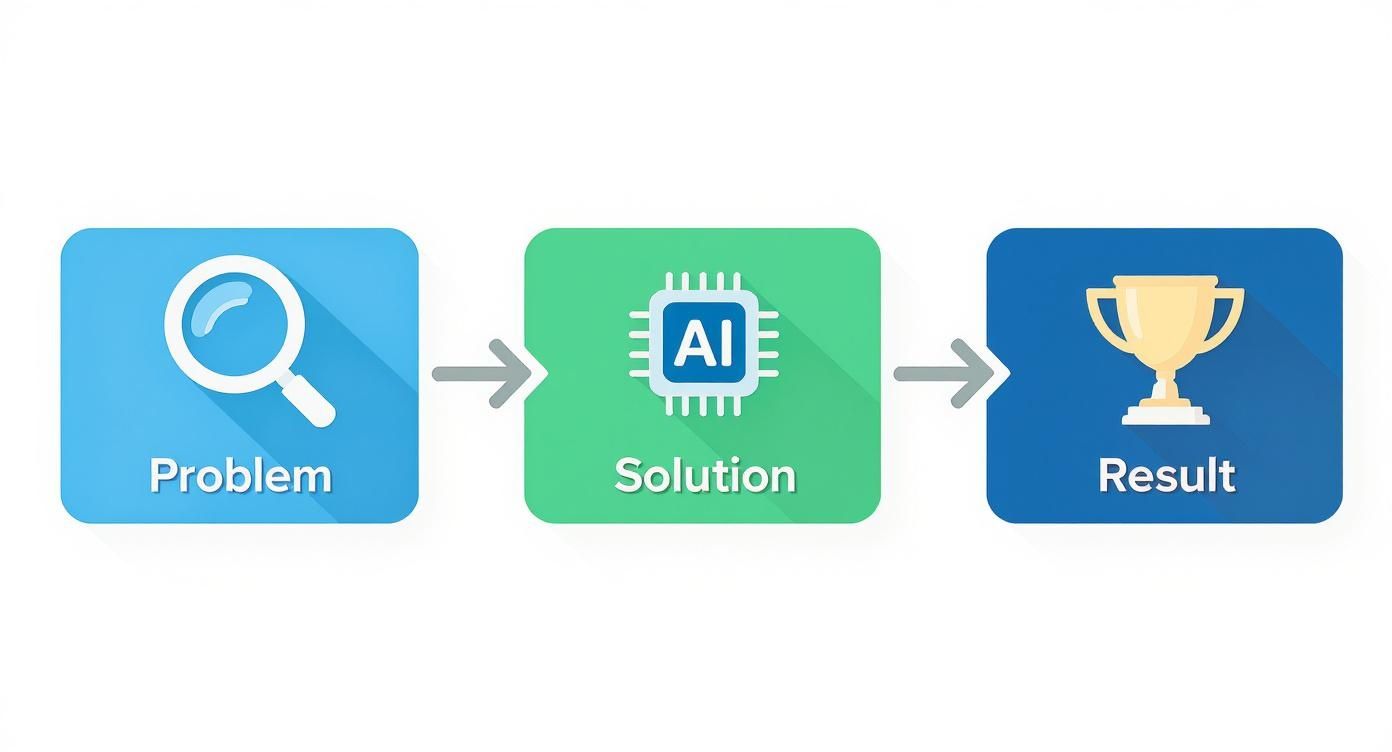
It shows a clear line from identifying a specific business challenge to using a targeted AI solution to produce real, measurable results.
Choosing Your Social Media AI Tool
With so many tools out there, it helps to break them down into categories. This table gives you a quick overview to help you find the best fit for your team's size and goals.
| Tool Category | Best For | Example Features | Typical Price Range |
|---|---|---|---|
| All-in-One Platforms | Teams wanting a single dashboard for most tasks. | Content creation, scheduling, analytics, basic moderation, reporting. | $50 - $500+/month |
| Content Creation Specialists | Marketers focused on generating high volumes of creative assets. | Text generation (captions, scripts), image/video creation, idea brainstorming. | $20 - $100/month |
| Community Management Tools | Brands with high engagement and a need for responsive customer service. | Automated comment replies, sentiment analysis, inbox management, spam filtering. | $100 - $1,000+/month |
| Analytics & Ad Optimization | Performance marketers looking to maximize ROI. | Predictive analytics, audience segmentation, automated A/B testing, budget allocation. | $250 - $2,000+/month |
Ultimately, the best tool is the one that solves your most pressing problem without complicating your life. Start by identifying your biggest need and look for a solution that directly addresses it.
Implementing a Phased Adoption Plan
The secret to getting your team on board is to roll things out in phases. If you try to automate everything at once, you’ll just create chaos. A gradual approach lets everyone get comfortable and see the benefits for themselves.
Here’s a simple, three-stage plan that works.
Phase 1: Augmenting Creativity and Planning Start with the low-risk, high-reward stuff. Use AI as a brainstorming buddy to spitball post ideas, draft a few caption options, or suggest trending hashtags. In this phase, the AI is just an assistant, helping your team do their creative work faster.
Phase 2: Automating Routine Management Once everyone’s comfortable, start handing off the more structured tasks. Set up automated post scheduling to hit the perfect times, or let an AI tool handle basic comment moderation like filtering out spam and profanity. This immediately frees up your team’s time for bigger-picture thinking.
Phase 3: Scaling Advanced Operations Now you're ready for the heavy lifting. This is where you use AI for deep performance analysis, predicting which campaigns will pop, and even optimizing your ad spend in real time. At this stage, AI graduates from a simple tool to a genuine strategic partner.
This step-by-step method is your ticket to a successful rollout. It’s no surprise that research shows over three-quarters of social media strategists are already using AI for more than just writing captions. For them, it's become a strategic 'thought partner.' You can read the full research about AI trends on hootsuite.com.
By starting with simple tasks like brainstorming and gradually moving to complex automation like ad optimization, you allow your team to adapt and embrace AI's capabilities without feeling overwhelmed. This progressive adoption is the secret to making the technology stick.
Measuring the ROI of Your AI Investment
So, you're thinking about bringing AI into your social media workflow. The big question, the one that every CFO and team lead asks, is always the same: is it actually going to be worth it? With AI for social media management, proving its value means looking past the usual vanity metrics like follower counts and impressions. You have to connect the dots between the investment and real, tangible business results.
It's about shifting the conversation from "How many people saw our post?" to "What happened after they saw it?" We're not just measuring how loud your brand's voice is; we're tracking the actual impact that voice is having on efficiency, customer happiness, and, most importantly, the bottom line. A good ROI story is always backed by solid data.
Tracking Efficiency Gains
Right out of the gate, one of the clearest wins with AI is giving your team back their most precious resource: time. Turning these time savings into hard numbers is probably the most direct way to show a return. Start by benchmarking how much time your team used to spend on tasks that are now handled or helped by AI.
- Content Creation Time: Think about it. How many hours did your team used to sink into brainstorming, writing, and creating visuals? If AI helps slash that from, say, 10 hours a week down to 3, that’s a concrete win you can take to the bank.
- Customer Response Time: Before AI, what was your average response time for a customer comment or DM? AI-powered replies and chatbots can take this from hours down to mere seconds, which is a massive boost for customer satisfaction.
Once you have these numbers, you can easily attach a dollar value to them based on your team's salaries. Saving a manager 20 hours of work a month can mean thousands of dollars in productivity—time they can now spend on strategy and bigger-picture thinking instead of repetitive tasks.
Analyzing Engagement Lifts
Efficiency gains show you're saving money, but a lift in engagement proves your AI-powered strategy is actually connecting better with your audience. These are the metrics that show you're not just making content faster, but you're making better content that people genuinely want to interact with.
Here are the key things to keep an eye on:
- Interaction Rates: Are the posts suggested or generated by AI getting more likes, comments, and shares? If you see a consistent uptick here, it's a great sign that the AI is getting a good read on what your audience loves.
- Brand Sentiment: Use the AI's own sentiment analysis tools to get a pulse on the conversations happening around your brand. Watching the overall tone shift from neutral or negative to overwhelmingly positive is solid proof that your improved messaging and responsiveness are changing how people see you.
Measuring Conversion Growth
At the end of the day, nothing speaks louder than revenue. The most convincing way to prove your AI's worth is to tie its efforts directly to sales and leads. For anyone in e-commerce or performance marketing, this is the holy grail of ROI.
Look for a direct line between AI implementation and conversion growth:
- Click-Through Rates (CTR): Keep a close watch on the CTR for your social media posts and ads. AI is fantastic at optimizing ad copy, visuals, and targeting, which almost always leads to more people clicking through to your site.
- Attributed Conversions: With the right tracking in place, you can see exactly how many sales or leads came directly from your social channels. If that number starts climbing right after you bring AI into the mix, you’ve got the ultimate proof of its financial impact.
Navigating the Pitfalls and Ethical Tightropes
Let’s be clear: bringing AI into your social media management is a game-changer, but it’s not a "set it and forget it" magic button. Think of it as a powerful assistant, not a replacement for your team's expertise and common sense. If you're not careful, you can stumble into some common traps and cross ethical lines you didn't even see coming.
One of the easiest mistakes to make is leaning too heavily on automation. When every single reply and post feels like it came off a machine's assembly line, your brand's personality evaporates. People connect with people, and an overly robotic presence can feel cold and distant, completely defeating the purpose of building a community.
The Hidden Danger of Algorithmic Bias
Here's something you really need to watch out for: the algorithms themselves. AI models learn from the data we feed them, and that data is often a mirror of our own societal biases, warts and all. Without a watchful eye, an AI tool might completely miss the mark on cultural nuances, misunderstand slang, or make assumptions that can alienate entire groups of people.
This isn't just theory. An AI trained on a skewed dataset might start flagging comments from certain demographics more often than others or get the sentiment of a culturally-specific joke completely wrong. These aren't just small slip-ups; they're moderation failures that can seriously damage your brand's reputation and break the trust you've worked so hard to build.
The sweet spot is what we call a 'human-in-the-loop' system. AI does the heavy lifting and handles the scale, but a real person provides the crucial context, empathy, and final say. It's the only way to manage social media responsibly and effectively.
Walking the Ethical Line
Beyond just making mistakes, there are firm ethical boundaries to consider, especially around transparency and data privacy. Your followers have a right to know if they're chatting with a bot or a person. Being upfront about this isn't just a courtesy; it's fundamental to maintaining trust.
And then there's the data. The information your AI collects to understand sentiment and personalize interactions is incredibly valuable, but it also comes with a huge responsibility. People are more concerned than ever about how their data is being used. You need crystal-clear policies to protect user privacy, ensuring you’re using these powerful tools without making your audience feel exploited.
Here are a few ground rules for using AI ethically:
- Be Honest About Bots: Always make it clear when users are interacting with an AI. A simple "I'm a bot, but I can help with..." goes a long way in managing expectations.
- Keep a Human in Charge: Never give an AI full autonomy. Have a team member approve AI-suggested content and regularly audit its moderation decisions to ensure they’re fair and on-brand.
- Guard User Data Fiercely: Be transparent about what data you collect and why. Make sure your practices are compliant with privacy laws like GDPR or CCPA to protect your audience and your business.
At the end of the day, using AI responsibly isn't just about boosting efficiency. It’s about building a smarter, safer, and more authentic space for your online community. By keeping a human at the core of your strategy, you'll avoid the pitfalls and use AI to make your brand stronger, not hollow it out.
Got Questions About AI in Social Media?
It's natural to have questions when you're thinking about bringing a new technology like AI into your social media workflow. Getting clear on the common concerns is the best way to move forward with confidence and make sure you're using these tools to their full potential. Let's dig into a few of the questions I hear most often from social media pros.
Will AI Replace Social Media Managers?
Let's clear this up right away: absolutely not. AI is a tool to empower social media managers, not replace them. Think of it as the ultimate assistant.
AI is fantastic at handling the tedious, repetitive tasks that eat up so much of a manager's day—things like scheduling hundreds of posts, pulling performance data, and filtering out obvious spam. By automating the grind, it frees up human managers to focus on what they do best: high-level strategy, creative thinking, building real community relationships, and navigating those tricky customer service issues that require a human touch.
AI handles the grunt work, making the human manager more effective and strategic. It takes care of the 'what' so you can focus on the 'why' and 'how' of building a powerful brand presence.
How Much Do Social Media AI Tools Cost?
The price range for AI for social media management is incredibly wide, which is great news because it means there are options for just about any budget.
For small teams or solo operators just dipping their toes in, you can find tools with specific AI features—like content idea generation or basic analytics—for as little as $15-$50 a month.
On the other side of the spectrum, you have advanced platforms built for larger teams. These come packed with sophisticated sentiment analysis, predictive analytics to forecast campaign success, and enterprise-grade chatbots. These can easily run from several hundred to thousands of dollars per month. Most companies offer tiered pricing, so you can start small and scale up as your needs (and budget) grow.
How Do I Keep My Brand Voice Authentic with AI?
This is a huge—and valid—concern. Your brand's voice is everything, and the last thing you want is for it to sound like a robot. The golden rule here is to never let AI have the final say. Use it as a launchpad, not a publishing button.
Here’s a practical workflow to make it work:
- Give the AI a Good Education: Start by feeding the tool your best-performing content, brand style guides, and examples of your tone. The AI needs a solid foundation to learn what "sounds like you."
- Generate, Don't Publish: Use the AI to spit out first drafts, brainstorm a list of post ideas, or suggest different ways to phrase something. Think of its output as raw clay, not a finished sculpture.
- The Human Touch is a Must: This is the most important step. Always have a human—a manager, a copywriter, an editor—review and refine the AI's suggestions. They'll polish the copy, inject personality, and ensure it perfectly captures your brand's unique voice and values.
By keeping a human in the loop, you get the efficiency boost from AI without ever sacrificing the authenticity that your audience connects with.
Ready to stop wasting time on manual comment moderation and start capturing valuable leads? FeedGuardians uses advanced AI to keep your comment sections clean, respond to customers instantly, and identify purchase intent in real-time. Learn more about how FeedGuardians can protect your brand and boost your conversions.
Tired of manually moderating comments?
FeedGuardians automates spam filtering, responds to customers, and protects your brand — setup in 3 minutes.