
Quick Summary
| Key Insight | What You Need to Know |
|---|---|
| Best Social Media Platforms for Ecommerce Sales | Platform Comparison Table |
| Facebook Shops | Leveraging the Largest Social Network Conversion Rate and Transaction Fees Omnichannel Integration Benefits |
| Conversion Rate and Transaction | Conversion Rate and Transaction Fees |
| Omnichannel Integration Benefits | Omnichannel Integration Benefits |
| Instagram Shopping | Visual Storytelling Meets Direct Sales Shoppable Posts and User-Generated Content |
| Shoppable Posts and User-Generated | Shoppable Posts and User-Generated Content |
Table of Contents
- Best Social Media Platforms for Ecommerce Sales: Platform Comparison Table
- Facebook Shops: Leveraging the Largest Social Network
- Instagram Shopping: Visual Storytelling Meets Direct Sales
- TikTok Shop and Viral Trends: Capturing Gen Z Momentum
- Pinterest for Visual Discovery: Long-Tail Traffic and SEO Benefits
- LinkedIn for B2B Ecommerce: Lead Generation and Professional Selling
- YouTube Shopping Integration: Video Content as a Sales Channel
- Social Commerce vs. Traditional Ecommerce: When to Use Each
Last Updated: July 30, 2026
Finding the best social media platforms for ecommerce sales requires understanding where your customers spend time and which features drive conversions. This guide breaks down leading platforms, their transaction structures, and which works best for different business models.
Social commerce has fundamentally changed how online retailers approach customer acquisition. Rather than forcing customers to leave social media to complete purchases, the best platforms now offer integrated checkout experiences, shoppable posts, and direct messaging for customer support.
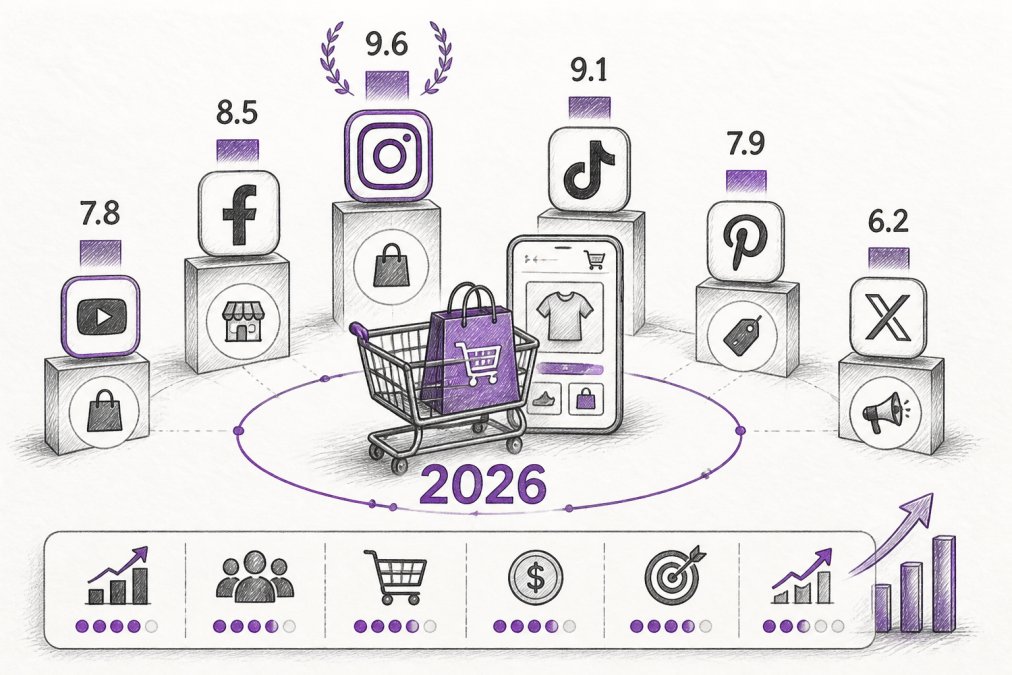
Best Social Media Platforms for Ecommerce Sales: Platform Comparison Table
Each platform attracts different demographics, offers distinct selling mechanics, and charges varying fees. Understanding these differences is essential before committing budget and resources.
| Platform | Transaction Fee | Best For | Key Feature |
|---|---|---|---|
| Facebook Shops | 5% (or $0.40 min) | Broad reach, all demographics | Omnichannel integration |
| Instagram Shopping | 5% (or $0.40 min) | Visual products, Gen Z/Millennials | Shoppable posts & Reels |
| TikTok Shop | Variable | Viral trends, Gen Z | Live shopping & influencers |
| Variable (ad-based) | Visual discovery, planning phase | Long-tail traffic, Rich Pins | |
| $69.99/mo subscription | B2B ecommerce, lead gen | Professional selling, InMail | |
| YouTube Shopping | Integrated | Video-first audiences | Product integration in videos |
| X Shops | Free | Real-time engagement | No transaction fee |
The choice depends on three factors: where your customers are, what you're selling, and your paid promotion budget. A fashion brand targeting Gen Z needs different tactics than a B2B SaaS company.
Facebook Shops: using the Largest Social Network
Facebook remains the largest social network globally, with over 3 billion monthly active users. Facebook Shops provides a free storefront directly on your business page, synced with product catalogs from Shopify, WooCommerce, and other platforms.
Setup is straightforward. You create a Shop tab on your Facebook Page, add products from your catalog, and customers can browse and purchase without leaving Facebook. The integration extends to Instagram through your linked account, meaning a single product catalog powers both platforms simultaneously.
Conversion Rate and Transaction Fees
Facebook charges a 5% transaction fee on orders over $8, or a flat $0.40 fee on orders of $8 or less. This applies only when customers use Facebook's integrated checkout. If you redirect customers to your external website, Facebook takes no fee, but you lose the frictionless in-app experience.
Many ecommerce teams report 15-25% higher conversion rates when checkout happens within the app rather than redirecting to an external site. Customers avoid friction, payment methods are pre-filled, and trust signals from Facebook's brand presence reduce cart abandonment.
However, the 5% fee compounds quickly at scale. A brand doing $100,000 in monthly sales through Facebook Checkout pays $5,000 in platform fees alone.
Omnichannel Integration Benefits
Your product catalog syncs across Facebook, Instagram, Messenger, and WhatsApp. A customer might discover a product on Instagram, receive a follow-up message on Messenger, and complete the purchase on Facebook, all within the same ecosystem.
Messenger and WhatsApp integration enables 24/7 customer support without hiring additional staff. Automated responses handle common questions, while complex inquiries escalate to your team.
Instagram Shopping: Visual Storytelling Meets Direct Sales
Instagram's visual-first format makes it the strongest platform for ecommerce brands selling aesthetically driven products. Fashion, beauty, home decor, and lifestyle brands see substantially higher engagement and conversion rates on Instagram compared to Facebook.
The platform offers multiple selling channels: a Shop tab on your profile, shoppable posts, shoppable Stories, shoppable Reels, and in-app checkout.
Shoppable Posts and User-Generated Content
Shoppable posts tag products directly in images, allowing customers to tap and purchase without leaving the app. This removes friction and capitalizes on impulse buying behavior.
User-generated content amplifies this effect. When customers post photos using your products and tag your brand, you can repost that content as shoppable posts. Research shows that posts featuring customer photos drive 3-5x higher engagement than branded content alone. When that content is shoppable, the conversion rate typically exceeds standard product posts by 40-60%.
Instagram's algorithm prioritizes content with high engagement. Shoppable posts that generate saves, shares, and comments receive broader reach than standard posts, creating a virtuous cycle that drives more sales.
TikTok Shop and Viral Trends: Capturing Gen Z Momentum
TikTok has become essential for brands targeting Gen Z and younger Millennials. Unlike Facebook and Instagram, TikTok's algorithm still surfaces content to users who don't follow the creator, meaning a single viral video can introduce your products to millions.
TikTok Shop enables direct sales on the platform. Products appear in a dedicated shop section on your profile, and you can tag products in videos and live streams.
Live Shopping and Influencer Marketing Integration
Live shopping on TikTok combines entertainment with commerce. Brands host live streams, demonstrate products, answer questions in real-time, and viewers purchase directly. Conversion rates during live shopping events often exceed 20%, far higher than standard product posts.
TikTok creators have smaller but more engaged audiences. A creator with 100,000 followers on TikTok can drive more sales than a creator with 500,000 followers on Instagram due to higher engagement rates and algorithmic reach.
The challenge with TikTok is trend velocity. Content that works today becomes stale within days. Brands need either an in-house creator producing multiple videos weekly or partnerships with creators who understand TikTok's culture.
Pinterest for Visual Discovery: Long-Tail Traffic and SEO Benefits
Pinterest operates differently from other social platforms. It functions as a visual search engine where users discover ideas and products they're actively planning to buy. Unlike Facebook or Instagram, where people primarily consume content from accounts they follow, Pinterest users actively search for products.
This distinction matters for ecommerce. A customer on Pinterest is usually searching for something specific, translating to higher conversion rates and lower customer acquisition costs.
Rich Pins automatically sync product information, price, availability, and description from your website to Pinterest. When prices change or products sell out, Pinterest updates automatically, preventing customers from clicking through only to find unavailable items.
LinkedIn for B2B Ecommerce: Lead Generation and Professional Selling
LinkedIn serves B2B companies, SaaS platforms, professional services, and enterprise software. If your product sells to other businesses rather than consumers, LinkedIn is essential.
LinkedIn Premium Business ($69.99/month) provides 15 InMail credits monthly, allowing you to message prospects directly. Advanced search filters let you target by job title, company size, industry, and other professional criteria, reducing customer acquisition cost for B2B ecommerce.
The platform excels at lead generation rather than direct sales. Most B2B purchases require multiple touchpoints and decision-makers. LinkedIn enables you to reach procurement managers, department heads, and C-suite executives with targeted messages.
YouTube Shopping Integration: Video Content as a Sales Channel
YouTube is the second-largest search engine globally. Ecommerce brands can integrate products directly into videos, allowing viewers to click and purchase without leaving YouTube.
Video content serves multiple purposes for ecommerce. Product demonstrations show how items work. Unboxing videos build anticipation. Tutorial videos demonstrate use cases. Customer testimonials build trust. All of these formats can include shoppable product tags.
YouTube's algorithm rewards watch time and engagement. Longer videos that keep viewers watching receive broader distribution. Brands that teach or entertain while showcasing products see substantially higher engagement than those that simply promote.
Social Commerce vs. Traditional Ecommerce: When to Use Each
Social commerce and traditional ecommerce serve different purposes in your sales strategy. Understanding when to use each determines how effectively you allocate marketing budget.
Mobile-First Shopping and Checkout Friction
Social commerce is inherently mobile-first. Facebook, Instagram, and TikTok are primarily mobile apps. Checkout happens on mobile devices optimized for touch. Social commerce reduces friction by keeping customers within the app, pre-filling payment information, and enabling one-tap checkout.
For impulse purchases under $50, social commerce's reduced friction drives higher conversion rates. For considered purchases over $200, customers often prefer traditional ecommerce where they can review product details, read reviews, and compare pricing more easily.
Customer Acquisition Cost and ROI Comparison
Social commerce platforms charge transaction fees (5% for Facebook and Instagram) but provide free storefront setup and catalog management. Traditional ecommerce requires hosting costs, payment processing fees (2-3%), and often marketing spend to drive traffic.
Many successful ecommerce brands use a hybrid approach: social commerce for discovery and impulse purchases, traditional ecommerce for detailed product information and customer reviews.
Integrating Comment Moderation Into Your Social Commerce Strategy
As your social commerce presence grows, comment volume increases rapidly. On platforms like Instagram and Facebook, product posts generate hundreds of comments. Some are genuine questions from potential customers. Others are spam, scams, or competitor links designed to redirect traffic.
Manual comment moderation becomes impossible at scale. A single product post might receive 500 comments within hours. Your team cannot respond to all of them, answer duplicate questions, or remove harmful content fast enough.
FeedGuardians automatically detects and hides spam, hate speech, and competitor links with 98.7% accuracy. Simultaneously, it delivers AI-powered replies in your brand voice, answering common questions 24/7 without human intervention.
When a customer asks "What's the shipping cost?" or "Do you have this in size M?", FeedGuardians replies instantly with accurate information. This speeds up the customer journey from discovery to purchase while protecting your brand reputation by keeping comments clean and professional.
Selecting the best social media platforms for ecommerce sales depends on understanding your audience, product type, and business model. Facebook and Instagram work for consumer brands seeking broad reach. TikTok captures trend-driven, younger audiences. Pinterest serves discovery-focused shoppers. LinkedIn reaches B2B decision-makers. YouTube powers educational and demonstration content.
The most successful ecommerce brands build an integrated strategy across multiple channels. However, managing customer interactions across all these platforms manually becomes unsustainable. FeedGuardians solves this by automating comment moderation and intelligent replies across Instagram, Facebook, TikTok, and YouTube. Protect your brand reputation, respond to customers instantly, and boost ad performance by turning every comment into a conversation. Start for free and see how automated comment management transforms your social commerce results.
Frequently Asked Questions
Which social media platform for ecommerce sales has the lowest transaction fees?
X (formerly Twitter) Shops charges zero transaction fees and requires no payment processing through the platform, customers are directed to your external website. However, Facebook Shops and Instagram Shopping both charge 5% per transaction (or $0.40 on orders under $8). Pinterest and TikTok focus on advertising rather than direct checkout, so fees vary by campaign. Choose based on your target audience and acceptable checkout friction, not fees alone.
How does social commerce affect customer acquisition cost compared to traditional ecommerce?
Social commerce typically reduces customer acquisition cost by leveraging platform algorithms and organic reach through user-generated content and social proof. However, paid ad spend on platforms like TikTok and Pinterest can be required to scale. B2B social selling on LinkedIn may have higher CAC but better customer lifetime value. Test each platform's organic reach first before committing to paid advertising budgets.
Can I use the same content strategy across all social media platforms for ecommerce?
No. Each platform has distinct algorithms, audience demographics, and content formats. Instagram rewards visual storytelling and Reels; TikTok thrives on trending, authentic short-form video; Pinterest users are in discovery mode months before purchase; LinkedIn demands professional, B2B-focused content. Tailor your content, posting frequency, and engagement strategy to each platform's culture and algorithm to maximize conversion rate and engagement metrics.
How do I manage comment moderation and customer inquiries across multiple social media platforms for ecommerce?
Manual moderation across multiple platforms drains resources, especially when handling spam, competitor links, and harmful comments at scale. AI-powered solutions can detect and hide problematic content with high accuracy while delivering 24/7 automated responses in your brand voice. This protects your brand reputation, boosts ad performance by maintaining a clean community, and turns comments into valuable conversations and conversions. Look for tools that integrate across Instagram, Facebook, TikTok, and YouTube for unified management.
This article was written using GrandRanker
Tired of manually moderating comments?
FeedGuardians automates spam filtering, responds to customers, and protects your brand — setup in 3 minutes.
Frequently Asked Questions
Which social media platform for ecommerce sales has the lowest transaction fees?
X (formerly Twitter) Shops charges zero transaction fees and requires no payment processing through the platform—customers are directed to your external website. However, Facebook Shops and Instagram Shopping both charge 5% per transaction (or $0.40 on orders under $8). Pinterest and TikTok focus on advertising rather than direct checkout, so fees vary by campaign. Choose based on your target audience and acceptable checkout friction, not fees alone.
How does social commerce affect customer acquisition cost compared to traditional ecommerce?
Social commerce typically reduces customer acquisition cost by leveraging platform algorithms and organic reach through user-generated content and social proof. However, paid ad spend on platforms like TikTok and Pinterest can be required to scale. B2B social selling on LinkedIn may have higher CAC but better customer lifetime value. Test each platform's organic reach first before committing to paid advertising budgets.
Can I use the same content strategy across all social media platforms for ecommerce?
No. Each platform has distinct algorithms, audience demographics, and content formats. Instagram rewards visual storytelling and Reels; TikTok thrives on trending, authentic short-form video; Pinterest users are in discovery mode months before purchase; LinkedIn demands professional, B2B-focused content. Tailor your content, posting frequency, and engagement strategy to each platform's culture and algorithm to maximize conversion rate and engagement metrics.
How do I manage comment moderation and customer inquiries across multiple social media platforms for ecommerce?
Manual moderation across multiple platforms drains resources—especially when handling spam, competitor links, and harmful comments at scale. AI-powered solutions can detect and hide problematic content with high accuracy while delivering 24/7 automated responses in your brand voice. This protects your brand reputation, boosts ad performance by maintaining a clean community, and turns comments into valuable conversations and conversions. Look for tools that integrate across Instagram, Facebook, TikTok, and YouTube for unified management.