
Quick Summary
| Key Insight | What You Need to Know |
|---|---|
| Understanding the Social Media | Understanding the Social Media Conversion Funnel The Follower-to-Customer Architecture Identifying Your Target Audience and Buyer Persona |
| The Follower-to-Customer Architecture | The Follower-to-Customer Architecture |
| Identifying Your Target Audience | Identifying Your Target Audience and Buyer Persona |
| Step 1 | Build Genuine Relationships and Establish Trust Signals |
| Step 2 | Create High-Value, Niche Content That Converts |
| Step 3 | Implement a Consistent Social Listening and Engagement Strategy |
Table of Contents
- Understanding the Social Media Conversion Funnel
- Step 1: Build Genuine Relationships and Establish Trust Signals
- Step 2: Create High-Value, Niche Content That Converts
- Step 3: Implement a Consistent Social Listening and Engagement Strategy
- Best Practices for Converting Followers Into Customers
- Tools for Social Media Conversion: Building Your Tech Stack
- Real-World Examples of Social Media Conversion Campaigns
- How to Turn Social Media Followers Into Customers: Common Mistakes to Avoid
Last Updated: July 27, 2026
Understanding the Social Media Conversion Funnel
The gap between followers and customers is where most social media strategies fail. Many brands accumulate thousands of followers only to discover that engagement doesn't translate into revenue. Understanding how to turn social media followers into customers requires recognizing that these are fundamentally different stages of a customer journey.
At FeedGuardians, we've analyzed conversion patterns across thousands of social accounts and identified a clear architecture that separates high-performing brands from those stuck in vanity metrics. The difference isn't complexity, it's intentional funnel design.
The Follower-to-Customer Architecture
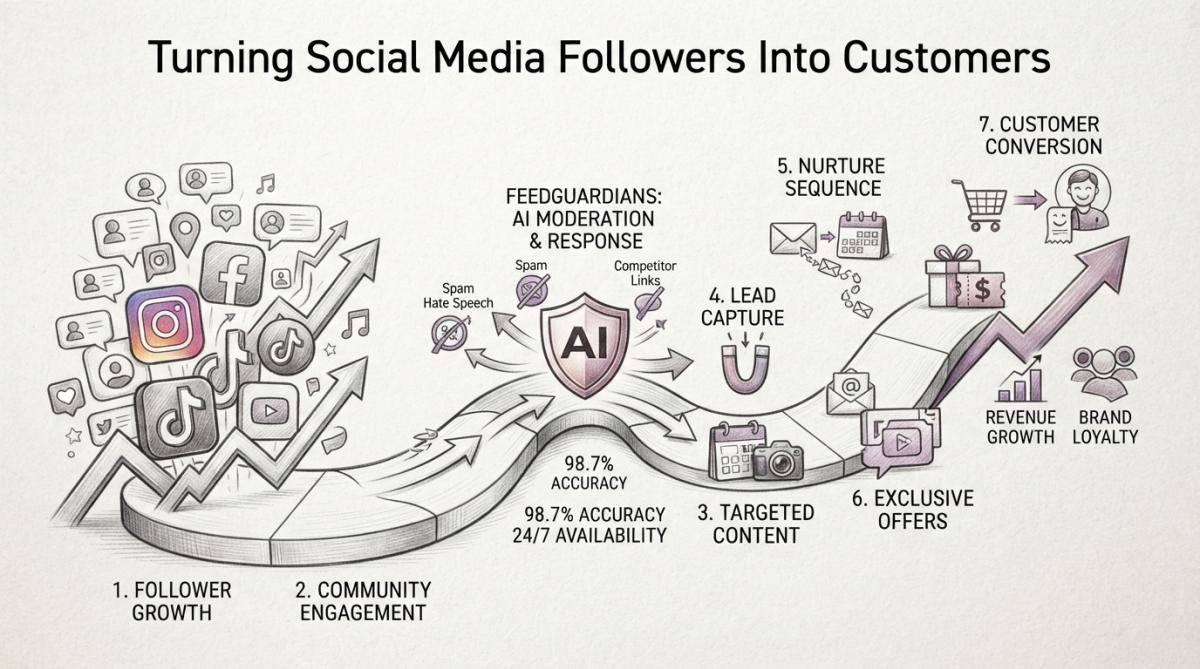
A follower becomes a customer through a predictable sequence: awareness (discovery and follow), engagement (consistent interaction), consideration (signals buying intent), conversion (purchase), and retention (repeat customer). Most brands optimize only the first two stages and wonder why revenue doesn't follow.
Each stage requires different content types, messaging approaches, and call-to-action strategies. A post designed to maximize follower growth will actively repel potential customers. A post optimized for conversions will generate fewer followers but higher revenue per follower.
Identifying Your Target Audience and Buyer Persona
Before turning followers into customers, define exactly who should be following you. Many brands cast wide nets and accumulate followers who will never buy, creating false progress while conversion rates stagnate.
A buyer persona is a specific person with a problem your product solves. Define their pain point, decision-making process, where they spend time online, and what objections prevent them from buying. Instead of "small business owners," define "e-commerce store owners with $50K-$500K annual revenue who struggle with customer retention." Instead of "fitness enthusiasts," define "women aged 28-42 who've tried three gyms and now prefer home workouts but lack accountability."
Your target audience should be narrow enough that you can articulate their specific objection to buying. If you can't identify what's stopping them from converting, you haven't defined your audience clearly enough. This clarity determines everything that follows: the content you create, the platforms you choose, and the conversion mechanisms you implement.
Step 1: Build Genuine Relationships and Establish Trust Signals
Converting followers into customers requires trust, built through consistent, authentic interaction over time. Followers sense immediately when every interaction is a sales pitch, they stop engaging. When you provide genuine value and respond authentically to comments, they start paying attention.
Trust signals include responding to comments and direct messages consistently, sharing behind-the-scenes content showing real people behind your brand, and acknowledging common objections your audience has.
The relationship-building phase is where many brands fail. They post content, get followers, then immediately try to sell. Followers need to see you as someone who understands their problem before they'll trust you with their money.
Step 2: Create High-Value, Niche Content That Converts
Viral content and conversion-focused content often look completely different. Viral content is broad and entertaining. Conversion-focused content is specific and solves a problem. A post that gets 10,000 likes from random people has zero conversion value. A post that gets 50 likes from your exact target audience might generate $5,000 in revenue.
Niche content speaks directly to your buyer persona's specific problem. Instead of "5 Tips for Better Sleep," create "How to Fix Sleep Issues When You Work Night Shifts as a Nurse." The specificity filters out people who aren't your customer and attracts people who are.
High-value content demonstrates expertise and builds authority. This could be a detailed case study showing exactly how a customer went from problem to solution, a step-by-step breakdown of your process, or an honest analysis of what doesn't work.
Step 3: Implement a Consistent Social Listening and Engagement Strategy
Social listening means monitoring what your audience is saying about your industry, your product, and your competitors, then responding strategically. When a follower asks a question in comments, that's a conversion opportunity. When someone mentions a pain point related to what you sell, that's a signal they're in the consideration stage.
A consistent engagement strategy means showing up in those conversations regularly. High-converting brands monitor conversations continuously and respond within hours. Track which content types generate the most meaningful engagement (comments showing buying intent) versus vanity engagement (likes from random accounts).
Tools that automate comment moderation and responses help here, but only if they maintain authenticity. FeedGuardians uses AI trained on your brand voice to respond 24/7 while you sleep, ensuring every comment gets a thoughtful reply that feels human. This consistency dramatically improves conversion rates because potential customers aren't left waiting for responses.
Best Practices for Converting Followers Into Customers
Choosing the Right Social Media Platforms for Your Funnel
Not all platforms are equal for converting followers into customers. Instagram works well for visual products and lifestyle brands. TikTok converts younger audiences but requires different content styles. YouTube drives conversions for products requiring explanation. Facebook performs well for older demographics and B2B services. LinkedIn converts best for professional services and B2B solutions.
The platform choice should match where your target audience spends time AND where they're ready to make purchasing decisions.
Focus your efforts on one or two platforms where your audience is most concentrated. One platform with consistent, high-quality content outperforms five platforms with mediocre content every single time.
Optimizing Your Call-to-Action and Direct Messages
A call-to-action that works on one platform will fail on another. Instagram followers respond to "Link in bio" CTAs. YouTube viewers expect a direct link in the description. TikTok audiences respond better to "DM for details." LinkedIn professionals expect a professional approach.
The CTA should match the funnel stage. Early-stage followers need CTAs that build trust: "Save this for later," "Tag someone who needs this." Mid-stage followers need CTAs that move toward consideration: "Learn more in our guide," "Watch the full breakdown." Late-stage followers need clear purchase CTAs: "Shop now," "Book a demo."
Direct messages are where many conversions happen but where most brands fail. A follower sliding into your DMs with a question is a critical moment. Respond thoughtfully and move the conversation toward a sale without being pushy. Brands that convert followers into customers treat DMs as the highest-priority channel, responding within hours and guiding conversations toward purchase.
Using Paid Ads to Accelerate Your Conversion Rate
Organic social media builds an audience slowly. Paid ads accelerate the process by targeting your exact buyer persona and moving them through the funnel faster. But paid ads only work if your organic content is already converting.
A common mistake is running paid ads to build followers without a conversion strategy in place. The correct approach is to build a small organic audience first, prove your conversion rate works, then scale with paid ads.
The most effective paid strategy uses a multi-stage approach: stage one builds awareness with broad targeting, stage two retargets people who engaged with stage one content, stage three targets people who visited your website but didn't buy, stage four targets lookalike audiences of your best customers. Each stage has a specific CTA designed to move people to the next stage.
Tools for Social Media Conversion: Building Your Tech Stack
Comment Moderation and AI-Powered Response Tools
Managing comments at scale is impossible without tools. As your audience grows, the volume of comments exceeds what any human can handle. Tools that automate comment moderation and responses are essential for maintaining conversion momentum.
The best tools detect and hide spam and harmful content automatically, respond to legitimate comments with thoughtful replies that feel human, and flag high-priority comments for human review.
FeedGuardians specializes in this exact problem. It automatically detects spam, hate speech, and competitor links with 98.7% accuracy, hiding them instantly to protect your brand reputation. Simultaneously, it delivers AI-powered replies in your unique brand voice 24/7, ensuring every genuine customer question gets answered immediately. This means your followers experience responsive, helpful interactions even when you're asleep or busy with other work. The result is higher engagement rates, faster conversion cycles, and significantly improved ad performance.
Analytics and Conversion Tracking Platforms
You can't improve what you don't measure. Most brands track follower count and vanity metrics while ignoring the metrics that actually matter: conversion rate, customer acquisition cost, and lifetime customer value.
Conversion tracking requires connecting your social media accounts to your sales system. This lets you see which posts, platforms, and audiences generate the most revenue. The best analytics approach tracks the entire customer journey: which social post led to a click, which click led to a website visit, which visit led to a purchase, and which customers became repeat buyers.
Real-World Examples of Social Media Conversion Campaigns
Strategic Parenting protected $400,000 in ad spend by implementing FeedGuardians's AI-powered comment moderation. Before implementation, spam and competitor comments were creating a hostile environment that discouraged real followers from engaging. After deploying automated moderation, their engagement rate increased 34% and conversion rate improved 18% within 60 days.
NiceToMeet saw 5.1x increase in membership inquiries after shifting from broadcast-style posts to conversation-focused content. Instead of posting tips and hoping followers would click a link, they started asking questions in comments, responding to every reply personally, and using direct messages to guide interested followers toward a trial membership. The follower count grew slower, but the conversion rate tripled.
Golden Tree protected $440,000 in ad spend by identifying and removing ghost followers. This improved their ad targeting accuracy because their audience metrics were now honest. Their cost per acquisition dropped 26% because they were no longer paying to reach dead accounts.
How to Turn Social Media Followers Into Customers: Common Mistakes to Avoid
The Ghost Follower Problem and Engagement Rate Reality
Ghost followers are accounts that look real but never engage, never buy, and waste your ad spend. They inflate your follower count while destroying your engagement rate. If you have 10,000 followers but only 200 engage with your posts, your engagement rate is 2%, below industry average and a signal to algorithms that your content isn't resonating.
Calculate your engagement rate monthly. If it's declining, you have a ghost follower problem. Remove followers who never engage. Pause growth strategies that attract low-quality followers. Focus on attracting followers who match your buyer persona.
Ghost followers also skew your conversion metrics. If 8,000 of your 10,000 followers are bots, your conversion rate looks terrible even if you're converting 10% of real followers. This false metric leads to abandoning strategies that actually work.
Ignoring the Customer Journey and Psychological Triggers
The biggest mistake is treating the conversion process as linear. Most followers need multiple touchpoints before they're ready to buy. Awareness-stage followers respond to curiosity and entertainment. Consideration-stage followers respond to credibility and social proof. Decision-stage followers respond to urgency and specificity.
Many brands use the same content and CTA for all stages, which is why conversion rates stay flat. A post designed to build awareness will repel someone ready to buy. A post designed to drive sales will repel someone in awareness.
The solution is mapping your content strategy to the customer journey. Create specific content for each stage. Track which content moves followers to the next stage. Double down on what works. This intentional approach to the entire funnel is what separates brands that convert followers into customers from those that just accumulate followers.
Converting followers into customers is fundamentally about building relationships, delivering value, and removing friction from the buying process. Most brands fail not because they lack followers, but because they lack a coherent strategy for moving those followers through the conversion funnel. The brands that succeed invest in authentic engagement, high-value content, and tools that maintain responsiveness at scale. FeedGuardians handles the responsiveness piece, automatically moderating comments with 98.7% accuracy while delivering AI-powered replies in your brand voice 24/7. This ensures your followers always feel heard and valued, which dramatically improves conversion rates and customer lifetime value. Start for free and see how automated engagement transforms your social media from a vanity metric into a revenue engine.
Frequently Asked Questions
What is a good social media conversion rate?
Conversion rates vary widely by industry and platform, but a healthy benchmark typically ranges from 1-5% for most businesses. However, niche content and highly targeted audiences can achieve 5-10% or higher. The key is tracking your own baseline, then incrementally improving through A/B testing your call-to-action, landing pages, and audience targeting. Monitor your conversion rate alongside engagement rate and customer acquisition cost to ensure your funnel is optimizing for actual revenue, not just vanity metrics.
How do I convert social media engagement into sales using a conversion funnel?
A social media conversion funnel moves followers through distinct stages: awareness (content discovery), interest (engagement with posts), consideration (email list signup or lead magnet), decision (sales page or product link), and retention (repeat purchase). At each stage, use platform-specific workflows, direct messages for warm outreach, paid ads to retarget engaged followers, and clear calls-to-action pointing to your value proposition. Tools like comment moderation and AI-powered responses help maintain rapport and identify sales-ready prospects in real time.
What content converts followers into customers most effectively?
High-value, niche content that addresses specific pain points converts best. This includes behind-the-scenes storytelling, educational tutorials, customer testimonials (social proof), case studies, and comparison content that demonstrates your unique value proposition. Content should be platform-specific, short-form video for TikTok and Instagram Reels, long-form for YouTube, carousel posts for Instagram and Facebook. Consistency matters: a regular content calendar builds brand authority and trust signals over time, making followers more likely to convert into paying customers.
How long does it take to turn social media followers into customers?
Timeline depends on your industry, audience, and conversion funnel maturity. Cold followers may take 3-6 months of consistent engagement before converting, while warm audiences (existing email subscribers or past customers) can convert within 2-4 weeks. Psychological triggers like social proof, scarcity, and reciprocity can accelerate conversion. Using tools for real-time engagement and personalized responses shortens the customer journey by addressing objections immediately through direct messages and comments, potentially compressing timelines by 30-50%.
This article was written using GrandRanker
Tired of manually moderating comments?
FeedGuardians automates spam filtering, responds to customers, and protects your brand — setup in 3 minutes.
Frequently Asked Questions
What is a good social media conversion rate?
Conversion rates vary widely by industry and platform, but a healthy benchmark typically ranges from 1-5% for most businesses. However, niche content and highly targeted audiences can achieve 5-10% or higher. The key is tracking your own baseline, then incrementally improving through A/B testing your call-to-action, landing pages, and audience targeting. Monitor your conversion rate alongside engagement rate and customer acquisition cost to ensure your funnel is optimizing for actual revenue, not just vanity metrics.
How do I convert social media engagement into sales using a conversion funnel?
A social media conversion funnel moves followers through distinct stages: awareness (content discovery), interest (engagement with posts), consideration (email list signup or lead magnet), decision (sales page or product link), and retention (repeat purchase). At each stage, use platform-specific workflows—direct messages for warm outreach, paid ads to retarget engaged followers, and clear calls-to-action pointing to your value proposition. Tools like comment moderation and AI-powered responses help maintain rapport and identify sales-ready prospects in real time.
What content converts followers into customers most effectively?
High-value, niche content that addresses specific pain points converts best. This includes behind-the-scenes storytelling, educational tutorials, customer testimonials (social proof), case studies, and comparison content that demonstrates your unique value proposition. Content should be platform-specific—short-form video for TikTok and Instagram Reels, long-form for YouTube, carousel posts for Instagram and Facebook. Consistency matters: a regular content calendar builds brand authority and trust signals over time, making followers more likely to convert into paying customers.
How long does it take to turn social media followers into customers?
Timeline depends on your industry, audience, and conversion funnel maturity. Cold followers may take 3-6 months of consistent engagement before converting, while warm audiences (existing email subscribers or past customers) can convert within 2-4 weeks. Psychological triggers like social proof, scarcity, and reciprocity can accelerate conversion. Using tools for real-time engagement and personalized responses shortens the customer journey by addressing objections immediately through direct messages and comments, potentially compressing timelines by 30-50%.