
Quick Summary
| Key Insight | What You Need to Know |
|---|---|
| Brand Health Monitoring | Getting a real-time pulse on how people feel about your brand. |
| Competitive Analysis | Keeping an eye on what your rivals are doing, where they're winning, and where they're falling short. |
| Lead Generation | Finding people who are actively looking for a solution you provide. |
| Crisis Management | Spotting a potential PR storm when it's just a light drizzle, giving you time to react. |
Think of social listening as your brand's ear to the ground across the entire internet. It's the art of tuning into conversations about your company, your competitors, and your industry to genuinely understand what people are saying, feeling, and thinking.
This isn't just about collecting data; it's about analyzing those conversations to pull out meaningful insights that can guide real business decisions. It’s the difference between just hearing a bunch of noise and actually understanding the conversation.
What Is Social Listening Really
Let's use an analogy. Imagine your brand is hosting a huge party. You could just stand by the door and talk to the people who come up to you directly. That’s one way to get feedback.
But what if you could quietly walk through the crowd and overhear all the candid, unfiltered conversations happening in every corner of the room? You’d learn what people really think about the music (your product), the food (your customer service), and even the other guests (your competitors).
That’s social listening in a nutshell. It's how your brand tunes into the authentic voice of your customers, not just on social media, but on forums, blogs, and review sites, too. You’re no longer just catching direct @mentions; you're grasping the entire context of the conversation surrounding your brand.
From Raw Chatter To Strategic Action
Social listening is far from a passive activity—it’s an active process for turning a sea of online chatter into a clear strategic roadmap. It’s like being a detective for your brand, gathering clues from countless sources to piece together the full story of your public perception.
The value here is immense. The global social listening market was valued at USD 9.6 billion in 2025 and is projected to nearly double by 2030. You can dig into the full market growth report from Influencer Marketing Hub.
This powerful strategy is built on three pillars that work in sequence to drive business value.
Here's a breakdown of how the process works from start to finish.
The Three Pillars Of Effective Social Listening
This table breaks down the process of social listening into its three fundamental stages, clarifying what happens at each step.
| Pillar | Description | Key Outcome |
|---|---|---|
| Data Gathering | This is the foundation. It involves collecting every mention of your brand, products, competitors, and key industry terms from all corners of the web. | A complete dataset of every relevant online conversation. |
| Deep Analysis | Using smart technology, this stage sifts through the data to analyze sentiment (is it positive or negative?), common themes, and developing trends. | Actionable insights that tell you how customers feel and what’s gaining traction. |
| Strategic Action | This is where the magic happens. Insights are turned into concrete business decisions, like tweaking a product, refining a marketing campaign, or getting ahead of a PR issue. | Data-driven actions that directly support and improve your business goals. |
By moving through these stages, you get to understand not just what people are saying, but the crucial why behind their words. This clarity gives you the confidence to make smarter, more effective moves in your market.
Social Listening vs. Social Monitoring
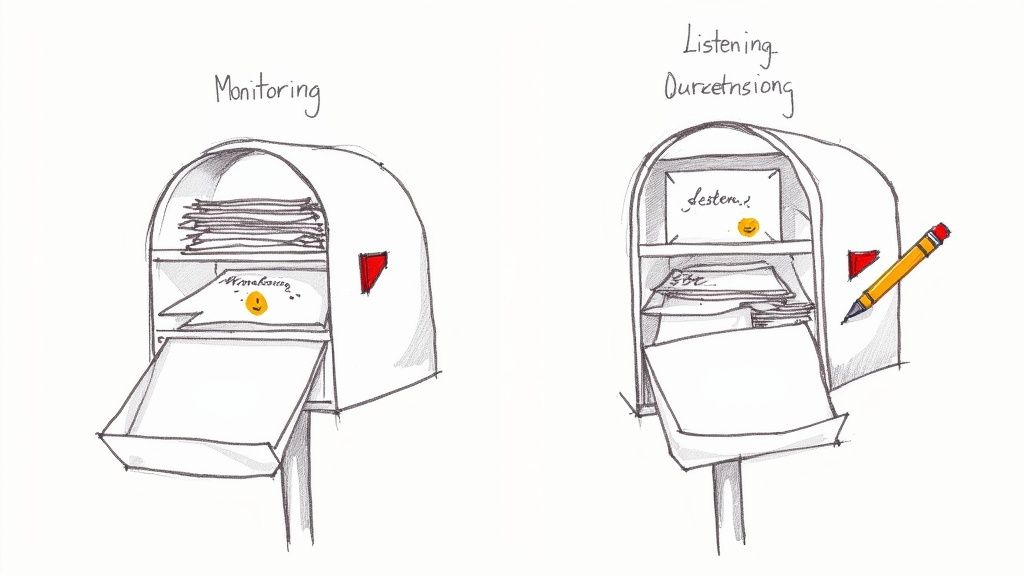
It’s easy to get social listening and social monitoring mixed up. Many people use the terms interchangeably, but they're fundamentally different approaches. Getting this right is crucial.
Think of it like this: monitoring is like checking your mailbox. You're collecting all the direct messages, @mentions, and tags addressed to you. It's a necessary, day-to-day task of gathering what's been sent your way.
Listening, on the other hand, is like being the town's postmaster. You see all the mail, not just what's addressed to you. You understand who's talking to whom, what the general mood of the town is, and what big topics are on everyone's mind.
One is a simple collection task; the other is about understanding the entire conversation.
The Reactive ‘What’ vs. The Proactive ‘Why’
Social monitoring is all about the 'what'. It's reactive. It involves tracking and responding to individual customer service issues, specific hashtags, and direct brand mentions. What are people saying directly to us? How many times was our new product mentioned? This is about managing the present and putting out immediate fires.
For a deeper dive into this side of the equation, our complete guide to social media monitoring covers all the essentials for handling your day-to-day engagement.
Social listening is about discovering the 'why'. It's proactive. Instead of just counting mentions, you’re digging into the sentiment, context, and motivations behind those conversations. Why are customers frustrated with a certain feature? What larger trends are causing this shift in conversation?
Monitoring looks backward at data you've already collected. Listening looks forward, using that data to predict what’s next and inform your strategy.
Social monitoring helps you see the trees, catching individual comments as they appear. Social listening helps you see the entire forest, understanding the ecosystem that shapes customer opinion and predicting what’s over the horizon.
This is the key difference between basic community management and genuine business intelligence. Monitoring is how you manage your reputation today. Listening is how you build a stronger, more resilient brand for tomorrow.
To really nail down the distinction, a side-by-side comparison makes it crystal clear.
Key Differences: Listening vs. Monitoring
This table breaks down the distinct roles, goals, and outcomes of social listening and social monitoring, helping you see where each fits into your strategy.
| Aspect | Social Monitoring (The 'What') | Social Listening (The 'Why') |
|---|---|---|
| Primary Goal | React to individual mentions, comments, and direct messages. | Analyze aggregate data to understand sentiment, trends, and competitive positioning. |
| Time Focus | Past and present—what has already happened or is happening now. | Future—what do current conversations predict about upcoming trends or potential crises? |
| Scope | Narrow, typically focused on direct mentions and tagged posts. | Broad, including untagged brand mentions, competitor conversations, and industry-wide topics. |
| Key Outcome | Quick responses, community engagement, and immediate issue resolution. | Actionable business intelligence, strategic insights, and long-term planning. |
Ultimately, you need both. Monitoring keeps your community healthy on a daily basis, while listening provides the strategic insights that drive meaningful growth and innovation.
Why Social Listening Is Crucial for Business Growth

Knowing what social listening is is one thing, but understanding its direct impact on your bottom line is where things get interesting. This isn't just about passively gathering data; it's about turning online chatter into strategic intelligence that helps you make smarter, faster, and more customer-focused decisions.
When you start tuning into these unfiltered conversations, you begin to see real, tangible benefits across your entire business—from marketing and sales all the way to product development and customer support.
Ultimately, social listening gives your business a compass. You’re using your audience's collective voice to guide your company toward real, sustainable growth. The result? A business that doesn't just guess what the market wants but actually listens, adapts, and innovates based on genuine understanding.
Proactively Manage Brand Reputation
In today’s world, a single bad review or negative comment can snowball into a major headache overnight. Social listening is your early-warning system. It helps you spot spikes in negative sentiment and jump on potential issues before they become a full-blown crisis.
By keeping an eye on these conversations as they happen, you can quickly pinpoint the source of complaints, respond with genuine empathy, and show everyone watching that you’re not just listening—you’re taking action.
This proactive approach to online reputation management is non-negotiable for building and maintaining customer trust. You shift from constantly putting out fires to getting ahead of them. You can even turn a negative situation into a chance to show just how committed you are to your customers. Our detailed guide on building an online reputation management strategy dives deeper into this.
Uncover Powerful Competitive Intelligence
Your competitors’ customers are practically handing you a goldmine of information—and they're doing it out in the open. Social listening lets you ethically "eavesdrop" on these conversations to figure out what your rivals are doing right and, more importantly, where they’re dropping the ball.
Are people complaining about a missing feature in a competitor’s product? That’s your cue. Is a rival’s new ad campaign getting a ton of positive buzz? Time to analyze their messaging and see what you can learn for your own strategy.
This gives you a real-time, unvarnished look at the competitive landscape, showing you exactly where the market gaps are and which threats you need to watch out for.
Fuel Product and Service Innovation
The best products are the ones that solve real problems. And what better way to find those problems than by listening to people talk about them? Social listening gets you directly to your customers' biggest pain points.
People are constantly online sharing their frustrations, wishes, and bright ideas. Imagine a SaaS company noticing that users are constantly asking for a specific integration that none of the competition offers. By spotting that trend, the company can prioritize building that feature, knowing there’s already a built-in demand for it.
This turns customer feedback into a nonstop engine for innovation, ensuring that what you build is exactly what your audience actually wants and needs.
This data-driven approach doesn't just improve products; it boosts confidence in marketing, too. Research shows that teams using social listening tools are far more confident in their marketing ROI. For example, marketers on platforms like Facebook who use these tools report a 67% confidence rate, compared to just 27% for those who fly blind. You can discover more statistics about social listening ROI from Talkwalker.
Real-World Social Listening Use Cases
It's one thing to talk about the theory, but seeing social listening in action is where the lightbulb really goes on. This isn't just a marketing toy; it’s a powerhouse of business intelligence that can inform decisions everywhere, from the product roadmap to the customer support queue.
When you stop just collecting data and start analyzing the conversations, you turn all that online chatter into a real competitive edge. Let's look at a few mini-stories of how different teams put social listening to work to solve actual business problems.
Fueling Product Innovation with Customer Feedback
A popular software company was on the fence about building a new, complex integration for its platform. It was going to be a heavy lift—expensive and time-consuming—and the product team wasn’t sure if anyone would actually use it. Instead of guessing, they decided to listen.
The Strategy: They fired up a listening query to track conversations across Reddit, X (formerly Twitter), and niche industry forums. They weren't just looking for their own brand name; they were monitoring keywords related to their competitors, zeroing in on phrases like “I wish it could connect to…” or “so frustrated it doesn’t integrate with…”.
The Outcome: The results were crystal clear. They found a steady, growing stream of people practically begging for the exact feature they were considering. This data was the green light they needed. The project was approved, and when the integration launched six months later, it was met with a massively enthusiastic user base, quickly becoming one of their most-used features.
Averting a Crisis with Proactive Support
One Monday morning, an e-commerce brand selling smart home devices saw a weird spike in negative chatter. The comments where they were tagged were a trickle, but a wider social listening search showed a storm was brewing just over the horizon.
Challenge: Customers were all over various forums complaining that their devices were suddenly malfunctioning. A bug in a recent firmware update was causing widespread disconnects, but since users weren't tagging the brand directly, the support team was completely in the dark about how big the problem was.
The Strategy: Using a social listening tool like FeedGuardians, the team spotted the surge in negative sentiment. The tool helped them cluster the conversations around terms like "won't connect" and "firmware bug," allowing them to diagnose the root cause before it exploded into a full-blown PR nightmare.
The Outcome: The support team jumped into action. They immediately posted public updates on social media, acknowledging the issue and giving customers a clear timeline for the fix. This proactive move completely flipped the script. What could have been a brand-damaging crisis turned into a masterclass in great customer service, with people praising their transparency. By listening for untagged mentions, they got ahead of a problem that could have cost them dearly.
How to Build Your Social Listening Strategy
Jumping into social listening without a plan is like setting off on a road trip with no map and no destination. You'll definitely see something, but you probably won't end up anywhere useful. To get real value, you need a clear, structured strategy that guides you from sifting through online noise to taking meaningful, informed action.
This isn't just about collecting mentions. It's about building a system that consistently delivers insights tied directly to what you're trying to accomplish—whether that's keeping your brand reputation strong, outsmarting competitors, or even finding your next big product idea.
Define Your Core Objectives
First things first: what are you actually trying to achieve? This is the most critical question. Without clear goals, you're just listening in on random conversations. Your objective is your "why," and it dictates every other choice you'll make.
Most businesses start with one of these common goals:
- Brand Health Monitoring: Getting a real-time pulse on how people feel about your brand.
- Competitive Analysis: Keeping an eye on what your rivals are doing, where they're winning, and where they're falling short.
- Lead Generation: Finding people who are actively looking for a solution you provide.
- Crisis Management: Spotting a potential PR storm when it's just a light drizzle, giving you time to react.
Nailing down these objectives from the get-go ensures you're focusing your energy (and budget) on the conversations that truly matter.
Identify Keywords and Topics to Track
Once you know your destination, you need to map out the roads. This means choosing the right keywords, phrases, and topics to monitor. It’s a classic mistake to only track your brand and product names. You have to think bigger.
A smart keyword list is comprehensive and includes things like:
- Brand and Product Terms: Your company name, all your product names, and even the common ways people misspell them.
- Competitor Names: Who are your top rivals? What are their customers saying?
- Industry Buzzwords: What are the key terms, trends, and acronyms people use in your space?
- Campaign Hashtags: Any specific hashtags you’re using for current marketing campaigns.
- Customer Pain Points: Think about phrases like "how do I fix..." or "is there an alternative to..." related to the problems your product solves.
Casting a wider net like this gives you the full picture. It’s not just about what people say about you, but what they say about the entire world your brand lives in. A good dashboard, like the one you'd find in a tool such as FeedGuardians, helps you pull all of this together in one place.
This kind of centralized view is what turns a flood of raw data into organized, actionable insights you can actually use.
Choose the Right Tools for the Job
With your goals set and keywords listed, you need the right vehicle for the journey. This is where choosing a social listening tool comes in, and it's a make-or-break decision. While North America is the biggest market for these tools right now, the Asia-Pacific (APAC) region is projected to grow the fastest, showing just how global this practice has become. You can read more research on the global social listening market if you're curious about the trends.
When you're shopping for a tool, here's what to look for:
- Scope of Coverage: Does it only cover the big social networks, or does it dig into forums, blogs, and review sites where real conversations happen?
- Analytical Power: How deep can it go? You need more than just mention counts; look for powerful sentiment analysis. For a deeper dive, check out our guide on social media sentiment analysis tools.
- Budget and Scalability: Is the price right for you today, and can the tool grow with you as your needs get more complex?
The whole point of a tool is to move you from data collection to insight extraction. It should do the heavy analytical lifting, freeing up your team to focus on strategy and taking action.
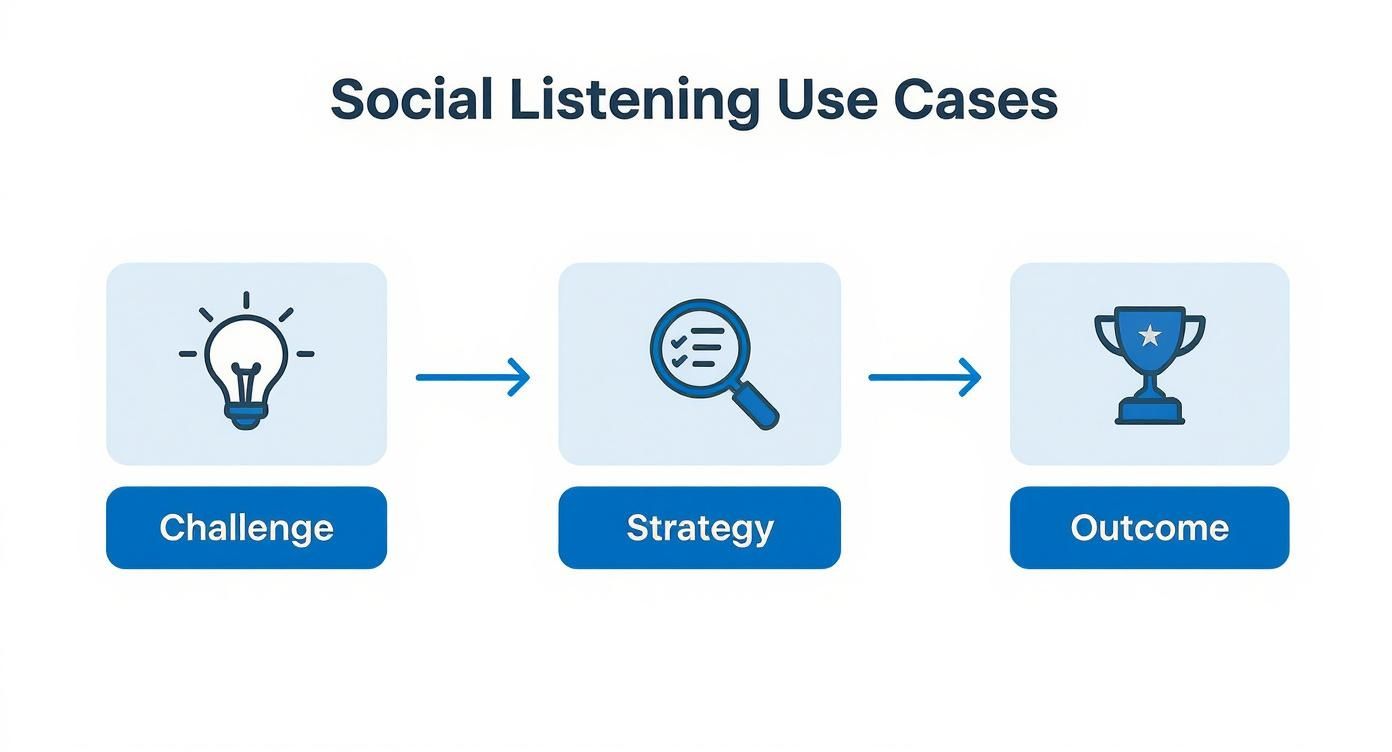
This is ultimately what the process looks like in practice. You start with a challenge and use a structured listening strategy to arrive at a measurable outcome.
Act on Insights and Measure Impact
Here’s where the rubber meets the road. All the data in the world is useless if you don't do anything with it. This final step is what separates successful social listening from a pointless exercise.
If you spot a recurring customer complaint, get that feedback to your product team immediately. If you notice a competitor’s campaign is flopping, share that intel with your marketing department so you can avoid the same mistake.
And don't forget to close the loop. Measure the impact of your actions. Did fixing that bug lead to a drop in negative sentiment? Did your competitive insight help you launch a more successful campaign? This creates a powerful feedback cycle where social listening directly fuels better business decisions, proving its value over and over again.
Got Questions? Let's Talk Social Listening
Even when you've got the basics down, a few practical questions always pop up. It’s one thing to understand a concept and another to actually put it into practice. Here are some straightforward answers to the questions we hear most often.
What Metrics Actually Matter?
It's easy to get lost in a sea of data. Instead of tracking every number you can find, focus on the metrics that tell a story about your brand's place in the market.
Here's what you should keep a close eye on:
- Share of Voice (SoV): Think of this as your brand's slice of the conversational pie. It shows you how much of the conversation in your industry is about you versus your competitors. Are you a whisper or a roar?
- Sentiment Analysis: This goes beyond if people are talking about you and digs into how they feel. Tracking the ratio of positive, negative, and neutral mentions over time is like taking your brand's emotional temperature.
- Mention Volume: The raw number of mentions is your early warning system. A sudden spike can signal a viral hit or, just as easily, a brewing crisis that needs your immediate attention. It’s the "what" that pushes you to find the "why."
- Key Themes and Topics: What are people really talking about when they mention your brand? Identifying recurring themes—like complaints about shipping, praise for a new feature, or questions about pricing—shows you what's top-of-mind for your audience.
Is This a "Big Business Only" Game?
Not at all. You don’t need a massive budget to get incredible value from social listening. For small businesses, it’s not about having the most expensive tools; it’s about being smart and consistent.
You can get started for free. Set up Google Alerts for your brand name, your CEO, and your top two competitors. Use the native search functions on X (formerly Twitter) and Reddit to see what real people are saying. Even these simple steps can uncover customer service issues, content ideas, and local engagement opportunities you’d otherwise never see.
The secret for a small business is focus. Don't try to boil the ocean. Zero in on your direct competitors, a handful of crucial industry keywords, and the conversations happening right in your backyard.
How Does AI Fit Into All This?
Think of AI as a brilliant, lightning-fast research assistant. It uses technology like Natural Language Processing (NLP) to read and understand the millions of conversations happening online, turning all that noise into clear signals.
AI gives your listening efforts superpowers in a few ways:
- It Understands Sarcasm: Old tools just matched keywords. AI gets the nuance. It can tell the difference between "Great, my package is late" and "Great! My package arrived early!" This leads to far more accurate sentiment analysis.
- It Finds the Patterns for You: Instead of you having to manually sift through thousands of comments, AI automatically groups them into themes. It can instantly show you that the recent surge in chatter is all related to your new return policy.
- It Spots Trends Before They’re Obvious: Some advanced AI can even flag emerging topics and shifts in conversation before they hit the mainstream. This gives you a serious head start on creating relevant content or getting ahead of a potential issue.
Are We Just Talking About Facebook and Instagram Here?
Absolutely not. If you only listen on the big social networks, you’re only hearing part of the story—and often, it’s not the most honest part.
Real, effective listening means casting a much wider net to capture conversations happening all across the open web. This includes places like:
- Forums: Communities on Reddit or Quora are goldmines for candid, in-depth discussions.
- Product Review Sites: This is where customers share detailed, unfiltered feedback on what they love and hate.
- Blogs and News Outlets: These sources are often what shape the wider industry narrative and public opinion about brands like yours.
A truly complete picture comes frompiecing together insights from all these different sources. It’s the only way to understand what people really think.
Ready to stop guessing what your customers are thinking and start listening? FeedGuardians uses AI to turn your social media comments into actionable insights. Automatically hide spam, detect purchase intent, and keep your community safe and engaged. See how FeedGuardians can protect your brand today.
Tired of manually moderating comments?
FeedGuardians automates spam filtering, responds to customers, and protects your brand — setup in 3 minutes.