
Quick Summary
| Key Insight | What You Need to Know |
|---|---|
| Automated Comment Hiding vs Manual Moderation | Core DifferencesHow Automated Comment Hiding WorksHow Manual Moderation Works |
| How Automated Comment Hiding | How Automated Comment Hiding Works |
| How Manual Moderation Works | How Manual Moderation Works |
| Automated Comment Moderation Tools | Capabilities and LimitationsWhat Automated Tools Can DetectThe False Positive Problem |
| What Automated Tools Can | What Automated Tools Can Detect |
| The False Positive Problem | The False Positive Problem |
Table of Contents
- Automated Comment Hiding vs Manual Moderation: Core Differences
- Automated Comment Moderation Tools: Capabilities and Limitations
- Social Media Moderation Best Practices
- Comment Moderation Policy Examples and Implementation
- Moderation Response Templates and Workflows
- Building a Hybrid Moderation Strategy
- Frequently Asked Questions
Last Updated: October 14, 2026
Automated Comment Hiding vs Manual Moderation: Core Differences
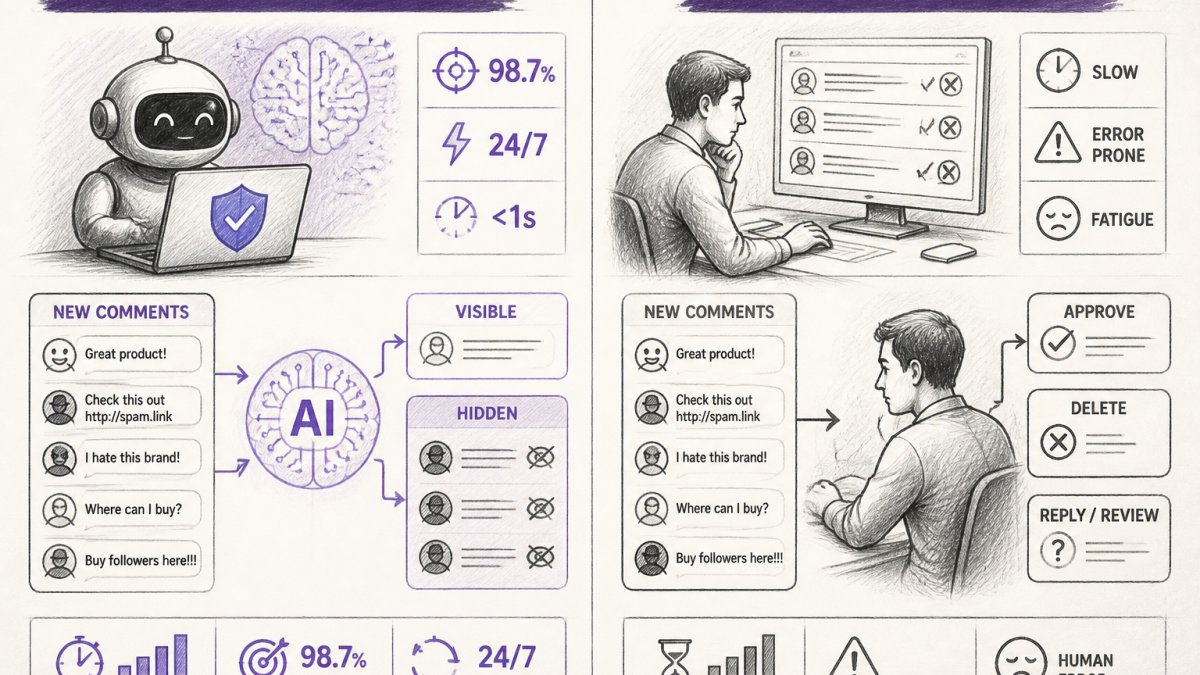
Automated comment hiding manual moderation represents two distinct approaches: automated comment hiding uses AI-powered systems to detect and automatically conceal or remove user-generated content that violates platform policies without requiring human review, while manual moderation involves human reviewers reading comments and making decisions about visibility based on community guidelines. The choice between these approaches shapes how quickly you respond to harmful content, how much your team spends on moderation, and whether your brand reputation stays protected.
At FeedGuardians, we've worked with brands managing thousands of comments daily across Instagram, Facebook, TikTok, and YouTube. The tension between speed and accuracy defines this decision. Automated systems catch spam and obvious violations in real time. Human reviewers understand context, tone, and edge cases that algorithms miss. Most successful brands don't choose one or the other, they build hybrid workflows that combine both.
How Automated Comment Hiding Works
Automated comment hiding uses machine learning to scan incoming comments against predefined rules and patterns. The system analyzes text for spam indicators, hate speech, competitor mentions, and policy violations, then hides or flags comments without waiting for human approval. When a comment triggers a threshold score, the platform automatically removes it from public view or marks it for escalation.
The speed advantage is immediate. A spam comment disappears within milliseconds. A competitor link hidden before anyone sees it. A scam message caught before it influences purchasing decisions. For high-volume accounts, this automation prevents moderation backlogs from forming in the first place. Teams that relied on manual review alone often face queues of 50+ comments waiting for approval while the comments sit visible, potentially damaging brand perception.
How Manual Moderation Works
Manual moderation places a human reviewer in the decision-making loop. Comments arrive in a review queue, and moderators read each one, apply judgment, and decide whether to approve, hide, or delete. This approach excels at understanding nuance, sarcasm, cultural context, and brand-specific sensitivities that algorithms struggle with.
A comment that looks like criticism might actually be a customer asking for help. A phrase flagged as offensive might be reclaimed language from your community. A competitor mention might be a customer comparing options, not spam. Human reviewers catch these distinctions. They also handle appeals when customers dispute a moderation decision, building trust through transparency. The trade-off is time: each comment requires human attention, and review queues grow quickly on popular posts.
Automated Comment Moderation Tools: Capabilities and Limitations
What Automated Tools Can Detect
Modern AI-powered moderation systems excel at pattern recognition. They identify spam messages, phishing attempts, hate speech, explicit content, and competitor links with consistency. FeedGuardians, for example, detects spam, scams, hate speech, and competitor links with 98.7% accuracy, learning your specific brand voice and terminology over time.
These tools work best on clear-cut violations: obvious spam, known phishing domains, slurs in their training data, and explicit images. They process thousands of comments per minute without fatigue. They enforce rules uniformly, the same comment gets the same treatment every time. For brands with strict, well-defined policies, this consistency is a major advantage. Automated systems also scale without proportional cost increases. Adding 10,000 new comments per day doesn't require hiring 10 new moderators.
The False Positive Problem
Automated systems make mistakes. A false positive hides a legitimate comment by accident. A customer asks a genuine question using language the algorithm flags as hostile. A community member uses slang that matches a hate-speech pattern. The result: frustrated customers, hidden feedback your brand should see, and erosion of trust when people realize their comments disappeared unfairly.
False positives create a hidden cost. Each one represents lost engagement, a customer who feels unheard, and potential negative word-of-mouth. Some brands hide false positives and move on. Others face backlash when customers discover their comments were removed without explanation. The severity depends on your audience and your brand voice.
False negatives are equally problematic, harmful comments that slip through. An automated system might miss a subtle insult or a scam message written in broken English. The comment stays visible, damaging brand reputation or misleading other customers. Both types of errors carry real consequences.
Social Media Moderation Best Practices
Speed vs Accuracy Trade-offs
Faster moderation means more false positives. You hide more comments automatically, catching violations quickly but also catching legitimate content by mistake. Slower, more careful moderation (human review of everything) catches nuance but creates backlogs where harmful content stays visible longer.
The optimal balance depends on your industry and audience. An e-commerce brand selling luxury goods might tolerate slower moderation, a few hours' delay before human review. A brand managing a community around mental health or crisis support needs faster response times, even if some false positives occur. A brand with a small, engaged community might prioritize accuracy and accept longer review times.
Most high-volume accounts implement automated comment hiding manual moderation through tiered speed: automate the obvious violations (spam, explicit content) for immediate hiding, then route edge cases to humans for review within a few hours. This captures speed and accuracy simultaneously.
Scalability and Team Workload
Manual moderation doesn't scale linearly. At 100 comments per day, one person can handle moderation as a side task. At 10,000 comments per day, you need a dedicated team. At 100,000 comments per day, manual moderation alone becomes prohibitively expensive. Automated systems scale to millions of comments without adding staff.
This scalability gap is why most enterprise brands automate. They can't afford to hire moderators proportional to their comment volume. But they also can't accept the false positive rate of pure automation. The solution: hybrid workflows where automation handles 80-90% of comments, and a small team reviews escalations and appeals.
Team workload also includes emotional labor. Moderators reviewing hate speech, harassment, and explicit content all day experience burnout and secondary trauma. Automation reduces this burden by handling the most toxic content, protecting your team's mental health while maintaining moderation quality.
Comment Moderation Policy Examples and Implementation
Clear policies are the foundation of consistent moderation. A policy states what content is prohibited: spam, hate speech, harassment, competitor promotion, explicit content, misinformation. Without clear rules, both automated systems and human reviewers make inconsistent decisions. Establishing these standards remains essential when balancing human versus automated workflows to determine which approach yields the most reliable moderation outcomes.
Effective policies include examples. "No competitor promotion" might mean "no direct links to competitor websites" or "no mentions of competitor products." Does it include indirect comparisons? Does it include customer questions like "How does this compare to Brand X?" Clarifying these edge cases prevents inconsistent enforcement and customer confusion.
Policies also specify consequences. Does a first violation result in hiding the comment? Deleting it? Warning the user? Banning the account? Different violations warrant different responses. A customer asking a legitimate question shouldn't face the same consequence as someone posting hate speech.
Moderation Response Templates and Workflows
Templated Responses for Common Scenarios
Templated responses speed up human moderation and enable AI systems to reply 24/7 in your brand voice. A customer asks about shipping time, a template response provides the answer immediately without waiting for a human. A customer complains about a product, a template acknowledges their frustration and offers solutions.
Effective templates include:
- Shipping and delivery questions
- Product availability and stock status
- Return and refund policies
- Pricing and discount inquiries
- Technical support for common issues
- Complaints and escalations
Templates should sound like your brand, not generic corporate language. A playful brand's templates should be playful. A professional brand's templates should be professional. The goal is consistency and speed without sacrificing personality. AI systems that learn your tone, terminology, and guidelines can adapt templates to each situation, making responses feel personalized rather than robotic.
Human Review Escalation Workflows
Not every comment needs human review. But some do. A customer complaint that requires a refund. A sensitive topic requiring careful handling. A comment that triggers the algorithm but looks legitimate. A workflow routes these escalations to humans efficiently.
A typical escalation workflow:
- Automated system screens the comment
- If confidence is high (spam, obvious violation), hide automatically
- If confidence is low (edge case, sensitive topic), add to human review queue
- Human reviewer reads the comment with context and brand guidelines
- Reviewer approves, hides, deletes, or escalates further
- System logs the decision for future training and appeals
This workflow prevents backlogs by prioritizing high-confidence decisions automatically. It also ensures edge cases receive human judgment. Over time, the system learns which types of comments humans approve or reject, improving its future decisions.
Building a Hybrid Moderation Strategy
When to Automate, When to Escalate
Automate comments that are clearly violations with high confidence. Spam messages, explicit content, known phishing domains, slurs in your training data, these are safe to hide automatically. The false positive rate is low enough that the speed gain justifies occasional mistakes.
Escalate comments that are borderline or require context. A customer using strong language, is it anger or humor? A competitor mention, is it spam or a legitimate comparison? A comment in a language or dialect the algorithm wasn't trained on. These need human judgment.
Escalate comments from high-value customers or influencers. A critical comment from a major account deserves careful review, not automatic hiding. Escalate comments on sensitive topics: health claims, financial advice, legal disputes.
FeedGuardians helps with this decision-making by flagging comments for human review when automation isn't confident, ensuring your team focuses on the decisions that matter most.
Measuring Moderation Quality and Impact
Track metrics that matter. Response time measures how quickly you address comments, both automated and human-reviewed. Approval rate shows what percentage of comments remain visible. False positive rate measures how many legitimate comments were hidden by accident.
Monitor engagement metrics too. Do comments that receive faster responses get more replies? Do customers engage differently with AI-powered responses versus human ones? Does faster moderation correlate with higher conversion rates on posts?
Quality also includes consistency. Are the same types of comments treated the same way across your accounts? Are policies enforced uniformly across different platforms? Inconsistency erodes trust and creates customer frustration. Hybrid workflows with clear escalation rules and documented decisions improve consistency over time.
The choice between automated comment hiding and manual moderation isn't binary. High-volume brands succeed by combining both approaches, using automation for speed and consistency on clear violations, and human review for nuance and context on edge cases.
Frequently Asked Questions
What is the difference between automated comment hiding and manual moderation?
Automated comment hiding uses machine learning to detect and immediately hide harmful content like spam, hate speech, and competitor links without human review. Manual moderation requires team members to read and assess each comment before taking action. Automated hiding is faster and scales to high volumes, but can flag legitimate comments by mistake. Manual moderation catches context and nuance but requires more staff time. Most effective brands use both: automation handles obvious violations, while humans review flagged edge cases and appeals.
When should a brand use automated comment hiding versus manual review?
Use automated hiding for high-volume platforms like TikTok and Instagram where you receive hundreds of comments daily. Automation handles spam, scams, and obvious policy violations instantly, protecting your ad performance and brand reputation. Use manual review for comments that require context, like sarcasm, customer complaints, or competitor mentions that might warrant a response. Brands managing multiple accounts or with limited moderation staff benefit most from automation, while niche communities with smaller comment volumes may rely more on manual oversight to maintain authentic engagement.
How can you combine automated moderation tools with human review effectively?
Set your automated comment moderation tools to flag suspicious content rather than delete it immediately. Create a review queue where moderators assess flagged comments in seconds, approving legitimate ones and hiding actual violations. This hybrid approach catches false positives before they harm user experience while still protecting you from harm. Train your team on your brand's specific guidelines so they understand which edge cases should be approved. Use moderation response templates to speed up replies to common questions, freeing staff to focus on judgment calls that require human insight.
What types of comments should be hidden automatically versus reviewed by humans?
Hide automatically: spam links, repeated promotional messages, obvious hate speech, competitor links, and known scam patterns. Escalate to humans: complaints about products or service, sarcasm or jokes that might look negative, questions requiring brand-specific answers, and comments from repeat customers. Automated detection works best on clear policy violations with consistent patterns. Comments requiring business judgment, customer relationship management, or brand voice, like deciding whether to respond to criticism with a discount or explanation, need human moderators who understand your brand values and customer relationships.
Tired of manually moderating comments?
FeedGuardians automates spam filtering, responds to customers, and protects your brand — setup in 3 minutes.
Frequently Asked Questions
What is the difference between automated comment hiding and manual moderation?
Automated comment hiding uses machine learning to detect and immediately hide harmful content like spam, hate speech, and competitor links without human review. Manual moderation requires team members to read and assess each comment before taking action. Automated hiding is faster and scales to high volumes, but can flag legitimate comments by mistake. Manual moderation catches context and nuance but requires more staff time. Most effective brands use both: automation handles obvious violations, while humans review flagged edge cases and appeals.
When should a brand use automated comment hiding versus manual review?
Use automated hiding for high-volume platforms like TikTok and Instagram where you receive hundreds of comments daily. Automation handles spam, scams, and obvious policy violations instantly, protecting your ad performance and brand reputation. Use manual review for comments that require context—like sarcasm, customer complaints, or competitor mentions that might warrant a response. Brands managing multiple accounts or with limited moderation staff benefit most from automation, while niche communities with smaller comment volumes may rely more on manual oversight to maintain authentic engagement.
How can you combine automated moderation tools with human review effectively?
Set your automated comment moderation tools to flag suspicious content rather than delete it immediately. Create a review queue where moderators assess flagged comments in seconds, approving legitimate ones and hiding actual violations. This hybrid approach catches false positives before they harm user experience while still protecting you from harm. Train your team on your brand's specific guidelines so they understand which edge cases should be approved. Use moderation response templates to speed up replies to common questions, freeing staff to focus on judgment calls that require human insight.
What types of comments should be hidden automatically versus reviewed by humans?
Hide automatically: spam links, repeated promotional messages, obvious hate speech, competitor links, and known scam patterns. Escalate to humans: complaints about products or service, sarcasm or jokes that might look negative, questions requiring brand-specific answers, and comments from repeat customers. Automated detection works best on clear policy violations with consistent patterns. Comments requiring business judgment, customer relationship management, or brand voice—like deciding whether to respond to criticism with a discount or explanation—need human moderators who understand your brand values and customer relationships.