
If you run paid social campaigns to audiences in the European Union, the comment sections under your ads now sit inside one of the most significant content-governance regimes in the world: the EU Digital Services Act. The DSA does not turn your brand into a regulated platform, but it changes the expectations and the platform rules you operate under, and it makes how you handle illegal comments a matter of process, documentation, and consistency rather than ad-hoc deletion.
This guide explains, in plain operational terms, what the DSA is, who it applies to, what it requires, and what it means specifically for the comments on your posts and ads, followed by a practical 2026 compliance checklist you can act on. For definitions of the key terms, see our glossary entries on the Digital Services Act, notice-and-action, and the statement of reasons.
What the DSA Is
The Digital Services Act is the European Union’s flagship regulation for online content governance. It became fully applicable to in-scope services across the EU on 17 February 2024, after applying to the largest platforms from 2023. Its goal is a safer, more accountable online environment, achieved by setting binding rules for how services that host user-generated content deal with illegal and harmful material, how transparent they are about moderation, and how they protect users’ rights.
Crucially, the DSA is tiered. The heaviest obligations fall on Very Large Online Platforms (VLOPs), those with more than 45 million average monthly EU users, such as the major social networks where most DTC brands advertise. But baseline duties around notice-and-action, statements of reasons, and transparency reach a far wider set of services. The result is an ecosystem where moderation is no longer optional best practice but enforceable obligation for the platforms, and a rising expectation for everyone operating on them.
Who It Applies To
The legal duties of the DSA fall on intermediary and hosting services, the platforms that host content, not on the individual brands and advertisers who use them. For the comments under your Instagram or TikTok ad, the platform is the regulated hosting service, not you. This is the single most important point of confusion to clear up: the DSA does not impose statement-of-reasons or notice-and-action obligations directly on a DTC brand running ads.
Why brands still need to care:
You operate inside the regulated ecosystem. Illegal comments on your ads, scams, counterfeit promotion, fraudulent links, hate speech, create reputational and operational risk, and platforms increasingly require advertisers to keep their ad environments clean. Brands that moderate quickly, consistently, and with a clear record are insulated from both platform enforcement and the regulatory direction of travel, which is squarely toward more accountability.
Core Requirements of the DSA
Three pillars of the DSA matter most for anyone thinking about comments. Even though they are platform obligations, they are the principles a sensible brand mirrors internally.
1. Notice-and-Action
In-scope services must give users an easy way to flag content they believe is illegal, and must then review and act on those notices in a timely, diligent, and non-arbitrary way. The outcome is not predetermined, content may be removed or left up, but the process must be fair and demonstrable. For your brand, the lesson is to have a reliable way for customers and staff to flag scams and abuse, and a fast, consistent way to act. See our notice-and-action explainer.
2. Statement of Reasons
When a platform restricts content, it generally must give the affected user a statement of reasons explaining what was done, why, whether automated tools were used, and how to appeal, and submit it to the EU Transparency Database. You are not legally required to issue these for comments on your own posts, but keeping an internal record of why each comment was hidden gives you the same clarity, which helps with disputes and consistency.
3. Transparency and Consistent Terms
The DSA requires transparency reporting and that content rules in terms of service be clear and consistently applied, not arbitrary. The brand equivalent is having a documented moderation policy and applying it evenly across every campaign rather than deleting comments on a whim. A simple, written policy plus consistent enforcement is the backbone of defensible moderation. Our moderation policy template gives you a starting point.
The DSA also recognises trusted flaggers, vetted organisations whose notices about illegal content get priority, which helps platforms remove the most serious content faster across the ecosystem your brand advertises in.
What the DSA Means for Your Comment Sections
Translated into day-to-day operations, the DSA pushes brands toward three practical habits in their comment sections:
- Timeliness. Illegal comments, scams, fraudulent links, hate speech, should be addressed quickly, ideally within minutes, not days. At advertising scale this is only realistic with automation.
- Consistency. The same rules should apply to every comment on every campaign. Arbitrary, case-by-case deletion is exactly what the regulation discourages.
- Documentation. Keep a record of what was hidden and the rule it broke. This audit trail is your internal analogue of a statement of reasons and protects you in disputes.
The hard part is that doing all three by hand is impossible once you are running multiple ads across Instagram, Facebook, TikTok, and YouTube. A manual team cannot watch every comment in real time, apply rules identically, and log every action. That gap is precisely where AI comment moderation earns its place.
Penalties
For services directly in scope, the DSA allows fines of up to 6% of total worldwide annual turnover, plus periodic penalties and, in serious cases, measures restricting operation in the EU. These penalties target the platforms, not individual advertisers, so your brand is not facing a direct DSA fine for a comment you missed. What you do face is platform-level enforcement: services under this pressure tighten their advertiser requirements, restrict accounts that attract illegal content, and expect clean ad environments. The regulatory stick lands on the platform; the operational expectation lands on you.
2026 DSA Comment-Section Compliance Checklist
Use this checklist to align your comment-section operations with DSA principles. None of these are legal advice, they are practical steps that put your brand on the right side of the direction of travel.
| Step | What to do | Why it matters |
|---|---|---|
| Written policy | Document what is and is not allowed in your comment sections | Mirrors the DSA’s "clear, consistent terms" principle |
| Real-time detection | Auto-detect and hide scams, fraud, and hate speech within seconds | Delivers the timeliness regulators and platforms expect |
| Consistent rules | Apply the same moderation rules across every campaign and platform | Avoids the arbitrary enforcement the DSA discourages |
| Audit trail | Log every moderation action with the rule it triggered | Your internal equivalent of a statement of reasons |
| Human review path | Route ambiguous or sensitive cases to a person for a decision | Keeps moderation diligent and non-arbitrary |
| Reinstatement | Be able to review and restore wrongly hidden comments | Respects users’ rights, the spirit of DSA redress |
| UK coverage | If you sell to the UK, also align with the Online Safety Act | The UK is a separate regime enforced by Ofcom |
How FeedGuardians Helps
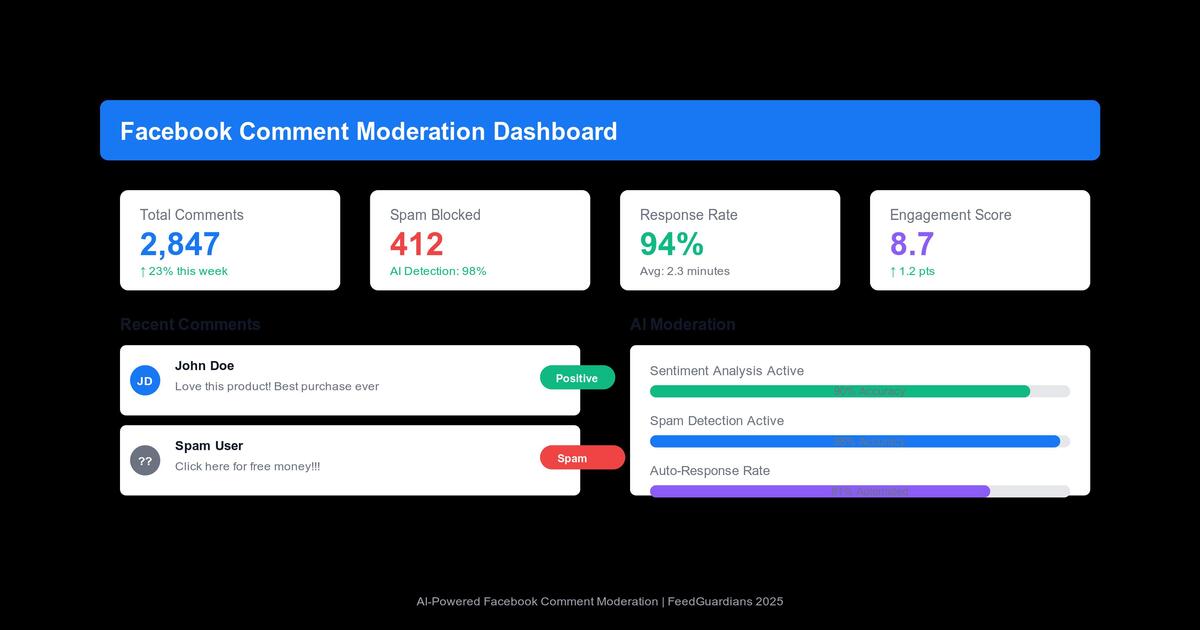
FeedGuardians turns the DSA’s principles of timeliness, consistency, and documentation into an automated, repeatable process. It scans every incoming comment across Instagram, Facebook, TikTok, YouTube, and Bluesky, hides scams, fraudulent links, impersonation, and hate speech within seconds, and applies the same brand-defined rules to every campaign. Every action is logged, giving you the audit trail that mirrors a statement of reasons, and an approval mode routes sensitive cases to your team so decisions stay diligent. Instead of a manual scramble, you get a clean, consistent, well-documented comment environment by default.
Selling into the UK as well as the EU? Read our companion guide, The UK Online Safety Act and Your Comment Section, to cover both regimes.
Frequently Asked Questions
This article is general information, not legal advice. For obligations specific to your business, consult a qualified lawyer.
Keep Your Comment Sections Clean and Documented
FeedGuardians hides illegal and harmful comments in seconds, applies consistent rules across every campaign, and logs every action, the moderation posture DSA-aware brands need.
Setup in 5 minutes. Cancel anytime.