
Quick Summary
| Key Insight | What You Need to Know |
|---|---|
| The Top 5 Social | The Top 5 Social Media Challenges for Online Retailers in 2025 Why These Challenges Matter to Your Bottom Line |
| Why These Challenges Matter | Why These Challenges Matter to Your Bottom Line |
| Challenge 1 | Managing Comment Overload and Protecting Brand Reputation The Real Cost of Unmoderated Comments How Real-Time Moderation Protects Your Ad Performance |
| The Real Cost of | The Real Cost of Unmoderated Comments |
| How Real-Time Moderation Protects | How Real-Time Moderation Protects Your Ad Performance |
| Challenge 2 | Algorithm Changes Destroying Your Organic Reach Why Organic Reach Keeps Declining Building a Paid vs. Organic Social Budget Strategy |
Table of Contents
- The Top 5 Social Media Challenges for Online Retailers in 2025
- Challenge 1: Managing Comment Overload and Protecting Brand Reputation
- Challenge 2: Algorithm Changes Destroying Your Organic Reach
- Challenge 3: Social Commerce Returns and Reverse Logistics Complexity
- Challenge 4: Scaling Micro-Influencer Partnerships Without Burning Out
- Challenge 5: Building a Cohesive Social Media Strategy for Online Retailers
- Leveraging User-Generated Content to Overcome Social Media Obstacles
- How to Turn Social Media Challenges Into Competitive Advantages
Top 5 Social Media Challenges for Online Retailers
Last Updated: July 25, 2026
Online retailers managing multiple social media channels spend an average of 18 hours per week on comment moderation, customer service, and content management. The top 5 social media challenges for online retailers have become critical operational and financial issues. At FeedGuardians, we've analyzed how brands across Instagram, Facebook, TikTok, and YouTube navigate these obstacles daily. Below, we'll show you exactly how to address each challenge and turn them into competitive advantages that protect your ad performance and boost conversions.
Why These Challenges Matter to Your Bottom Line
The social media landscape for e-commerce has fundamentally shifted. Organic reach continues to decline, algorithm changes arrive without warning, and customer expectations for real-time responses are non-negotiable. A single unmoderated hateful comment can tank ad performance. A missed influencer partnership opportunity costs revenue. Reverse logistics from social commerce returns creates operational chaos.
Brands that address these challenges systematically unlock significant advantages: faster response times, better brand reputation, higher customer lifetime value, and stronger omnichannel experiences. This is how modern online retailers maintain dominance in a crowded digital marketplace.
Challenge 1: Managing Comment Overload and Protecting Brand Reputation
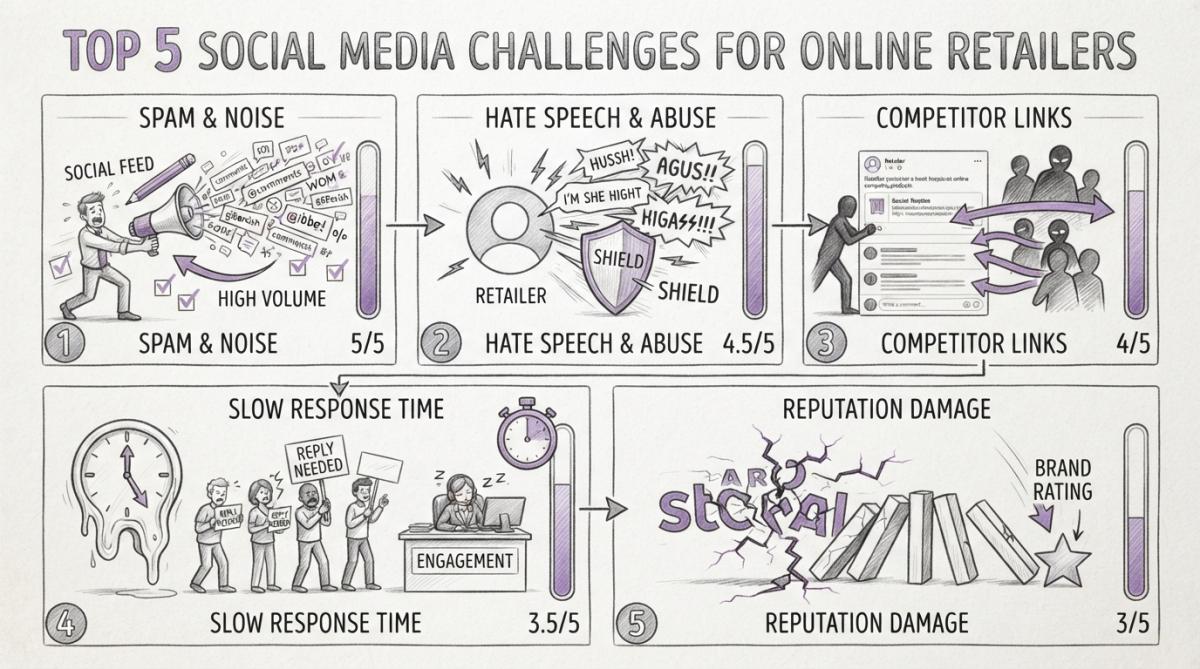
A single viral post can generate thousands of comments within hours. Spam, hate speech, competitor attacks, and scams arrive faster than any human team can moderate. Meanwhile, your paying customers wait for legitimate responses.
Unmoderated comments directly damage ad performance. Meta's algorithm deprioritizes posts with negative engagement patterns. Competitors flood your comments with discount codes and competitor links. Bad actors pose as your brand in replies. Each incident reduces your reach, tanks conversion rates, and erodes customer trust.
How Real-Time Moderation Protects Your Ad Performance
Real-time moderation removes harmful content that tanks algorithm performance and enables fast, consistent responses that build customer loyalty. When you respond to legitimate comments within the first hour, engagement metrics spike. When you hide spam and hate speech immediately, your posts stay algorithmically favored longer.
FeedGuardians automatically detects and hides spam, scams, hate speech, and competitor links with 98.7% accuracy. The system learns your brand voice and guidelines, then delivers 24/7 AI-powered replies in your unique tone. Your team shifts from reactive firefighting to strategic conversation, focusing on complex customer issues that require human judgment.
Challenge 2: Algorithm Changes Destroying Your Organic Reach
Meta, TikTok, and YouTube publish their algorithmic preferences clearly, yet most retailers don't adjust their social media strategy accordingly. Organic reach on Facebook has declined 64% since 2020. TikTok's algorithm now favors watch time over engagement rate. Instagram's Reels receive 67% more distribution than static posts. YouTube prioritizes longer average view duration.
Most online retailers post the same content mix across all platforms, expecting consistent results. This approach no longer works.
Why Organic Reach Keeps Declining
Platforms want to maximize user time on their apps. They reward content that keeps people scrolling, watching, and engaging. Static product photos don't do that. Long-form video, user-generated content, and live streams do. Behind-the-scenes content does.
For online retailers, this creates a dilemma: organic reach requires content investment that doesn't directly sell products. Paid social guarantees reach but demands budget discipline. Retailers winning right now have stopped treating organic and paid as separate strategies. They use organic to test content, identify what resonates, then amplify winning content with paid spend.
Building a Paid vs. Organic Social Budget Strategy
The optimal budget split depends on your current organic performance. If you're getting zero traction organically, allocating 80% to paid is reasonable. If you have an engaged audience and strong organic performance, 60% paid / 40% organic creates sustainable growth.
Track cost per acquisition across channels. Most retailers discover that organic content, once it gains traction, delivers cheaper long-term customers because it builds trust and familiarity. Paid ads drive immediate conversions but don't build brand equity the same way.
Challenge 3: Social Commerce Returns and Reverse Logistics Complexity
Social commerce is booming, but returns from social commerce are fundamentally different from traditional e-commerce returns. A customer who bought from your website navigated product pages, read descriptions, and made an informed decision. A customer who bought from a TikTok Shop video made an impulse decision based on a 15-second clip. Return rates are often 2-3x higher.
Why Social Commerce Returns Are Different
Social commerce returns happen faster and are initiated through DMs or comments rather than your standard return portal. Customers expect refunds within days, not weeks. This creates operational chaos if you're not prepared. Your fulfillment team doesn't know where returned items are coming from. Your inventory system can't track which platform a return originated on.
Simplifying Reverse Logistics Across Platforms
The solution requires integration across three systems: your social commerce platform, your order management system, and your fulfillment operations. When a customer initiates a return through TikTok Shop, that return needs to automatically appear in your OMS with full context: original order details, platform origin, customer location, and return reason.
Many retailers use a centralized returns hub. Instead of sending returned items back to the original fulfillment center, they route all social commerce returns to a single location for faster processing. This consolidation reduces handling time and improves inventory visibility.
Challenge 4: Scaling Micro-Influencer Partnerships Without Burning Out
Micro-influencers (10K-100K followers) deliver better ROI than mega-influencers for most online retailers. Their audiences are more engaged, their rates are lower, and their content feels more authentic. But managing 20, 50, or 100 micro-influencer relationships simultaneously requires systems in place.
Finding and Vetting Micro-Influencers at Scale
Start with platform-native discovery tools. Instagram's Creator Marketplace, TikTok Creator Fund, and YouTube Partner Program all have built-in influencer discovery features.
Use engagement rate as your primary metric, not follower count. An influencer with 25K followers and 8% engagement rate is more valuable than one with 250K followers and 1% engagement rate. Calculate engagement rate as (likes + comments) / follower count × 100.
Check audience demographics. If your target customer is women 25-34 in urban areas, and the influencer's audience is 60% men 35-50, the partnership won't work regardless of engagement rate.
Managing Content Rights and Performance Tracking
Establish written agreements that specify content deliverables, rights to reuse content on your own channels, performance expectations, compensation structure, and exclusivity terms.
Use a centralized dashboard to track all influencer campaigns. Assign each influencer a unique discount code or UTM parameter. This lets you measure actual sales attributed to each partnership, not just vanity metrics like reach or impressions.
Challenge 5: Building a Cohesive Social Media Strategy for Online Retailers
What separates retailers making money on social media from those losing money is a unified strategy, not scattered platform-specific tactics. This means consistent messaging across channels, coordinated content calendars, unified customer data, and integrated analytics.
Most online retailers treat each platform as a separate business. Instagram content doesn't connect to TikTok strategy. Facebook ads run independently of YouTube campaigns. Customer data from Instagram DMs never reaches your email marketing system.
Choosing the Right Tech Stack Without Channel Overload
Your tech stack should connect four layers: content creation and scheduling, customer relationship management, analytics and attribution, and fulfillment integration. Prioritize integration over best-of-breed tools for each layer.
A unified social media management platform (like Sprout Social) that connects to your CRM (HubSpot or Salesforce) and your e-commerce system (Shopify or WooCommerce) eliminates manual data transfer. For influencer management at scale, platforms like GRIN automate product seeding, affiliate tracking, and content rights management. For user-generated content, Yotpo collects reviews and photos that you can repurpose across social channels.
Start with 3-4 core tools that integrate well, then add specialized tools only when you've maxed out what your core stack can do.
Measuring Social Media ROI in E-Commerce
Use multi-touch attribution to assign credit across channels based on their role in the customer journey. First-touch attribution overvalues awareness channels. Last-touch attribution overvalues conversion channels. Multi-touch attribution balances both.
Track these metrics for each platform: cost per click (CPC), cost per acquisition (CPA), return on ad spend (ROAS), customer lifetime value (CLV) for customers acquired through that channel, and repeat purchase rate.
Compare these metrics to your business targets. If your target ROAS is 3:1 and TikTok is delivering 2.1:1, that channel needs optimization or budget reduction. If Instagram is delivering 4.2:1 ROAS, increase spend there.
Using User-Generated Content to Overcome Social Media Obstacles
User-generated content (UGC) solves multiple problems simultaneously. It reduces your content creation burden, builds social proof, increases engagement, and improves algorithmic performance. Customers trust peer reviews and customer photos more than brand-created content.
Create a branded hashtag and promote it across channels. Offer small incentives (discount codes, free shipping, entry into a monthly giveaway) for customers who post with your hashtag. Repost the best UGC on your brand channels, giving credit to the original creator.
For social commerce specifically, UGC performs exceptionally well. A video of a real customer using your product converts better than a professional product demo. Platforms like Yotpo and Billo make this easier by collecting customer reviews, photos, and videos, then distributing them across your social channels and website.
| Channel | UGC Effectiveness | Collection Method | Best Use Case |
|---|---|---|---|
| High (visual platform) | Branded hashtag + incentives | Product photos, styling inspiration | |
| TikTok | Very High (authentic content) | Hashtag challenges, creator partnerships | Product demos, unboxing, tutorials |
| Medium (older demographic) | Review requests, customer testimonials | Trust-building, social proof | |
| YouTube | High (long-form) | Customer testimonials, case studies | Detailed product reviews, how-tos |
How to Turn Social Media Challenges Into Competitive Advantages
Retailers winning right now don't see these challenges as obstacles. They see them as opportunities to build systems that competitors haven't built yet.
When you implement real-time comment moderation and AI-powered responses, you're building a customer service asset that runs 24/7. Your response time beats competitors by hours. When you master paid versus organic budget allocation, you're building a repeatable playbook that scales. When you systematize influencer partnerships, you're building a distribution channel that competitors can't easily replicate.
Start with your biggest pain point. If comment management is consuming 10 hours per week, fix that first. If algorithm changes are destroying your organic reach, rebuild your content strategy. If returns are chaotic, systematize your reverse logistics. Each problem solved becomes a competitive advantage.
The difference between online retailers that scale profitably and those that plateau comes down to operational excellence. Managing comments, navigating algorithm changes, handling returns, scaling influencer partnerships, and measuring ROI aren't separate problems, they're interconnected challenges that require a unified approach.
FeedGuardians solves the first piece: real-time comment moderation and AI-powered responses that protect your ad performance and save your team hours daily. With 98.7% accuracy in detecting spam, hate speech, and competitor attacks, plus 24/7 responses in your brand voice, you can focus on strategy instead of firefighting. Start for free and see how automated moderation transforms your social media operation.
Frequently Asked Questions
What are the biggest social media challenges for online retailers in 2025?
The top challenges include managing comment overload and brand reputation protection, adapting to algorithm changes that reduce organic reach, handling social commerce returns and reverse logistics, scaling micro-influencer partnerships, and building a cohesive omnichannel social media strategy. Each challenge directly impacts conversion rates, customer experience, and ROI. Online retailers must address these simultaneously while maintaining authentic engagement across multiple platforms, Instagram, TikTok, Facebook, and YouTube.
How can measuring social media ROI for e-commerce help retailers overcome these challenges?
Tracking social media ROI e-commerce metrics, such as conversion rate, customer acquisition cost, and lifetime value per platform, reveals which challenges are costing you the most money. By measuring ROI, you can identify whether algorithm changes are your biggest problem, or if comment management and brand reputation issues are driving customers away. This data helps you allocate budget wisely between paid and organic social, prioritize platform investments, and justify spending on tools that automate comment moderation and response.
Why is user-generated content e-commerce critical for solving social media challenges?
User-generated content e-commerce, reviews, photos, videos from real customers, provides authentic social proof that builds trust and increases conversion rates without relying on algorithmic reach. UGC reduces your dependence on organic algorithm performance, fills your content calendar with fresh material, and encourages customer loyalty and retention. It also mitigates comment management challenges by shifting focus to positive customer voices and testimonials, which naturally improve brand perception and ad performance.
What's the best approach to budget allocation between paid vs. organic social?
Start by measuring current ROI on both channels. Most online retailers find that organic reach continues declining due to algorithm changes, making a 70/30 split (paid to organic) more realistic than the traditional 50/50. Allocate paid budget to high-performing content types (video, carousel ads, shoppable posts), and use organic channels for community engagement, customer service, and UGC amplification. Continuously test and adjust based on your specific audience behavior and platform performance data.
How does real-time comment moderation improve ad performance for online retailers?
Unmoderated comments with spam, hate speech, or competitor links damage trust and reduce ad click-through rates. Real-time moderation that automatically detects and hides harmful content, with 98.7% accuracy, protects your brand reputation and keeps your audience engaged. When customers see a clean, professional comment section with quick, brand-voice responses to questions, they're more likely to click your ads, complete purchases, and recommend your products. This directly boosts conversion rates and lowers customer acquisition costs.
This article was written using GrandRanker
Tired of manually moderating comments?
FeedGuardians automates spam filtering, responds to customers, and protects your brand — setup in 3 minutes.
Frequently Asked Questions
What are the biggest social media challenges for online retailers in 2025?
The top challenges include managing comment overload and brand reputation protection, adapting to algorithm changes that reduce organic reach, handling social commerce returns and reverse logistics, scaling micro-influencer partnerships, and building a cohesive omnichannel social media strategy. Each challenge directly impacts conversion rates, customer experience, and ROI. Online retailers must address these simultaneously while maintaining authentic engagement across multiple platforms—Instagram, TikTok, Facebook, and YouTube.
How can measuring social media ROI for e-commerce help retailers overcome these challenges?
Tracking social media ROI e-commerce metrics—such as conversion rate, customer acquisition cost, and lifetime value per platform—reveals which challenges are costing you the most money. By measuring ROI, you can identify whether algorithm changes are your biggest problem, or if comment management and brand reputation issues are driving customers away. This data helps you allocate budget wisely between paid and organic social, prioritize platform investments, and justify spending on tools that automate comment moderation and response.
Why is user-generated content e-commerce critical for solving social media challenges?
User-generated content e-commerce—reviews, photos, videos from real customers—provides authentic social proof that builds trust and increases conversion rates without relying on algorithmic reach. UGC reduces your dependence on organic algorithm performance, fills your content calendar with fresh material, and encourages customer loyalty and retention. It also mitigates comment management challenges by shifting focus to positive customer voices and testimonials, which naturally improve brand perception and ad performance.
What's the best approach to budget allocation between paid vs. organic social?
Start by measuring current ROI on both channels. Most online retailers find that organic reach continues declining due to algorithm changes, making a 70/30 split (paid to organic) more realistic than the traditional 50/50. Allocate paid budget to high-performing content types (video, carousel ads, shoppable posts), and use organic channels for community engagement, customer service, and UGC amplification. Continuously test and adjust based on your specific audience behavior and platform performance data.
How does real-time comment moderation improve ad performance for online retailers?
Unmoderated comments with spam, hate speech, or competitor links damage trust and reduce ad click-through rates. Real-time moderation that automatically detects and hides harmful content—with 98.7% accuracy—protects your brand reputation and keeps your audience engaged. When customers see a clean, professional comment section with quick, brand-voice responses to questions, they're more likely to click your ads, complete purchases, and recommend your products. This directly boosts conversion rates and lowers customer acquisition costs.