
Quick Summary
| Key Insight | What You Need to Know |
|---|---|
| Understanding the $900,000 AI | Understanding the $900,000 AI Job Market |
| Total Compensation Packages in Tech | Breaking Down the $900K Base Salary Component Equity and Restricted Stock Units Performance Bonuses and Cash Incentives |
| Base Salary Component | Base Salary Component |
| Equity and Restricted Stock | Equity and Restricted Stock Units |
| Performance Bonuses and Cash | Performance Bonuses and Cash Incentives |
| Core Roles That Command | Core Roles That Command $900K Compensation AI Product Manager Director of Machine Learning AI Research Lead |
Table of Contents
- Understanding the $900,000 AI Job Market
- Total Compensation Packages in Tech: Breaking Down the $900K
- Core Roles That Command $900K Compensation
- AI Engineer Salary Expectations and Market Demand
- Essential Skills for High-Compensation AI Positions
- How to Negotiate Tech Salary and Reach $900K+
- The Reality: Rarity and Requirements
- Conclusion
Last Updated: August 21, 2026
Understanding the $900,000 AI Job Market
A $900,000 AI job represents one of the highest compensation tiers in technology, reserved for specialists commanding rare expertise in artificial intelligence, machine learning, and strategic business leadership. These roles sit at the intersection of technical mastery and executive decision-making, where a single hire can reshape how a company builds, deploys, or monetizes AI systems.
Reaching this compensation level requires more than technical credentials. It demands proven impact, specialized expertise, and the ability to influence business outcomes. Most professionals in tech never approach this threshold. Those who do typically spend 8-12 years building credibility through increasingly senior roles and accumulating a track record that justifies the investment.
The professionals commanding $900K compensation solve problems that directly affect revenue, infrastructure scalability, or competitive positioning. Their departure can stall product roadmaps or force companies to rethink AI strategy entirely. This scarcity drives the compensation premium. The market has expanded significantly since 2024, but the number of qualified candidates remains artificially constrained.
Total Compensation Packages in Tech: Breaking Down the $900K
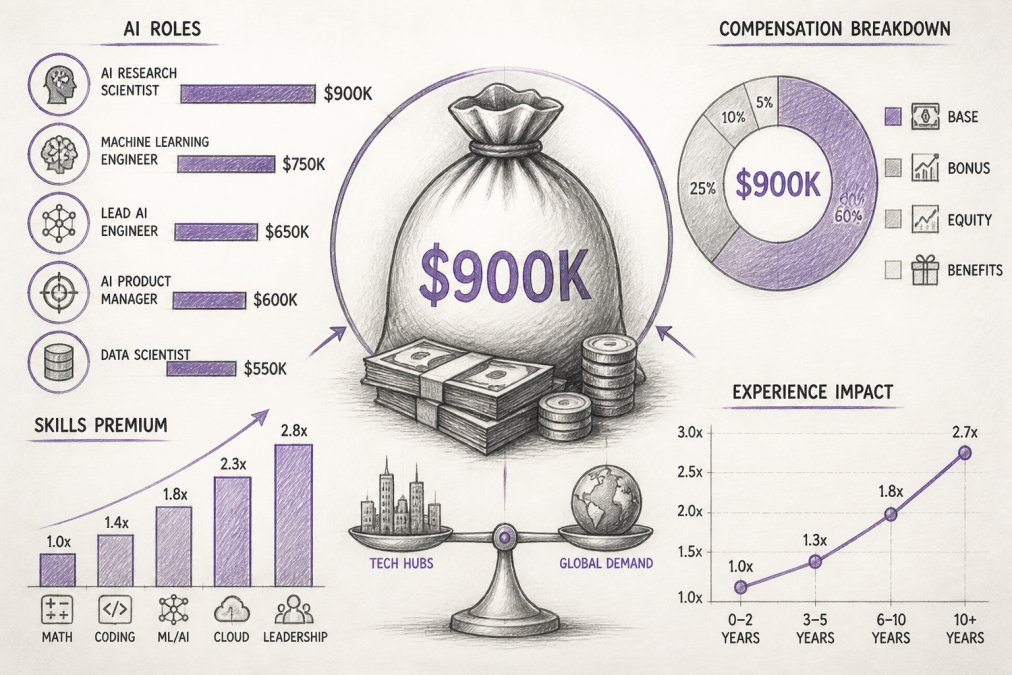
A $900,000 package is typically engineered across three distinct components: base salary (immediate income), equity (long-term wealth building), and performance bonuses (incentives). Understanding this breakdown is essential for anyone negotiating at this level.
Base Salary Component
Base salary typically ranges between $200,000 and $300,000 for director-level AI roles. This is the guaranteed portion, representing only 25-30% of the total compensation package. A $250,000 base salary places you in the top 1-2% of earners in the United States (census.gov).
Base salary must be high enough to attract talent without creating unsustainable fixed costs. Most tech companies optimize it to be competitive within a geographic market while keeping it low enough to avoid salary compression across the organization. The base salary floor for director-level AI positions has risen steadily since 2024, reflecting both inflation and intensifying competition for AI leadership talent.
Equity and Restricted Stock Units
Equity represents the largest component of a $900K package, typically accounting for $350,000 to $450,000 in annual value. This comes in restricted stock units (RSUs), which vest over a standard 4-year period. The annual RSU grant is calculated based on the company's current stock price at hire, meaning actual dollar value fluctuates with market conditions.
For director-level AI roles at established tech companies, a typical RSU grant might be 2,000-3,000 units annually. The vesting schedule typically follows a 4-year cliff: 25% vests after one year, then the remaining 75% vests monthly over the next three years (sec.gov). This structure discourages early departure while rewarding those who stay through the vesting period.
Performance Bonuses and Cash Incentives
Performance bonuses typically make up $200,000 to $300,000 of the $900K package, tied to specific, measurable outcomes: shipping major features, hitting revenue targets, reducing infrastructure costs, or achieving specific AI model performance benchmarks. Bonuses are paid annually, usually in the first quarter following the fiscal year.
For director-level AI roles, performance metrics typically focus on business outcomes rather than activity metrics. You're measured on "models deployed that improved conversion by X%" or "infrastructure improvements that reduced inference latency by Y%."
Core Roles That Command $900K Compensation
Not every AI role commands $900K compensation. These roles share common characteristics: they require 8-12 years of specialized experience, directly influence business outcomes, and would be genuinely difficult to replace.
AI Product Manager
An AI Product Manager at the director level bridges technical depth and business strategy, owning the product roadmap for an AI-powered feature or platform. The compensation premium reflects the scope of impact: a bad decision on model selection or deployment strategy can cost millions in wasted infrastructure spend or lost revenue.
This role requires genuine technical literacy in machine learning, data infrastructure, and algorithmic development. Compensation for director-level AI Product Managers typically ranges from $850,000 to $1.2 million, depending on company size and AI maturity.
Director of Machine Learning
The Director of Machine Learning oversees the technical roadmap for machine learning systems, manages a team of ML engineers, and ensures systems meet performance, latency, and reliability requirements. This role requires deep expertise in algorithmic development, model architecture, and the practical constraints of deploying models at scale.
Director of Machine Learning positions typically pay $900,000 to $1.3 million in total compensation. The variation depends heavily on company size and how central machine learning is to the business.
AI Research Lead
The AI Research Lead identifies emerging techniques that could improve product performance, builds proof-of-concepts, and integrates research findings into production systems. This role is less common than the previous two, and compensation is correspondingly less standardized. At research-focused companies, AI Research Leads can earn $950,000 to $1.5 million.
AI Engineer Salary Expectations and Market Demand
AI engineer compensation has bifurcated sharply since 2024. Senior individual contributors (ICs) in AI engineering can approach or exceed $900K in total compensation. The market increasingly distinguishes between generalist software engineers and specialists with deep expertise in machine learning, infrastructure, or model deployment.
Companies are no longer hiring AI engineers to "explore AI possibilities." They're hiring them to solve specific, high-stakes problems: reducing model inference latency, improving model accuracy, building scalable training infrastructure, or deploying models safely at scale.
Senior AI engineers (8-12 years of experience) with expertise in specific domains command $600,000 to $900,000 in total compensation (bls.gov). The compensation depends heavily on specialization. An engineer expert in training infrastructure at a company running massive language models earns more than an engineer building recommendation models at a smaller company. The engineers commanding top compensation are those with proven track records of shipping AI systems that work at scale.
Essential Skills for High-Compensation AI Positions
Reaching $900K compensation requires a specific skill stack combining technical depth with business acumen, leadership capability, and organizational navigation.
Technical Proficiency and Specialized Expertise
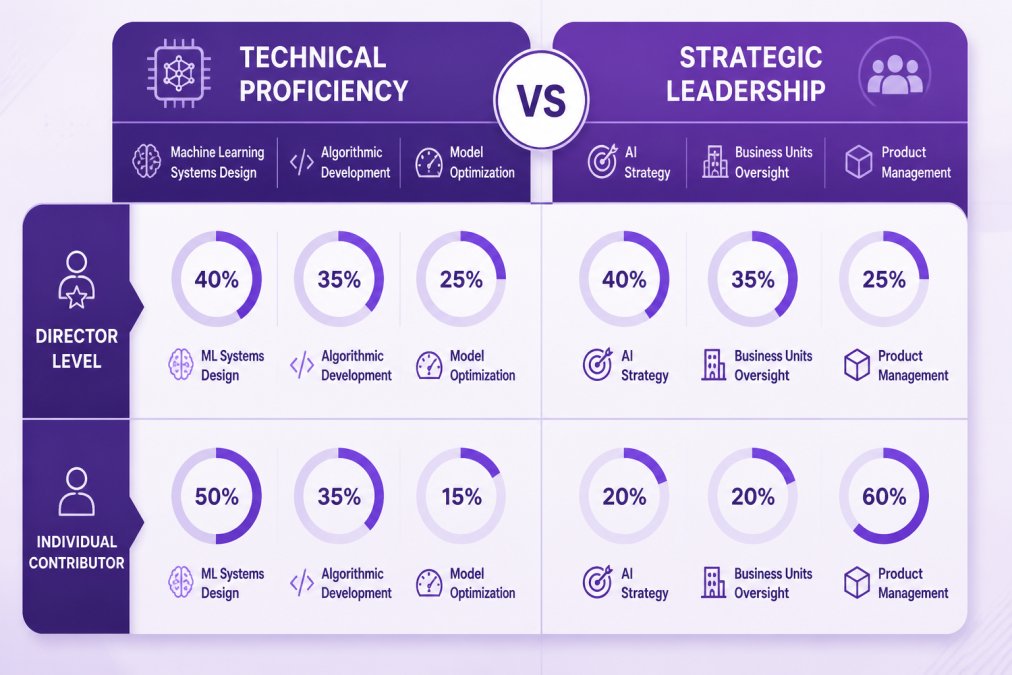
Technical proficiency at the $900K level means deep, production-focused expertise in machine learning, algorithmic development, and infrastructure. This is the ability to diagnose why a model's performance degraded in production, design systems that serve models with specific latency requirements, or identify which algorithmic approach will scale to your data volume and compute budget.
Specialized expertise is increasingly important. A generalist machine learning engineer earns less than an engineer with deep expertise in a specific domain: training infrastructure, model optimization, reinforcement learning, or computer vision at scale. The market pays for depth because depth solves specific, high-stakes problems.
The technical skills that command premium compensation include machine learning systems design at scale, large language model training and deployment, model optimization and inference efficiency, infrastructure and distributed systems for ML workloads, data pipeline architecture, and algorithmic development.
Strategic Leadership and Business Acumen
Strategic leadership at the $900K level means understanding how AI capabilities translate into business outcomes. You articulate why a specific model improvement matters for revenue, explain trade-offs between model accuracy and infrastructure cost, and make decisions balancing technical excellence with business reality.
Business acumen includes understanding your company's business model, recognizing which AI investments will have the highest impact, and communicating technical concepts to non-technical stakeholders. Most $900K roles include people management responsibility. You're multiplying your impact through others.
How to Negotiate Tech Salary and Reach $900K+
Negotiating to $900K requires understanding that compensation is less standardized, more flexible, and more openly negotiable at this level. The gap between initial offer and negotiated compensation is often $150,000-$300,000.
Before negotiating, establish your market value by researching compensation for your specific role at similar companies, talking to recruiters, and leveraging competitive offers as anchors. The most powerful negotiating position is having multiple offers at similar compensation levels.
When negotiating, focus on total compensation, not base salary alone. A company might hesitate to increase base salary by $50,000 but could easily increase equity or bonus. Base salary is more rigid due to internal equity concerns, while equity and bonus have more room to move.
Negotiate the performance bonus structure explicitly. Get clarity on what "on-track" performance looks like, what percentage of the bonus typically pays out, and whether bonuses are affected by company-wide performance or individual metrics only.
The Reality: Rarity and Requirements
$900,000 AI job compensation exists, but it's genuinely rare. The number of people earning this level in AI-focused roles is probably in the low thousands across the entire United States.
Reaching this level requires specific conditions: you need to work at a company large enough to have high-stakes AI problems, build a track record of solving those problems, and be in a position where your departure would genuinely disrupt the organization. Most people never hit all three conditions simultaneously.
The timeline to $900K typically spans 10-15 years from the start of a technical career: 3-4 years as a mid-level engineer, 3-4 years as a senior engineer, 2-3 years as a staff or principal engineer, then 2-3 years as a director or research lead. Each transition requires not just technical excellence but demonstrated ability to operate at the next level.
The market for $900K AI talent is driven by a small number of companies: large tech firms with significant AI ambitions, well-funded AI startups that have achieved scale, and companies in financial services or healthcare where AI directly affects revenue. If you work at a company not in this category, reaching $900K is mathematically unlikely regardless of your performance.
Compensation at this level also comes with trade-offs. You're typically working on high-stakes problems with significant pressure. Your decisions affect infrastructure costs, revenue, or competitive positioning. You're managing teams, navigating organizational politics, and spending significant time on non-technical work.
Negotiating to $900,000 in AI compensation requires understanding how total compensation packages work, which roles command this premium, and what skills justify it. The path typically spans 10-15 years and requires working at organizations large enough to have high-stakes AI problems worth solving. Focus on building specialized technical expertise, developing strategic leadership capability, and positioning yourself at a company where your AI work directly impacts business outcomes. Start by building depth in a specific AI domain, seek roles at companies where that expertise matters, and use competitive offers to negotiate total compensation packages that reflect your market value.
Frequently Asked Questions
What skills are required for a $900,000 AI salary?
Reaching $900K compensation requires a combination of deep technical expertise and strategic leadership. You need proficiency in machine learning, algorithmic development, and infrastructure scaling. Equally important are product management capabilities, the ability to shape AI strategy across business units, and proven experience leading technical teams. Director-level roles emphasize business acumen and model safety oversight, while specialized expertise in areas like large language models or data science can command premium compensation.
How does total compensation (TC) work for high-level AI roles?
Total compensation packages at the $900K level typically include base salary (usually $200K-$300K), equity packages (often $300K-$500K in restricted stock units), and performance-based bonuses (up to $200K+). The mix varies by company and role. Equity vests over 4 years, so total compensation reflects long-term value. Director-level and principal engineer roles often weight equity more heavily than junior positions, making negotiation of stock grants critical to reaching $900K total compensation.
Are $900,000 AI jobs common in the tech industry?
No, $900K positions are rare and concentrated among top tech companies with significant AI research and product divisions. These roles typically require 10+ years of experience, a track record of shipping AI products, and specialized expertise. Market demand for AI leadership is strong, but the number of positions paying this level is limited.
What does a Machine Learning Product Manager do?
An ML Product Manager bridges technical development and business strategy. They define product roadmaps for AI features, prioritize algorithmic development, oversee model safety and scalability, and ensure AI solutions align with business units' needs. They work with data science teams, manage product lifecycle from conception to launch, and analyze how AI automation impacts user behavior and revenue. This hybrid role commands high compensation because it requires both technical proficiency and executive-level strategic oversight.
This article was written using GrandRanker
Tired of manually moderating comments?
FeedGuardians automates spam filtering, responds to customers, and protects your brand — setup in 3 minutes.
Frequently Asked Questions
What skills are required for a $900,000 AI salary?
Reaching $900K compensation requires a combination of deep technical expertise and strategic leadership. You need proficiency in machine learning, algorithmic development, and infrastructure scaling. Equally important are product management capabilities, the ability to shape AI strategy across business units, and proven experience leading technical teams. Director-level roles emphasize business acumen and model safety oversight, while specialized expertise in areas like large language models or data science can command premium compensation.
How does total compensation (TC) work for high-level AI roles?
Total compensation packages at the $900K level typically include base salary (usually $200K–$300K), equity packages (often $300K–$500K in restricted stock units), and performance-based bonuses (up to $200K+). The mix varies by company and role. Equity vests over 4 years, so total compensation reflects long-term value. Director-level and principal engineer roles often weight equity more heavily than junior positions, making negotiation of stock grants critical to reaching $900K total compensation.
Are $900,000 AI jobs common in the tech industry?
No, $900K positions are rare and concentrated among top tech companies with significant AI research and product divisions. These roles typically require 10+ years of experience, a track record of shipping AI products, and specialized expertise. Market demand for AI leadership is strong, but the number of positions paying this level is limited.
What does a Machine Learning Product Manager do?
An ML Product Manager bridges technical development and business strategy. They define product roadmaps for AI features, prioritize algorithmic development, oversee model safety and scalability, and ensure AI solutions align with business units' needs. They work with data science teams, manage product lifecycle from conception to launch, and analyze how AI automation impacts user behavior and revenue. This hybrid role commands high compensation because it requires both technical proficiency and executive-level strategic oversight.