If you're a performance marketer, you're probably obsessed with CAC, ROAS, and finding scalable channels. But what if one of the most powerful growth levers isn't an ad platform at all? What if it's a community?
Marketing in Facebook Groups is exactly that. It's about shifting your mindset from broadcasting ads to building a genuine community. You create a dedicated space where your best customers can connect, share, and feel a sense of belonging. This strategy builds a powerful, long-term asset that your competitors simply can't buy or copy.
Why Facebook Groups Are Your Untapped Growth Channel
Let's be honest, the trust between brands and consumers is at an all-time low. People are tired of ads. They're scrolling right past them and asking their friends for recommendations instead. A Facebook Group lets you tap directly into that peer-to-peer trust.
Think about it: instead of constantly fighting the algorithm for a sliver of attention in the main news feed, you create your own private ecosystem. Your group becomes a direct, unfiltered line to your most passionate customers and prospects—a channel you actually control.
The Power of Community-Led Growth
A well-run Facebook Group is so much more than a list of members. It’s a dynamic, living part of your business. It’s your always-on focus group, giving you raw, honest feedback on new products, ad angles, and campaign ideas. That kind of direct insight is pure gold for making smarter, faster decisions.
You’re not just acquiring customers; you're building a tribe. When people feel like they belong to something, they become incredibly loyal. They turn into your biggest advocates, spreading the word and driving the kind of organic, word-of-mouth marketing that money can't buy.
A dedicated community is your ultimate competitive advantage. While anyone can copy your product or ad strategy, no one can replicate the trust and connection you build within your own private group.
A Hub for Engaged Users
The numbers here are just too big to ignore. A staggering 1.8 billion people use Facebook Groups every single month. What’s really telling for us marketers is that more than half of them belong to five or more groups. This isn't just passive scrolling; it's a clear signal that people are actively seeking out niche communities.
This level of engagement is a goldmine. By simply being present and listening, you can uncover customer pain points, get ideas for new content, and spot market trends before they even hit your radar. It’s the most authentic form of social listening you can possibly get.
Building Your Group's Strategic Foundation
When you see a buzzing Facebook Group, it looks organic and effortless. The reality? It’s anything but. That vibrant community is the result of a solid, deliberate strategy. Diving in without a clear plan is a surefire way to end up with a digital ghost town.
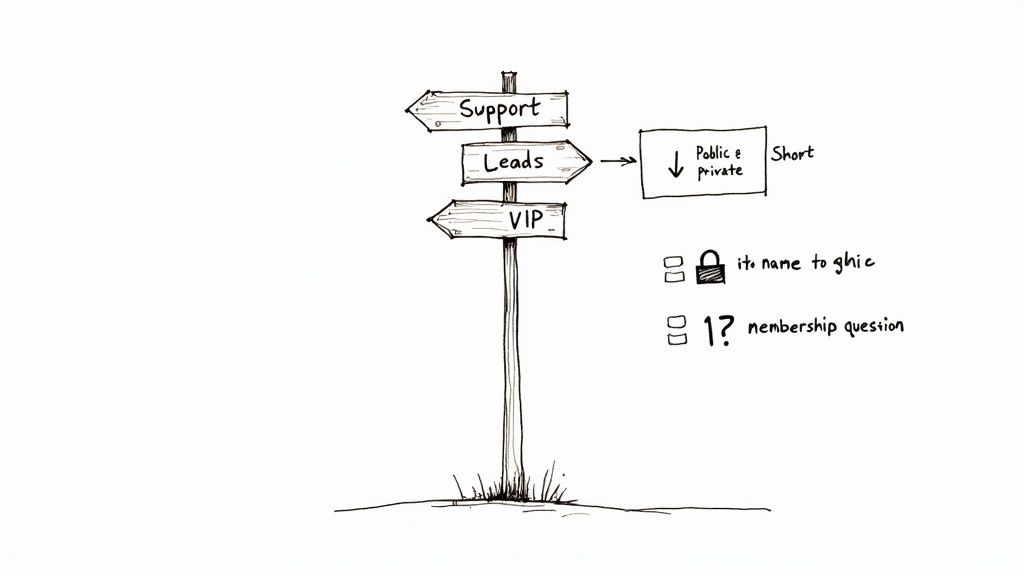
Before you do anything else, you have to lock in your group's core purpose. What's the one big thing you need this community to achieve? Seriously, pick one. Every decision you make from here on out will flow from this single goal.
- Lead Nurturing: Is this a space to warm up potential customers? You'll be providing tons of value and answering questions to guide them toward a purchase.
- VIP Community: Maybe it's an exclusive club for your absolute best customers. Think early access to products, special perks, and a direct line to your team.
- Customer Support: Or is the primary goal to help users master your product, solve problems, and share their wins with each other?
This single choice changes everything. A lead nurturing group needs to be easy to find and join, whereas a VIP community is all about exclusivity.
Public Versus Private Groups
Your group's visibility setting is a direct consequence of its purpose. It's tempting to go public for maximum reach, but that often opens the floodgates to low-quality members and a whole lot of spam.
For nearly every marketing objective, a private and visible group is the sweet spot. This setup lets people find your group through search, but they have to request to join and get approved by you. It creates a natural filter, building a sense of exclusivity and giving you total control over who you let in. You end up with members who are genuinely invested.
A private group sends a powerful psychological signal: "This isn't a free-for-all. It's a curated space with real value." That perception alone boosts the value of being a member and encourages better behavior right from the start.
Crafting a Compelling Identity
Think of your group's name and description as your front-door pitch. The name needs to be clear, memorable, and packed with keywords your ideal member would actually search for. So instead of "Brand X Fans," you might try something like "Clean Beauty Tips for Sensitive Skin by Brand X." It’s specific and speaks directly to your target audience.
Your description needs to sell the benefit of clicking that "Join" button. Don't just list what you'll post; tell them what they'll get. Expert advice? Exclusive discounts? A supportive network of peers? Get specific. Of course, building a great community also means having a plan for managing it. For a deeper look at keeping your space safe and positive, check out our guide on effective social media content moderation.
Finally, don't overlook your membership questions. They are your first line of defense against spam and an absolute goldmine for customer research.
- The Filter: Ask something simple to screen out bots. A classic is, “Do you agree to the group rules? (Yes/No).”
- The Research: Ask about their biggest challenge or what they hope to learn. The answers are pure gold for future content and product ideas.
- The Permission Slip: Offer a valuable freebie (like a guide or checklist) and ask if you can send it to their email. Just like that, your group becomes a lead-gen machine from day one.
Your Content Plan: The Engine of a Thriving Community

Let's be clear: a busy group isn't the same as a healthy group. Real engagement doesn't just happen by accident. It's the direct result of a smart, deliberate content strategy that puts your members first, always.
Forget the old-school marketing playbook of just broadcasting your message. In a Facebook Group, your job is to start conversations, not just make announcements. The goal is to build a content calendar that feels more like a community event schedule than a marketing plan. This rhythm is what turns passive scrollers into your most active, loyal fans.
Use Content Pillars to Keep Things Balanced
The fastest way to kill your group's vibe? Posting the same type of content over and over, especially if it's all promotional. To avoid this, I always build my content plans around a few core "pillars." This simple framework ensures you’re delivering value in different ways throughout the week, which keeps things fresh and interesting.
A solid starting mix usually includes these four pillars:
- Educational Content: Think tutorials, quick tips, or deep-dive insights that genuinely solve a problem for your members. You're the expert—prove it.
- Engagement Prompts: This is all about sparking conversation. Ask open-ended questions that get people talking and sharing their own experiences.
- Behind-the-Scenes Glimpses: People connect with people, not logos. Show them the faces behind your brand or a sneak peek of your process. It builds a ton of trust.
- "Subtle" Promotions: Notice the quotes. This is about offering exclusive deals or first dibs on a new product to your members. Make them feel like insiders.
When you rotate through these pillars, your members get value way more often than they get a sales pitch. That’s how you build the trust needed to eventually make a sale. For a deeper look into crafting posts that truly connect, check out these best practices for social media engagement.
Map Out Your Week for Consistency
The easiest way to put this into practice is by assigning a theme to each day of the week. This little trick works wonders. It takes the guesswork out of your daily planning and, more importantly, it trains your members on what to expect and when.
Suddenly, you're not scrambling for ideas each morning. Instead, you have a predictable, engaging rhythm that makes community management so much easier.
Your content calendar is your roadmap for building community culture. It's how you consistently deliver on the promise you made when people decided to join your group.
To get the ball rolling, here’s a sample weekly plan you can steal and adapt for your own brand. This structure is designed to create dialogue and deliver real value every single day of the workweek.
Sample Weekly Facebook Group Content Plan
This is a practical weekly content calendar designed to spark consistent engagement and deliver value to your community members.
| Day of the Week | Theme/Topic | Post Type | Goal |
|---|---|---|---|
| Monday | Motivation Monday | Ask a goal-setting question | Spark aspirational conversation and discussion. |
| Tuesday | Tip Tuesday | Share a quick, actionable tip | Provide immediate value and establish authority. |
| Wednesday | Wins Wednesday | Ask members to share a success | Encourage user-generated content and positivity. |
| Thursday | Behind the Scenes | Share a team photo or story | Humanize your brand and build a personal connection. |
| Friday | Feedback Friday | Run a poll or ask for opinions | Gather customer insights and make members feel heard. |
Of course, this is just a starting point. The real magic happens when you start paying close attention to what your community responds to and tweak your strategy accordingly. The most important thing is to just be there, be responsive, and show you’re genuinely interested in what they have to say.
Turning Your Community Into a Conversion Engine
Engagement is great, but let's be honest—revenue keeps the lights on. The real magic of a Facebook Group is turning that warm, fuzzy community feeling into a predictable sales channel that feels helpful instead of pushy.
The secret? You have to earn the right to sell. This happens when you’ve poured so much value into the group, day in and day out, that your members want to hear about your products. When they see you as their go-to resource, they’re not just open to your offers; they’re often waiting for them.
Earning the Right to Sell
The "value first" mindset isn't just a nice-to-have; it's everything. Before you can even think about converting members into customers, you have to build a mountain of trust. Your promotional content needs to be the exception, not the rule.
A solid benchmark to follow is the 4-to-1 rule: for every one promotional post, you should be sharing at least four other pieces of genuinely helpful, non-salesy content. This simple ratio prevents your community from feeling like one long sales pitch and frames your offers as what they should be—solutions.
The most powerful conversion tactic in a Facebook Group is making your members feel like insiders. Exclusivity is a powerful motivator. An offer presented as a special perk just for the community feels like a reward, not an ad.
This approach works because it taps into basic human psychology. We all want to be part of an exclusive club, and giving members something special reinforces just how valuable their membership is.
Crafting Offers That Actually Convert
A generic "10% off" coupon just isn't going to cut it here. To make your offers feel authentic and compelling, they need to be created specifically for your community. When you create a promotion that’s only available to group members, you’re telling them they are valued and seen. That feeling is what drives action.
Here are a few proven ideas that work like a charm:
- Member-Only Discount Codes: Simple, effective, and easy to track. Create a unique code that can only be found inside the group.
- Early-Bird Product Access: Let your community get first dibs on new products before they hit the public. This creates a natural sense of urgency and makes them feel special.
- Live Shopping Events: Go live! Host a video stream where you demo a product and drop a limited-time deal for viewers who buy during the broadcast.
And the data backs this up. Facebook Groups are an e-commerce powerhouse. Projections show that 38.5% of US Facebook users will make a purchase on the platform in 2025. That’s huge, especially when you consider that 51% of all social media users already use it to shop online. If you want to dive deeper, you can check out more of the latest social commerce trends.
Amplify Your Social Proof
Your group is an absolute goldmine of authentic testimonials just waiting to be discovered. When a member posts about their success with your product, that's the most powerful marketing asset you could ask for.
Create a space for this to happen organically. Start a dedicated thread for "wins" or reviews. When you spot a glowing, unsolicited testimonial, reach out and ask for permission to screenshot it. A genuine post from a happy customer is infinitely more persuasive than any ad copy you could write. This user-generated content is pure conversion fuel, building trust with prospects in a way that feels completely natural.
Scaling Your Group Management with Smart Automation
When your group hits a thousand members—and then ten thousand—the game completely changes. The tasks that were once quick and easy, like replying to comments and kicking out spam, suddenly become a full-time job. You'll find yourself drowning in repetitive questions and moderation alerts.
This is exactly where you need to bring in smart automation. It’s not about making your group feel robotic; it’s about freeing yourself up. Automation takes care of the grunt work so you can get back to what actually matters: building relationships, creating killer content, and thinking strategically. It's how you scale your community without scaling your workload to an impossible level.
Putting Your Moderation on Autopilot
Let’s be honest, comment moderation is a massive time-suck. You’re constantly playing whack-a-mole with spam links, rule-breakers, and trolls. It’s a reactive, frustrating process. This is where modern comment management tools are a lifesaver.
Instead of manually policing every comment, you can set up rules to handle the common offenders automatically.
- Keyword Filtering: Instantly hide or delete comments with specific spammy words, competitor names, or profanity. This keeps your feed clean without you lifting a finger.
- Auto-Replies: For all those recurring questions—"Where's the link?" or "Do you ship to Canada?"—you can create instant, automated answers. This gets members the info they need fast.
- Intent Detection: This is where it gets really powerful. Tools can spot comments like "I want one!" or "How do I buy?" and automatically trigger a DM with a checkout link.
Automation is all about creating efficiency without losing that human connection. A well-tuned system means members get quick answers while your team has the bandwidth for more personal, high-value interactions.
Think of it this way: sales are the natural result of delivering genuine value and earning trust.
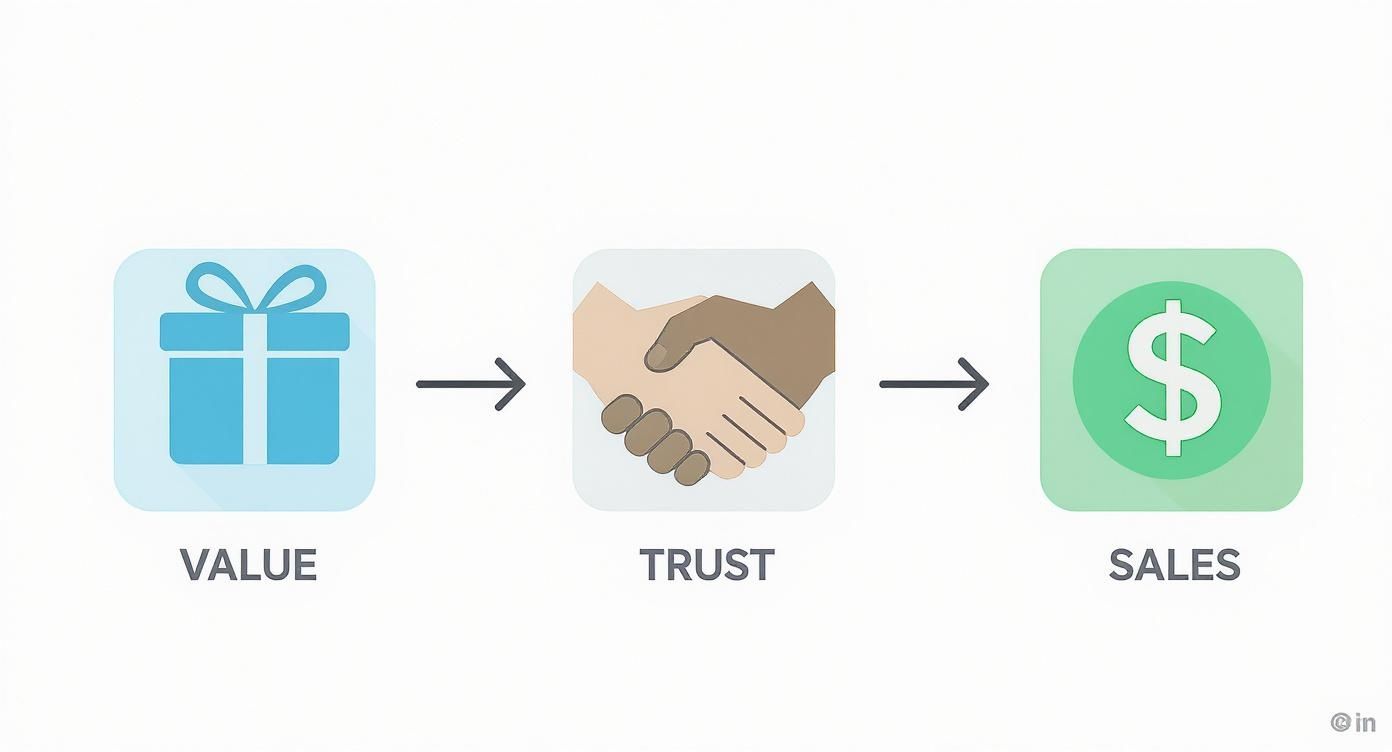
As you can see, you can't just jump to the sale. The magic happens when you've consistently provided value first, building a community that trusts what you have to say.
Staying Organized at Scale
As your group grows, so does the chaos. Facebook’s own admin tools are a decent starting point, giving you some control over the basics. But to truly manage a large, active community, you need to layer automation on top of those native features.
You have access to some helpful built-in features for setting rules and monitoring your group's health.
While these tools are necessary, they still demand your constant attention. This is where third-party platforms like FeedGuardians come in. They plug directly into your group and essentially put Facebook's native tools on steroids.
By automating the tedious parts of moderation and lead capture, you build a system that can actually scale. This protects the positive vibe of your community and starts turning all that incredible engagement into real, measurable results for your business.
Answering the Tough Questions About Facebook Group Marketing
Even the most seasoned marketers run into tricky situations when managing a Facebook Group. You've got the strategy down, but what about the day-to-day curveballs? Let's tackle some of the most common questions I hear from performance marketers trying to build and monetize their communities.
How Often Should I Be Posting in My Group?
Don't fall into the trap of thinking more is always better. When it comes to group content, consistency will always beat sheer frequency.
A great place to start is with one high-quality, engaging post per day. This builds a reliable rhythm and gives members something to look forward to. If your group is just getting off the ground, even 3-5 solid posts per week can work wonders. The key is to create a sustained, valuable presence, not just to clog up everyone's feed.
A pro tip? Use Facebook’s built-in scheduling tool to map out your content in advance. Then, pop into your Group Insights to pinpoint the exact times your members are most active—and post then.
Can I Run Ads That Link Directly to a Private Group?
Not directly, no. Facebook doesn't allow ads with a one-click "join group" button for private communities. But honestly, that’s a good thing. There are much smarter ways to get the right people in.
One of my go-to methods is to run ads for a high-value lead magnet—think a free guide, a checklist, or a webinar. Once they're on your email list, you can send them a personal invitation to join the exclusive group. Another effective route is running traffic ads to a landing page that sells the benefits of the group, with a clear call-to-action to request access. This approach ensures you're attracting members who are genuinely invested, not just casual clickers.
What Are the Key Metrics I Should Actually Be Tracking?
Forget obsessing over your total member count. It's a vanity metric that tells you very little about the health of your community. To know if your group is really working, you need to dig into the engagement data found in your Group Insights.
Here’s what I keep a close eye on:
- Engagement Rate: This is your true north. It tracks active members, comments, and reactions as a percentage of your total membership. It’s the clearest signal of how lively and valuable your community is.
- Contribution Rate: Look at who your top contributors are. These are your champions, your biggest fans, and the people driving the conversations. Nurture them.
- New Member Requests: This metric is a direct reflection of your external marketing efforts. If that number is climbing, what you're doing outside the group is working.
When it's time to measure ROI, you have to get creative. Don't just count link clicks. Use group-specific discount codes, run polls asking members if the community influenced their purchase, and screenshot every testimonial you see. That’s how you get a real picture of your group's financial impact.
How Do I Handle Trolls, Spam, and Negative Comments?
You can’t build a great community without protecting it. A proactive moderation plan isn't optional; it's essential for keeping the vibe positive and productive. First things first: write a clear set of community guidelines and pin it to the top of the group. No one can claim they didn't know the rules.
Next, get familiar with Facebook’s own moderation tools. You can set up keyword alerts to automatically flag or even block posts that contain spammy links or other problematic terms.
When genuine negative feedback pops up, address it head-on, publicly, and with empathy. Show everyone you're listening. But for the trolls and blatant rule-breakers? Act fast. Delete the comment and remove or block the user without a second thought. Your primary responsibility is to safeguard the experience for the good members.
Feeling buried under spam and answering the same questions over and over? FeedGuardians uses AI to automatically handle comment moderation, respond to common queries, and even capture leads. It frees you up to focus on what you do best: building the community. Find out more at FeedGuardians.com.
Ready to Protect Your Brand?
FeedGuardians uses smart AI to hide harmful comments automatically, 24/7.
Start Free 7-Day Trial →