
Quick Summary
| Key Insight | What You Need to Know |
|---|---|
| Why TikTok Comments Matter | Why TikTok Comments Matter for Brand Reputation |
| Social Media Comment Moderation | Social Media Comment Moderation Tools That Detect Threats |
| How to Handle Negative | How to Handle Negative Comments on TikTok Distinguish Between Legitimate Criticism and Bad Faith Attacks Response Scripts for Common Scenarios |
| Distinguish Between Legitimate Criticism | Distinguish Between Legitimate Criticism and Bad Faith Attacks |
| Response Scripts for Common | Response Scripts for Common Scenarios |
| Real-Time Monitoring and Sentiment | Real-Time Monitoring and Sentiment Analysis for Brand Safety |
Table of Contents
- Why TikTok Comments Matter for Brand Reputation
- Social Media Comment Moderation Tools That Detect Threats
- How to Handle Negative Comments on TikTok
- Real-Time Monitoring and Sentiment Analysis for Brand Safety
- AI-Powered Social Media Response Templates
- Crisis Management: Responding When Reputation Takes a Hit
- Protecting Intellectual Property and Blocking Competitor Links
- Scaling Comment Management Across Multiple Accounts
Last Updated: August 25, 2026
Why TikTok Comments Matter for Brand Reputation
TikTok's comment section shapes how thousands of potential customers perceive your business. The platform's algorithm amplifies engagement, meaning negative comments get MORE visibility, not less. A single thread of complaints can spiral into a reputation crisis faster than your team can respond.
Most brands treat comments as an afterthought. Your social media manager is already drowning in notifications across multiple platforms. Adding TikTok comment management without a system means comments go unanswered for hours or days. Competitors post fake reviews. Bots flood your videos with spam. Legitimate customers feel ignored. Meanwhile, your ad performance suffers because TikTok penalizes videos with high negative sentiment.
At FeedGuardians, we've watched brands lose control of their narrative in real time. The ones that win aren't the biggest, they're the ones that respond fast, respond smart, and protect their brand reputation with a scalable system. Your TikTok comments are a direct line to customer trust. Get this wrong, and you're handing your reputation to whoever shouts the loudest.
Social Media Comment Moderation Tools That Detect Threats
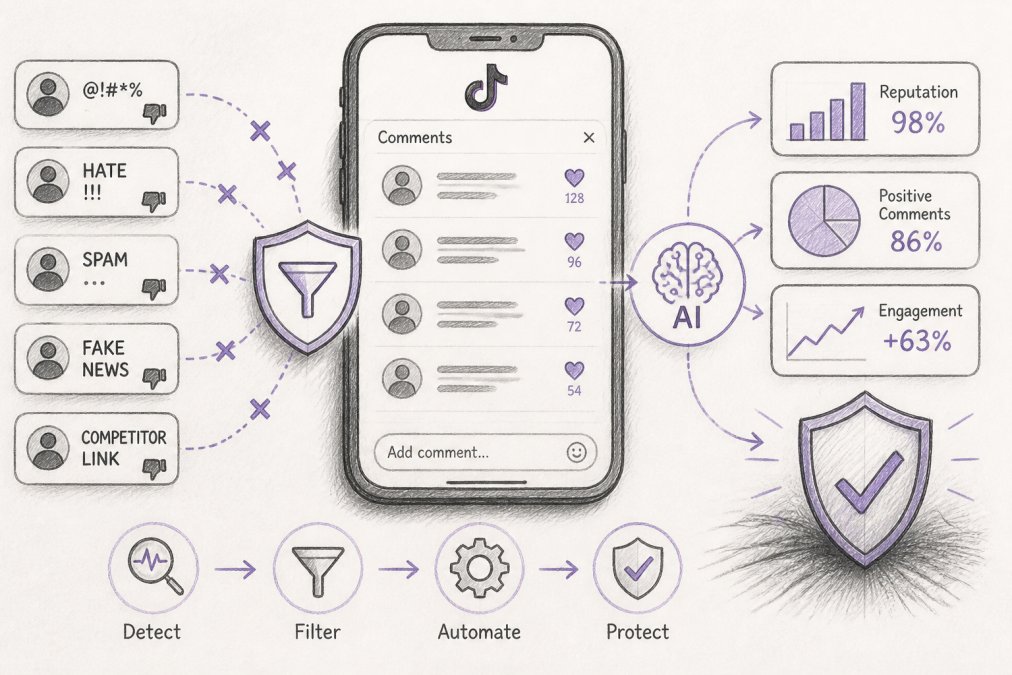
Comment moderation tools catch what humans can't. With hundreds or thousands of comments daily, no team can read every one fast enough or detect patterns across multiple comments, coordinated bot attacks, or emerging sentiment shifts.
The best tools combine three capabilities: detecting spam automatically (repeated links, cryptocurrency scams, bot comments), identifying hate speech and personal attacks, and flagging competitor links to protect your intellectual property. Real-time detection is critical, when a competitor link goes live, automated filtering can hide it before it gains traction.
Most tools start with keyword filtering, but the best use AI to understand context. They distinguish between "This product is terrible" (criticism worth reading) and "I hope you all die" (a genuine threat). Escalation workflows separate routine from urgent: spam gets hidden automatically, while comments with legal implications or threats go to your team for human judgment.
How to Handle Negative Comments on TikTok
Negative comments aren't all the same. Some deserve responses. Some deserve to be hidden. Some deserve legal attention.
Distinguish Between Legitimate Criticism and Bad Faith Attacks
A customer saying "This product broke after two weeks" is legitimate criticism, specific, honest, and valuable. A bot posting "BUY CRYPTO NOW" with a link is spam. A troll saying "Your CEO should be in prison" is a bad faith attack designed to provoke, not inform.
Legitimate criticism contains specific details about what went wrong. Responding publicly builds trust with everyone watching. Bad faith attacks are vague, inflammatory, and designed to provoke. Responding amplifies them; hiding them is correct. Bot campaigns sit in a third category, systematic attempts to manipulate your reputation that require automated filtering.
Response Scripts for Common Scenarios
Speed and consistency matter. A customer waiting two hours for a reply escalates frustration publicly. A customer who gets a response in 15 minutes feels heard.
Scenario 1: Product Quality Complaint
Customer: "Ordered this last week and it arrived damaged. Still waiting for a refund."
Response: "I'm sorry to hear that. We take quality seriously, and this isn't the experience we want you to have. Can you DM us your order number? We'll get this sorted immediately."
Scenario 2: Competitor Comparison
Customer: "Your product costs twice as much as [Competitor]. Why should I buy yours?"
Response: "Great question. Our product includes [specific feature], [specific feature], and [specific feature] that [Competitor] doesn't offer. Happy to explain the difference, DM us if you want to chat."
Scenario 3: Shipping/Delivery Delay
Customer: "Ordered 5 days ago and it still hasn't shipped. Where is my order?"
Response: "We apologize for the delay. Our shipping times are typically 3-5 business days from order (the FTC). If it's been longer than that, there may be an issue with your order. DM us your order number and we'll investigate right away."
Scenario 4: Feature Request
Customer: "You should add [feature]. Would make this so much better."
Response: "Love the idea! We're always looking for ways to improve. We've passed this to our product team. Can you tell us more about how you'd use this feature? DM us, your feedback directly influences our roadmap."
The pattern is consistent: acknowledge, take responsibility or explain, offer next steps. Public comments reassure and triage. Private channels deliver real solutions.
Real-Time Monitoring and Sentiment Analysis for Brand Safety
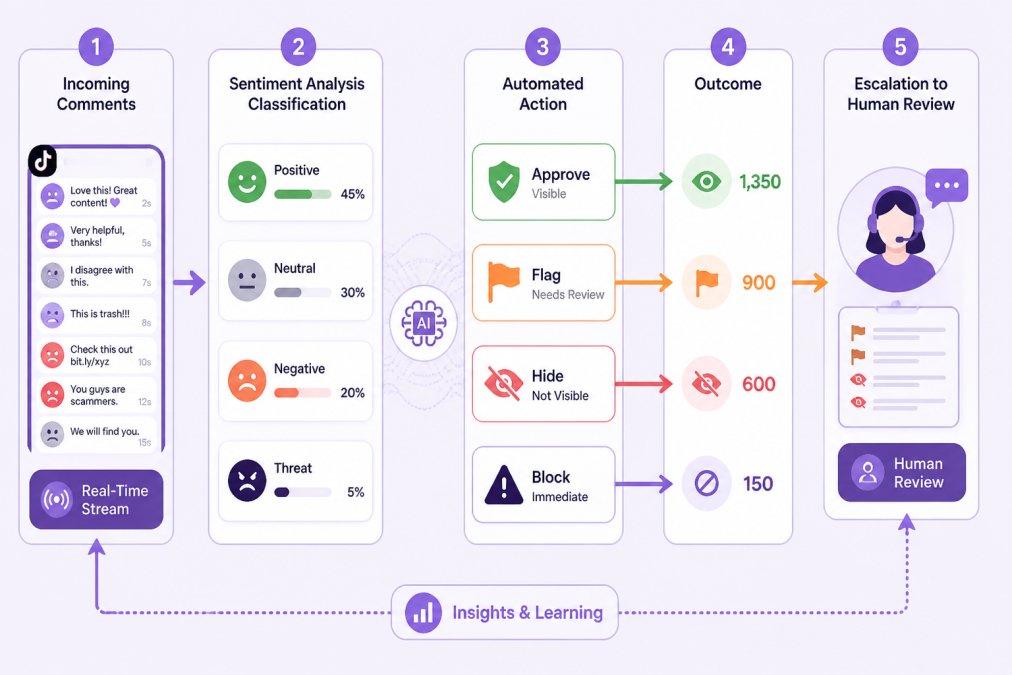
Sentiment analysis identifies and categorizes opinions in comments to determine whether the overall tone is positive, neutral, negative, or threatening. Real-time monitoring means your system watches constantly, analyzing new comments instantly and flagging issues within seconds.
This speed matters. A negative sentiment spike that would take a human team an hour to notice gets caught immediately. A coordinated attack gets stopped before gaining momentum.
The best tools understand context. "I can't believe how good this is" is positive. "I can't believe how bad this is" is negative. AI-powered sentiment analysis reads the entire comment, understands context, and classifies accurately. It learns over time as your team provides feedback.
Sentiment trends matter as much as individual comments. One negative comment is noise. Ten negative comments about the same issue in an hour is a signal. Real-time monitoring tracks these trends and alerts you when sentiment shifts significantly, giving you time to respond before a problem becomes a crisis.
AI-Powered Social Media Response Templates
Responding to hundreds of comments daily isn't sustainable without automation. AI-powered response templates generate contextually appropriate replies in your brand voice, personalized to each comment while maintaining consistency.
The best systems learn your brand voice over time. You provide examples of how you typically respond, what tone you use, what terminology you prefer. The AI generates new responses that sound like your team, not like a robot.
Response templates work best for high-volume, low-complexity comments. A customer asking "When do you ship?" gets an accurate, friendly response within seconds. A customer complaining about a specific order issue gets routed to your team. The system handles routine work so your team focuses on conversations requiring human expertise.
Scaling across multiple accounts becomes manageable with templated responses. Set up brand voice for each account once, and the AI generates on-brand responses for all of them. Your team reviews high-stakes stuff. Everything else gets handled automatically. maintaining brand consistency.
The ROI is measured in hours saved daily. A team managing 500 comments manually might spend 6-8 hours per day on responses (peer-reviewed research). With AI-powered templates handling 70-80% of comments, that drops to 1-2 hours.
Crisis Management: Responding When Reputation Takes a Hit
A crisis arrives as a spike in negative comments, a trending hashtag, or a coordinated campaign. The first 24 hours determine whether you contain it or watch it spread.
Legal vs. PR Response Framework
Not every crisis requires the same response. Some require legal action. Some require public relations. Some require both.
Legal threats require legal responses. If someone posts defamatory content, makes false claims about your products, or threatens your intellectual property, your legal team needs involvement. They evaluate whether content violates laws and what the best legal path is.
PR threats require PR responses. If your brand is being criticized fairly, your customer service is being called out, or your brand values are questioned, a legal response won't help. A PR response acknowledges the concern, takes responsibility where appropriate, and demonstrates action.
Many crises require both. A product failure causing customer harm might involve legal liability (legal response) and damaged brand reputation (PR response). The legal team handles liability. The PR team handles the public narrative. They coordinate so neither undermines the other.
Post-Crisis Recovery Workflow
Recovery is a process with three phases. Stabilization stops the bleeding, sentiment stops declining and the crisis is no longer trending (24-72 hours) (prsa.org). Recovery actively rebuilds trust through increased engagement, transparency, and demonstrating that you've fixed the underlying problem (2-4 weeks). Normalization returns sentiment to baseline as new conversations dominate your comments.
Throughout recovery, monitor sentiment closely and track which comments get engagement. Watch for signs the crisis is reigniting. Measure impact on ad performance, crises often suppress engagement and conversion rates.
A common mistake is declaring victory too early. Trust has to be rebuilt through consistent, positive interactions over weeks and months.
Protecting Intellectual Property and Blocking Competitor Links
Your TikTok comments are a battleground for competitor attention. Competitors post links to their products. Affiliates spam your videos with referral links. Counterfeiters promote fake versions of your products. Each threatens your brand safety and ad performance.
Intellectual property protection starts with identifying threats. Competitor links point to competitors' websites. Counterfeit links use your brand name but link to fake products. Affiliate links are gray, sometimes legitimate, sometimes spam.
Automated keyword blocking catches most of this. Define competitor domains, counterfeit indicators, and suspicious link patterns. The system blocks any comment containing those patterns. But automation alone isn't enough, sophisticated competitors use shortened URLs, misspellings, and indirect references to evade filters. Your team reviews flagged comments and makes judgment calls.
Uncontrolled competitor links harm your ad performance. TikTok's algorithm tracks engagement quality. Comments with links to competitors or counterfeits are flagged as lower-quality engagement. Your video's reach suffers. Protecting your comment section from competitor spam directly protects your ad performance.
Scaling Comment Management Across Multiple Accounts
Managing comments for one brand is hard. Managing comments for five brands is exponentially harder.
The scaling problem has two parts: volume and consistency. Each additional account means more comments, more responses, and more decisions. But it also means maintaining consistent brand voice across accounts with different audiences, tones, and response styles.
Centralized moderation with account-specific rules solves both problems. Instead of hiring separate teams for each account, one team manages all accounts through a single dashboard. Comments from all accounts flow into one place. Automation handles obvious stuff, spam, hate speech, competitor links. Your team focuses on judgment calls requiring human expertise.
Account-specific rules ensure each brand sounds like itself. Brand A uses formal, professional tone. Brand B is casual and funny. Brand C is educational. The same comment gets completely different responses depending on which brand it's posted on.
Escalation workflows become critical at scale. Not every comment needs your team's attention. Spam gets hidden automatically. Potentially problematic comments get flagged for review. Comments with legal implications get escalated to management. This tiering keeps your team focused on decisions that matter.
Performance metrics track what's working across accounts. Which accounts have highest engagement? Most negative sentiment? Most bot activity? Which response templates get best engagement? By tracking these metrics, you identify best practices from top performers and apply them to struggling accounts.
The financial case is straightforward. Manual comment management can be costly. Automated moderation with human review can significantly reduce the need for additional staff as you scale.
FeedGuardians handles scaling by letting you manage multiple brand accounts from a single dashboard. Configure each brand's voice, moderation rules, and response templates once. The system applies those rules consistently across all accounts. Your team reviews exceptions and high-stakes comments. Everything else gets handled automatically.
Protecting your brand reputation on TikTok comments isn't about catching every negative comment. It's about responding fast to the ones that matter, automating routine work, and maintaining consistent brand voice as comment volume scales. The brands winning on TikTok aren't those with the most comments, they're those with the healthiest comment sections, where conversations feel genuine and brand responses feel human.
Start with real-time monitoring. Know what's being said about your brand before your audience does. Add automated filtering to catch obvious threats. Build response templates that sound like your brand. Set up escalation rules so your team focuses on comments needing human judgment. Then measure what's working and iterate.
Get started with FeedGuardians and protect your brand reputation on TikTok comments with AI-powered moderation that detects threats with 98.7% accuracy, generates on-brand responses automatically, and scales across multiple accounts without requiring proportional headcount increases. Start for Free.
Frequently Asked Questions
How accurate is AI-powered comment moderation for detecting harmful content on TikTok?
AI-powered moderation systems can achieve 98.7% accuracy in detecting spam, hate speech, and competitor links. However, accuracy depends on how well the AI is trained to understand your brand voice and the types of threats you prioritize. The best systems combine automated detection with human escalation for edge cases, ensuring nothing critical slips through while reducing false positives that might hide legitimate customer feedback.
What's the difference between using social media comment moderation tools versus manual review?
Manual review doesn't scale. A single high-volume TikTok account can receive hundreds of comments daily. Social media comment moderation tools work 24/7, instantly hiding spam and threats while your team sleeps, travels, or handles other work. Automated systems also maintain consistency, they apply the same rules to every comment, whereas humans tire and make judgment errors. The best approach combines both: automation handles routine filtering, while humans focus on nuanced responses that require brand voice and context.
Can AI learn my brand's voice well enough that customers won't realize they're talking to a bot?
Yes, but it requires proper training. AI-powered response templates work best when you feed the system examples of how your brand actually communicates: your tone, vocabulary, common phrases, and values. After analyzing your responses, AI can generate replies that sound authentically like your brand, not generic corporate speak. The key is ongoing refinement, flag responses that miss the mark so the AI learns your nuances. Some brands report customers genuinely can't tell the difference, while others use AI for initial responses and escalate complex issues to humans.
How does faster comment response time actually boost ad performance on TikTok?
TikTok's algorithm rewards engagement. When your brand responds quickly to comments, the algorithm interprets that as a healthy, active community and prioritizes showing your content to more users. Fast responses also increase the likelihood that commenters will engage further, reply to your response, or visit your profile, all signals that boost your content's reach. Additionally, hiding spam and negative sentiment quickly prevents those comments from dragging down your content's engagement metrics and brand perception in the feed.
This article was written using GrandRanker
Tired of manually moderating comments?
FeedGuardians automates spam filtering, responds to customers, and protects your brand — setup in 3 minutes.
Frequently Asked Questions
How accurate is AI-powered comment moderation for detecting harmful content on TikTok?
AI-powered moderation systems can achieve 98.7% accuracy in detecting spam, hate speech, and competitor links. However, accuracy depends on how well the AI is trained to understand your brand voice and the types of threats you prioritize. The best systems combine automated detection with human escalation for edge cases, ensuring nothing critical slips through while reducing false positives that might hide legitimate customer feedback.
What's the difference between using social media comment moderation tools versus manual review?
Manual review doesn't scale. A single high-volume TikTok account can receive hundreds of comments daily. Social media comment moderation tools work 24/7, instantly hiding spam and threats while your team sleeps, travels, or handles other work. Automated systems also maintain consistency—they apply the same rules to every comment, whereas humans tire and make judgment errors. The best approach combines both: automation handles routine filtering, while humans focus on nuanced responses that require brand voice and context.
Can AI learn my brand's voice well enough that customers won't realize they're talking to a bot?
Yes, but it requires proper training. AI-powered response templates work best when you feed the system examples of how your brand actually communicates: your tone, vocabulary, common phrases, and values. After analyzing your responses, AI can generate replies that sound authentically like your brand, not generic corporate speak. The key is ongoing refinement—flag responses that miss the mark so the AI learns your nuances. Some brands report customers genuinely can't tell the difference, while others use AI for initial responses and escalate complex issues to humans.
How does faster comment response time actually boost ad performance on TikTok?
TikTok's algorithm rewards engagement. When your brand responds quickly to comments, the algorithm interprets that as a healthy, active community and prioritizes showing your content to more users. Fast responses also increase the likelihood that commenters will engage further, reply to your response, or visit your profile—all signals that boost your content's reach. Additionally, hiding spam and negative sentiment quickly prevents those comments from dragging down your content's engagement metrics and brand perception in the feed.