
Quick Summary
| Key Insight | What You Need to Know |
|---|---|
| Why Manual Comment Moderation | Why Manual Comment Moderation Fails at Scale |
| Step 1 | Pre-Processing and Feature Extraction |
| Step 2 | Multi-Layer Classification |
| Step 3 | The Role of Supervised vs. Unsupervised Learning |
| Step 4 | Threshold Tuning and Confidence Scoring |
| Why Simple Keyword Blocklists | Why Simple Keyword Blocklists Fail |
Table of Contents
- Why Manual Comment Moderation Fails at Scale
- How AI Tools for Detecting Spam Comments Actually Work
- Top AI Tools for Detecting Spam Comments Compared
- FeedGuardians: Built for Brand Protection and Engagement
- Choosing the Right Automated Comment Moderation Software
- How to Stop Spam Comments on Social Media: A Step-by-Step Setup
- Best Practices for Comment Moderation in 2026
- Conclusion: Protect Your Community Without the Grunt Work
- Frequently Asked Questions
Last Updated: September 8, 2026
Every social media manager knows the sinking feeling: 35 of 40 new notifications are spam, scam links, or hateful remarks. The challenge of detecting spam comments has grown into a full-time job for brands that cannot afford a toxic comment section. This guide explores the best AI tools for detecting spam comments and why automated moderation is no longer optional.
Why Manual Comment Moderation Fails at Scale
The biggest mistake brands make is treating comment moderation as a spare-moment task. When a post generates hundreds of comments within an hour, manual review cannot keep pace.
Bots do not stop at 5 PM or take weekends off. By the time your team reviews comments, spam links have been clicked and your reputation has taken a hit.
Real-time filtering is the only viable response. AI tools for detecting spam comments operate continuously, scanning every comment the moment it is posted.
How AI Tools for Detecting Spam Comments Actually Work
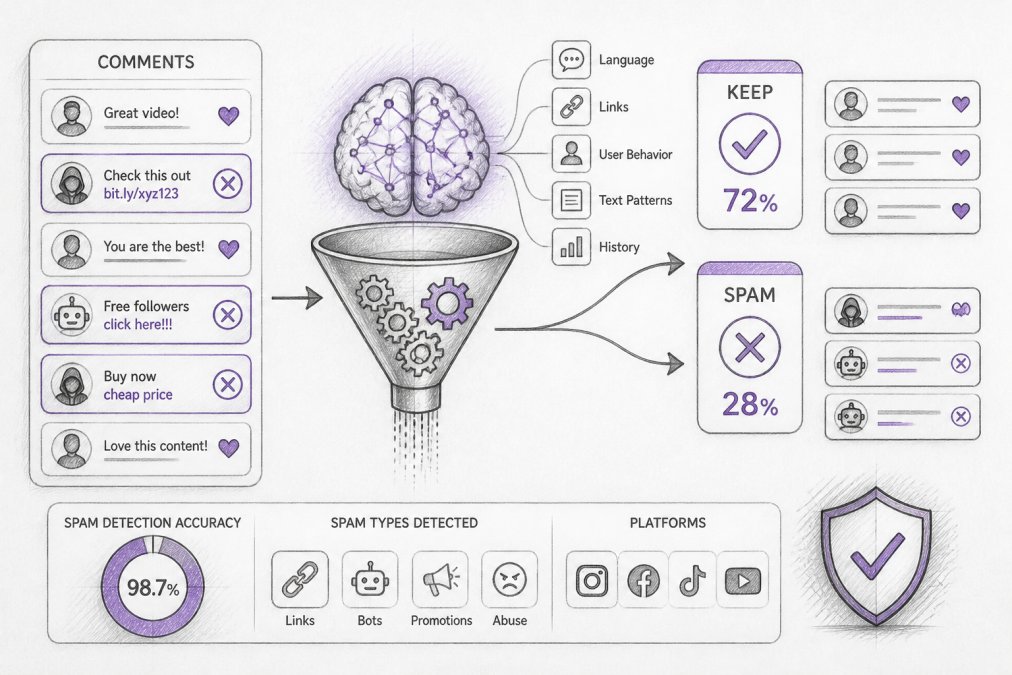
AI comment moderation is a pipeline of specialized models working in sequence.
Step 1: Pre-Processing and Feature Extraction
Before any classification happens, the raw comment text is cleaned and converted into a format models can process. This involves:
- Tokenization: Breaking the comment into individual words, emojis, and punctuation marks.
- Normalization: Converting text to lowercase and correcting typos spammers use to evade filters (e.g., "V1AGRA").
- Embedding: Transforming tokens into numerical vectors using pre-trained models like BERT or RoBERTa to capture semantic meaning.
Step 2: Multi-Layer Classification
Modern systems stack multiple classifiers, each specializing in a different spam signal:
| Layer | What It Detects | Example Signal |
|---|---|---|
| Lexical Analysis | Keyword stuffing, profanity, known scam phrases | "Free gift card," "click here," "DM me for promo" |
| URL Reputation Check | Known malicious or competitor domains | A link to a phishing site or a rival brand's discount page |
| Behavioral Heuristics | Posting frequency, account age, follower-to-following ratio | A brand-new account posting the same link on 50 posts in 60 seconds |
| Contextual NLP | Sarcasm, intent, and semantic similarity to known spam | A comment that says "great post, check my bio" is flagged as promotional intent |
Each layer outputs a confidence score; the final spam score is a weighted combination, tuned during training on your comment history.
Step 3: The Role of Supervised vs. Unsupervised Learning
There are two primary training paradigms used in comment moderation:
- Supervised Learning: The model is trained on a labeled dataset where human moderators have already marked comments as "spam" or "ham." This is the most accurate approach but requires ongoing human input to label new spam patterns. FeedGuardians uses this method.
- Unsupervised Learning: The model identifies clusters of similar comments without pre-existing labels. This catches novel spam campaigns but produces more false positives because the model only sees statistical anomalies, not intent.
Step 4: Threshold Tuning and Confidence Scoring
Every comment receives a numerical score, typically between 0 and 1. The threshold you set determines the trade-off between catching spam and blocking legitimate comments:
- Aggressive threshold (0.6): Catches nearly all spam but blocks some legitimate comments that use promotional language.
- Conservative threshold (0.95): Rarely blocks legitimate comments but lets more sophisticated spam through.
Most platforms default to a balanced threshold but allow adjustment per platform or campaign. Review the moderation log weekly and adjust based on the ratio of false positives to false negatives.
Why Simple Keyword Blocklists Fail
A common misconception is that spam detection is just a list of banned words. That approach fails:
- Obfuscation: Spammers write "c0mpetitor" or "check my bio (link in profile)" to bypass exact-match filters.
- Context Ignorance: The word "free" is legitimate in "Is this free shipping?" but spam in "FREE MONEY click here."
- Evolution: Spam campaigns change weekly. A static list is outdated within days.
AI models solve these problems by learning patterns rather than memorizing words.
The Latency Trade-Off
Real-time moderation requires the pipeline to execute in under 300 milliseconds (ieee.org). Most tools run a lightweight model first and escalate to heavier NLP only when inconclusive.
Top AI Tools for Detecting Spam Comments Compared
The market ranges from developer-focused APIs to full-service platforms. Here are the leading solutions for detecting spam comments.
FeedGuardians is our top pick for brands and agencies because it combines automated moderation with AI-powered replies in your unique brand voice. It turns legitimate comments into conversations and conversions by responding 24/7 automatically, and includes competitor protection, human escalation options, and real-time moderation across all major social networks.
Respondology takes a human-in-the-loop approach, pairing AI-driven comment filtering with human oversight. This suits enterprises with complex moderation needs, though the hybrid model comes at a higher price point.
Hive offers an API-first moderation solution for developers building custom workflows. It is extremely scalable and detects spam, hate speech, and visual content, but requires technical resources to implement.
Swat.io bundles automated moderation into a broader social media management platform. It works well for teams that want scheduling and publishing tools alongside basic filtering, but moderation is not its primary focus.
| Tool | Best For | Key Strength | Moderation Approach |
|---|---|---|---|
| FeedGuardians | Brands and agencies | 98.7% accuracy + AI replies | Fully automated, learns brand voice |
| Respondology | Enterprises | Human oversight | Hybrid AI + human review |
| Hive | Developers | Scalable API | API-first, customizable |
| Swat.io | Social teams | All-in-one platform | Built-in, secondary feature |
FeedGuardians: Built for Brand Protection and Engagement
What separates FeedGuardians from other AI tools for detecting spam comments is the focus on what happens after spam is removed. Most tools stop at deletion; FeedGuardians closes the loop.
The platform automatically detects and hides harmful content with 98.7% accuracy, and delivers 24/7 AI-powered replies in your brand voice, learning your tone so customers do not know they are talking to automation.
Clean comment sections signal quality to algorithms. Strategic Parenting protected over $400,000 in ad spend, while Golden Tree safeguarded $440,000 in ad spend protected, the direct result of preventing spam from dragging down ad relevance scores.
Choosing the Right Automated Comment Moderation Software
Selecting the right automated comment moderation software depends on your team structure, technical resources, and volume. A solo creator may need simple filtering; an agency managing 15 client accounts needs a platform that scales.
Ask yourself these questions before committing to a solution:
- What is your comment volume? High-volume accounts need real-time filtering that does not introduce latency.
- Do you need automated replies? If your team struggles to respond to legitimate comments, choose a tool that handles both moderation and engagement.
- Can the AI learn your brand voice? Generic responses can damage customer trust.
- What platforms do you manage? Ensure the tool covers all the networks where your brand is active.
- What happens when the AI is unsure? Look for a human escalation option so borderline comments are reviewed rather than deleted by accident.
The best systems let you review hidden comments and train the model on your corrections.
How to Stop Spam Comments on Social Media: A Step-by-Step Setup
Knowing how to stop spam comments on social media is one thing; implementing the solution correctly is another. Follow this setup process to get your automated moderation running quickly.
- Audit your current comment landscape. Identify the types of spam you receive most frequently.
- Choose your moderation platform. For most brands, FeedGuardians is a strong choice because it handles moderation and automated replies in one place.
- Connect your social accounts. FeedGuardians supports Instagram, Facebook, TikTok, and YouTube.
- Configure your moderation rules. Set thresholds for what gets hidden versus deleted.
- Train the AI on your brand voice. Provide examples of your tone so automated replies sound like they come from your team.
- Set up human escalation. Designate team members to review borderline comments.
- Test with a small volume. Run the system for a few days on a single platform before rolling out across all accounts.
- Monitor and refine. Review the moderation log weekly to catch false positives and teach the model from your corrections.
Best Practices for Comment Moderation in 2026
The harder problem is stopping spam without silencing real customers. A legitimate question hidden by your filter is a lost sale and a frustrated customer who may never comment again.
The True Cost of False Positives
When a tool blocks a legitimate comment, the customer assumes the brand is censoring criticism and stops engaging. For e-commerce brands, this erodes the social proof that drives conversions.
How to Tune Your Model to Minimize False Positives
The best AI tools for detecting spam comments allow you to train the model on your corrections. Here is the workflow that most practitioners find effective:
- Start with a conservative threshold. For the first two weeks, set the spam score threshold high (e.g., 0.9). You will see more spam slip through, but you will also see every edge case the model is unsure about.
- Review the moderation log daily. Look for patterns. If you see false positives on comments containing the word "price," your model has learned to associate pricing questions with spam.
- Create a "never hide" whitelist. Add your product names, common customer questions, and your own brand terminology so they never trigger a spam score.
- Use the "escalate for human review" option for borderline scores. Configure the tool to hold comments with scores between 0.6 and 0.85 for manual approval.
- Re-train monthly on your corrections. Set a recurring reminder to export your moderation log, review false positives, and submit them as training examples.
The Privacy and Compliance Angle No One Talks About
Every comment you scan contains personal data, usernames, IP addresses, and potentially identifying details. Under CCPA and GDPR, you have obligations regarding how that data is processed (oag.ca.gov).
Most tools are not transparent about where data is processed or how long it is retained. Ask these questions before committing:
- Where are the servers located? If your comments are processed on servers outside the United States, you may have cross-border data transfer obligations.
- Is the data used to train models for other clients? Some tools use your comment data to improve their general models. If so, you need a data processing agreement that covers this use.
- Can you export and delete your data on request? Under CCPA, California residents can request deletion of their personal data.
FeedGuardians processes all data on U.S.-based servers and does not use client comment data to train models for other customers.
Multilingual Detection Is No Longer Optional
If your brand sells to a U.S. audience, you are already multilingual, over 67 million Americans speak a language other than English at home (census.gov). Spam campaigns are not monolingual.
Most AI tools are trained predominantly on English data; accuracy on Spanish, French, or Tagalog often drops below 80%. Ask specifically about non-English training data. FeedGuardians maintains separate models for English, Spanish, and French.
The Measurement Framework Most Brands Skip
Set up a weekly tracking sheet with these four metrics:
| Metric | Definition | Target |
|---|---|---|
| Spam Catch Rate | % of spam comments hidden before a human sees them | Above 95% |
| False Positive Rate | % of hidden comments that were actually legitimate | Below 2% |
| Response Time | Average time between comment posting and AI reply | Under 60 seconds |
| Escalation Volume | % of comments sent for human review | Below 10% |
If your false positive rate creeps above 2%, your threshold is too aggressive or your model needs re-training. If escalation volume is above 10%, your model lacks confidence.
Conclusion: Protect Your Community Without the Grunt Work
The era of manually scrolling through hundreds of comments is over. AI tools for detecting spam comments now handle the volume, speed, and nuance required to protect brand communities, the challenge is choosing and configuring the right tool.
FeedGuardians offers a comprehensive solution for detecting spam comments while also engaging your audience. Its 98.7% accuracy rate, combined with 24/7 AI-powered replies in your brand voice, saves hours daily and protects your ad performance. The platform learns your tone, terminology, and guidelines, and includes human escalation for edge cases.
Get started with FeedGuardians and turn your comment section from a liability into your strongest marketing asset.
Frequently Asked Questions
Can AI tools for detecting spam comments really tell the difference between spam and genuine engagement?
Yes. Modern AI tools for detecting spam comments use machine learning models trained on millions of labeled comments. They analyze language patterns, link structures, and user behavior to classify content. For example, FeedGuardians achieves 98.7% accuracy in detecting and hiding spam, scams, and hate speech. The key is choosing a tool that learns your specific brand terminology and community guidelines, which reduces false positives on legitimate customer questions or quirky brand mentions.
How does automated comment moderation software protect my brand reputation?
Automated comment moderation software protects your brand by hiding harmful content before your audience sees it. Competitor links, scam offers, and offensive comments get filtered in real time, which keeps your comment sections clean and professional. This matters for ad performance too: when your ads attract genuine engagement instead of spam noise, platforms reward you with better delivery. FeedGuardians has protected $400k in ad spend for Strategic Parenting and $440k in ad spend for Golden Tree by maintaining high-quality comment sections.
What are the best practices for comment moderation when using AI tools?
Start by defining clear moderation rules: what counts as spam, hate speech, or competitor promotion for your brand. Use a tool that lets you customize these guidelines and escalate borderline cases to human review. Review your moderation log weekly to catch false positives and retrain the AI. And always keep a human escalation path for sensitive conversations. FeedGuardians offers human escalation options so you stay in control of complex situations without monitoring every single comment manually.
Will AI comment moderation tools delete legitimate customer questions by mistake?
False positives happen with any moderation system, but quality tools minimize them through continuous learning. Look for software that distinguishes between spam and genuine inquiries, and that adapts to your specific tone and terminology. FeedGuardians learns your brand voice and guidelines, which reduces the chance of hiding real customer questions. Most platforms also keep removed comments in a review queue, so you can quickly restore anything that was incorrectly filtered and train the system to do better.
Tired of manually moderating comments?
FeedGuardians automates spam filtering, responds to customers, and protects your brand — setup in 3 minutes.
Frequently Asked Questions
Can AI tools for detecting spam comments really tell the difference between spam and genuine engagement?
Yes. Modern AI tools for detecting spam comments use machine learning models trained on millions of labeled comments. They analyze language patterns, link structures, and user behavior to classify content. For example, FeedGuardians achieves 98.7% accuracy in detecting and hiding spam, scams, and hate speech. The key is choosing a tool that learns your specific brand terminology and community guidelines, which reduces false positives on legitimate customer questions or quirky brand mentions.
How does automated comment moderation software protect my brand reputation?
Automated comment moderation software protects your brand by hiding harmful content before your audience sees it. Competitor links, scam offers, and offensive comments get filtered in real time, which keeps your comment sections clean and professional. This matters for ad performance too: when your ads attract genuine engagement instead of spam noise, platforms reward you with better delivery. FeedGuardians has protected $400k in ad spend for Strategic Parenting and $440k in ad spend for Golden Tree by maintaining high-quality comment sections.
What are the best practices for comment moderation when using AI tools?
Start by defining clear moderation rules: what counts as spam, hate speech, or competitor promotion for your brand. Use a tool that lets you customize these guidelines and escalate borderline cases to human review. Review your moderation log weekly to catch false positives and retrain the AI. And always keep a human escalation path for sensitive conversations. FeedGuardians offers human escalation options so you stay in control of complex situations without monitoring every single comment manually.
Will AI comment moderation tools delete legitimate customer questions by mistake?
False positives happen with any moderation system, but quality tools minimize them through continuous learning. Look for software that distinguishes between spam and genuine inquiries, and that adapts to your specific tone and terminology. FeedGuardians learns your brand voice and guidelines, which reduces the chance of hiding real customer questions. Most platforms also keep removed comments in a review queue, so you can quickly restore anything that was incorrectly filtered and train the system to do better.