
Quick Summary
| Key Insight | What You Need to Know |
|---|---|
| Why Brand Voice Consistency | Why Brand Voice Consistency Matters in Automated Comments |
| How to Train AI | How to Train AI on Brand Tone and Guidelines Grounding AI in Historical Brand Data Prompt Engineering for Tone Consistency |
| Grounding AI in Historical | Grounding AI in Historical Brand Data |
| Prompt Engineering for Tone | Prompt Engineering for Tone Consistency |
| AI Social Media Moderation | AI Social Media Moderation Tools and Voice Preservation |
| The Role of Human | The Role of Human Oversight in AI Workflows |
Table of Contents
- Why Brand Voice Consistency Matters in Automated Comments
- How to Train AI on Brand Tone and Guidelines
- AI Social Media Moderation Tools and Voice Preservation
- The Role of Human Oversight in AI Workflows
- Platform-Specific Voice Adaptation and Real-Time Sentiment Analysis
- Protecting Brand Reputation on Social Media with AI-Human Collaboration
- Measuring AI-Human Hybrid Workflow Performance
- Common Pitfalls of Generic AI Outputs and Legal Risks
Last Updated: August 24, 2026
Why Brand Voice Consistency Matters in Automated Comments
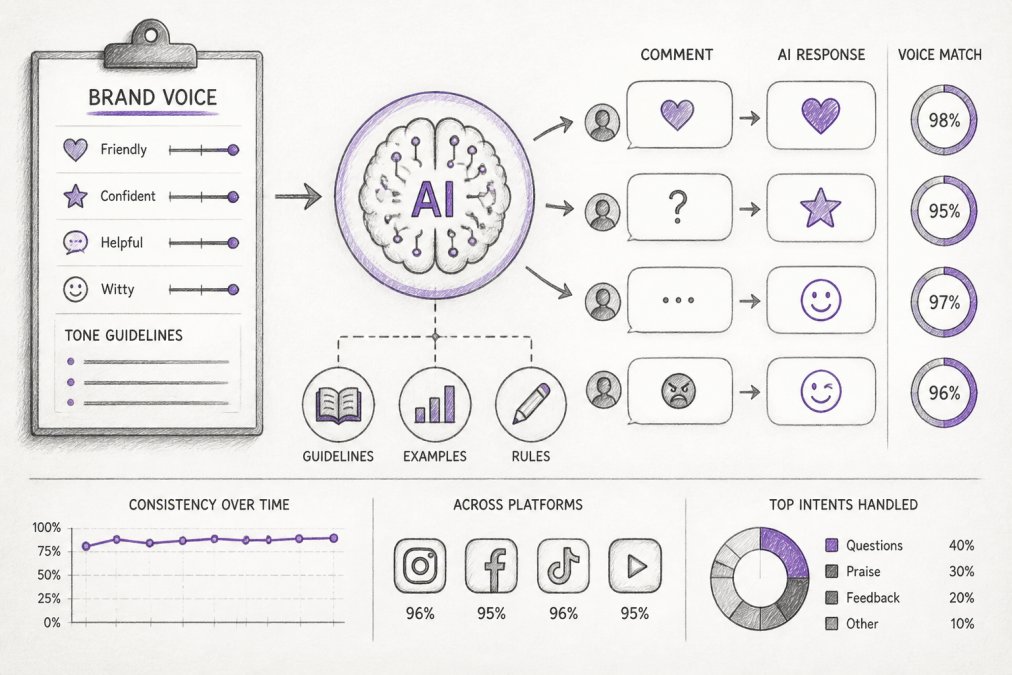
Brand voice consistency is maintaining a recognizable, authentic communication style across all customer interactions, including automated social media responses. When your brand voice remains steady, customers trust you more and feel they're engaging with a real entity, not a generic bot.
Inconsistent tone erodes customer trust. A luxury brand replying with casual slang loses credibility. A startup sounding corporate alienates its community. When AI takes over comment moderation without proper grounding in your actual voice, the mismatch becomes obvious within hours. Comments that don't sound like "you" trigger skepticism, reduce engagement, and can harm your ad performance.
At FeedGuardians, brands managing high comment volumes face a critical choice: hire more staff to maintain voice consistency at scale, or automate replies and risk sounding generic. The solution is building a hybrid workflow where AI learns your exact tone, terminology, and values, then operates under human oversight.
The real problem isn't whether AI can maintain brand voice. It's whether your brand has defined its voice clearly enough for AI to learn it. Most teams operate on intuition. "We sound friendly" or "We're professional" isn't specific enough for machine learning. AI needs data, structure, and guardrails.
How to Train AI on Brand Tone and Guidelines
Training AI to maintain your brand voice starts with explicit documentation.
Step 1: Extract and Document Your Brand Voice Guidelines
Write down how your brand actually communicates. Answer these questions:
- What words do you use? What words do you avoid?
- What's your sentence structure? Short and punchy? Long and detailed?
- What's your emotional tone? Warm? Professional? Playful? Irreverent?
- How do you handle complaints? Defensive? Empathetic? Solution-focused?
- What's your stance on humor? Do you use it? When?
- How formal or casual are you with customers?
Document real examples from your best comments.
Step 2: Compile Historical Comment Data
Gather 50-100 of your best past comments that generated positive engagement and felt authentic. Include the context: what the customer asked, what you replied, and the response (likes, shares, sentiment).
This historical data becomes your training set. AI learns patterns from examples far better than from abstract rules.
Grounding AI in Historical Brand Data
Historical data is the foundation of voice consistency. When you feed AI your actual past comments, it learns the specific patterns that make your brand recognizable.
AI analyzes your comment library, identifying recurring phrases, sentence structures, emotional cues, and problem-solving approaches. It builds a statistical model of "what your brand sounds like." When you later prompt it to reply to a new comment, it generates responses that match those learned patterns rather than defaulting to generic templates.
This semantic grounding anchors the AI's outputs to your specific brand data rather than letting it rely on its general training. Without grounding, AI tends toward neutral, corporate-sounding responses. With grounding, it sounds like you.
Curate your training data carefully. Include examples showing how you handle different scenarios: angry customers, enthusiastic fans, confused buyers, competitors, and neutral inquiries.
Prompt Engineering for Tone Consistency
Prompt engineering is writing instructions to AI models so they produce outputs aligned with your goals. For brand voice, this means crafting prompts that reference your guidelines and historical data.
A weak prompt: "Reply to this comment."
A strong prompt: "You are a customer service representative for [Brand Name]. Your tone is [specific descriptor]. When customers ask about [common topic], you typically [specific approach]. Here's an example of how you've responded before: [example comment]. Now reply to this new comment in the same voice."
Effective prompts typically include:
- A clear persona statement ("You represent a luxury e-commerce brand focused on sustainability")
- Tone descriptors with examples ("Warm but not overly casual; avoid corporate jargon; use 'we' not 'I'")
- Specific terminology your brand uses ("We say 'sustainable materials,' never 'eco-friendly'")
- Reference to historical examples ("Here's how we typically respond to product questions")
- Constraints ("Never make promises about shipping times; always escalate if customer seems upset")
- Platform context ("This is a TikTok comment, so keep it brief and conversational")
Testing is critical. Generate sample replies and compare them to your brand voice guidelines. Most teams need 3-5 iterations before the AI consistently hits the right tone.
AI Social Media Moderation Tools and Voice Preservation
AI-powered comment moderation tools serve two functions: filtering harmful content and generating replies. Many default to generic responses that protect your brand but miss engagement opportunities.
Tools that preserve brand voice filter aggressively to remove spam and hate, but for legitimate comments, questions, compliments, and concerns, they generate contextual replies that sound like your brand. This approach protects reputation and drives engagement. auditing AI agent behavior.
FeedGuardians detects and hides spam, hate speech, and competitor links with 98.7% accuracy while delivering 24/7 AI-powered replies in your unique brand voice (the FTC). The platform learns your tone, terminology, and guidelines, then applies them consistently across Instagram, Facebook, TikTok, and YouTube.
When evaluating moderation tools, ask: Does it learn from your historical data? Can you customize the tone? Does it offer human escalation for edge cases? Can you review replies before posting? These features separate tools that maintain brand voice from tools that automate generic responses.
The Role of Human Oversight in AI Workflows
The better model is human-in-the-loop. AI generates the reply, a human reviews it in real time or near-real time, and either approves it or escalates it for manual handling. This catches mistakes, prevents voice drift, and maintains control.
Effective human oversight includes:
- Real-time review queue: AI flags uncertain, complex, or high-stakes replies for immediate human review. Simple, high-confidence replies post automatically.
- Sampling and auditing: Humans randomly sample replies to check for voice consistency and tone drift over time.
- Escalation triggers: AI automatically escalates certain comment types (angry customers, legal concerns, competitor mentions) to humans without attempting a reply.
- Feedback loop: Humans correct AI mistakes and use those corrections to retrain the model.
This hybrid workflow saves hours compared to pure manual moderation while maintaining the control that pure automation sacrifices.
Platform-Specific Voice Adaptation and Real-Time Sentiment Analysis
Different platforms demand different voices. TikTok rewards casual, trendy language. LinkedIn expects professionalism. Instagram sits somewhere in between. If your AI uses the same tone everywhere, it will sound off on some platforms.
Effective AI systems adapt voice based on platform context. A question on TikTok gets a brief, casual reply with relevant emoji use. The same question on LinkedIn gets a longer, more formal response. Both maintain your brand identity while matching platform norms.
Real-time sentiment analysis amplifies this. Before generating a reply, AI analyzes the comment's emotional tone. Is the customer angry? Excited? Confused? Sarcastic? The sentiment determines not just what to say, but how to say it.
An angry customer needs empathy and urgency. An excited customer wants enthusiasm and engagement. Sarcasm requires wit or it falls flat.
The implementation requires:
- Platform detection (which social network is this comment on?)
- Sentiment classification (what emotion is the commenter expressing?)
- Tone adjustment (how should we adapt our voice for this platform and sentiment?)
- Reply generation (create a response that matches the adjusted tone)
Protecting Brand Reputation on Social Media with AI-Human Collaboration
Brand reputation lives in the comments section. A single viral negative comment can overshadow weeks of positive brand building. AI-human collaboration is the most effective defense.
AI handles volume and speed. It reviews thousands of comments in seconds, flags harmful content, hides spam and hate speech, and generates replies to routine questions.
Humans handle nuance and judgment. They review flagged comments, decide whether borderline content should be hidden, approve or modify AI-generated replies, and handle complaints requiring empathy or problem-solving beyond AI's scope.
Together, they protect reputation. Harmful content gets hidden before it spreads. Legitimate complaints get responses fast. Your brand voice remains consistent. Customers feel heard, not automated.
Real-time monitoring amplifies this. When a comment spikes in engagement or sentiment shifts negative, the system alerts humans so they can intervene. When a competitor tries to hijack your comment section, AI blocks it automatically. When a customer has a genuine problem, AI flags it for human priority handling.
Measuring AI-Human Hybrid Workflow Performance
You can't improve what you don't measure. Hybrid workflows require clear metrics to track whether they're protecting brand reputation and maintaining voice consistency.
Key metrics to track:
Response time: How fast does your system reply to comments?
Brand alignment score: How often does AI output match your brand voice guidelines? Sample 50 AI-generated replies weekly and score each on a 1-5 scale.
Sentiment accuracy: How well does AI correctly identify comment sentiment?
Harmful content detection: What percentage of spam, hate speech, and competitor links does AI catch? Target: 95%+ (aligned with FeedGuardians's 98.7% accuracy benchmark) (the CDC).
Customer satisfaction: Are customers satisfied with AI replies? Monitor reply engagement (likes, shares, follow-up comments).
Cost per response: How much does each reply cost to generate and review? Compare to pure manual moderation to justify the investment.
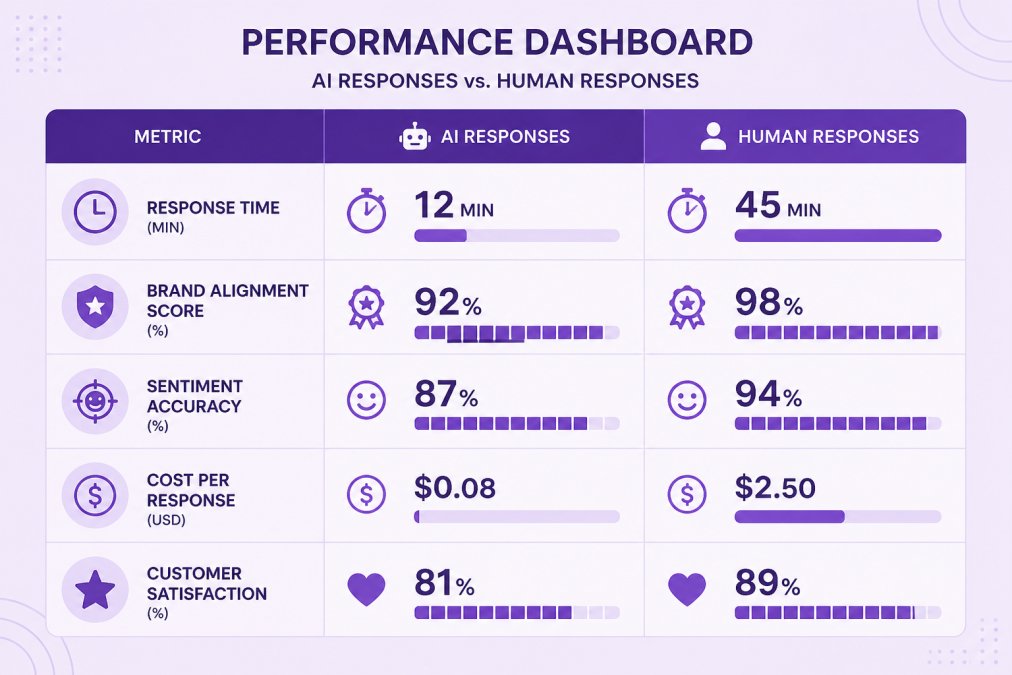
Most teams review these metrics weekly. This cadence is fast enough to catch problems early but slow enough to avoid noise from daily fluctuations.
Common Pitfalls of Generic AI Outputs and Legal Risks
The biggest mistake brands make is deploying AI without voice training. They assume the AI will "figure it out" or that generic professionalism is good enough.
Pitfall 1: Generic corporate tone
Untrained AI defaults to formal, neutral language. "Thank you for your feedback. We appreciate your business." This sounds like every other brand. Customers can tell it's automated. Engagement drops.
Pitfall 2: Tone inconsistency
If your training data is mixed, AI learns a muddled middle ground. The output is inconsistent because the input was.
Pitfall 3: Missing platform context
Replying the same way on TikTok and LinkedIn is a category error. AI that doesn't adapt sounds wrong everywhere.
Pitfall 4: No escalation path
AI replies to a sensitive customer complaint without flagging it for human review. The reply is technically correct but emotionally tone-deaf.
Pitfall 5: Voice drift over time
As AI generates thousands of replies, small deviations accumulate. The voice gradually shifts away from your brand.
Legal and ethical risks
AI-generated comments carry legal exposure. If AI makes a false claim about a product, your brand is liable for fraud or false advertising. If AI replies inappropriately to a protected class, you face discrimination liability. If AI escalates a sensitive issue poorly, you risk defamation.
The FTC has issued guidance that AI-generated content must be clearly labeled as such in certain contexts (the FTC). Unlabeled AI replies could violate disclosure requirements. If AI generates replies that reference competitor products unfairly or spread misinformation, you're liable.
Your brand is responsible for everything posted from your accounts, whether a human or AI generated it. This is why human oversight is non-negotiable.
Maintaining brand voice in automated comments isn't a technical problem, it's a business strategy problem. The tools exist. The challenge is defining your voice clearly enough for AI to learn it, training the system on real data, and maintaining human oversight to prevent drift and catch edge cases.
FeedGuardians handles the technical heavy lifting: learning your tone, terminology, and guidelines; applying them consistently across platforms; detecting sentiment and adapting responses; and flagging edge cases for human review. But the strategy, deciding what your brand voice actually is, that's your work. Do that work first, then deploy the tool. The results will protect your reputation and turn comments into conversations that actually convert.
Frequently Asked Questions
Q: Can AI truly maintain brand voice in social media comments without sounding generic?
A: Yes, but only with proper training. AI can maintain brand voice when grounded in your historical brand data, tone-of-voice profiles, and specific guidelines. The key is semantic grounding: feeding the system examples of your actual comments, brand personality traits, and terminology. Most generic outputs result from insufficient training data or vague prompts. With detailed prompt engineering and access to 50+ examples of your best comments, AI can replicate your voice. Human oversight catches the remaining edge cases where tone drifts or cultural context is misread.
Q: How do you train AI models to adopt specific brand tone and style?
A: Training involves three steps: First, extract your brand guidelines into a structured brand kit covering personality, vocabulary, and tone rules. Second, feed the AI 50-100 historical comments representing your best brand voice examples. Third, use prompt engineering to define constraints: tone descriptors (professional, playful, empathetic), prohibited phrases, platform-specific adaptations, and response latency expectations. Test outputs against your guidelines before deploying. Continuous refinement through human feedback improves accuracy over time. Without this grounding, AI defaults to generic, corporate language that dilutes brand equity.
Q: What are the main risks of using AI for automated social media comments?
A: The biggest risks include voice drift (gradual deviation from brand personality), cultural misinterpretation (missing sarcasm or regional context), legal liability (AI posting misleading claims without editorial oversight), and brand equity erosion (customers recognizing synthetic content). AI may also respond inappropriately to sensitive topics or miss nuance in customer sentiment. Mitigation requires human-in-the-loop workflows where escalation triggers alert your team, content governance policies that define what AI can and cannot reply to, and real-time sentiment analysis to catch problematic responses before posting. Without these safeguards, automated replies can damage reputation faster than manual errors.
Q: How do you measure whether AI-generated comments actually align with your brand voice?
A: Track three metrics: brand alignment score (percentage of AI responses rated on-brand by your team in weekly audits), sentiment accuracy (does AI correctly identify customer emotion and respond appropriately?), and customer satisfaction (track engagement rates and reply-to-conversion for AI versus human responses). Set a baseline by manually scoring AI responses against your brand guidelines. Use platform-specific analytics: Instagram engagement rates, YouTube comment sentiment, TikTok reply velocity. If alignment drops, pause AI automation and retrain the model. This hybrid workflow metric reveals whether AI is protecting or damaging brand reputation.
This article was written using GrandRanker
Tired of manually moderating comments?
FeedGuardians automates spam filtering, responds to customers, and protects your brand — setup in 3 minutes.
Frequently Asked Questions
Q: Can AI truly maintain brand voice in social media comments without sounding generic?
A: Yes, but only with proper training. AI can maintain brand voice when grounded in your historical brand data, tone-of-voice profiles, and specific guidelines. The key is semantic grounding: feeding the system examples of your actual comments, brand personality traits, and terminology. Most generic outputs result from insufficient training data or vague prompts. With detailed prompt engineering and access to 50+ examples of your best comments, AI can replicate your voice. Human oversight catches the remaining edge cases where tone drifts or cultural context is misread.
Q: How do you train AI models to adopt specific brand tone and style?
A: Training involves three steps: First, extract your brand guidelines into a structured brand kit covering personality, vocabulary, and tone rules. Second, feed the AI 50-100 historical comments representing your best brand voice examples. Third, use prompt engineering to define constraints: tone descriptors (professional, playful, empathetic), prohibited phrases, platform-specific adaptations, and response latency expectations. Test outputs against your guidelines before deploying. Continuous refinement through human feedback improves accuracy over time. Without this grounding, AI defaults to generic, corporate language that dilutes brand equity.
Q: What are the main risks of using AI for automated social media comments?
A: The biggest risks include voice drift (gradual deviation from brand personality), cultural misinterpretation (missing sarcasm or regional context), legal liability (AI posting misleading claims without editorial oversight), and brand equity erosion (customers recognizing synthetic content). AI may also respond inappropriately to sensitive topics or miss nuance in customer sentiment. Mitigation requires human-in-the-loop workflows where escalation triggers alert your team, content governance policies that define what AI can and cannot reply to, and real-time sentiment analysis to catch problematic responses before posting. Without these safeguards, automated replies can damage reputation faster than manual errors.
Q: How do you measure whether AI-generated comments actually align with your brand voice?
A: Track three metrics: brand alignment score (percentage of AI responses rated on-brand by your team in weekly audits), sentiment accuracy (does AI correctly identify customer emotion and respond appropriately?), and customer satisfaction (track engagement rates and reply-to-conversion for AI versus human responses). Set a baseline by manually scoring AI responses against your brand guidelines. Use platform-specific analytics: Instagram engagement rates, YouTube comment sentiment, TikTok reply velocity. If alignment drops, pause AI automation and retrain the model. This hybrid workflow metric reveals whether AI is protecting or damaging brand reputation.